


Arguably, the second most important part of your camera setup, beyond the best camera body, is the lens. We have tested and recommend the best lenses for astrophotography, but oftentimes, for those looking for more cost-effective models, going for a third-party camera lens can save you money and they can be of comparable (if not better) quality than first-party models.
The key is knowing which ones are worth your money. That is why we have hand-picked the best third-party lenses you can buy for astrophotography in 2026.
Once you have picked out your new lens, head over to our night sky guide for an in-depth rundown of the whole month in skywatching.
The quick list

The best third-party lens for astrophotography overall
Thanks to its quick and accurate autofocusing, the Sigma 14mm f/1.4 DG DN Art lens is great for astrophotography but it can handle hybrid shooting as well.

The best budget Sigma lens
A well-built prime lens that offers phenomenal image quality at a more palatable price.

The best wide zoom third-party lens
If you want a flexible focal range that allows wide-angle shooting and excellent optical clarity, this third-party lens is hard to beat.

The best third-party lens for aperture
You can't get much faster than f/1.2, the only snag is that this lens is best suited for APS-C cameras.

The best third-party telephoto lens
A large, heavy, but capable telephoto lens for those who already dabble with astrophotography.

The best budget third-party lens
An accessible route into astrophotography with a flexible focal range and a reasonably fast aperture.
The best third-party lenses we recommend for astrophotography in 2026
Why you can trust Space.com Our expert reviewers spend hours testing and comparing products and services so you can choose the best for you. Find out more about how we test and review products.
The best third-party lens overall


✅ You're an astrophotographer: We think this might be the best lens for astrophotography on the market.
✅ Maximum aperture is important: A maximum of f/1.4 is perfect for astrophotography.
✅ Build quality matters: This lens has a premium build quality that will last a lifetime if you look after it.
❌ You need something lightweight: At 1.6 lbs, this lens is quite heavy and best used with a tripod.
❌ Zoom is important: The focal length is fixed at 14mm, which might be restrictive depending on what you like to shoot.
🔎 We think the Sigma 14mm f/1.4 DG DN Art is a staggeringly good third-party lens for astrophotography. It has fast and precise autofocusing, and it works well for shooting video too. ★★★★½
The Sigma 14mm f/1.4 DG DN Art is a standout choice for astrophotography, combining an ultra-wide 14mm field of view with genuinely impressive low-light performance. As a third-party lens, it proves just how far Sigma has pushed optical quality, offering performance that rivals, and in some cases surpasses, native alternatives at a more affordable price.
The Sigma 14mm f/1.4 DG DN Art is unapologetically large. It is a hefty lens, but it feels premium in every sense, especially the build quality that inspires confidence in the hand. It feels robust and purposeful, but its weight means it is not ideal for long handheld sessions; a tripod is almost essential to get the most out of this lens. The lens includes a lens cap that doubles as a filter holder, which helpfully also works with the lens hood attached.
Optically, this lens delivers where it matters. In our hands-on Sigma 14mm f/1.4 DG DN Art Lens review, we found sharpness to be excellent across the frame and distortion to be impressively low, even toward the edges. The autofocus is fast and accurate, while the manual focus ring feels smooth and precise, making it particularly satisfying for fine adjustments when shooting the night sky. We found its low-light performance to be the standout area of expertise. You can push the ISO higher, but still be confident you will capture crisp images, especially important when capturing starry nightscapes.
The Sigma 14mm f/1.4 DG DN Art is a versatile tool. The aperture ring offers tactile, precise control with clearly defined steps, plus an auto mode and the option to de-click for video work. Because of the bulbous front element, filters can only be fitted at the rear, but Sigma's included GP-11 filter holder makes this surprisingly straightforward.
While it can handle a range of photography styles, from architecture, events and creative wide-angle work, this lens truly comes into its own under dark skies. As a third-party option, it is a compelling example of how you do not have to rely on native glass to achieve exceptional results.
- Read our full Sigma 14mm f/1.4 DG DN Art Lens review
Attributes |
Notes |
|---|---|
Design |
Quality, but heavy |
Performance |
Sharpness across the whole frame. Fast autofocus |
Functionality |
Ideal aperture for night sky shooting but versatile enough for other styles |
Best budget Sigma lens


✅ You want exceptional image quality: For the price, you can't get much better results than with this lens.
✅ You're budget-conscious: Although not cheap, the value for money is excellent.
✅ You want a large (not fixed) maximum aperture: The range of f/1.8 - f/16, so you have options when you're shooting different subjects.
❌ You want lightweight kit: 2.58 lbs is heavy for a lens.
❌ You use filters a lot: This lens isn't equipped with a filter thread, though you can get around this problem with other mounts or clamping systems.
❌ You don't want a fixed focal length: 14mm is best for capturing ultra-wide images.
🔎 The Sigma 14mm F1.8 DG HSM ART lens is a phenomenal lens for night-sky photography. If you’re after a lens that will get you long shutter speeds without a star tracker, with technically excellent results throughout its aperture range, this is a piece of kit that will serve you well. ★★★★★
This Sigma lens leaves a strong first impression. It earned a full five stars in our hands-on Sigma 14mm f/1.8 DG HSM Art review, and it is easy to see why. Undoubtedly, the first thing we noticed is the weight. At 2.58 lbs (1.17 kg), this lens is heavy, especially compared to many other ultra-wide options (though not the heaviest in this guide). Shooting handheld for long periods is not particularly comfortable, but it certainly feels solid in the hand, and it is clearly built to last.
For astrophotography, the weight is far less of a concern as you'll be using a tripod more often than not — stability is more important than portability.
The Sigma 14mm f/1.8 DG HSM Art is fully weather sealed, so damp nights, dew and unpredictable weather are not really a concern.
One limitation to be aware of is the large, rounded front element, which prevents the use of front-mounted filters. For astro shooters, this is unlikely to be a major drawback, and for other shooters, there's always another way to use a filter, with a bit of creativity or using an alternative clamping system.
Optical performance is where this lens truly shines. Chromatic aberration is very well controlled, with minimal color fringing even when shooting wide open. Distortion is also impressively low for such an ultra-wide focal length.
At its maximum f/1.8 aperture, stars remain sharp and well defined across most of the frame, which is no small achievement. Stopping down slightly can further improve corner performance, but the lens' wide open performance gives you valuable flexibility when working in low light.
Overall, the Sigma 14mm f/1.8 DG HSM Art is a heavyweight in every sense. It is not subtle or lightweight, but it delivers exceptional image quality and reliability. For serious astrophotographers, it remains one of the best ultra-wide lenses you can buy.
- Read our full Sigma 14mm f/1.8 DG HSM Art review
Attributes |
Notes |
|---|---|
Design |
Heavy but quality |
Performance |
Outstanding & crisp images |
Functionality |
Wide maximum f/1.8 aperture |
Best wide zoom

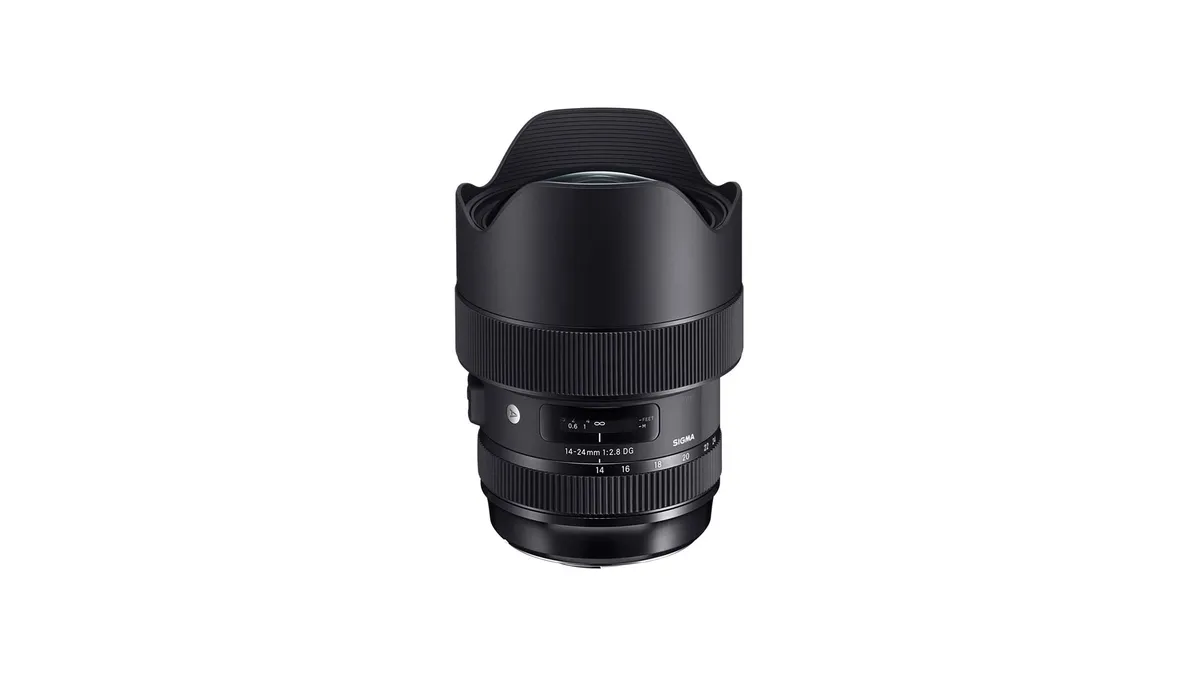


✅ You want excellent optical clarity: We found it difficult to fault this lens.
✅ You want a flexible focal range: Unlike some models in this guide, the 14-24mm focal range affords versatility.
✅ You want something that is built to last: Like most Sigma lenses, the build quality is excellent.
❌ You want a lightweight lens: At 2.54 lbs, this isn't one of the lightest lenses in this guide and is best used with a tripod.
❌ You use filters a lot: This lens has no filter threads.
❌ You want to spend less: For around $400 less, you can get the Sigma 20 mm F1.4 DG HSM prime lens which has a larger aperture.
🔎 The Sigma 14-24mm F2.8 DG HSM ART is particularly great for wide-field astrophotography. Despite being cheaper, it easily holds its own against other high-end, wide-angle, big-aperture lenses. ★★★★★
The Sigma 14–24mm f/2.8 DG HSM Art carries all the hallmarks you would expect from Sigma's Art lineup. It is designed with full-frame cameras in mind, and like (most of) the other Sigma lenses we've reviewed, it feels reassuringly solid in the hand. It is made for professionals and serious shooters.
The zoom and focus rings are smooth, and autofocus is quick and near silent so you can use it without creating too much attention. Great for capturing candid shots.
When we reviewed the lens, the comparison with Sigma’s 14mm f/1.8 DG HSM Art was inevitable. The big difference, however, is flexibility. The 14–24mm zoom range opens up far more creative options, allowing you to move from ultra-wide vistas to tighter compositions without changing lenses. This versatility will appeal to photographers who want one lens to cover multiple bases.
The mount options are generous too; it is available for Nikon and Canon systems, and Sony users can adapt it to E-mount bodies using Sigma's MC-11 converter.
Performance is where the lens really impresses. Images are sharp and vibrant across the frame, with stars rendered cleanly and clearly when shooting at night. Chromatic aberration is extremely well controlled, even when working wide open at f/2.8. Sigma makes a bold claim that there is no image distortion, and after our hands-on review, it is hard to argue otherwise.
As a zoom lens, the Sigma 14–24mm f/2.8 DG HSM Art does sacrifice some light compared to faster primes, but that is the trade-off. An f/2.8 maximum aperture is still more than capable for astrophotography, while the zoom range adds genuine practical value. Whether that balance is right for you depends on how much you value flexibility over outright speed, but as an all-around ultra-wide performer, we don't have any complaints.
- Read our full Sigma 14-24mm f/2.8 DG HSM review
Attributes |
Notes |
|---|---|
Design |
Strong, robust build quality Sigma is known for |
Performance |
Zero image distortion and negligible chromatic aberration |
Functionality |
Constant f/2.8 aperture but zoom versatility |
Best for aperture


✅ You want a fast prime lens: You can't get much faster than f/1.2.
✅ You want exceptional image quality: And let's face it, who doesn't?
❌ You want a wider lens: This sits just outside the specs of being a wide-angle lens.
❌ You shoot full-frame: This lens needs to be used with a crop sensor in crop mode.
🔎 The Viltrox Af 27mm f/1.2 Pro's f/1.2 maximum aperture is a boon for astrophotographers, and given the excellent build quality and exceptional image quality, this lens offers excellent value for money. ★★★★★
The Viltrox AF 27mm f/1.2 Pro, which we reviewed recently, is an impressive prime lens for APS-C mirrorless cameras, offering a 40.5mm full-frame equivalent focal length and a hard-to-beat f/1.2 maximum aperture at a highly attractive price, making it a strong option for astrophotography and general photography without costing as much as first-party glass.
The lens is compact at 3.23 x 3.62-in / 82 x 92 mm and weighs about 565 g, so it partners well with Sony E, Nikon Z and Fujifilm X bodies.
Build quality is excellent, with a full-metal body and weather sealing, making it well-suited to outdoor use, whether shooting night skies or everyday scenes.
We found the controls to be straightforward and practical, including a large manual focus ring and a manual aperture ring that can be set to clicked or click-less operation, useful for both stills and video. It's worth noting that there is no screen like some Viltrox lenses.
The autofocus is fast, quiet and reliable, aided by a stepping motor, though some photographers still prefer manual focus for greater precision. There is no optical image stabilization, but in-body stabilization on many APS-C cameras compensates for this. The minimum focus distance is short at about 28 cm, which adds versatility even if it is not essential for astrophotographers.
We were impressed by the image quality, which was exceptionally sharp even at the widest f/1.2 aperture. Corner sharpness remained strong, and we only found minimal distortion and chromatic aberration. Vignetting is noticeable wide open at f/1.2, but all but disappears at f/2.8. Aperture settings around f/8 offer the sharpest overall results, but the standout here is reliable sharpness at f/1.2 itself, which benefits the astrophotographers amongst us.
Overall, we think the Viltrox AF 27mm f/1.2 Pro delivers excellent value, blending excellent build quality, versatile performance and a fast aperture that will appeal to astrophotographers and more general shooters alike, all at a competitive price point, and definitely much more affordable than similarly specced native lenses.
- Read our full Viltrox AF 27mm f/1.2 Pro lens review
Attributes |
Notes |
|---|---|
Design |
Compact, lightweight |
Performance |
Excellent at f/8 but performing well wide open |
Functionality |
Not good for full-frame shooting |
Best telephoto lens


✅ You appreciate good value for money: This is a competitively priced lens
✅ You already have astrophotography experience: This lens isn't particularly beginner-friendly.
❌ You want something lightweight: At 1.8 kg, it isn't the most portable lens to take to the best skywatching locations, particularly if you need to hike there.
❌ You don't need the full focal length: 200mm is pretty nice in astrophotography, a 24-70mm might be more appropriate.
❌ You have a Sony: There is no E-mount version.
🔎 The Sigma 70-200mm f/2.8 DG OS HSM is a tempting and worthwhile purchase if you particularly want a telephoto lens. Own-brand equivalents are a lot more expensive. ★★★★
The Sigma 70–200mm f/2.8 DG OS HSM is a fast telephoto zoom that delivers strong optical performance at a lower price than many first-party rivals, and we struggled to find much fault.
With a constant f/2.8 aperture, it suits a wide range of photography, from wildlife and sports to portraits and selected astrophotography applications. While 200mm can be challenging for night sky shooting without a star tracker, the lens is still useful for mid-field targets and creative compositions, such as the Milky Way behind an interesting foreground.
This lens sits in Sigma’s Sports line (opposed to the ART line) and feels every bit the part, with a solid metal barrel and a reassuring weight of around 1.8 kg. Weather sealing means it is suitable for use in less forgiving conditions, too.
In our hands-on Sigma 70-200mm f/2.8 DG OS HSM review, we found the image quality to be impressive throughout the zoom range. Sharpness is excellent when focus is nailed, and distortion is minimal. We found that the autofocus is fast, accurate and silent, and the stabilization system is handy for counteracting wobble when the camera isn't mounted on a tripod.
Overall, this is not the most typical or easiest lens for beginners, but it is a nice option for photographers who want a bright, versatile telephoto zoom with professional build quality and strong performance.
- Read our full Sigma 70-200mm f/2.8 DG OS HSM lens review
Attributes |
Notes |
|---|---|
Design |
Very heavy, optical stabilization |
Performance |
Sharp images when paired with a star tracker, little chromatic aberration |
Functionality |
Not suitable for beginners, best to use with a tripod |
Best budget overall

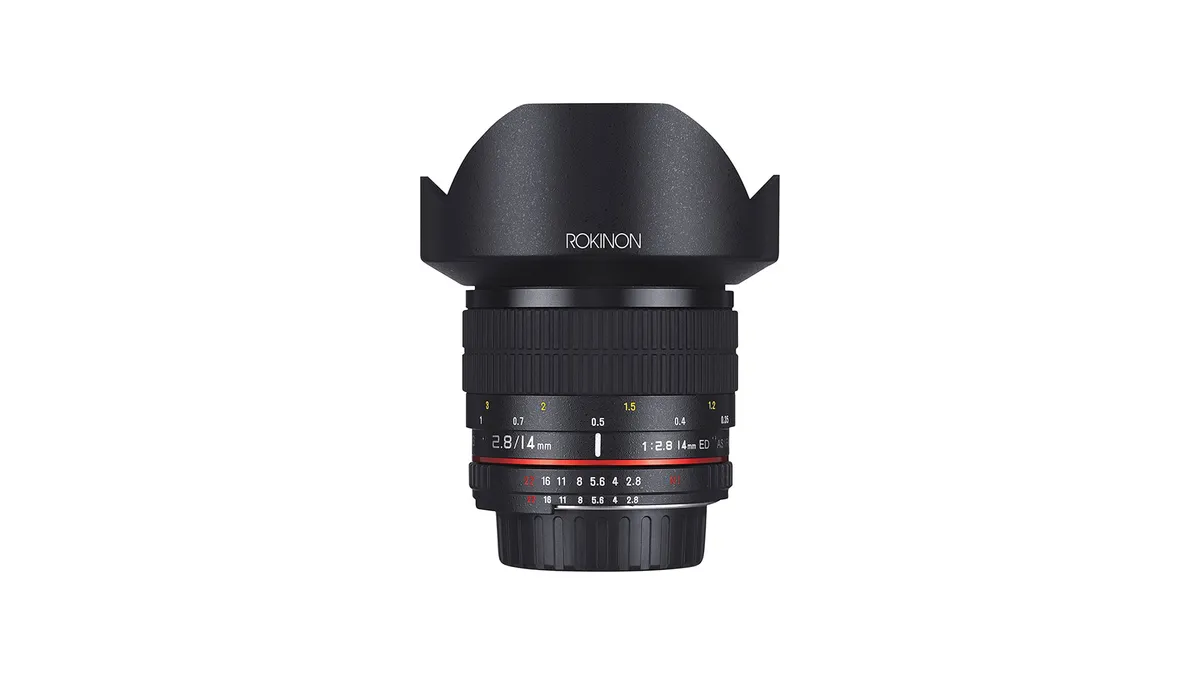


✅ You're on a budget: Astro lenses aren't cheap, but this is more affordable than most.
✅ You want to see a chunk of the landscape at once: A 115-degree field of view allows for huge starscapes and wide landscape shots.
❌ You want a wider aperture: This is fixed at f/2.8. If you want something wider, you'll probably have to spend a fair amount more.
❌ You want perfect clarity across the whole image. You will see some soft corners and vignetting.
🔎 If you want a budget-friendly ultra-wide lens for astrophotography, landscapes or architecture, there are few options that compete with the Rokinon or Samyang 14mm f/2.8 for this price. ★★★★
The Rokinon or Samyang 14mm f/2.8 is one of those lenses that quietly punches above its weight. Made in South Korea and priced firmly at the budget end of the spectrum, it still earned four out of five stars in our Rokinon/Samyang 14mm f/2.8 review. This is one of the cheapest ultra-wide options available for astrophotography, yet it delivers results that feel far more expensive than the price tag suggests.
The low cost is afforded by the simple design. Aperture control is handled via a manual ring near the lens base, and there is no electronic connection to the camera body. That means no image data is recorded with your shots, which may bother some users but will not trouble most night sky shooters. The lens is fully manual, covering both focus and aperture. For astrophotography, manual focus is standard practice anyway, so this likely won't be an issue for Space.com readers. Where it becomes less convenient is in daytime use or when photographing moving subjects, where autofocus would be most welcomed.
Despite its plastic and lightweight construction, the lens feels solid. It is highly portable and easy to use, making it a great choice for beginners. Astrophotography can be an expensive hobby — lenses like this make it more accessible.
Performance-wise, this lens won't win any awards, but it is by no means bad. When shooting at f/2.8, sharpness drops slightly, along with noticeable vignetting and distortion. The good news is that these issues are easily corrected in post-processing and do not detract much from the overall experience.
For newcomers to astrophotography, this lens makes a lot of sense. It lets you experiment and capture impressive images of the night sky without spending a huge amount of money.
- Read our full Rokinon/Samyang 14mm f/2.8 review
Attributes |
Notes |
|---|---|
Design |
Lightweight but well made |
Performance |
Some loss of sharpness and vignetting, but fixable in post production |
Functionality |
Fully manual focus and aperture |
Best third-party lenses: Frequently Asked Questions
What is the best third-party lens overall?
We think the Sigma 14mm f/1.4 DG DN Art lens is the best third-party lens overall, but it does come with one of the higher price tags.
What size lens is best for astrophotography?
Typically, the better the optics, the heavier the lens. In astrophotography, you'll usually use a tripod, which means that as long as your tripod's payload can handle it, you can opt for a bigger, heavier lens on the camera. That said, if you're hoping to take your lens on the road often, or you will be trekking to one of the best skywatching locations, you'll want to be mindful of its weight and the space it will take up in your backpack.
Focal length is another important factor when choosing a lens for astrophotography. A length of around 24mm, like the Viltrox AF 27mm, is most suitable for night sky photography, while telephoto lenses like the Sigma 70-200mm are best for deep-field photography and close-ups of celestial objects.
Should I buy a prime or zoom lens for astrophotography?
Zoom vs prime lenses: Which is best?
This really comes down to what you enjoy shooting and how you like to work, with a few practical considerations layered on top. Versatility, budget and your camera system should all play a part in the decision.
Prime lenses usually deliver cleaner results, with less distortion and stronger performance in low light. They are often the go-to choice for night sky shooters for that very reason. Zoom lenses, on the other hand, offer greater flexibility. Having a range of focal lengths in one lens makes it better suited to photographers who like to switch between subjects without changing glass. The trade-off is that zooms usually have smaller maximum apertures, so they let less light reach the sensor.
If you want one lens to cover most situations, a wide-angle zoom like the Sigma 14-24mm F/2.8 DG HSM ART can be a sensible and practical option. It gives you room to experiment and adapt. If astrophotography is your main focus, aperture matters more than flexibility. A fast lens like the Sigma 14mm f/1.4 DG DN ART lens will serve you better.
For budding astrophotographers, the Rokinon 14mm f/2.8 is a smart place to begin. As we've described above, it offers solid optics and excellent value.
Do I need any other camera gear to take astrophotographs?
Taking awe-inspiring astrophotography shots usually requires investing in various kit. First off, one of the best cameras for astrophotography is recommended (but not essential) to get the best results. What's more important is having one of the best tripods or best travel tripods to keep your whole setup steady and avoid blurry images.
There are a variety of other accessories to push your results even further. Lens heaters, for example, can prevent your lens from fogging when shooting in cold conditions, and intervalometers let you trigger your camera remotely, reducing camera shake from physically pressing the shutter.
Update log
How we tested the best third-party lenses
We put every lens we recommend through a rigorous review process to ensure we provide you with honest and up-to-date advice. Our expert staff and knowledgeable freelance contributors test each lens based on a variety of factors, including its construction, ease of use, design and most importantly, optical performance.
Each lens is evaluated on its intended use and price point. We consider the lens' weight and portability, as well as its build quality and functionality.
At Space.com, we are committed to providing reliable and transparent buying advice. Our reviews and buying guides are completely editorially independent, ensuring you can trust us to provide the best possible information, whether you decide to make a purchase or not.
