A SpaceX Dragon cargo capsule is back on Earth after six months in orbit.
The robotic Dragon departed the International Space Station (ISS) on schedule Thursday (Feb. 26) at 12:05 p.m. EST (1705 GMT), ending a roughly six-month orbital stay during which it demonstrated a novel ISS-boosting capability.
The cargo capsule splashed down under parachutes in the Pacific Ocean off the California coast on Friday (Feb. 27) at around 2:44 a.m. EST (0744 GMT), according to SpaceX. "Splashdown of Dragon confirmed, completing SpaceX's 33rd Commercial Resupply Services mission to the Space Station!" the company posted on X.
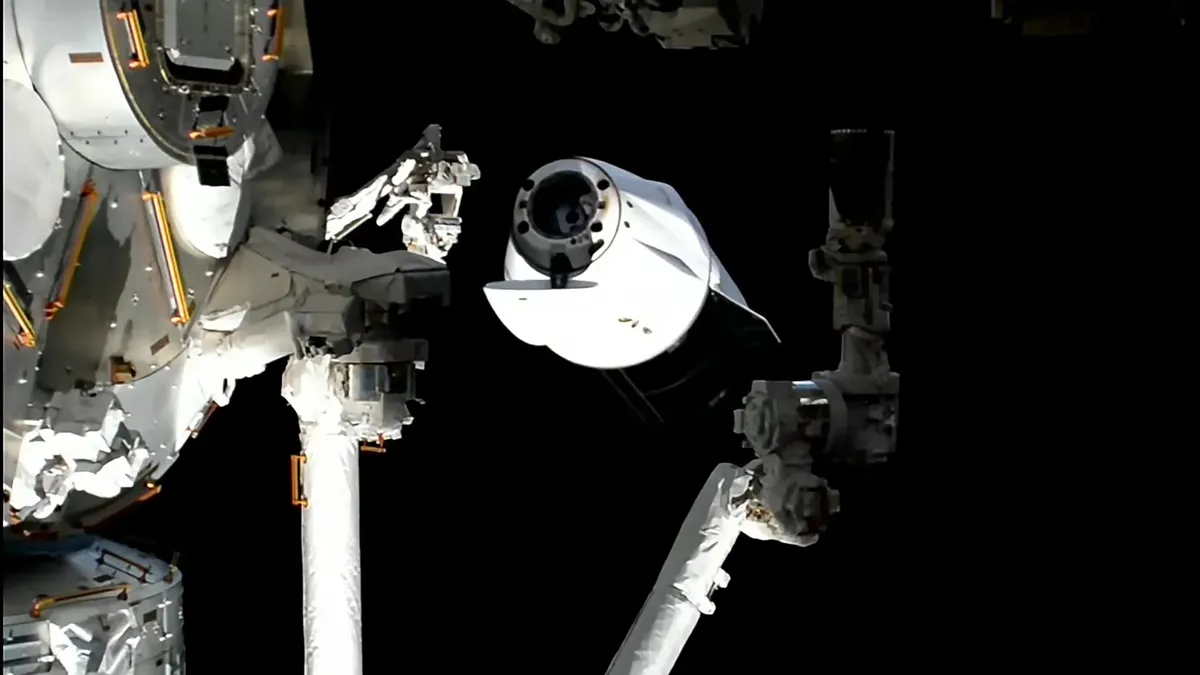
The Dragon arrived at the ISS on Aug. 25 of last year, delivering about 5,000 pounds (2,270 kilograms) of supplies and scientific gear to the astronauts aboard the orbiting lab. It was the 33rd such robotic cargo run that SpaceX has performed for NASA's Commercial Resupply Services program.
The capsule also conducted other useful work during its mission, which is known as CRS-33.
For example, it "introduced a new capability to reboost the space station, helping maintain its altitude and counter atmospheric drag, which is critical for safe operations and the long-term sustainability of the orbital complex," NASA officials said in a statement on Monday (Feb. 23).
"During its time docked to the station, Dragon performed six reboosts — five in 2025 and a final maneuver on Jan. 23 — before preparations for its departure began," they added.
Such reboosts have historically been done by Russia's Progress freighter. It's unclear, however, if Russia will remain an ISS partner through the lifetime of the orbiting lab, which is expected to be deorbited in late 2030.
If Russia leaves the consortium early, other reboosting methods will be needed. Dragon just showed it can handle the job, and Northrop Grumman's Cygnus cargo craft has done so as well.
Progress, Cygnus and Japan's HTV-X spacecraft — the other currently operational ISS cargo craft — are all designed to burn up in Earth's atmosphere when their missions are done. But Dragon is reusable, which means it can haul cargo in the downward direction as well. And it carried lot of gear back to wrap up CRS-33.
For example, Dragon brought down experiments from the Euro Material Aging study, "which exposed 141 samples to space for a year to examine how coatings, insulation, and 3D-printed materials degrade," NASA officials said in the same statement.
It also hauled material from Thailand's Liquid Crystals experiment, which "observed the stability of films used in electronics in microgravity," they added. "Both could lead to stronger spacecraft, better displays and improved optical devices on future missions."
Editor's note: This story was updated at 10 a.m. ET on Feb. 27 with news of successful splashdown.