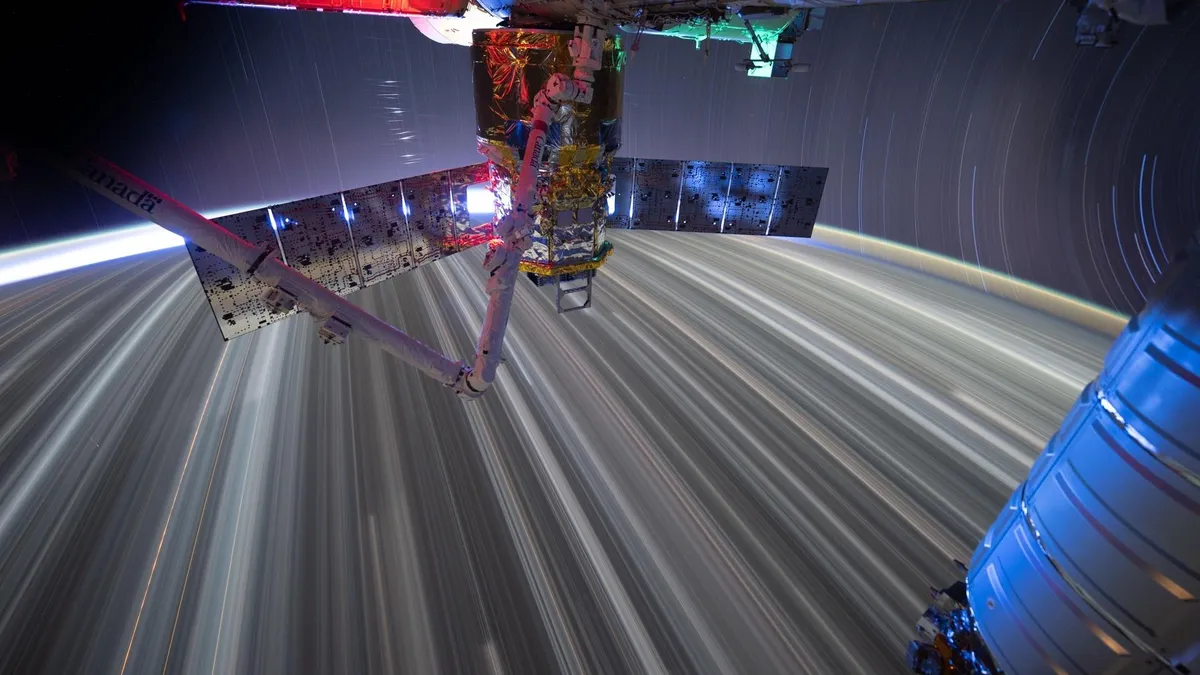
Cities far below the International Space Station (ISS) and stars far in the cosmic distance create ghostly trails of light in this long-exposure photograph from NASA astronaut Chris Williams.
Williams took the photo as the ISS was orbiting above the India-Pakistan border in the middle of the night local time, while the station was flying at an altitude of around 261 miles (420 kilometers).
What is it?
In the background of the image, city lights far below streak by rapidly as the ISS flies over Earth at an orbital velocity of around 17,500 mph (28,000 km/h). Farther behind, stars in the distance create circular star trails. As the ISS orbits Earth, it also rotates to keep the same side facing the planet. This creates the circular trails we see in photos taken aboard the orbital laboratory.
In the foreground of the image, several pieces of ISS hardware are visible close to Williams' perch aboard the orbital laboratory. To the right of the photo, the Cygnus-23 cargo craft is docked at the space station's Unity module. This new, larger version of Northrop Grumman's robotic supply vehicle brought some 11,000 pounds (4,990 kilograms) of cargo to the ISS in September 2025.
JAXA's (Japan Aerospace Exploration Agency) HTV-X1 cargo craft can also be seen at the top of the image docked to the Earth-facing port of the ISS's Harmony module just behind the Canadarm2 robotic arm.
Why is it amazing?
From the spacecraft docked at the ISS in the foreground, to the lights of Earth below, then to the stars seen far in the far background across distances hard for our minds to fathom, this striking timelapse photograph is a stark reminder of the vastness of space and the incredible technological wonder that is the International Space Station.