


Buying a telescope can be very confusing and take a while to decide which model you actually want to buy. Our guide is split into sections for different levels of experience, budgets and target preferences. Now is a great time to start researching and thinking of what models you might want with with October Prime Day arriving on Oct. 6-7 and Black Friday coming in November. It is best to be ready to buy as soon as deals go live as the holiday sales season usually see some of the best prices of the year and many often sell out quickly.
Experts have rounded up the best telescopes to suit a range of purposes and budgets. Whether you're eagerly awaiting Saturn's October 4 opposition, when it appears brighter than ever or plan on seeking out nebulas and galaxies, we have you covered.
We've included beginner-friendly, basic telescopes and smart telescopes that make stargazing super easy, zooming in on a target with a button press. And if you're not sure where to start, check out our night sky guide.
The quick list

Best for beginners
A great scope for beginners, the Celestron NexStar 4SE is easy to use and set up, it produces clear and bright images and has a whole host of useful features.

Best budget telescope
The Celestron Inspire 100AZ is a great beginner scope for anyone just getting started with astronomy, it comes with a variety of accessories.

Best for astrophotography
This smart telescope takes beautiful deep sky photos in just a few seconds, but it's not an all-rounder telescope.

Best motorized telescope
A fantastic scope for any experience level, incredibly easy to use yet powerful enough for deep space exploration and even astrophotography.

Best for portability
If you live in an urban area with lots of light pollution and need a telescope you can comfortably carry to dark sky sites, this could be the one for you.

Best smart telescope
If you've got the budget for it, this is Unistellar's most advanced telescope to date. It has a very reliable app and features a Smart Light Reduction feature to eliminate light pollution in urban environments.
Load the next 4 products ↴

Best for deep space
Great for experienced, long-time astronomers, this scope is excellent for astrophotography thanks to the Edge HD technology. It's a little on the heavy side, but it can carry a load of up to 30 lbs.

Best for kids
This is a great tabletop telescope with a big aperture and an ideal starting point for young astronomers, with an inspiring design celebrating modern space exploration.

Best portable smart telescope
Everyone can have fun using the ZWO Seestar S30 Pro — it's lightweight and easy to use without any compromise on optical quality. Get clear and sharp shots of night sky objects easily.

Best for solar viewing
Simply attach the solar filter, and you can be viewing the sun in minutes. This scope is ideal for beginners to solar viewing, but its versatility as a nighttime scope gives it extra credit.
Best telescopes in 2026 that we recommend
Why you can trust Space.com Our expert reviewers spend hours testing and comparing products and services so you can choose the best for you. Find out more about how we test and review products.
Best for beginners
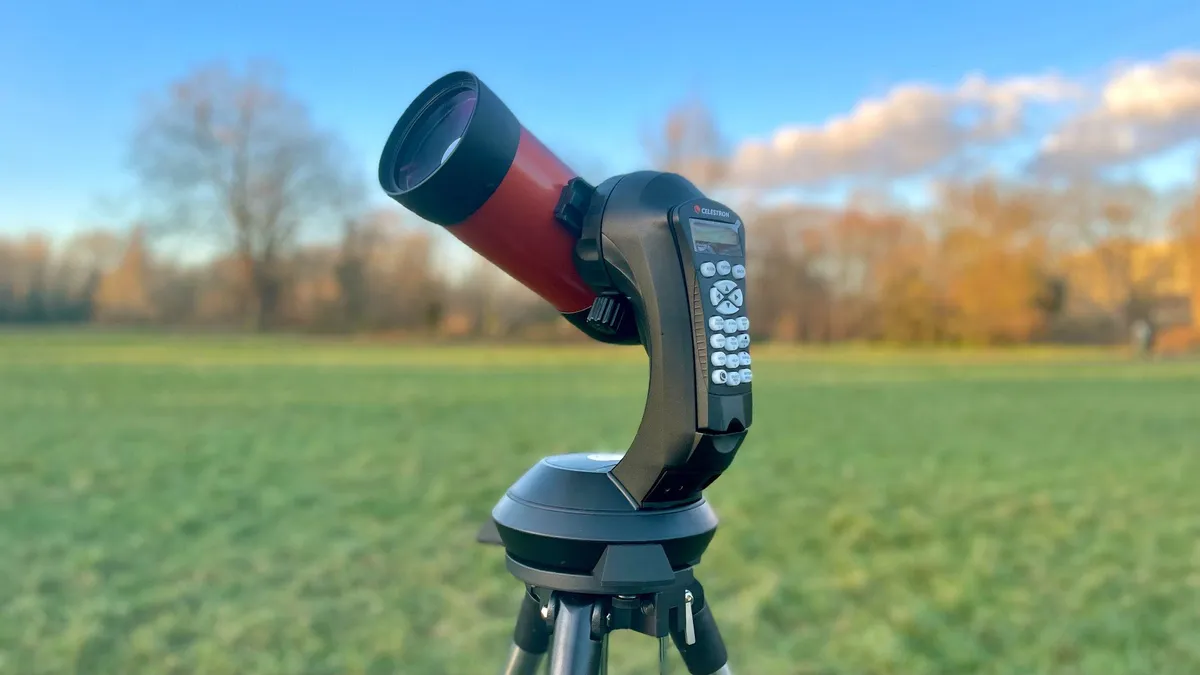


✅ It's your first telescope: This scope is easy to use and set up, making it perfect for beginner astronomers.
✅ You want GoTo technology: You can easily find and track specific celestial objects with little or no prior knowledge.
❌ You want to travel with it: This telescope isn't the most portable as the tripod doesn't fold down entirely.
🔎 Celestron NexStar 4SE: If you want to view the planets and bright objects in the sky quickly and effortlessly, the Celestron NexStar 4SE will certainly do the job. ★★★★
The Celestron NexStar 4SE is a fantastic choice for beginners thanks to its fully computerized mount. Celestron's SkyAlign technology identifies the current date and time as well as your location to auto-find various targets within the night sky at the push of a button, making it easy for newcomers to get to grips with stargazing.
This telescope has a 4-inch (102mm) aperture and a focal length of 1,325mm, enough to give sharp views of the planets and other bright sky objects. The downside is that this combination results in a fairly narrow field of view of only 1.2 degrees, which means you will struggle to fit bigger deep sky objects into the view. The NexStar 4SE comes with a 25mm Plossl eyepiece, but we think you'll get better results if you purchase an additional 32mm eyepiece and Barlow lens to make the most of the 241x highest useful magnification.
This telescope is very sturdy in design, which is reflected in its weight. At 23 lbs (10.4 kg) the NexStar 4SE is far from the lightest on this list, nor is it the most portable, as its accompanying tripod doesn't fold down completely.
Another thing to note about this telescope is how power-hungry it is; the mount tears through the 8xAA batteries required so quickly, we'd recommend using an external power source instead. Because of this, the NexStar 4SE is perhaps best suited for those who want to stargaze from their backyard rather than take it on the go.
- Read our full Celestron NexStar 4SE review
Attributes |
Notes |
|---|---|
Design |
Solid and sturdy build, signature orange colors. |
Performance |
Great for observing the moon and planets. |
Functionality |
Alignment correction can be tricky. |
Best budget telescope
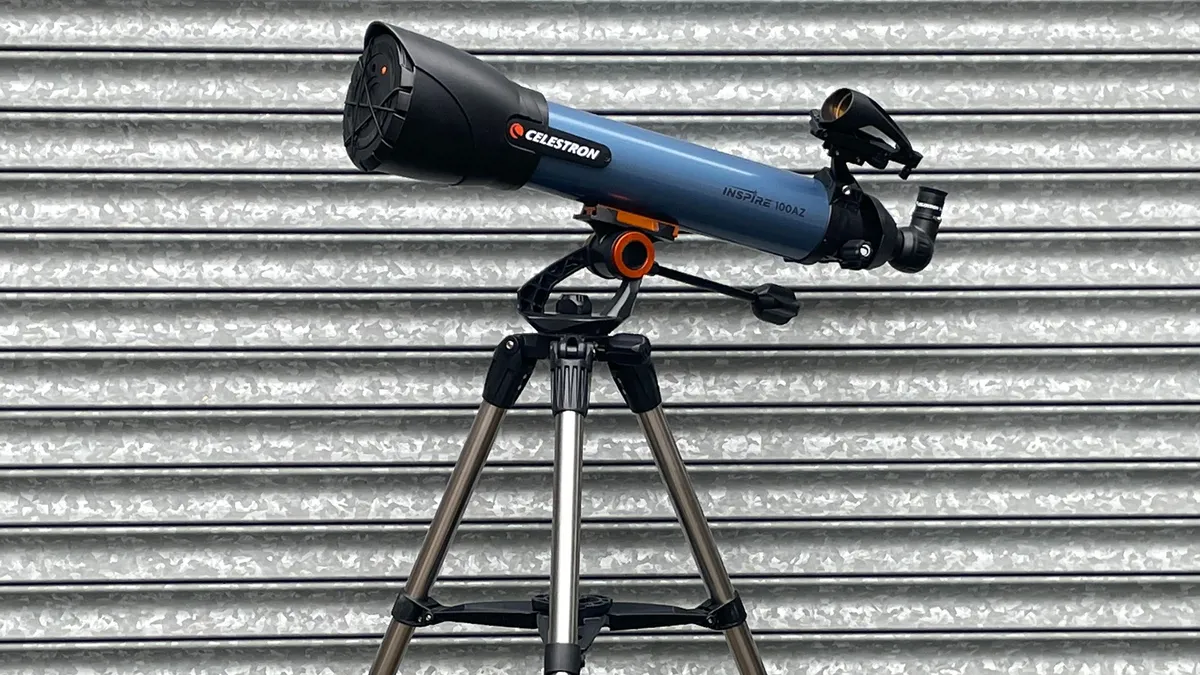


✅ You're a beginner: We found it easy to set up and take down, perfect for beginners.
✅ You want to take astro shots on your smartphone: The lens cap cleverly turns into a smartphone holder so you can capture images of the night sky.
❌ You aren't confident locating objects yourself: This telescope doesn't have GoTo technology, so you'll need to be able to locate specific celestial objects yourself (or with the help of a stargazing app).
❌ You want detailed views of deep sky objects: While this telescope can give great views of planets and the moon, objects further away may appear a little underwhelming.
🔎 Celestron Inspire 100az: Aimed at beginners and those looking to upgrade, this 4-inch refractor performs best with the moon and planets. It comes with a lens cap that converts to a smartphone holder for easy astrophotography. ★★★★
The Celestron Inspire 100AZ is a great choice for beginners. Its user-friendly features and sturdy build make it a breeze to use even for the uninitiated, and it's a relatively affordable option compared to other telescopes in this guide.
An achromatic refractor with a 4-inch/100mm aperture and a reasonably short focal length of 660mm, the Celestron Inspire 100AZ is designed to be used at home to view planets, the moon and deep sky objects. It's perched on a simple altazimuth mount that moves side to side and up and down, with a panhandle to lock it in the exact position you want.
The 100mm aperture gathers a significant amount of light, allowing clear observations of faint celestial objects like nebulas and galaxies. Moreover, its long focal length provides substantial magnification for detailed views of planets and other nearby objects.
During our Celestron Inspire 100AZ review, we noticed a small amount of false color (purple color fringing), and a slight blurring in the field of view. The latter is easily resolved by investing in one of the best eyepieces to make the most of the Inspire 100AZ's optical system. The slight amount of false color shouldn't be a dealbreaker for most, unless you are particularly keen on getting completely accurate colors.
The Inspire 100AZ telescope comes with various accessories including two eyepieces, a red LED flashlight to maintain night vision, an accessory tray and a StarPointer Pro finderscope for locating celestial objects. We loved that the lens cap turns into a smartphone adapter, so you can take astro shots with your phone.
- Read our full Celestron Inspire 100AZ review
Attributes |
Notes |
|---|---|
Design |
Fairly lightweight. |
Performance |
Excels with lunar views. |
Functionality |
Easy to set up and take down. |
Best for astrophotography


✅ You want an automated telescope: Focusing, tracking, finding targets and stacking processed images is all automatic with this one.
✅ You want to take incredible deep sky images: The Origin can take high-definition shots of deep space with little prior knowledge required.
❌ You want a traditional telescope: It doesn't have an eyepiece and requires a mobile device to observe your chosen target.
❌ You're on a budget: It costs over $4,200, so this telescope is on the pricier side.
🔎 Celestron Origin Intelligent Home Observatory Mark II: While expensive, it can do every part of stargazing autonomously and easily produces some of the sharpest photos of deep sky objects we've seen from a smart telescope. ★★★★
The Origin Intelligent Observatory Mark II is a premium smart telescope that comes with the high-level optics you would expect from an industry leader like Celestron. It retains the same Rowe-Ackermann Schmidt astrograph optical build and 6-inch (152 mm) aperture as the original Origin but includes an upgraded Sony IMX678 sensor with a smaller pixel size (2.0 µm) and an 8.2 MP resolution. This small tweak allows for a huge boost in image detail and allows finer sections of targets to be resolved.
The design of the Origin Mark II looks more like a traditional telescope than other smart telescopes but it is still fully controlled by the easy-to-use Celestron Origin app. This includes locating deep sky targets, autofocus and taking photographs of your targets. There is an option for manual focus adjustments on the app if required but there is a small lag between making the adjustments on the smartphone and the telescope changing the focus.
Expert tester Brett Tingley used the Origin Mark II with a Celestron Origin nebula filter (sold separately) in a Bortle 4 area and got some incredibly sharp results. He imaged a range of galaxies, including Bode's galaxy (M81), the Whirlpool galaxy (M51) and the Needle galaxy (NGC 4565). The images are crisp and really do stand out as some of the best smart telescope astrophotography when compared to competitors like Unistellar and Vaonis.
The app was easy to use and offers a range of menus, allowing users to choose objects from a virtual planetarium or see what is visible on any given night. Operation of the motors was fairly audible though and while not a dealbreaker, it might be something to be aware of if you need to use it in a quiet setting. Other handy features include a built-in red light for shining at the tray when changing filters or accessories and a bubble level to assure a completely level setup.
The minimal physical controls of the Origin Mark II are what make it so simple to use, needing only your smart device for operation. With that, it is very easy to get high-end astrophotography from your backyard without needing a degree in astronomy or years of photography experience. The price tag is a huge $4,200, but the results do not let you down.
Attributes |
Notes |
|---|---|
Design |
Heavy but with premium optics and setup |
Performance |
Sharp images of galaxies and the moon |
Functionality |
Fully controlled by smart device with motorized go-to mount |
Best motorized telescope


✅ You're looking for a long-term telescope: There's no question that this telescope is pricey, but it's one that will last you for decades — it's not called 'The World's Most Beloved Telescope' for nothing.
✅ You want to use it for astrophotography: Thanks to the smooth and accurate tracking, this scope is a great option for taking stunning astro images of deep sky objects.
❌ You're on a budget: Although this is definitely worth the money and we'd recommend it if your budget can stretch to it, it is very pricey. If you're on a budget or you're new to the medium, there are plenty of cheaper alternatives that will be more than good enough.
🔎 Celestron NexStar 8SE: An outstanding telescope with incredible optics that would suit a beginner, intermediate or advanced astronomer. It's great for astrophotography and gives beautifully bright and detailed views. Our only fault with it is that it can price out beginners. ★★★★½
The Celestron NexStar 8SE is one of the most flexible telescopes we've ever reviewed, and an ideal scope to learn and grow with. It's beginner-friendly, requiring no prior knowledge of the night sky to use, yet its stunning optics will be enough to satisfy intermediate to advanced astronomers as well. The only downside is the price, but if you have the funds, then we have no qualms about recommending it.
The Celestron SkyAlign app helps you to align the scope using three bright stars, after which the entire operation is automated. You simply push the buttons on the handheld remote to select your desired celestial object and the motorized mount will slew the telescope towards your target. You can select from a range of objects categorized under 'solar system', 'stars' or 'deep sky', or you can select 'sky tour' which will automatically choose objects of interest to show you depending on your location.
With an 8-inch aperture and Schmidt-Cassegrain optical design, this telescope is able to absorb a huge amount of light and offers bright and clear views of objects within our solar system and beyond. The catadioptric construction, which combines both refraction and reflection, has allowed Celestron to keep the distinctive orange tube relatively short, so it's eminently portable for taking with you on the hunt for darker skies.
In our Celestron NexStar 8SE review we were seriously impressed by the smoothness and accuracy of the motorized fork arm and think it would be a great option for those seeking to do long-exposure astrophotography. However, the telescope does require a whopping 8x AA batteries, so we'd recommend buying some rechargeable batteries for this power-hungry scope to prevent future costs from mounting up. This is especially important considering that the range of the Celestron NexStar 8SE means that you'll likely be using it for many years to come.
- Read our full Celestron NexStar 8SE review
Attributes |
Notes |
|---|---|
Design |
Can be transported as a fully-assembled setup. |
Performance |
Outstanding optics, slightly tricky to align if you're not used to it. |
Functionality |
Easy to assemble and disassemble. |
Best for portability
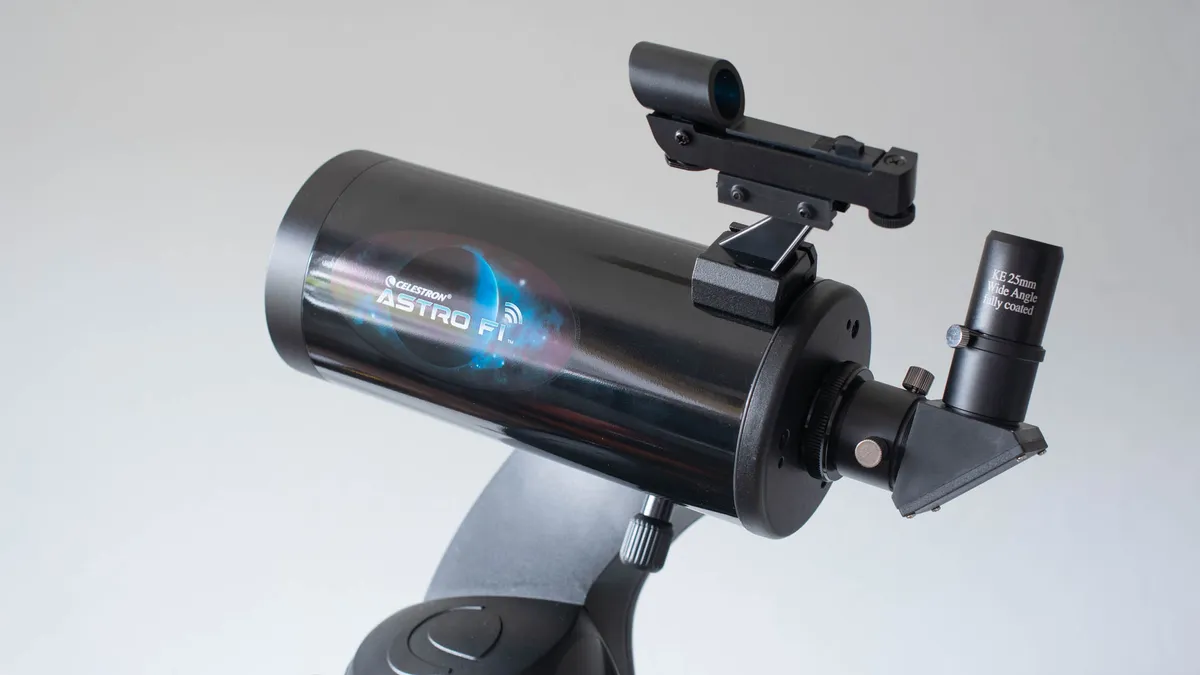


✅ You'll be traveling with it: This scope is our top choice for portability, so it's ideal if you plan on taking it away on camping trips or to areas with darker skies.
✅ You're a beginner: If you just want to look at the moon and some planets, this is a great choice.
❌ You want good quality parts: This telescope has an element of 'you get what you pay for'. It's adequate for basic astronomy, but the tripod isn't the best quality, the optics could be better and it didn't have a premium feel.
🔎 Celestron Astro Fi 102: Best suited for viewing the moon and planets, this telescope is great for beginners and anyone with no prior experience. It can be a little tricky to setup initially, and it's not the best quality scope we've reviewed, but it'll do the job. ★★★½
The Celestron Astro Fi 102 has many benefits for newcomers to astronomy — it's relatively easy to set up, it has a motorized mount that automatically slews to your chosen target and it's in an affordable price bracket for a Maksutov-Cassegrain scope. It also has an array of convenient features and accessories to help you get started.
One of the things we loved about this scope in our Celestron Astro Fi 102 telescope review was its portability. It has a compact body and weighs only 6 lbs (2.7kg), so it's extremely easy to carry with you out in the field. A word of caution, though, it's not as robust as some pricier scopes and probably couldn't withstand getting wet, so make sure to take a cover with you in case of passing showers. We also think it would feel more stable with a sturdier tripod as the one that's included felt a bit flimsy and needed some extra weighing down.
This telescope comes with integrated WiFi so you can pair it with your phone using the Celestron SkyPortal app. The app contains around 100,000 celestial objects that you can select for the telescope to slew to, making it easy for beginners to navigate the sky above them with no prior knowledge.
For the price, the Celestron Astro Fi 102 offers good views of the moon and its craters and closer planets such as Mars, Saturn and Jupiter. In good conditions, you can also hope to catch a glimpse of Uranus or Neptune. There is some sharpness drop-off towards the edges, but you'd need to purchase a much more expensive scope to avoid this.
The plastic casing is acceptable but we don't think it could survive a substantial knock or a soaking from a passing shower as the seals aren't great, unlike some of the hardier, fully-sealed telescopes available.
- Read our full Celestron Astro Fi 102 review
Attributes |
Notes |
|---|---|
Design |
Highly transportable, but tripod needs weighing down. |
Performance |
Initial setup can be tricky, but after that it's a breeze. |
Functionality |
Large database of celestial objects on SkyPortal. |
Best smart telescope
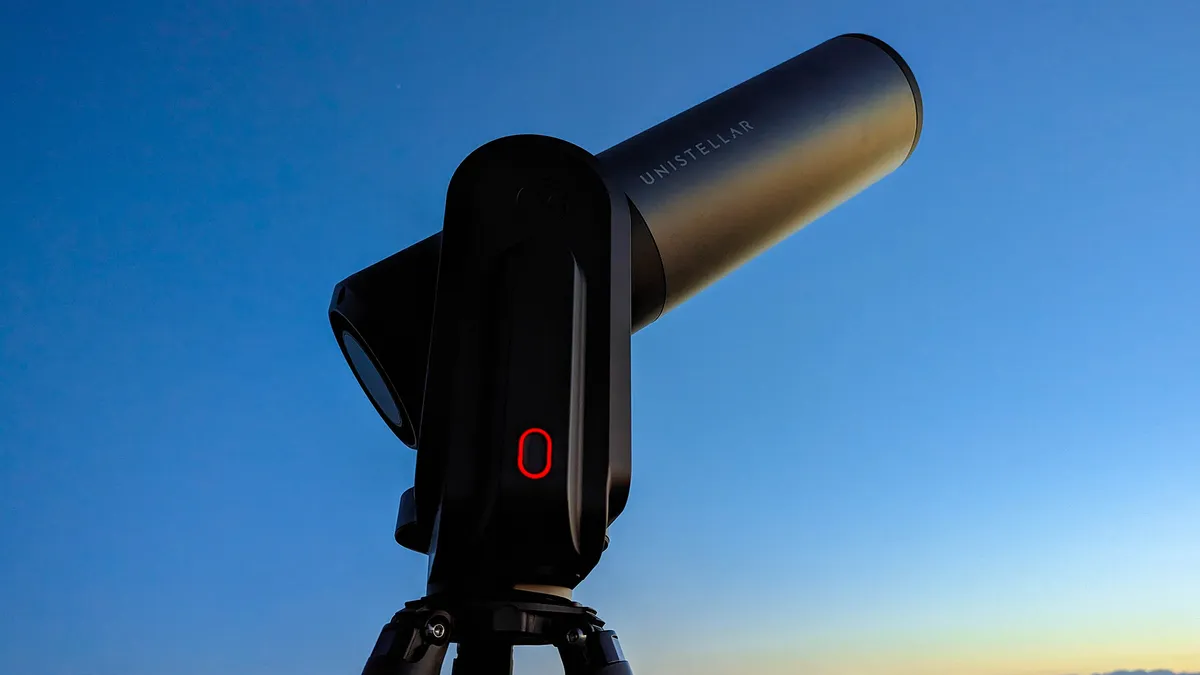


✅ You live in an urban area: This scope has a Smart Light Pollution Reduction feature that removes light pollution, s it's a great option if you don't live near a dark sky site.
✅ You want simplicity: This is an incredibly sleek, all-in-one telescope that has no need for additional accessories and can take you to your chosen celestial objects with ease.
❌ You're on a budget: Unsurprisingly, this is an expensive bit of kit, so it'll price out most beginners and anyone who doesn't have a big budget.
🔎 Unistellar eQuinox 2: An easy-to-use motorized smart telescope that can locate night sky objects at the push of a button, the eQuinox 2 can have you exploring the stars in minutes without the need for prior knowledge, although its in-built camera isn't quite detailed enough. ★★★★½
The Unistellar eQuinox 2 packs all the latest smart technology in a sleek and modern motorized reflector telescope. It features a single power button on the fork arm, and all other controls are operated via the Unistellar app. Unlike traditional telescopes, you won't get a finderscope, eyepieces or other accessories included in the package because the Unistellar eQuinox 2 doesn't need them.
The telescope contains a 6.2MP image sensor (an improvement over the 4.9MP sensor in the previous model) which captures several images one after the other and stacks them to give the appearance of a long exposure. As a result, objects become brighter as the image on your phone or tablet screen gets updated in real-time.
While this may not appeal to astronomers who enjoy a more traditional approach to sky-watching, it has particular benefits when stargazing from urban locations thanks to the Smart Light Pollution Reduction feature, which removes the effects of light pollution as you view. We also like that it's very easy to save and share photos of what you're seeing in real-time.
During our Unistellar eQuinox 2 review, we found it quick and easy to set up using the Autonomous Field Detection feature, after which you can use Unistellar's intuitive app to navigate automatically to different objects in the night sky. The menu screen displays a choice of objects that are currently available to view, as well as objects that will make an appearance within the next few hours. Alternatively, you can search for the specific object you're interested in in their huge database of 37 million stars and over 5,000 celestial objects.
It's worth noting, though, that this high-tech telescope will set you back around $2,000. If your budget will stretch that far, then the Unistellar eQuinox 2 may be the telescope for you.
- Read our full Unistellar eQuinox 2 telescope review
Attributes |
Notes |
|---|---|
Design |
Slim, sleek, neat package. |
Performance |
Quick go to location of night sky objects. |
Functionality |
Doesn't orientate until well after twilight, easy once oriented. |
Best for deep space


✅ You want to see everything: While some telescopes are only good for seeing the moon and planets or deep space, this telescope is good for seeing all types of celestial objects.
✅ You want a seamless experience: We found the motorized mount on this telescope very smooth and slick.
❌ You're a beginner: This telescope is intended for those with experience and knowledge of the sky and telescopes, so if you're just starting out, we'd suggest a more beginner-friendly model.
❌ You want something lightweight: At 61 lbs (27.67kg), this telescope is heavier than most other choices in this guide.
🔎 Celestron Advanced VX 8 EdgeHD: Intended for serious amateurs, this optically excellent telescope is suitable for all types of visual astronomy with its rugged, lightweight computerized mount. If you know the sky and plan to be doing astronomy for a long time, this is the telescope to get. ★★★★½
Celestron's EdgeHD technology greatly improves Schmidt-Cassegrain telescopes, especially for astrophotography. Normally, these telescopes produce a curved focal plane that doesn't match the flat surface of a CCD camera sensor. This mismatch causes field curvature, making stars at the image edges appear blurry. However, Celestron's EdgeHD technology solves this problem by providing a perfectly flat field. This enables astrophotographers to capture sharp and detailed photos across the entire frame without any blur.
During our Celestron Advanced VX 8 EdgeHD review, we were pleased to find that the optics in the EdgeHD negate the blurred edges, creating a perfectly flat field right to the edge of the frame for pinpoint sharpness across the whole image. The Celestron Advanced VX 8 EdgeHD's optical performance is impressive, with crisp and clear views with no optical distortion or false color.
The Celestron Advanced VX 8 EdgeHD can handle a weight of up to 30 lbs (13.6kg), ensuring stable and secure support for the tube and all your accessories. The package includes the standard NexStar+ hand controller, a 40mm eyepiece and access to Celestron's SkyPortal app and Starry Night Special Edition software.
As a bonus, the optical tube assembly includes Celestron's Advanced VX mount, specifically designed for photographers. It can capture images across the meridian (an imaginary north-south line) without requiring a meridian flip. The setup also corrects errors periodically while tracking objects and includes an auto guider port.
Views of Saturn and Jupiter are dramatic; globular clusters are resolved into stars; all the Messier Objects are plainly visible; and with a trained eye and a dark country sky, galaxies are visible down to 12th magnitude. It's a telescope you won't outgrow.
Check out our Celestron deals page to see if you can snap up a bargain.
- Read our full Celestron Advanced VX 8 EdgeHD review
Attributes |
Notes |
|---|---|
Design |
EdgeHD optical design outperforms Schmidt-Cassegrain. |
Performance |
Finds and tracks celestial objects reliably. |
Functionality |
Great views of all types of celestial objects. |
Best for kids


✅ You want to introduce kids to the night sky: This is a great simple Dobsonian telescope that will give kids a fun stargazing experience without any complex set-up, plus it comes with a detailed moon map and moon filter for assisting with lunar viewing.
✅ You need ease-of-use: All you need to do is add the eyepiece and set the telescope on a flat surface and then you can start looking around the sky.
❌ You want complex tracking mechanisms: While it does come with a red dot finderscope, you won't be able to track objects with this model as you observe them which means you will have to get used to re-centering an object if observing the same target for longer periods.
❌ You want a huge aperture: A 3.9-inch aperture isn't tiny but it also isn't huge, whilst good for brighter objects, this telescope will struggle to deliver sharp clarity on deep-sky objects like galaxies and nebulas.
🔎 Celestron Moon Mission 100mm tabletop Dobsonian: If you want to get your children interested in the night sky, this telescope inspired by modern space exploration will have them gazing around the sky in no time with a simple set-up that means they can start observing straight out of the box. ★★★
The Celestron Moon Mission 100mm tabletop Dobsonian telescope is part of Celestron's special edition Moon Mission line of telescopes for entry-level stargazing and lunar observation. It's a great pick for kids because it is simple to use and draws their focus to one of the easiest targets to pick out in the night sky, the moon. It has a finish inspired by modern lunar exploration like the recent Artemis II mission, a detailed moon map for identifying craters and a 1.25-inch thread-on moon filter for reducing glare and boosting contrast.
Our expert reviewer Gemma Lavender found that using the 8mm included eyepiece and the moon filter delivered a detailed view that filled the field-of-view with brighter crater rays visible on lunar seas. It is also great for basic stargazing on bright targets like Castor, Pollux and Jupiter, which, at the time of testing, were easily found and located in the sky.
It comes with a red-dot finder scope for helping to center a target before looking through the eyepiece, but you won't find any complex tracking mechanisms that will keep the target in the middle of the view. The Dobsonian design is meant to be very easy to use, just set it on a flat surface and slew the telescope up, down, left or right, to find your target. It lacks the precision to find deep sky objects easily, but it will help develop astronomical skills in locating targets in the sky and is great for hands-on learners.
The aperture isn't huge at 3.9 inches but it is perfect for lunar views and spotting bright objects in the night sky. Galaxies and nebulas will still look like faint smudges, but the views will be much closer. It's a great tool that will help ignite an interest in the night sky, teach kids about the moon and give them a taster of what telescope stargazing can offer. The Celestron Moon Mission 100mm tabletop Dobsonian is currently available for $208 from Kohl's.
Attributes |
Notes |
|---|---|
Design |
Moon Mission inspired finish on a Dobsonian design |
Performance |
Simple set-up and great for lunar observation and bright objects |
Functionality |
Good focusing and easy to use |
Best portable smart telescope


✅ You want a smart telescope to take anywhere: The Seestar S30 Pro offers high-end optics in a fully portable setup that is quick and easy to use at home or in the field.
✅ You want a group telescope: Thanks to smart device functionality and automated image processing, a whole group of people can view the target as it is being imaged on a total of eight different devices, with one acting as the host and seven guests.
❌ You want complete manual imaging control: The Seestar S30 Pro manages most of the imaging process automatically and while you can select different imaging times and gain control for 'solar system' mode, it lacks full manual control of all exposure settings for astrophotography.
❌ You are a planetary enthusiast: Whilst great for deep-sky imaging of galaxies, star clusters and nebulas, planetary imaging on the S30 Pro is basic at best and will likely disappoint people wanting detailed and sharp shots of planets.
🔎 ZWO Seestar S30 Pro: A powerful smart telescope packed into a portable design, it removes necessity of technical know-how for astrophotography and locating hard-to-find deep sky objects in the night sky ★★★★
The Seestar S30 Pro is the upgraded version of ZWO's highly portable smart telescope, the Seestar S30. This version adds a sharp 8.3MP Sony IMX585 Starvis 2 sensor, quadruplet apochromatic optics, a high-resolution wide-angle camera, expanded internal storage and an integrated dew heater to keep optics clear on chilly or humid nights. During our testing, astronomy expert Jamie Carter managed to get some amazing shots of the Orion nebula (M42), Bode's galaxy (M81), the Whirlpool galaxy (M51) and the Hercules globular cluster (M13). During image stacking, the S30 Pro automatically discards poor frames and only uses the best frames to gradually build a bright and detailed image of your chosen target.
Despite all these upgrades that add resolution and optical quality to the telescope, it manages to weigh the exact same as the regular S30 at 3.64 lbs (1.65 kg). This means that you can get even better images without having to move around a much heavier device.
Operation is very simple and only requires turning the telescope on and connecting your phone before choosing a target to image but the S30 Pro is not just a beginner smart telescope. Professional features like equatorial (EQ) mode, foreground lock and advanced imaging modes make the S30 Pro suitable for astrophotographers who may want some more variability in how they shoot. That being said, there is still a lack of total manual imaging control for exposure settings but it supports the FITS format for export to move the sub-frames to a computer for manual post-processing.
The Seestar app works seamlessly with the smart telescope and allows up to eight devices to be connected and watch as the target develops on screen. This is ideal for travelling deep-sky astrophotographers who prioritise portability without wanting to compromise on optical quality. The S30 Pro is almost twice the price of the base S30 model, coming in at $699, but this model is much more affordable than rival smart telescopes from Vaonis and Unistellar.
Attributes |
Notes |
|---|---|
Design |
Portable with high-quality optical design |
Performance |
Sharp images of deep-sky objects |
Functionality |
Automated imaging with intuitive smartphone app |
Best for solar viewing


✅ You’re a beginner to solar viewing: This scope is easy to set up and use so it would suit those new to solar viewing.
✅ Portability is key: This scope is lightweight and portable so it can be taken anywhere for solar viewing.
❌ You want to take photos of the sun: The small aperture means photographing the sun isn’t possible with this scope.
❌ You already own a telescope: We’d recommend purchasing a solar filter for your telescope rather than buying this one as an additional scope.
🔎 iOptron 80mm White Light Solar Scope: Versatile as both a solar scope and nighttime telescope, this scope offers beginners the chance to get acquainted with the sun, with good views of sunspots and more. ★★★½
The iOptron 80mm White Light Solar Scope is a compact and sleek refracting telescope. The SolarLite solar filter from Thousand Oaks simply mounts onto the end of the telescope with three screws and, being from a reputable company, is safe. We’d recommend this for beginners to solar viewing, as it is so easy to set up — you simply mount the scope to the tripod and attach the solar filter.
During our testing period, the scope performed well, allowing us to get good views of visible sunspots on the sun’s surface. When viewing the sun, the aperture is actually only 60mm due to the solar filter, and with the 9mm eyepiece, the views filled the space nicely. Even with the 25mm eyepiece, we still managed to see sunspots. We were impressed with the scope’s ability to pick out sunspots, especially when we compared our image to that of one taken by the Solar Dynamics Observatory.
If you’re looking for a scope that you can take with you, this is a good option. It’s lightweight and portable so you don’t need to worry about keeping it in one place — you can take it with you on holiday, for example. And as you can also use it for nighttime observations, its portability is an added benefit.
- Read our full iOptron 80mm White Light Solar Scope review
Attributes |
Notes |
|---|---|
Design |
Simple and compact |
Performance |
Good views of visible sunspots |
Functionality |
Easy to set up, even for beginners |
Contributing experts

A contributing expert to Space.com, Live Science, All About Space and more, Gemma is the author of several books including 'Quantum Physics in Minutes'. She holds a degree in physical sciences, a Master's in astrophysics and a PhD in computational astrophysics and became fellow of the Royal Astronomical Society in 2011. Gemma is also the Communications and Outreach Officer at the European Space Agency.
Telescope FAQ
How do I choose the right telescope for me?
Choosing the perfect telescope can be a serious challenge, especially as a beginner. There's a lot of jargon and technical knowledge that surrounds them. Plus, you've got hundreds of options to choose from, with multitudes of different configurations and settings, all at a wide range of prices.
The good news is that the quality of telescopes has drastically improved in recent years, so most models' quality is usually pretty good these days; you're unlikely to end up with a total dud. That said, there are better options than others, and we've endeavored to only include the very best in this guide.
The most important factor in choosing a telescope is the optical quality it provides. You'll also want to think about what aperture you need and whether you need a more portable model or a larger, more powerful one. Beginner telescopes are a brilliant option if you're just starting out in the field.
In order to get the best possible views of the night sky, you'll also need to consider where you're observing from, what objects you'd like to see in particular, your setup if you're going to attempt astrophotography, and more. If you're planning on roaming with your telescope, weight and portability are other factors to take into consideration.
We'd strongly advise you to stick to reputable telescope dealers to buy your scope from. That way you'll be sure to get exactly what you've ordered, and many will provide a warranty with your purchase. Astronomical equipment businesses also tend to offer the best deals on their products, and have advisors on hand to help you make the right decision for you.
Below, you'll find a breakdown of the different types of telescopes you can buy, as well as which model we think is best.
What types of telescope are there?
There are three main types of telescopes: reflector, refractor and catadioptric telescopes.
Reflectors have a main mirror to gather and focus light, whereas refractors have an objective lens. Catadioptrics have a main mirror and a lens of the same diameter. All three of these types of telescopes have 'sub-types' which vary by design. For example, the most basic reflector telescopes have a Newtonian design, which means they have a main mirror and a smaller, secondary one to divert the light at right angles to the eyepiece from the top of the telescope.
As we've mentioned above, nowadays, you're spoilt for choice when it comes to quality (and relatively affordable!) telescopes. So, which type should you opt for? We think Newtonian reflector telescopes on a simple undriven alt-azimuth mount (known as a 'Dobsonian') offer the best value in terms of aperture.
However, if you are interested in learning your way around the night sky 'the old fashioned way', then a Dobsonian telescope might be the way to go. They don't come with any bells and whistles, so you'll need to arm yourself with a star map to make sense of stargazing. Dobsonians collect a lot of light, and they have enough resolving power to deliver breathtaking views of celestial objects. Dobsonian telescopes over 6 inches in aperture tend to be pretty large and imposing, so you'll need to consider where it can be stored if you purchase one. A garden shed or garage might be the best option.
If you add an equatorial or computerized mount, Newtonian or refractor telescopes become much more expensive. You can find several types of computerized mounts for Newtonian telescopes: Dobsonians (push-to or GoTo), single time-mounted (tracking or GoTo) and German equatorial (GoTo). For reference, for a computerized push-to Dobsonian, you'll be looking at spending about twice as much as for a manual model of the same aperture, while a GoTo will set you back almost four times the price of its manual counterpart. A premium Newtonian on a German equatorial mount can be as much as ten times more expensive than one on a manual mount!
If ease of use, portability and convenience are high on your requirements, and you like gadgets, then a short focal length refractor of up to 4 inches or a catadioptric (Schmidt- or Maksutov-Cassegrain) up to 5 inches on a computerized mount may well fit the bill. These are versatile telescopes with high magnification, which enables you to observe amazing details on the moon and planets.
Achromatic refractors with short focal lengths typically display a degree of false color around the edges of bright objects like the moon because they can't focus all wavelengths of light to a precise point. Most users are happy to accept this drawback because refractors are so easy to use and care for; however, if you're after a clean, high-contrast view without false color, the Maksutov is the best option here.
The best views of the night sky are obtained through apochromatic refractors. Using special glass objectives, they focus all wavelengths of light to as near a single point as possible and are free of false color. It is worth noting though, that apochromats cost around four times as much as equivalent-sized achromats. It's up to you whether you're prepared to invest that kind of money into your skywatching.

How does a refractor telescope work?
Refractors work by bending — or refracting — the light they gather to give you a view of your astronomical target. Easy to set up, the refractor is best suited to planetary and lunar viewing, using lenses to collect and focus light to form an image, while an eyepiece magnifies the view.
The refractor has a fairly straightforward design, with a main objective lens at one end and a star diagonal with a threaded eyepiece at the other. Being intuitive to use, the refractor is often a popular instrument for novice astronomers, given its low maintenance. Refractors are usually affixed to a simple alt-azimuth mount that slews from side to side and up and down to locate a desired target. Being easy to use means these telescopes are also simple to manufacture (at least for novice models) and, therefore, cheaper to buy.
The downside is that the higher the aperture, the more expensive the refractor gets. Unfortunately, this means that a basic refractor is also the number one target to replicate in mail-order catalogs and other non-reputable vendors, so caution must be exercised when purchasing this type of telescope.
Refractors are particularly good at giving highly magnified and high-contrast images and, because of this, are ideal instruments to use when looking at solar system targets such as the moon and the planets. The best refractors usually have an aperture of 2 inches (60mm) or more and will provide you with reasonable views of astronomical objects. A 3- to 4-inch (80 mm - 90 mm) would be best suited if you're looking for a larger aperture.
The drawback of a refractor is that it can suffer from chromatic aberration, also known as color fringing. When a single lens doesn't focus all the colors emitted from a target object at the same point, bright objects such as the moon, Venus or Jupiter usually have a colored halo around them. To reduce this problem, many refractors are manufactured as achromatic or APOchromatic (also known as Extra Dispersion (ED) telescopes).
The achromatic refractor is cheaper than the apochromatic refractor and, combined with its efficiency, is often the type of telescope that novice astronomers go for. Even if you choose the more expensive achromatic, you'll likely get a stubborn degree of purple fringing around some targets.
Unless you're a seasoned skywatcher and you can afford to go for the more expensive apochromatic — which corrects for such an effect by using exotic glass for the lenses — this degree of color fringing will not ruin your observing experience to any great extent. If you decide to go for the expensive option, you will be stunned by the views you will get through these excellent telescopes. Be warned, though, you might find that some apochromatics come without a tripod, something that you'll have to buy separately along with any accessories.
- Discover the Best tripods, Best travel tripods and Best camera accessories for astrophotography in our handy guides.

How does a reflector telescope work?
There are two common types of reflector telescope — the Newtonian and the Dobsonian. The way these instruments operate is the same — they both use mirrors to reflect light to create an image of the object you're looking at.
The Newtonian telescope comprises a curved light-collecting mirror, which can be found at the tube's base. The light that hits this mirror is reflected back to the front of the tube, where a smaller flat mirror — oriented at 45 degrees — brings light to the observer, who can see their chosen object.
The Newtonian can be found on alt-azimuth mounts, but you shouldn't be too surprised to find this type of reflector is more popularly affixed to an equatorial mount, allowing the telescope to follow the rotation of the sky while being aligned with your hemisphere's celestial pole. This reflector is a favorite in the amateur astronomy community due to its versatility in observing a wide selection of astronomical targets and allowing for astrophotography. With Newtonians, you can also buy a large aperture for less money — for instance, an eight-inch (203.2 mm) reflector would cost you less than a refractor with the same aperture, allowing you to get much more value for your money.
Newtonian reflector telescopes do require some maintenance. The mirrors must be aligned periodically to ensure that they are reflecting light properly. The mirrors can also become tarnished over time, so they may need to be repainted. If you choose a Newtonian reflector telescope, select one with a protective mirror coating. This will help extend the mirrors' life and make them easier to maintain.
Some beginners to the hobby of astronomy might find setting up and using an equatorial mount tricky — that's where the Dobsonian comes in. These telescopes give the capabilities of a reflector without the complexities an equatorial mount will bring since it employs an alt-azimuth mount. Dobsonians are very simple to use and can easily be pulled into orientation when looking at astronomical objects. If you're not confident in navigating your telescope, though, then GoTo or computerized Dobsonians and Newtonians (that slew to objects for you using an in-built motor) are on the market — but cost more. Learn more about these in our 'What are Dobsonian telescopes' guide.
Whatever reflector you choose, these telescopes are excellent for low-magnification targets such as galaxies and many nebulas.

How does a catadioptric telescope work?
Ideal for astrophotography, the catadioptric is an excellent instrument for taking a wide range of astronomical targets and is manufactured in order to take the best parts of two kinds of telescopes: The reflector and the refractor. What's more, the catadioptric takes advantage of a lightweight design, meaning that it's much more portable than other kinds of telescopes and its sealed optics promote little to no maintenance. The only major downside to choosing a catadioptric is that the vast majority can be expensive. However, if you are on a strict budget, picking up one of these instruments isn't unheard of — you've just got to make sure to shop around.
While refractors use lenses, and reflectors make use of mirrors, to create and magnify an image, the catadioptric makes use of both lenses and mirrors for high-definition and superior views. During your observations, light from your chosen target passes through to a lens, which corrects or reduces aberrations that distort the view that is later taken in through the eyepiece. Curved primary mirrors then reflect this light onto a secondary mirror, which then reaches your eyes. You will find two kinds of Catadioptric telescopes — the Schmidt-Cassegrain and the Maksutov-Cassegrain.
The Maksutov-Cassegrain, also affectionately known as the 'Mak', corrects the optical problem that is experienced by reflectors — an aberration effect called 'coma,' which can make objects look distorted and appear like they have a tail. This effect is reduced or banished with the combined efforts of a spherical mirror and a meniscus lens, the latter of which is 'weakly negative'. The Maksutov is also adept at correcting for chromatic aberration, or color fringing, a distortion that creates an unwanted purple or blue edging around bright night-sky objects.
Packed into its short optical tube is a system that allows you to target higher-magnification objects such as the planets, moon and double stars. Additionally, if you struggle to find objects and your way around the night sky, then both this type of catadioptric telescope and the Schmidt-Cassegrain can be found in abundance and equipped with a GoTo system.
The other most common kind of catadioptric, the Schmidt-Cassegrain, offers similar capabilities to the Maksutov and will allow you to make general observations of planetary targets and stars. It is also possible to expand the telescope's field of view with the help of corrector lenses, enabling exquisite views of an even wider selection of astronomical targets.
- Save money with the best Telescope deals or the Best budget telescopes under $500.

What is a finderscope?
A finder scope is a low-power (low magnification) telescope that sits on your main telescope to help you track down your desired subject. Your main telescope will typically have a narrow field of view, meaning you'll see only a little portion of the sky when you look through it. Your finder scope, with a wider field of view, assists you in pointing your telescope, making it easy to hone in on your target with minimal searching and repositioning.
Center your subject in the finder scope's frame; there are usually crosshairs or a dot so you know when it's central. Now when you look through your telescope's eyepiece, your subject will be centered here too.
Many telescopes include a finder scope with the package. But if you need to purchase one separately, it's important to know that there are two main types. One has a straight-through view, and one has a right-angled view. If you have a Newtonian reflector telescope, you'll want a right-angle finder. And if you use a refractor or catadioptric due to the location of their eyepieces, you should buy a finder with a straight-through view. Some finder scopes will also be magnified — higher magnification and a narrower field may be desirable if you need pinpoint accuracy.
You'll also come across the terms 'inverted' or 'erect image.' The latter means the finder scope has a correcting prism that flips the image the 'right way up’ (top-to-bottom) and ‘around’ (left-to-right). Some finder scopes don't have a correcting prism, so you see either a back-to-front image or upside down. This can be disorientating and make finding subjects more difficult, especially if you're just starting out and wondering why your telescope's controls seem to be inverted.
What does aperture, magnification and focal length mean on a telescope?
Time to dispel jargon myths with a bit of a telescope glossary. The larger a telescope's aperture (the size of its main lens or primary mirror), the more light is collected and more fine detail is revealed. For example, a 200 mm aperture collects four times more light than a 100 mm telescope. Under ideal conditions, a 100 mm telescope reveals stars down to magnitude +11.8, while a 200 mm telescope will show stars down to magnitude +13.3. A 100 mm telescope will 'split' a double star separated by 1.5 arcseconds and resolves a three-kilometer lunar crater; however, a 200 mm telescope resolves a crater just 1.5 km across and a double star separated by just 0.6 arcseconds. Resolution is limited by the telescope's optical quality and the steadiness of the Earth's atmosphere.
Telescopic magnification depends on the telescope's focal length (the distance between the objective lens/primary mirror and the point of focus of the light it collects) and the focal length of the eyepiece used. Magnification is calculated by dividing the telescope's focal length by the eyepiece's focal length. For example, a 100 mm telescope with a focal length of f/8 (eight times the telescope's aperture) has a focal length of 800 mm; used in conjunction with an eyepiece of 10mm, it will deliver a magnification of 80 times (800 divided by 10).
With any telescope, the range of useful magnification depends on a telescope's aperture and focal length, combined with the focal length of the eyepiece. Too low a magnification (taking in as wide an area as possible) will actually waste light since the 'exit pupil' of the eyepiece will be larger than the diameter of the pupil of your dark-adapted eye. On average, the adult pupil will dilate to around 7 mm in dark conditions. Therefore, the exit pupil delivered by an eyepiece ideally needs to be 7 mm or smaller so that all the light gathered by the telescope — especially when attempting to see faint objects — can be taken in. Exit pupil can be calculated by dividing the telescope's aperture by the magnification delivered by any particular eyepiece.

Magnification: How do telescope eyepieces work?
Eyepieces work by magnifying the light focused by the telescope's primary mirror or objective lens. Every telescope eyepiece has a specific focal length (given in millimeters), and the shorter this figure is, the higher the magnification. To calculate the magnification provided by any particular eyepiece on any telescope, divide the telescope's focal length by the focal length of the eyepiece used. For example, a 1000 mm focal length telescope (say, a 100 mm refractor of f/10, or a 200 mm Newtonian of f/5) will deliver a magnification of 100 with a 10 mm eyepiece (1000 divided by 10 = 100).
Although any telescope can give impressively high magnifications using short focal length eyepieces, there is a point when increasing magnification will provide a worse image rather than improve it. When an object is magnified, its brightness is reduced as the finite amount of light is spread over a larger area. In addition, increasing magnification exacerbates the amount of atmospheric turbulence visible; therefore, high magnifications can only be used when seeing conditions are good. Finally, high magnification is practical only with driven telescopes. Otherwise, the object will quickly drift out of the field of view.
As a guide, your highest power eyepiece should deliver a magnification double the telescope's aperture in millimeters — for example, 200x on a 100 mm telescope, 400x on a 200 mm telescope, and so on.
It's best to have at least three good quality eyepieces that deliver low, medium and high magnifications — say around 50x, 100x and 200x. Taking as an example a 100 mm f/10 telescope, those eyepieces would be of 20 mm, 10 mm and 5 mm focal length. Let's assume that these particular eyepieces are of the commonly used Plossl variety. A field of view around one degree across (an area of 0.8 square degrees) is given by the 20 mm eyepiece — ideal for sweeping the deep skies and finding objects. The 10 mm eyepiece will just take in the half-degree diameter moon and have a field covering just one-quarter that of the 20 mm eyepiece. With its high magnification, the 5 mm eyepiece has a field of view covering just one-sixteenth that of the 20 mm eyepiece and can only be used when seeing conditions allow.
How we test the best telescopes
To guarantee you are getting honest reviews and informed recommendations of the best telescopes, each telescope is thoroughly tested and used for observation to see how it performs in all aspects.
By looking at the build of the Optical Tube Assembly (OTA) we can give a clear breakdown to our readers. This includes discussing the type of telescope (refractor, reflector, catadioptric), how many parts the OTA consists of, the size of the OTA and the clarity of the lens. This is important because some telescopes require advanced collimation (alignment) of the mirrors and consistent cleaning to make sure that they perform at their best.
Telescope accessories, like eyepieces and mounts, are assessed in terms of their functionality and quality. Alt-azimuth and equatorial mounts are tested in terms of smooth movement, especially if they are motorized. Star alignment is another important feature we test, as it can range from aligning a finder scope to advanced laser collimation techniques.
Considering that telescopes are complicated optical instruments, we think about how much astronomical knowledge a user would need to operate the telescope with ease. Powerful, intricate telescopes often require regular collimation and movement can misalign the mirrors, meaning that they require adjustment before every observation. Our recommendations also include whether we think the telescope is portable and suitable for traveling to dark-sky sites.
The most important part of testing a telescope is seeing how powerful its observational abilities are. We give examples of what we were trying to observe and say how good the image was, with honesty. With a range of telescopes, our reviewers have observed the moon, Jupiter and a range of Messier objects, checking for a range of aberrations and distortions in the image.
To give you a review you can trust, we test the claims of the telescope manufacturers against their real-life use. Our staff and freelance reviewers are seasoned stargazers with many years of experience using telescopes. We also work with astronomy experts to ensure that we are giving you the most accurate and important information on telescope use.
Update Log
Editor's note 09/18/26: Updated introduction with details of October Prime Day 2026.