On Monday, Nov. 25, 2030, a total solar eclipse will sweep across the Southern Hemisphere. Although it will occur almost entirely over the Indian Ocean, totality will nevertheless happen just after sunrise in Namibia, Botswana, South Africa and Lesotho, before being glimpsed close to sunset from southeast Australia.
From remote areas of Queensland, Australia, it will be possible to witness a dramatic sunset eclipse if skies are clear. With spectacular stargazing and safari opportunities available, the 2030 total solar eclipse is bound to be popular and, for eclipse chasers in North America and Europe, rather expensive.
Related: What's the difference between a total solar eclipse and an annular solar eclipse?
What's special about the Nov. 25, 2030 total solar eclipse?

The Nov. 25, 2030, total solar eclipse presents the opportunity to combine the stunning celestial event with a safari and stargazing. In Namibia, the path of totality is conveniently placed between the giant dunes of Sossusvlei and Deadvlei and the spectacular Etosha National Park.
If you're looking for something extremely remote (and likely more expensive), the Kgalagadi Transfrontier Park in Botswana would make an excellent option.
There are two important marine mammal colonies in the path of totality. Cape Cross Seal Reserve, the world's largest breeding colony of Cape fur seals, on Namibia's Skeleton Coast, will get 1 minute, 22 seconds of totality, and Point Labatt Conservation Park (which features the Australian sea lion, one of Australia's most endangered marine mammals), in South Australia, will get 1 minute, 57 seconds of totality.
Path of totality for the Nov. 25, 2030 total solar eclipse


The path of totality for the Nov. 25, 2030, total solar eclipse will span 9,033 miles (14,538 kilometers). The eclipse will begin at sunrise in the Atlantic Ocean; pass over Namibia, Botswana, South Africa and Lesotho; cross the Indian Ocean; and finish as a low eclipse from southeastern South Australia and northwestern New South Wales, Australia. Those in the path of southeast Queensland will see a sunset eclipse, with the small rural town of Surat seeing the eclipsed sun just 2 degrees above the western horizon.
The maximum duration of totality will be 3 minutes, 44 seconds. However, not many observers will experience that because the eclipse takes place north of the remote Kerguelen Islands in the southern Indian Ocean. The maximum totality on land will be 2 minutes, 32 seconds, from just north of Durban, South Africa. From Australia, the eclipse will be on the wane by the time it hits Streaky Bay in South Australia, just south of Ceduna (the epicenter of a total solar eclipse in 2002). In total, about 10.6 million people live in the path of totality, according to Time and Date.
The path of totality passes just north of the High Energy Stereoscopic System (HESS), a cosmic-ray-hunting telescope in Namibia's Khomas highlands. The same fate befalls the HAKOS Astro Guest Farm, a remote mountainous escape for amateur astronomers. Both get a 99.9% partial solar eclipse. However, that's not the case for Tivoli Southern Sky Guest Farm, southeast of Windhoek, which will see totality for 1 minute, 53 seconds.
Where and when can I see the Nov. 25, 2030 total solar eclipse?

Here are some of the places eclipse chasers will gather for the total solar eclipse on Nov. 25, 2030:
Location |
Totality duration |
Time |
Sun height |
Spitzkoppe, Namibia |
1 minute, 53 seconds |
7:17 a.m. CAT |
14.6 degrees above east |
Brandberg Mountain, Damaraland, Namibia |
1 minute, 38 seconds (south side of the mountain) |
7:17 a.m. CAT |
13.6 degrees above east |
Windhoek, Namibia |
1 minute, 52 seconds |
7:19 a.m. CAT |
16.7 degrees above east |
Kgalagadi Transfrontier Park, Botswana |
Up to 2 minutes, 7 seconds |
7:21 a.m. CAT |
21.3 degrees above east |
Afriski Mountain Resort, Lesotho |
2 minutes, 11 seconds |
7:30 a.m. CAT |
31 degrees above east |
Schweizer-Reneke, South Africa |
1 minute, 57 seconds |
7:26 a.m. SAST |
26.8 degrees above east |
Durban, South Africa |
2 minutes, 22 seconds |
7:33 a.m. SAST |
33.6 degrees above east |
Surfers Beach; Streaky Bay, Australia |
2 minutes, 1 seconds |
6:49 p.m. AEST |
17.3 degrees above west |
Ikara-Flinders Ranges National Park, Australia |
1 minute, 53 seconds |
6:52 p.m. ACDT |
13 degrees above west |
Cunnamulla, Queensland, Australia |
1 minute, 13 seconds |
6:24 p.m. AEST |
5 degrees above west |
What will the weather be like for the Nov. 25, 2030 eclipse?
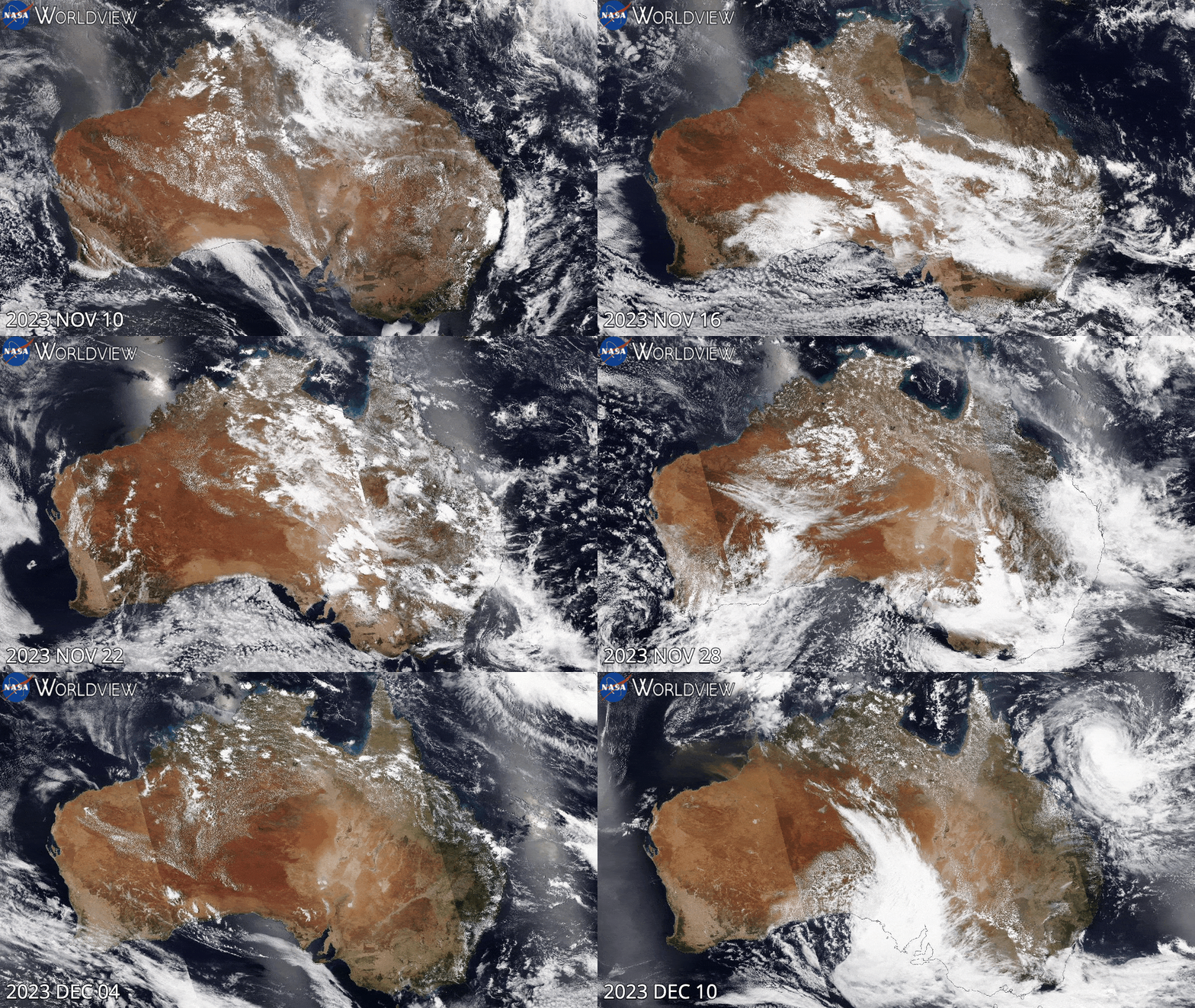
There's a saying among eclipse chasers: "Climate is what you expect; weather is what you get." Although you can maximize your chances of finding a clear sky if you're mobile, some regions have higher chances than others.
Inland Namibia is a good bet, with even the capital, Windhoek, having a cloudy day on Nov. 25 only 23% of the time since 2000, according to Timeanddate.com. Between Windhoek and the Skeleton Coast, there's a very low risk of clouds, but that changes dramatically on the coast itself.
Botswana has a very low chance of clouds. In the North West region of South Africa, there's around a 33% chance of a cloudy day. As you approach Durban, however, those odds rise to an alarming 67%. In Australia, Streaky Bay on the southern coast has a 48% chance of clouds, but the odds are about 33% for the rest of the track.
Where to see the partial solar eclipse on Nov. 25, 2030

A partial solar eclipse will be visible from central and southern Africa, the Indian Ocean, Australia and New Zealand. Here's what will be seen from major cities and destinations in the partial eclipse zone:
Location |
Percentage of the sun's disk covered |
Maseru, Lesotho |
98% |
Johannesburg, South Africa |
97% |
Brisbane, Australia |
96% |
Gaborone, Botswana |
95% |
Alice Springs, Australia |
95% |
Mbabane, Eswatini |
92% |
Maputo, Mozambique |
89% |
Kerguelen Islands |
82% |
Sydney, Australia |
79% |
Perth, Australia |
76% |
Melbourne, Australia |
75% |
Cape Town, South Africa |
71% |
Adelaide, Australia |
70% |
Heard and McDonald Islands |
68% |
Luanda, Angola |
61% |
Hobart, Australia |
58% |
Antananarivo, Madagascar |
41% |
Saint-Paul, Reunion |
37% |
Broome, Australia |
36% |
Queenstown, New Zealand |
33% |
Port Louis, Mauritius |
31% |
Darwin, Australia |
29% |
After Nov. 25, 2030, when is the next total solar eclipse?
After the total solar eclipse on Nov. 25, 2030, these are the dates and locations for the next total solar eclipses:
- Nov. 14, 2031: Pacific Ocean (hybrid-totality) and Panama (hybrid-annularity)
- March 30, 2033: Russia and the U.S. (Alaska)
- March 20, 2034: Benin, Nigeria, Cameroon, Chad, Sudan, Egypt, Saudi Arabia, Kuwait, Iran, Afghanistan, Pakistan, India and China
- Sept. 2, 2035: China, North Korea and Japan
- July 13, 2037: Australia
- Dec. 26, 2038: Australia and New Zealand
- Dec. 15, 2039: Antarctica
Additional resources
You can find a concise summary of solar eclipses out to 2030 on NASA's eclipse website. Read more about solar and lunar eclipses on EclipseWise.com, a website dedicated to predictions of eclipses, and find beautiful maps on eclipse cartographer Michael Zeiler's EclipseAtlas.com, as well as interactive Google Maps on Xavier Jubier's eclipse website and Timeanddate.com's Eclipse Central hub. You can see climate and weather predictions by meteorologist Jay Anderson on Eclipsophile.com and get photography advice from expert eclipse photographer Alan Dyer at AmazingSky.com.
Bibliography
Bakich, M. and Zeiler, M. (2022). Atlas Of Solar Eclipses 2020-2045.
https://www.greatamericaneclipse.com/books/atlas-of-solar-eclipses-2020-to-2045
Jubier, X. (n.d.). Solar eclipses: Interactive Google Maps. Retrieved Jun. 24, 2025, from http://xjubier.free.fr/en/site_pages/SolarEclipsesGoogleMaps.html
NASA Worldview application, part of the NASA Earth Science Data and Information System (ESDIS). Retrieved Jun. 24, 2025 from https://worldview.earthdata.nasa.gov
Time and Date. (n.d.). Nov. 25, 2030 Total Solar Eclipse. Retrieved Jun. 24, 2025, from https://www.timeanddate.com/eclipse/solar/2030-november-25