


Annular 'ring of fire' solar eclipse February 2026: Live updates
The first solar eclipse of the year was on Feb. 17, 2026. Here's what you need to know.

Countdown begins: Feb. 17’s annular solar eclipse is just over a week away

We're just over a week away from the first solar eclipse of 2026! An annular solar eclipse will take place on Feb. 17, 2026. During this dramatic event, the moon will slide in front of the sun but won't cover it completely, leaving a glowing 'ring of fire' around the edges. That dramatic view will only be visible from a remote part of Antarctica, where up to 96% of the sun will be eclipsed for a little over 2 minutes — meaning very few people on Earth will witness annularity in person.
More people will see a partial solar eclipse, with the moon covering a smaller portion of the sun across Antarctica, parts of southern Africa and the southern tip of South America.
To find out more, check out our annular solar eclipse 2026 guide.

One week to go! We're ready, are you?

We're just one week away from the first solar eclipse of 2026! Here's what you need to know before a dramatic "ring of fire" annular eclipse darkens the sky over Antarctica on Feb. 17, likely confusing millions of penguins.
Read more: 1 week until an annular solar eclipse turns the sun into a 'ring of fire' over Antarctica
Where will the annular solar eclipse be visible from?

The first solar eclipse of 2026 will be a dramatic annular solar eclipse on Feb. 17. The downside for most of us is that the stunning 'ring of fire' will be witnessed by more penguins than people.
Stretching 2,661 miles (4,282 kilometers) long and 383 miles (616 km) wide, the path of annularity — where the 'ring of fire' will be visible — cuts across western Antarctica and skims the Davis Sea coast of the Southern Ocean.
Read more: Where will the annular solar eclipse be visible on Feb. 17?

What happens during the annular solar eclipse?

An annular solar eclipse occurs when the moon passes directly in front of the sun's disk during the new moon phase while at a distant point from Earth in its elliptical orbit. Around this time, the lunar disk appears slightly smaller than the sun in Earth's sky. As a result, a sliver of the sun can be seen surrounding the moon during annularity — the equivalent to totality during a total solar eclipse.
Read more: Here's what will happen during each phase of the Feb. 17 'ring of fire' annular solar eclipse

Why do solar and lunar eclipses come in pairs?

Eclipses often feel like sudden, one-off spectacles, appearing out of nowhere after months of familiar moon phases. In reality, they arrive in predictable pairs during brief periods called eclipse seasons. The next one runs from Feb. 17 to March 3, 2026, bringing both a solar and a lunar eclipse. Here we explore why.
Read more: Why solar and lunar eclipses come in pairs — and what an eclipse season really is
Want to know more about the annular solar eclipse?

On Feb. 17, 2026, a dramatic annular solar eclipse will trace a narrow path across Antarctica, briefly turning the sun into a burning "ring of fire" as the moon passes almost completely in front of it. While only a handful of humans will see the full effect, much of Antarctica, along with parts of southern Africa and South America, will experience a partial solar eclipse, as the lunar disk occults a smaller section of the solar orb.
Read more: Annular solar eclipse 2026: Everything you need to know about the 'ring of fire'
Annular solar eclipse T-2 days

On Feb. 17, an annular solar eclipse will transform the sun into a breathtaking "ring of fire." To mark this precise celestial alignment — and the orbital choreography behind it — here are three fascinating facts about solar eclipses you might not know.
1 - Not all "ring of fire" eclipse look the same
The thickness of the glowing ring depends on how far the moon is from Earth. During this annular solar eclipse, the moon will be near its farthest point, making the ring appear especially bright and narrow.
2 - Eclipses only happen during short seasonal windows
Even though we get a new moon every month, eclipses are only possible during eclipse seasons, which occur roughly twice a year when the moon's orbit lines up with the sun and Earth.
3 - Solar eclipses are slowly changing over time
The moon is drifting away from Earth at about 1.5 inches (3.8 centimeters) per year. Far in the future, total solar eclipses will disappear, leaving only annular and partial solar eclipses behind.
What time is the annular solar eclipse?

An annular solar eclipse will turn the sun into a dramatic "ring of fire" on Feb. 17, as the moon passes between Earth and the sun, leaving a thin outer ring of sunlight visible. This striking "ring of fire" effect will last up to 2 minutes and 20 seconds on the path of annularity.
Read more: What time is the annular solar eclipse on Feb. 17?
Today is the day!

Today (Feb. 17), an annular solar eclipse will commence its journey across a remote region of Antarctica, where it will be visible to more penguins than people. The partial solar eclipse portion of the event will be visible to observers in parts of southern Africa and the southern tip of South America.
We'll be keeping you all up to date with everything annular solar eclipse throughout the day, so stay tuned!
Eclipse begins: Partial phase starts

The annular solar eclipse has begun! The moon has started to move in front of the sun, marking the start of the partial phase over Antarctica and parts of the Southern Hemisphere.
If you're outside these regions, you won't see the eclipse directly — this event is playing out over some of the most remote parts of Earth. As such, we'll be using imagery from previous eclipses to show what's happening in the skies over Antarctica.
Read more: Where will the annular solar eclipse be visible?
Eclipse deepens

The moon is covering more of the sun as the partial eclipse deepens across Antarctica and the surrounding southern oceans.
The most dramatic stage of this eclipse is still to come — but it will only be visible from Antarctica.
What would the eclipse look like from the south pole?

Earth's south pole sits outside of the path of annularity for the Feb. 17 eclipse, so a person sitting there watching it unfold wouldn't get to see the dramatic "ring of fire" visible to those in Concordia research station, for example, at the height of the event.
Instead, you would witness a partial eclipse culminating at 6:24 a.m. EST (1124 GMT), when the moon's silhouette occults the upper section of the solar disk, leaving a smiling crescent to shine out from beneath Earth's natural satellite.
Annularity begins (Antarctica)

Annularity has begun. From remote regions of Antarctica, the moon now appears slightly smaller than the sun, creating a thin "ring of fire" around its edges.
This phase is not visible from anywhere else on Earth.
Maximum eclipse

This is the peak of the annular solar eclipse. The alignment between the sun and moon is at its closest, producing the most complete "ring of fire" during this event over Antarctica.
Outside the path of annularity, the eclipse remains partial or not visible.
A live view of the partial eclipse
You can stream a live view of the eclipse from outside the corridor of annularity courtesy of the South African National Space Agency (SASNA)'s YouTube channel. From South Africa, the moon's silhouette will appear to take a "bite" out of our parent star as it skims left-to-right across the upper edge of the solar disk.
Annularity ends

The annular phase is now over. The moon has begun to move away from its central alignment with the sun and the ring of fire wanes over Antarctica.
Elsewhere, the eclipse continues only as a partial event.
Partial solar eclipse winds down

The moon continues to slide away from the sun, which appears as an ever thickening crescent as the partial eclipse gradually ends across Antarctica and parts of the Southern Hemisphere.
Eclipse ends

The moon has now fully cleared the sun's disk, bringing the remote annular solar eclipse to a close — likely with no-one on hand to witness its final act. Why not check out our wrap article below for a recap of events and to discover what lies ahead!
An epic eclipse seen from space
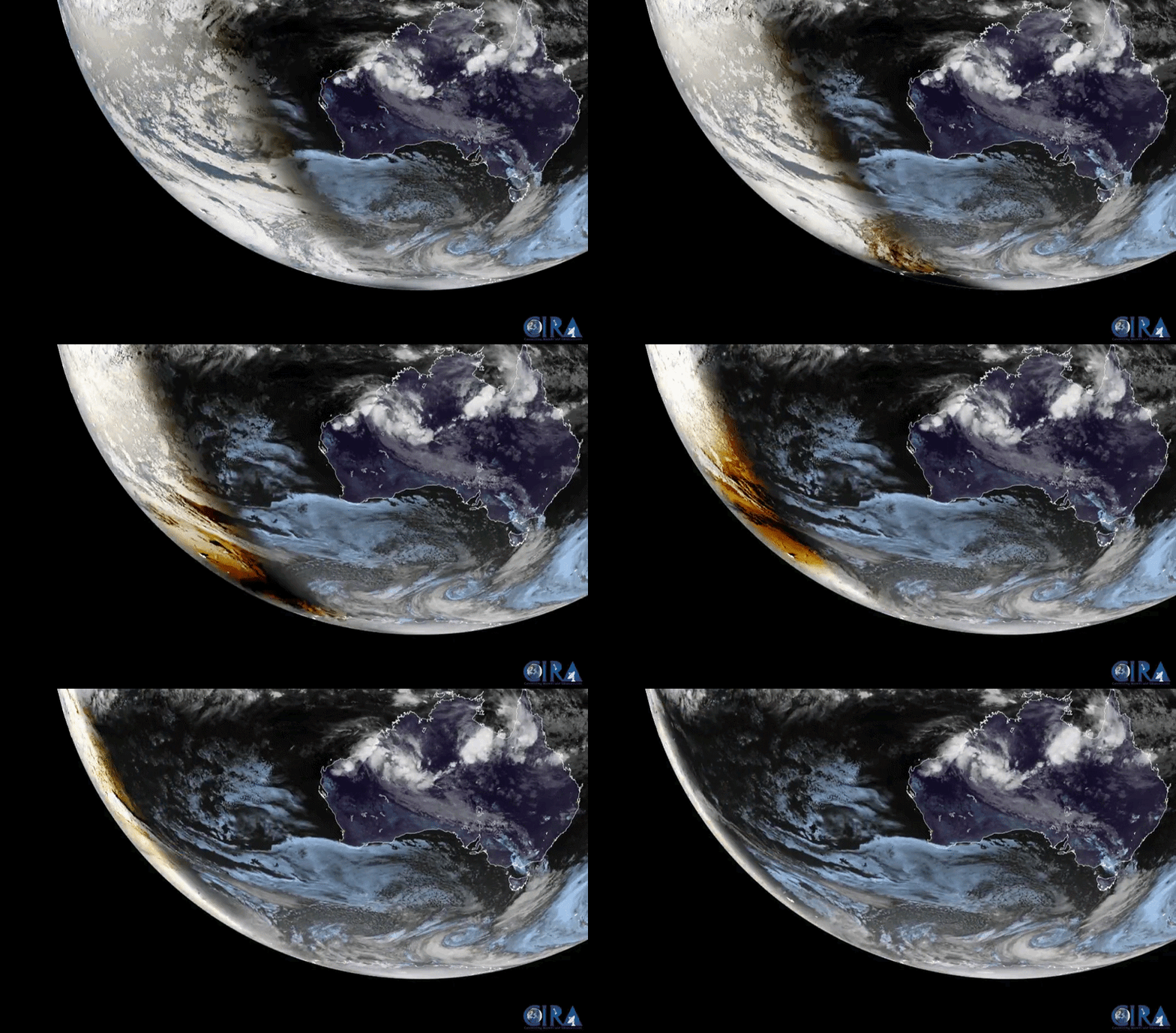
Thanks for joining us as we tracked this remote annular eclipse across Antarctica! While views from the ground were (understandably) scarce, we did get stunning orbital imagery of the moon's colossal shadow as it swept over the frozen continent from space!
Be sure to stick with us for all the latest news, viewing tips and more for the upcoming "blood moon" total lunar eclipse on March 3, phases of which will be visible from Australia, New Zealand, East Asia, parts of the Pacific and North America. That'll be followed by a total solar eclipse on Aug. 12, which will sweep through Greenland, Iceland, Portugal, Spain and Russia, while treating a wider swathe of the northern hemisphere to a lesser partial eclipse!