Editor's note: The first supermoon of 2025 has come and gone, putting on a dramatic display as it loomed large over the eastern horizon at sunset on Oct. 6, before soaring high to flood the night sky with its reflected light.
Check out our wrap article to see a collection of the best photos of the Harvest Supermoon, as captured through the lenses of the global astrophotography community!
The October Full Moon, also known as the Harvest Moon or Hunter's Moon, rises today, marking the first supermoon of the year.
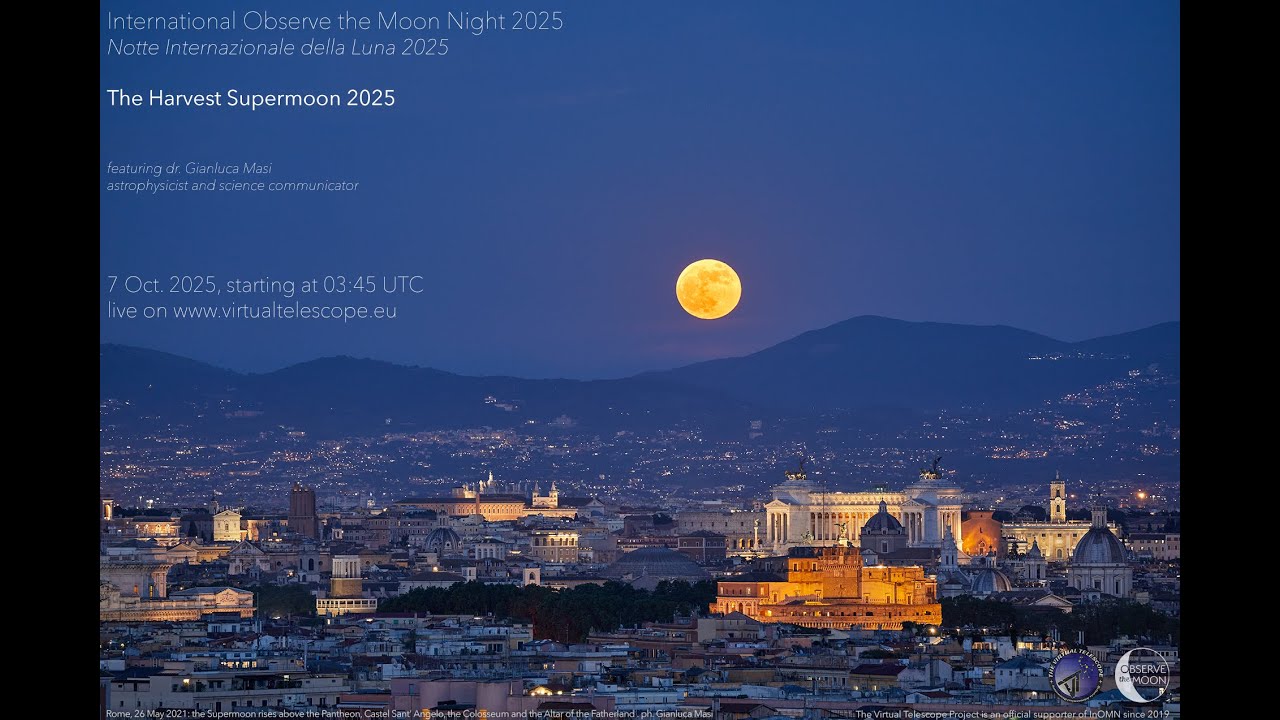
You can watch the lunar spectacle live online thanks to a free livestream from astronomer Gianluca Masi and his Virtual Telescope Project in Manciano, Italy. The webcast begins at 11 p.m. EDT (0300 GMT on Oct. 7), and you can watch it live here on Space.com (via the video above) or directly on the Virtual Telescope Project's WebTV or YouTube channel, weather permitting.
"At The Virtual Telescope project, we love sharing live views of our satellite: the upcoming supermoon is a wonderful opportunity to invite our community to look up, the first step to discover the wonderful universe where we live," Masi told Space.com in an email.
Why is this full moon special?
October's full moon occurs at 11:48 p.m. EDT on Oct. 6 (0348 GMT Oct. 7), when the moon lies opposite the sun in Earth's sky and appears fully illuminated. Known as the "Harvest Moon," this lunar event takes its name from the time of year when farmers traditionally harvested crops under the bright glow of the moonlight following the autumn equinox.
While the moment of full illumination is the same worldwide, moonrise and set times vary depending on your location. For example, in New York City, the Harvest Moon will rise at about 6:08 p.m. EDT and set the following morning at around 7:25 a.m. In Los Angeles, moonrise is later, at about 6:29 p.m. PDT (9:29 p.m. EDT), while in London, the full moon rises at 6:20 p.m. BST (1720 GMT).
This month's moon is also a supermoon, appearing slightly larger and brighter than a typical full moon because the moon is near perigee, its closest point to Earth in its orbit. While the size difference is subtle, supermoons are always a treat to watch — especially near the horizon, where the moon can appear even larger due to the "moon illusion".