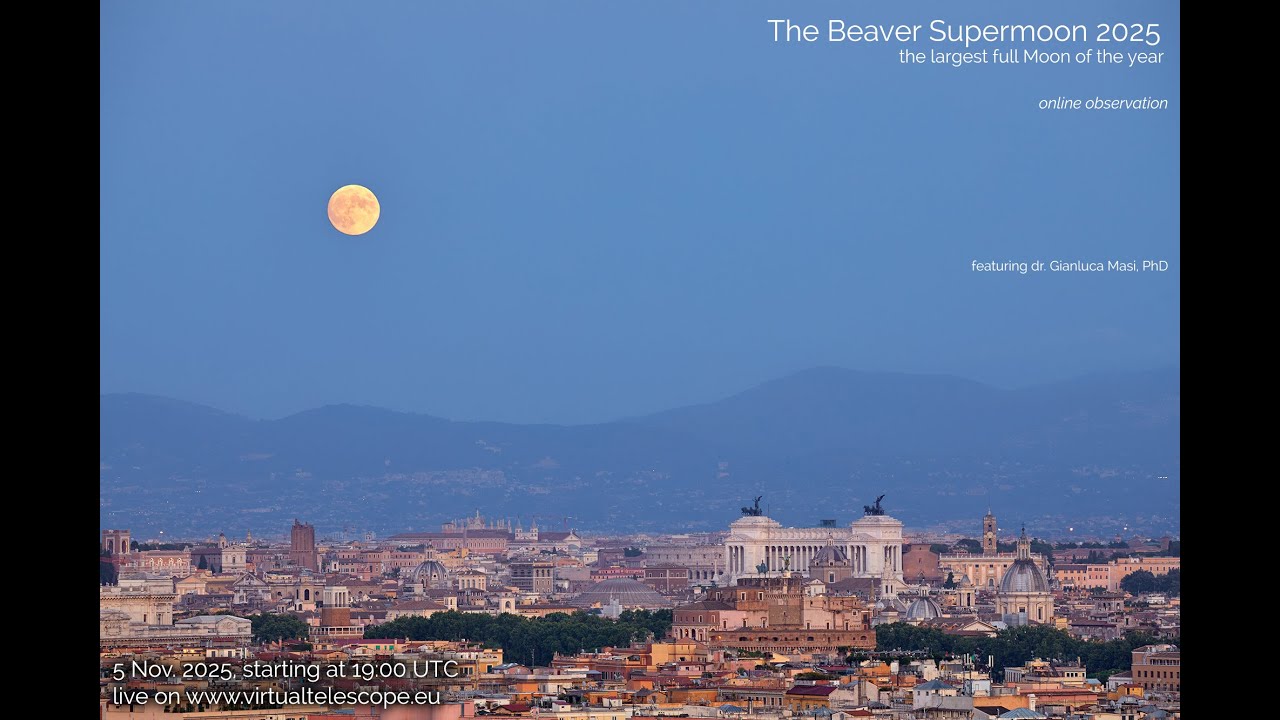
The November full moon, also known as the Beaver Moon or Frost Moon, rises today, marking the biggest and brightest full moon of 2025.
You can watch the supermoon live online thanks to a free livestream from astronomer Gianluca Masi and his Virtual Telescope Project in Manciano, Italy. The webcast begins at 2 p.m. EST (1900 GMT) on Nov. 5, and you can watch it live here on Space.com (via the video above) or directly on the Virtual Telescope Project's WebTV or YouTube channel, weather permitting.
"We will be observing it from Manciano, Italy, where our facility is based," Masi told Space.com in an email. "Also, we will show the best full Moon images we collected over the years, particularly those with our satellite shining above the legendary monuments and skyline of Rome".
Why is this full moon special?
The moon reaches its full phase at 8:19 a.m. EST (1319 GMT) on Nov. 5. Later the same at 5:30 p.m. EST (2230 GMT), it hits perigee — its closest point to Earth of the year — at a distance of 221,726 miles (356,833 kilometers). The close timing makes tonight's Beaver Moon a supermoon and the largest apparent full moon of 2025. It will appear about 6% larger and 16% brighter than an average full moon, a subtle difference that many casual observers won't notice.
Even so, supermoons are still a treat to watch, especially near the horizon, where the moon illusion can make the disk look dramatically larger.
If you're looking for a telescope or binoculars to observe the moon, our guides for the best binoculars deals and the best telescope deals now can help. Our best cameras for astrophotography and best lenses for astrophotography can help you get ready to capture the next stunning skywatching event.
Editor's Note: If you snap a photo of the moon and would like to share it with Space.com's readers, send your photo(s), comments, and your name and location to spacephotos@space.com.