British amateur astronomer, Sir Patrick Moore, used to say that the best first telescope isn’t a telescope at all — it’s a pair of binoculars. Telescopes are wonderful — the things you can see through them can be jaw-dropping — but they can so easily extinguish enthusiasm for the night sky.
Telescopes can take a beginner’s eyes from the sky at the wrong time by requiring attention to technology, like aligning optics, finding objects, fussing with eyepieces and battery changes.
However, binoculars are instant — and they’re portable. You pick them up, point them at the night sky, and the constellations you thought you knew suddenly reveal an extra layer of stars, clusters and nebulas you could never hope to see with the naked eye.
Why 10x50 is the sweet spot for stargazing

Binocular specs are written as two numbers, such as 10x50. The first is the magnification (also called power); 10x is 10 times bigger than what the naked eye sees. The second, 50mm, is the diameter of the objective (front) lenses in millimetres — the aperture, which controls how much light they collect and, therefore, how bright the image is.
There are several power-aperture combinations sold as astronomy binoculars, including 10x42 (10x magnification and 42 mm lenses) and 15x70 (15x magnification and 70 mm lenses). The former is more portable than, but not as bright as, a pair of 10x50 binoculars, while the latter is much heavier and harder to hold steady. That’s the problem in a nutshell because for stargazing, you’re trying to marry magnification and brightness in a way your hands can actually cope with.
Here’s why 10x50 is the classic spec for stargazing binoculars:
• 10x magnification is enough to split double stars, bring out lunar craters and reveal structure in bright nebulas. Go any higher, and the shake in your body will make them virtually unusable.
• 50mm objective lenses collect a generous amount of light — enough to see faint star clusters, nebulas and even some galaxies — without the binoculars being too heavy to hold steady.
Those after ultimate portability might think 8x25 or 10x25 binoculars are perfect for travel, but in low light, their tiny apertures struggle. Meanwhile, for spectacular close-ups of objects, 15x70, 18x50 or 20x80 binoculars hugely impress, but they’re so shaky that they need to be mounted on a tripod — which puts them on a par with a telescope.
Image-stabilized binoculars for astronomy

Here’s something to think about if you get obsessed with binocular astronomy and want to upgrade. Image-stabilized binoculars get rid of vibrations, using motion sensors to detect hand shake and then shifting actuators around the lenses to cancel it out. At 10x or 15x magnification, the effect is incredible — a click of the button freezes the night sky and makes the details much easier to see.
Image-stabilized binoculars are a game-changer for astronomy, but they’re very expensive — ordinary 10x50s will show you more than enough in the night sky during your first years of stargazing.
Why binoculars beat a telescope
If you’re more interested in stargazing than gadget-gazing, binoculars are exactly what you need. Compared to a telescope, binoculars give you four advantages:
1. You can take them everywhere

You can put them in a daypack, keep them in the car or hang them by the door for opportunistic clear nights. You can take them on holiday — perhaps the only time you ever get under a truly dark sky — without thinking about it. A telescope, by contrast, typically stays at home.
2. You see the sky the right way up

Binoculars give an upright, stereo view that matches what you see with the naked eye and what’s on your star chart or app. That makes learning the sky straightforward. Telescopes often invert or mirror the image, which easily confuses beginners, who are forced to scan a night sky they don’t know in an unnatural way.
3. You get a wide field of view

Binoculars frame some objects beautifully. The Pleiades (M45) look exquisite in binoculars — an entire sparkling cluster of stars in the same field of view — whereas a telescope can magnify them so much that the pattern falls apart. Depending on the object, binoculars can be superior to a telescope.
4. They’re easy to aim and focus

You point them at the night sky and tweak a single focus wheel. No finder alignment, no fuss. You spend your time in the sky, not on the kit. That said, it pays to make a quick diopter adjustment before you use binoculars, using the wheel on one of the eyecups to average out any differences between your eyes.
How to use binoculars for astronomy
Before you head out, take a minute to set your binoculars up properly with these simple steps, and then read our more in-depth guide to stargazing with binoculars.
• Adjust the hinge so both barrels line up comfortably with your eyes.
• Close one eye and focus on a distant object using the center focus wheel.
• Use the diopter ring on one eyepiece to fine-tune the other eye, averaging out your vision.
With your binoculars calibrated, hold them up to the night sky, keeping your elbows in to your chest to increase stability — and definitely not outstretched, where they will get tired. It also helps to sit in a lawn chair, resting your arms on the armrests and leaning back to avoid neck strain.
Another special skill for binocular astronomers that isn’t intuitive is averted vision. While your direct vision is good with detail, your peripheral vision is more sensitive to light — and for “faint fuzzies,” that’s crucial. So look slightly to the side of a faint nebula or star cluster, rather than straight at it, to appreciate its brightness.
Five binocular targets for January and February
In January and February, the evening sky is tailor-made for 10x50 binoculars, whether you’re in the Northern or Southern Hemisphere (though visibility may vary by location). Here are five easy, spectacular targets to get you started:
1. The Moon

Scan along the terminator, the line between day and night on the lunar surface, and you’ll see jagged crater rims, long shadows and bright mountain peaks catching the morning sun.
2. The Pleiades (M45)
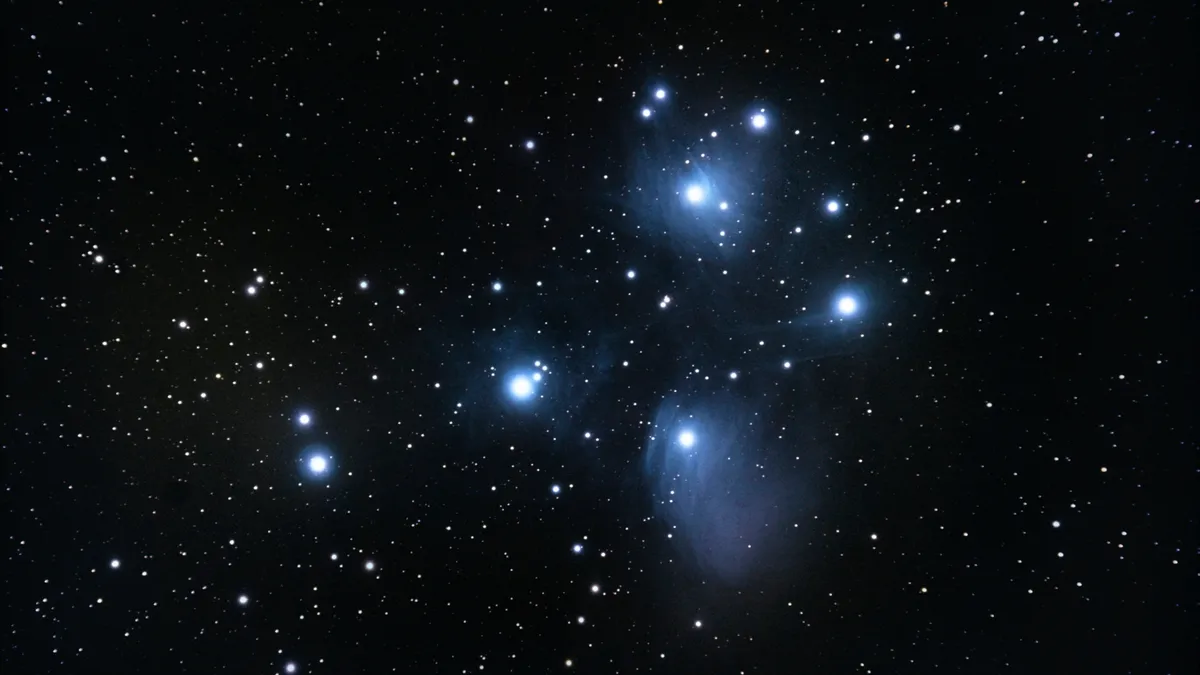
High in Taurus, the Pleiades are the definitive binocular object. To the naked eye, you might see six or seven stars; in 10x50s, the cluster blossoms into dozens, sparkling against a dark background. The Pleiades are the textbook example of why binoculars beat a telescope eyepiece for some targets.
3. Orion’s Sword and the Orion Nebula (M42)

Find Orion’s Belt, then drop down to the fainter line of stars in Orion’s Sword. In its center is the Orion Nebula, a glowing patch of light. In binoculars, you’ll see a wing-shaped mist with a knot of newborn stars (called the Trapezium) at its center.
4. The Hyades and Aldebaran
Between the Pleiades and Orion is the Hyades open star cluster, which forms a “V” that marks the head of the constellation Taurus. In 10x50s, you’ll see the cluster’s dozen or so brightest members.
5. Sirius and M41
Follow Orion’s Belt down toward the horizon, and you always come to Sirius, the brightest star in the night sky, in the constellation Canis Major. Put Sirius in the center of the field of view, then scan slightly down toward the horizon. You’ll notice a small, grainy patch — M41, an open cluster of around 100 stars.
A pair of 10x50s, a clear evening and a short hit-list of bright objects. Master those, and you’ll have not only seen some of the finest sights the winter sky can offer, but also learned the patterns that will make every future telescope easier — and far more rewarding — to use.