Northern lights forecast - Aurora season winds down as summer twilight takes over
Persistent twilight is making aurora viewing increasingly difficult across the northern latitudes, bringing our nightly forecast updates to a seasonal close until autumn.

Our aurora forecast live blog tells you everything you need to know about the likelihood of seeing the northern lights tonight and for the days ahead.
We'll also report on relevant solar activity and significant space weather events such as coronal mass ejections (CMEs) and coronal holes, which could bring strong aurora-sparking solar winds our way.
REMEMBER: The Kp index is important, with a higher Kp indicating stronger auroral activity. A key ingredient of aurora activity is the Bz value of the Interplanetary Magnetic Field, which can be easily viewed on SpaceWeatherLive.com. You're ideally looking for a strong "south" Bz which means it will connect with Earth's magnetosphere which points northward. A strong southward Bz can wreak havoc with Earth's magnetic field and send particles raining down through the atmosphere along magnetic field lines. When these energized particles collide with atoms in Earth's atmosphere they release the light we see as auroras. If there is a strong southward Bz, your chances of seeing auroras increase significantly.
Best year for auroras | Aurora colors | Aurora myths | Where to see

Daisy Dobrijevic is an experienced writer and aurora enthusiast, having authored numerous guides on the northern lights, including topics such as "What are the northern lights?" and "Where are the best places to see them?" Her expertise is rooted in firsthand experience from multiple aurora-chasing adventures. She has explored the Arctic Circle extensively, including Norway's dramatic coastline with Hurtigruten, Sweden's renowned Abisko National Park, and the stunning Vesterålen archipelago in Norway.
You can join Daisy on a Norwegian northern lights voyage with Hurtigruten in January 2027, where she will be the onboard astronomer for one of the sailings.
Monday, Nov. 8: Quiet sun but aurora sightings possible at high latitudes
Today there is a good possibility of seeing the northern lights at high latitudes primarily above the Arctic Circle. A maximum Kp of around 3 Kp is predicted for tonight from around 1:00 - 7:00 p.m. EST (1800-0000 GMT), according to the National Oceanic and Atmospheric Administration (NOAA)'s Space Weather Prediction Center. This could bring unsettled aurora activity in high latitudes.
A large Earth-facing coronal hole could also bring an increase in geomagnetic activity over the coming days. When directed at Earth, the stream of solar wind flowing from a coronal hole can impact Earth's magnetosphere, triggering geomagnetic storm conditions and resulting in impressive aurora displays.
The sun has been rather quiet of late, but if it unleashes a powerful solar flare (either M or X class) accompanied by a coronal mass ejection (CME) in the coming days, we could be in for an aurora treat. CMEs are large plumes of plasma and magnetic field that erupt from the sun. When they collide with Earth they can trigger geomagnetic storms which in turn lead to dramatic auroras.
Current solar flare predictions for today courtesy of SpaceWeatherLive.com
M-class solar flare: 50%
X-class solar flare: 10%
Tuesday, Nov. 19: Low Kp predicted but active sun could spell good conditions for later in the week
Today there is still a good chance of seeing the northern lights at high latitudes primarily above the Arctic Circle, despite lower Kp predictions compared to yesterday. A maximum Kp of around 2 is predicted for tonight from around 4 - 7 p.m. EST (2100-0000 GMT), according to the National Oceanic and Atmospheric Administration (NOAA)'s Space Weather Prediction Center. This could bring unsettled aurora activity in high latitudes.
A large coronal hole continues to face Earth and may trigger increased geomagnetic activity over the coming days. When directed at Earth, the stream of solar wind flowing from a coronal hole can impact Earth's magnetosphere, triggering geomagnetic storm conditions and resulting in impressive aurora displays.
The sun appears to be "waking up" from a brief hiatus in solar activity, unleashing nine M-class solar flares yesterday. A majority of the flares originated from a newly emerging sunspot group AR3901. The sunspot is turning toward Earth which means if it unleashes a powerful solar flare (either M or X class) accompanied by a coronal mass ejection (CME) in the coming days, we could be in for an aurora treat. CMEs are large plumes of plasma and magnetic field that erupt from the sun. When they collide with Earth they can trigger geomagnetic storms which in turn lead to dramatic auroras.
Current solar flare predictions for today courtesy of SpaceWeatherLive.com
M-class solar flare: 55%
X-class solar flare: 10%

Wednesday Nov. 20: Auroras possible at high latitudes despite relatively quiet sun
Even with low Kp predictions, there’s still a good opportunity to spot the northern lights today at high latitudes, particularly in areas above the Arctic Circle.
A maximum Kp of around 1.7 is currently predicted for tonight from around 7-10 p.m. EST (0000-0300 GMT on Nov.21), according to the NOAA's Space Weather Prediction Center.
Tonight's aurora activity could also be fuelled by a significant coronal hole that remains pointed toward Earth. Solar wind streams from coronal holes can interact with the planet's magnetosphere, potentially causing geomagnetic storms and creating stunning aurora displays. So while the Kp index is low, there is still a possibility of a nice show at high latitudes this evening.
While geomagnetic activity is forecasted to remain relatively low in the coming days, this could quickly change with the eruption of a coronal mass ejection (CME), potentially resulting in striking auroral displays. CMEs are enormous eruptions of plasma and magnetic energy released from the sun, often associated with powerful solar flares. Upon reaching Earth, they can induce geomagnetic storm conditions that give rise to breathtaking auroras. We will be sure to update you if any eruptions give rise to Earth-directed CMEs!
Current solar flare predictions for today courtesy of SpaceWeatherLive.com
M-class solar flare: 50%
X-class solar flare: 10%

Thursday, Nov. 21: Quiet aurora activity but conditions improving
Despite low Kp predictions, there’s still a possibility to see the northern lights today at high latitudes, particularly in areas above the Arctic Circle.
A maximum Kp of around 2 is currently predicted for tonight from around 7-10 p.m. EST (0000-0300 GMT on Nov.22), according to the NOAA's Space Weather Prediction Center. Kp's of 2 are not uncommon but it is a slight improvement on yesterday's forecast.
We could see a slight bump in aurora activity by the Earth-directed coronal hole that is currently present on the sun. However, it has shrunk significantly in the last few days and will not face Earth for much longer. But we constantly monitor the sun for other significant coronal hole formations. Solar wind streams from coronal holes can interact with the planet's magnetosphere, potentially causing geomagnetic storms and creating stunning aurora displays.
We could see a better aurora forecast tomorrow with maximum Kps of around 3 currently predicted.
While the forecast is still not too promising we need to remember that this can all change very quickly if the sun erupts with a coronal mass ejection (CME). CMEs are powerful eruptions of plasma and magnetic field from the sun, when Earth-directed they can slam into our magnetosphere and trigger geomagnetic storm conditions which in turn can lead to fantastic aurora displays. CMEs often accompany powerful solar flare eruptions (M or X class) so we will be sure to update you if any eruptions give rise to Earth-directed CMEs!
Current solar flare predictions for today courtesy of SpaceWeatherLive.com
M-class solar flare: 50%
X-class solar flare: 10%

Tonight and the weekend
Quiet aurora and dramatic farside eruption from the sun
The current forecast for tonight and over the weekend suggests it's likely to see the northern lights at high latitudes, particularly in areas above the Arctic Circle.
Over the weekend a maximum Kp of around 3 is currently predicted for Saturday night (Nov. 23) according to the NOAA's Space Weather Prediction Center. To get a thorough breakdown of the latest Kp predictions from Nov. 22. to Nov. 24, visit NOAA's 3-day forecast.
Keep in mind, that the sun is rather fickle and can change in an instant. Just when it seemed a bit too quiet, the sun erupted with a massive farside coronal mass ejection (CME). Unfortunately for aurora enthusiasts, the eruption on Nov. 21 doesn’t appear to have an Earth-directed component.
CMEs are powerful eruptions of plasma and magnetic field from the sun, when Earth-directed they can slam into our magnetosphere and trigger geomagnetic storm conditions which in turn can lead to fantastic aurora displays
While the CME was not Earth-directed, the eruption did cause the most energetic solar radiation storm since at least 2005 according to Space Weather Physicist Tamitha Skov.
"This means it was a BIG eruption. Likely launched from Region 3889 or 3897 on the Sun's farside, this #solarstorm doesn't appear to have any Earth-directed component. We can tell because the coronal wave stays localized near the west limb." Skov wrote in a post on X.
This eruption has caused the most energetic solar #RadiationStorm since the 2005 or possibly the 2003 Halloween events (i.e. very hard spectrum). This means it was a BIG eruption. Likely launched from Region 3889 or 3897 on the Sun's farside, this #solarstorm doesn't appear to… https://t.co/3xnw3VYPlj pic.twitter.com/Q43XgLLQD4November 21, 2024
The recent eruption reminds us that the sun can always throw up surprises. While the current weekend forecast doesn't look overly promising for dramatic auroras that can all change very quickly. We'll keep you updated on any significant developments or incoming CMEs.
Low predicted activity but a new explosive player may be entering the game in coming days
A maximum Kp of around 1.7 is currently predicted for tonight according to the NOAA's Space Weather Prediction Center. Despite low Kp predictions, there’s still a possibility of seeing the northern lights today at high latitudes, particularly in areas above the Arctic Circle.
In recent days, significant solar activity has predominantly occurred on the far side of the sun. On Nov. 21, a massive coronal mass ejection (CME) erupted, triggering the most powerful solar radiation storm recorded since at least 2005. Additionally, earlier this morning at 2:30 a.m. EST (0730 GMT), the sun unleashed an M9.45-class solar flare from a region just beyond the northeast limb. This active region, which nearly produced an X-class flare, is expected to rotate into Earth’s view within the next few days, potentially making any subsequent eruptions Earth-directed.
While the current forecast is not too promising, remember that this can change rapidly if the sun erupts with a coronal mass ejection (CME). CMEs are powerful eruptions of plasma and magnetic field from the sun, when Earth-directed they can slam into our magnetosphere and trigger geomagnetic storm conditions which in turn can lead to fantastic aurora displays. CMEs often accompany powerful solar flare eruptions (M or X class) so we will be sure to update you if any eruptions give rise to Earth-directed CMEs!
Current solar flare predictions for today courtesy of SpaceWeatherLive.com
M-class solar flare: 55%
X-class solar flare: 15%

Aurora conditions improving and possible Earth-directed solar storm
Finally, some promising aurora news! A coronal mass ejection (CME) erupted from the sun on Nov. 25 and may deliver a glancing blow to Earth in time for the Thanksgiving holidays.
CMEs are powerful eruptions of plasma and magnetic field from the sun, when Earth-directed they can slam into our magnetosphere and trigger geomagnetic storm conditions which in turn can lead to impressive auroras.
The eruption from sunspot region 3901 could result in a glancing blow impact predicted for around Nov. 28.
"Waiting for coronagraph imagery to confirm, but we might get some #aurora over the Thanksgiving holiday!" Space Weather Physicist Tamitha Skov wrote in a post on X.
Finally, a potentially Earth-directed #solarstorm! After a lot of eye-candy in all directions from our Sun, Region 3901 fires an M-flare and launches a storm towards us! waiting for coronagraph imagery to confirm, but we might get some #aurora over the Thanksgiving holiday! pic.twitter.com/7m2dQXEdRFNovember 25, 2024
And that's not all!
The active sunspot region that released an M9 (almost X)-class solar flare on Nov. 25 is currently turning into view. The region has already proven its explosive capabilities, which may become geoeffective as the region turns to face Earth toward the end of the week. Space weather scientists will be watching this region carefully.
As it stands, a maximum Kp of around 2 is currently predicted for tonight according to the NOAA's Space Weather Prediction Center. Despite low Kp predictions, there’s still a good chance of seeing the northern lights tonight at high latitudes, particularly in areas above the Arctic Circle.
Current solar flare predictions for today courtesy of SpaceWeatherLive.com
M-class solar flare: 55%
X-class solar flare: 15%

Keep your eyes skyward for possible Thanksgiving aurora!
You might have something to be extra thankful for this Thanksgiving, as the chances of aurora gracing our skies over the holiday are going up! A Nov. 25 coronal mass ejection (CME) from sunspot region 3901 is headed in our direction. The CME has resulted in a G1 (Minor) watch and a G2 (Moderate) watch for Nov. 28 and 29, respectively, according to a post on X from the NOAA Space Weather Prediction Center.

A G1 (Minor) watch has been issued for 28 Nov and a G2 (Moderate) watch was issued for 29 Nov due to the arrival of a CME associated with a filament eruption that took off the Sun late on 25 Nov. pic.twitter.com/pg1yihQdQyNovember 26, 2024
Good chance of auroras tonight and tomorrow
Good news aurora chasers! Things are looking up (and you should be too!)
A maximum Kp of around 3 is currently predicted for tonight according to the NOAA's Space Weather Prediction Center. But tomorrow night this rises close to Kp 6. NOAA has issued a geomagnetic storm watch for Nov. 28 and 29, with possible G1 and G2 conditions expected.
If G2 conditions are reached, the northern lights may be visible as far south as New York and Idaho.
You can keep up to date with the latest Kp breakdown for the next three days on NOAA's SWPC. We will update you on any significant developments here too.
We could be in for a nice aurora show over Thanksgiving as the thin waxing moon is nearing the new moon phase on Dec. 1, so moonlight will not interfere with northern lights viewing efforts. We are also in the midst of the Geminid meteor shower so when while you're out hunting auroras be sure to keep an eye out for some impressive Geminid meteors.
Current solar flare predictions for today courtesy of SpaceWeatherLive.com
M-class solar flare: 65%
X-class solar flare: 20%

Aurora alert: Thanksgiving northern lights could delight tonight
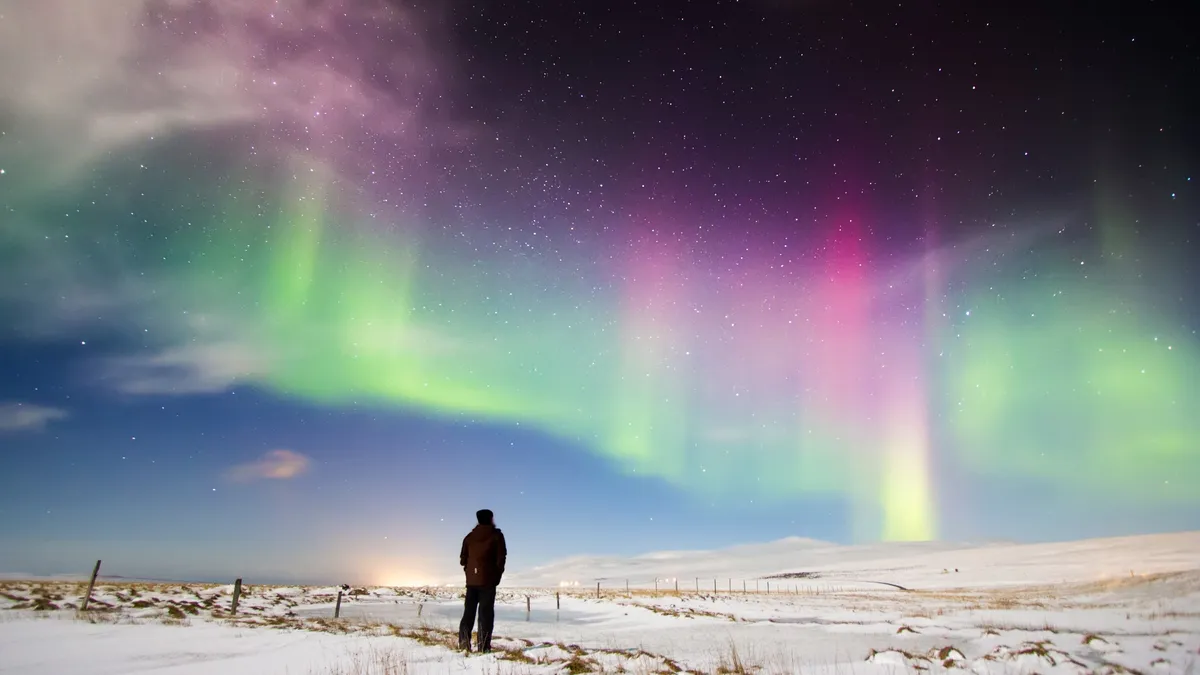
Tonight, there is a good chance of seeing the northern lights at high latitudes.
A maximum Kp of around 6 is currently predicted for tonight according to the NOAA's Space Weather Prediction Center.
NOAA's G1-G2 geomagnetic storm watch for Nov. 28 and Nov. 29 remains in place. If G2 conditions are reached, the northern lights may be visible as far south as New York and Idaho.
You can keep up to date with the latest Kp breakdown for the next three days on NOAA's SWPC. We will update you on any significant developments here too.
Visibility tonight will be good, as the thin waxing crescent moon is only 7% illuminated, providing dark skies for optimum northern lights viewing. Also, keep your eye out for the Geminid meteor shower, which is currently active.
There are a few active large sunspot regions on the sun today giving a high chance of some explosive eruptions.
Current solar flare predictions for today courtesy of SpaceWeatherLive.com
M-class solar flare: 65%
X-class solar flare: 20%

Northern lights forecast for tonight and the weekend
The aurora forecast for tonight and the weekend remains relatively positive, especially for those in high latitudes.
A maximum Kp of around 3 is currently predicted for tonight according to the NOAA's Space Weather Prediction Center.
Aurora chasers had been eagerly awaiting the arrival of a CME that left the sun on Nov. 25. Unfortunately, they were left in the dark as the CME struck Earth's magnetic field on Nov. 28 around 9:45 p.m. EST (0245 GMT on Nov. 29) but failed to spark the anticipated geomagnetic storm conditions.
According to Space Weather Physicist Tamitha Skov's recent space weather forecast on YouTube, solar weather could pick up this week as more active regions rotate into view, increasing our chances of solar storms. A good window of aurora viewing opportunities, especially at high latitudes remains over the holiday weekend.
Monday Dec. 2: Good possibility of northern lights at high latitudes
There is a good chance of seeing auroras at high latitudes tonight, with a maximum predicted Kp of 3 indicated by NOAA's Space Weather Prediction Center. The 1% illuminated new moon tonight will also provide dark skies perfect for aurora hunting and skywatching.
According to the astronomy website SpaceWeatherLive the aurora probability forecast for tonight is:
Aurora probability | Active (Kp 4) | Minor (Kp 6) | Severe (Kp >6) |
|---|---|---|---|
High latitude | 15% | 25% | 20% |
Mid latitude | 10% | 5% | 1% |
We could see a slight bump in aurora activity over the next few days as a large coronal hole turns to face Earth.
The coronal hole is visible in GOES-16 satellite imagery. We currently do not have any Solar Dynamics Observatory (SDO) imagery or data due to a flood at Standford University's Joint Center for Science Operations damaging the servers.

Solar wind streams from coronal holes can interact with the planet's magnetosphere, potentially causing geomagnetic storms and creating stunning aurora displays.

Tuesday, Dec. 3: Fair chance of northern lights at high latitudes
There is a fair chance of seeing auroras at high latitudes tonight, with a maximum predicted Kp of around 2.7, as indicated by NOAA's Space Weather Prediction Center. The 4% illuminated waxing crescent moon tonight will also provide dark skies perfect for aurora hunting and skywatching.
According to the astronomy website SpaceWeatherLive the aurora probability forecast for tonight is:
Aurora probability | Active (Kp 4) | Minor (Kp 6) | Severe (Kp >6) |
|---|---|---|---|
High latitude | 15% | 20% | 15% |
Mid latitude | 10% | 5% | 1% |
Over the next few days, we may observe a rise in aurora activity as a large coronal hole turns to face Earth.
The coronal hole is visible as a large dark patch in GOES-16 satellite imagery. We currently do not have any Solar Dynamics Observatory (SDO) imagery or data due to a flood at Standford University's Joint Center for Science Operations damaging the servers.
Read more: Broken water pipe knocks out data processing for NASA sun-studying spacecraft
Wednesday, Dec. 4: Large coronal holes could spark auroras in coming days

If you're hoping to catch a glimpse of the northern lights tonight, there's a decent chance for those at higher latitudes. According to NOAA's Space Weather Prediction Center, the aurora forecast predicts a maximum Kp index of approximately 1.7. While this is on the lower end of activity, it’s still worth keeping an eye on the skies, especially in areas with minimal light pollution.
Adding to the favorable conditions, tonight’s waxing crescent moon is just 10% illuminated. This means darker skies, offering an ideal backdrop for aurora-hunting and skywatching enthusiasts.
Over the next few days, we may observe a rise in aurora activity as two large coronal holes turn to face Earth. This is good news for aurora chasers as coronal holes release high-speed solar wind streams. When these particles interact with Earth's magnetic field they increase geomagnetic activity which in turn can spark intense auroras. We could see a rise in aurora activity by the weekend.
The coronal holes are visible as large dark patches in GOES-16 satellite imagery.
Thursday, Dec. 5: Fair chance of auroras at high latitudes, conditions improving

Today there is a good possibility of seeing the northern lights at high latitudes primarily above the Arctic Circle. A maximum Kp of around 1.7 is predicted for tonight from around 1:00 - 10:00 p.m. EST (1800-0300 GMT), according to the National Oceanic and Atmospheric Administration (NOAA)'s Space Weather Prediction Center.
A large Earth-facing coronal hole could also bring an increase in geomagnetic activity over Dec. 6 and Dec. 7. When directed at Earth, the stream of solar wind flowing from a coronal hole can impact Earth's magnetosphere, triggering geomagnetic storm conditions and resulting in impressive aurora displays.
The sun has been rather quiet of late, but if it unleashes a powerful solar flare (either M or X class) accompanied by a coronal mass ejection (CME) in the coming days, we could be in for an aurora treat. CMEs are large plumes of plasma and magnetic field that erupt from the sun. When they collide with Earth they can trigger geomagnetic storms which in turn lead to dramatic auroras.
Current solar flare predictions for today courtesy of SpaceWeatherLive.com
M-class solar flare: 30%
X-class solar flare: 5%
Northern lights forecast for tonight and the weekend
There is a good chance of auroras at high latitudes over the weekend, with a maximum predicted Kp of 3 according to NOAA's Space Weather Prediction Center.
While geomagnetic activity is forecasted to remain relatively low in the coming days, this could quickly change with the eruption of a coronal mass ejection (CME), potentially resulting in striking auroral displays. CMEs are enormous eruptions of plasma and magnetic energy released from the sun, often associated with powerful solar flares. Upon reaching Earth, they can induce geomagnetic storm conditions that give rise to breathtaking auroras. We will be sure to update you if any eruptions give rise to Earth-directed CMEs!
Monday, Dec. 9: Sporadic auroras likely this week
Expect good northern lights at high latitudes with possible heightened activity by Dec. 11.
A large coronal hole is currently facing Earth and continues to feed Earth's magnetosphere with a stream of fast-flowing solar wind triggering active aurora conditions, as reported by space weather and aurora website SolarHam in a post on X.
Coronal hole #98 is now facing Earth. A solar wind stream flowing from this zone appears to be moving past Earth. Unsettled (Kp3) to Active (Kp4) conditions will be possible should the Bz component of the IMF point south for any prolonged period of time. https://t.co/aqK4Q6XdAY pic.twitter.com/1da8my9qNBDecember 9, 2024
Yesterday (Dec. 8) the sun fired off an X-class solar flare accompanied by a coronal mass ejection (CME).
"The #solarstorm launched will graze Earth to the west. Sadly, the coming fast solar wind streams might deflect the structure even further to the west. Expect only mild impacts by midday December 11," Space Weather Physicist Tamitha Skov wrote in a post on X.
According to NOAA's Space Weather Prediction Center, the highest predicted Kp index for the next 24 hours is 2.67.
Skov took to X to post a 5-day space weather outlook, noting sporadic auroras likely at high latitudes due to fast solar wind and possible glancing blow from the CME on Wednesday.
The latest 5-Day Outlooks: Expect sporadic #Aurora at high latitudes due to a fast solar wind stream hitting now & a glancing #SolarStorm blow by Wednesday. Risks for R3-level #RadioBlackouts & #RadiationStorms remain elevated over the next 48 hours but should calm by mid-week. pic.twitter.com/dV9dUoifSbDecember 9, 2024
Tuesday Dec. 10: Great chance of auroras for those at high latitudes tonight
There is a great chance of auroras at high latitudes tonight. According to NOAA's Space Weather Prediction Center, the highest predicted Kp index for the next 24 hours is 3.67.
The large coronal hole continues to face us and feed Earth's magnetosphere with a stream of fast-flowing solar wind, which can trigger active geomagnetic conditions and impressive auroras.
Wednesday Dec. 11: Very good chance of auroras at high latitudes tonight
There is a very good chance of auroras at high latitudes tonight. According to NOAA's Space Weather Prediction Center, the highest predicted Kp index for the next 24 hours is 3.
Though a large coronal hole continues to face us and feed Earth's magnetosphere with a stream solar wind, these solar wind speeds have eased slightly in the last 24 hours according to the UK's national weather and climate service the Met Office.
We could experience unsettled geomagnetic activity by Dec. 13 due to a connection to the fast winds from another coronal hole, according to the Met Office. These could lead to sporadic active intervals of higher geomagnetic activity, so keep your eyes on the skies. You never know, you may catch a glimpse of the occasional Geminid meteor too!
Thursday Dec. 12: Fair chance of auroras at high latitudes, enhanced solar wind possible
There is a fair chance of auroras at high latitudes tonight. According to NOAA's Space Weather Prediction Center, the highest predicted Kp index for the next 24 hours is 1.67.
Enhanced solar wind could be observed on Dec. 14 through Dec. 15 due to a fast solar wind emitted from an Earth-facing coronal hole according to UK's national weather and climate service the Met Office.
A large coronal mass ejection (CME)—a vast plume of plasma and magnetic field—was released from the sun yesterday (Dec. 11). However, it emanated from the backside of the sun and so has no Earth-directed component.
Now that SOHO has backfilled the images from the far side CME we can see that it was a full halo. https://t.co/M5pb1Orh3d pic.twitter.com/J6QzAuvOsZDecember 12, 2024
Northern lights forecast for tonight and the weekend
There is a good chance of auroras at high latitudes tonight and over the weekend. According to NOAA's Space Weather Prediction Center, the highest anticipated Kp index for the next three days is 2.67, currently predicted for Dec. 15.
The rise in Kp by Dec. 14 and Dec. 15 is likely due to the fast solar wind emitted from an Earth-facing coronal hole according to the UK's national weather and climate service the Met Office.
Two M-class solar flares, the second most powerful category of solar flares, erupted from the sun on Dec. 12. It remains unclear whether these events were accompanied by notable coronal mass ejections (CMEs) with Earth-directed components.
Double boom! M2.2 and M1.6 flares from active region 3922 this afternoon. Both events appear to have been eruptive, awaiting coronagraph imagery to ascertain if there are noteworthy CMEs. Active region 3922 is rotating into an increasingly Earth-facing position. pic.twitter.com/Zda0OBWmnwDecember 12, 2024
The active region responsible for these eruptions, Region 3922, is beginning to rotate into a position facing Earth. Should this region produce significant CMEs in the days ahead, it could be excellent news for aurora enthusiasts.
Northern hemisphere aurora forecast courtesy of Met Office
Monday, Dec. 16: Great chance of northern lights tonight and the days ahead
There is a great chance of auroras at high latitudes tonight.
According to NOAA's Space Weather Prediction Center, the highest anticipated Kp index for the next 24 hours is 4.33.
Space weather activity has increased to moderate levels in recent days and more activity could be on the horizon!
A solar filament lifted off the sun yesterday and a coronal mass ejection (CME) appeared to accompany the event according to the UK's national weather and climate service the Met Office. There appears to be an Earth-directed component of the CME, which is great news for auroras chasers!
Northern hemisphere aurora forecast courtesy of the Met Office
The aurora forecast for the next few days is looking promising. According to the Met Office, at least one, perhaps two CMEs could have Earth-directed components that may arrive between Dec. 17 and Dec. 18.
Space Weather Physicist Tamitha Skov took to X to explain the possibility of an Earth-directed solar storm in the coming days.
"We have lift off! A snake-like filament is launching while passing through the Earth-strike zone!" Skov wrote in a post on X. "This means we likely have an Earth-directed #solarstorm, finally. Impact possible by midday December 18. Waiting for coronagraph imagery for a better estimate for prediction models," Skov continued.
We have lift off! A snake-like filament is launching while passing through the Earth-strike zone! This means we likely have an Earth-directed #solarstorm, finally. Impact possible by midday December 18. Waiting for coronagraph imagery for a better estimate for prediction models. pic.twitter.com/0E2XMujNYFDecember 15, 2024
Tuesday Dec. 17: Geomagnetic storm warning issued, more auroras could be on the way
Solar activity is improving for aurora chasers with favorable northern lights conditions predicted for tonight for those at high latitudes.
A coronal mass ejection — a plume of plasma and magnetic field from the sun — unexpectedly impacted Earth this morning at 12:19 a.m. EST (Dec. 17) at 0519 GMT. The CME was only predicted to narrowly miss Earth, but instead, it delivered a direct hit, triggering G1 geomagnetic storm conditions. Strong auroras were visible in the northern U.S. and Canada.
Yellowknife cam right now 😍 even with that moon #aurora pic.twitter.com/xbRzSAhQxADecember 17, 2024
Geomagnetic storms occur when solar wind or CMEs from the sun interact with Earth's magnetic field, causing charged particles to enter the atmosphere. These particles collide with gases like oxygen and nitrogen, exciting them and creating the colorful lights we see as auroras, especially near the poles.
According to NOAA's Space Weather Prediction Center, the highest anticipated Kp index for the next 24 hours is 4.33.
Northern Hemisphere aurora forecast courtesy of the Met Office
Wednesday Dec. 18: Good chance of auroras again tonight
Solar wind speeds remain relatively elevated due to the impact of the coronal mass ejection (CME) on Dec. 17. There is a good chance of northern lights at high latitudes.
According to NOAA's Space Weather Prediction Center, the highest anticipated Kp index for the next 24 hours is 3.
The sun unleashed several large CMEs — expulsions of plasma and magnetic field — yesterday (Dec. 17). Though every eruption is predicted to miss Earth, we cannot completely rule out a possible glancing blow. After all the CME that struck on Dec. 17 was forecast to be a glancing blow and ended up being a direct hit.
"There is some uncertainty in the forecast currently," says the U.K.'s national weather and climate service the Met Office.
Northern Hemisphere aurora forecast courtesy of the Met Office
Thursday, Dec. 19: Solar activity slows for now but some big players are on the horizon
There is still a good chance of northern lights at high latitudes. According to NOAA's Space Weather Prediction Center, the highest anticipated Kp index for the next 24 hours is 2.
Aurora watchers at mid-latitudes may feel it's been a while since a major geomagnetic storm lit up the skies. However, that could soon change. Several highly active sunspot regions will be rotating into view in the coming days, raising the potential for dramatic auroral displays.
On Dec. 17, the sun unleashed an extraordinarily fast coronal mass ejection (CME), traveling at an incredible speed of 1,964 miles per second (3,161 km/s). Had it been Earth-directed, it could have reached our planet in under 18 hours.
Read more: Watch the sun unleash 'extremely rare' solar storm in explosive eruption (video)
According to solar astrophysicist Ryan French, the CME had the potential to trigger one of the largest geomagnetic storms of the past few decades!
Yesterday, a *significant* coronal mass ejection erupted from the back of the Sun, with an estimated speed over 3000 km/s. If Earth-directed (and correctly-orientated) this would have had potential to cause one of the largest geomagnetic storms of the past few decades! Fun! (1/4) pic.twitter.com/DrodH1UlsXDecember 18, 2024
We just have to be patient and see what the sun has in store for us when these active regions begin to face Earth. Could some Christmas auroras be on the cards? Only time will tell.
Northern lights forecast for the weekend
There is a fair chance of northern lights at high latitudes. According to NOAA's Space Weather Prediction Center, the highest anticipated Kp index for Dec. 20 to Dec. 22 is 1.67.
It would be a very different story if we were on the other side of the sun. There are some incredibly active regions on the farside of the sun unleashing a barrage of powerful coronal mass ejections (CMEs). Had this happened on the Earth-facing side of the sun, we would have been in for a series of mighty solar storms.
The barrage of three big & fast far side full halo CMEs on Dec 15-19th is quite remarkable. Had this happened on the Earth facing side we would have been in for a series of geomagnetic storms quite possibly rivaling or exceeding the 2003 Halloween storms. Alas ... pic.twitter.com/fpqSBiHr62December 20, 2024
A cluster of sunspots located in the southeast quadrant are beginning to rotate into view and are already crackling with activity.
M3.5 solar flare detected around a cluster of sunspots located in the southeast quadrant at 15:34 UTC (Dec 19). https://t.co/aqK4Q6XLqw pic.twitter.com/Ac4YtZ9RsJDecember 19, 2024
Could some Christmas auroras be on the cards? We'll have to wait and see what the sun has in store for us.
Monday, Dec. 23: Very good chance of auroras tonight at high latitudes
There is a very good chance of northern lights at high latitudes. According to NOAA's Space Weather Prediction Center, the highest anticipated Kp index for Dec. 23 to Dec. 24 is 3.
Aurora chasers at high latitudes could be in for a Christmas treat. On Dec. 24, Earth could receive a glancing blow from a minor coronal mass ejection (CME) that left the sun on Dec. 21. CMEs are vast plumes of plasma and magnetic field from the sun. If they strike Earth and the conditions are right, they can trigger geomagnetic storms, which in turn lead to spectacular aurora displays.
Tuesday, Dec. 24: Enhanced aurora conditions good news for northern observers
The northern lights forecast looks promising in the coming days, driven by the influence of fast solar winds and the potential glancing blow of an incoming coronal mass ejection (CME). CMEs are massive eruptions of plasma and magnetic field from the sun, when they interact with Earth's magnetic field, they can trigger geomagnetic storms. These storms can result in striking auroral displays, sometimes visible as far as the mid-latitudes.
According to NOAA's Space Weather Prediction Center, the highest anticipated Kp index for Dec. 24 to Dec. 25 is Kp 5.33.
NOAA has issued a G1 geomagnetic storm warning for Dec. 25 due to the anticipated arrival of the incoming CME. Elevated geomagnetic conditions could enhance auroras at high latitudes, such as northern Michigan and Maine.
Northern Hemisphere aurora forecast courtesy of the Met Office
Wednesday, Dec. 25: Christmas geomagnetic storm watch!
The sun may be giving some skywatchers a gift this Christmas with a hightened northern lights watch for stargazers across the northernmost U.S. states, as well as north upper Midwest states. A class G1 geomagnetic storm watch is still in effect due to the arrival of solar winds from a coronal mass ejection (CME) that erupted from the sun on Dec. 23. As we said yesterday, such storms can spawn amazing auroral displays, sometimes visible as far as the mid-latitudes.
According to NOAA's Space Weather Prediction Center, the Kp index for Dec. 24 to Dec. 25 reached Kp 4.
NOAA issued a G1 geomagnetic storm warning for Dec. 25 on Monday, Dec. 23 after the CME erupted during a "moderate" M8.9 solar flare from a sunspot region called AR 3932.
Northern Hemisphere aurora forecast courtesy of the Met Office
Thursday, Dec. 26: Boxing Day auroras possible
The chance of auroras for Christmas appears to have fizzled as a potential G1 geomagnetic storm from a solar flare and coronal mass ejection earlier this week did not materialize. However, there is still a chance that the CME may be late, with chances for northern lights over the northern U.K.
"A Coronal Mass Ejection is likely to glance Earth on Wednesday night into Thursday (Christmas Day into Boxing Day), potentially giving aurora over Scotland, with a chance that aurora could extend more widely across Northern Ireland and Northern England and similar geomagnetic latitudes," the U.K. Meteorology Office reported today. "Aurora is likely to be declining by Thursday night, but with a slight chance of reaching northern Scotland."
Northern Hemisphere aurora forecast courtesy of the Met Office
Friday, Dec. 27 and the Weekend: Christmas solar flare
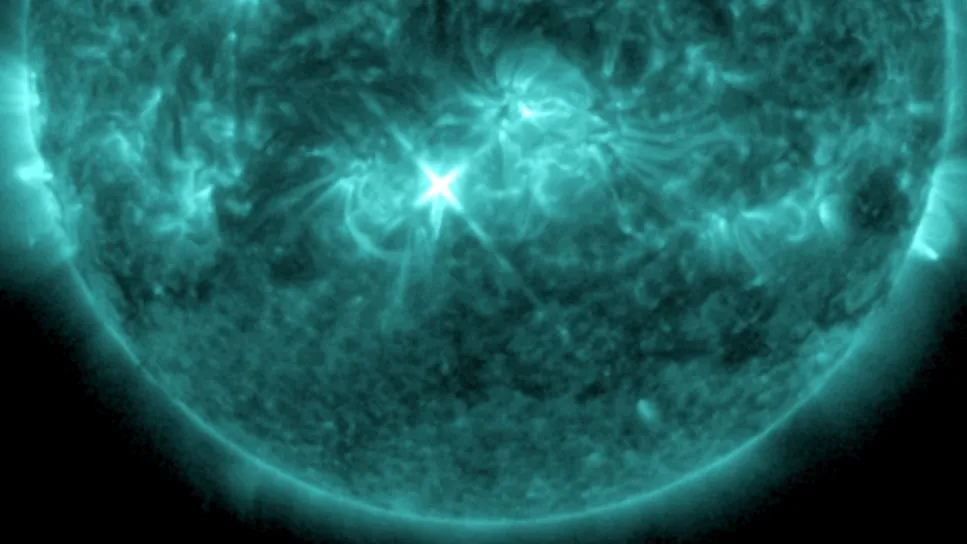
The sun fired off a series of intense solar flares on Christmas Day, Dec. 25, and some of them may amplify the changes of enhanced auroars over the weekend and days leading into New Year's Eve and New Year's Day.
According the U.K. Meteorology Office's space weather center, solar activity is fairly low, with up to 14 sunspot regions on the Earth-facing side of the sun.
"The current southern hemisphere far side [of the sun] is proving a fertile breeding ground for Coronal Mass Ejections (CMEs), with a good many observed through the Christmas period heading south and later southeast from the far side, implying the presence of a large and active region here - potentially of note into the New Year period," MET officials wrote in an update.
Northern Hemisphere aurora forecast courtesy of the Met Office
Monday, Dec. 30: Powerful geomagnetic storm could spark auroras deep into mid-latitudes tonight and tomorrow

Aurora alert!
We could be in for a New Year's aurora treat with northern lights potentially visible deep into mid-latitudes tonight and tomorrow (Dec. 30 to Dec. 31).
Due to an incoming solar storm, also known as a coronal mass ejection (CME), the National Oceanic and Atmospheric Administration (NOAA) Space Weather Prediction Center issued a G3 (strong) geomagnetic storm warning for Dec. 31.
This is great news for those wishing to see the northern lights as the predicted geomagnetic storm could spark auroras as far south as Illinois and Oregon (around 50° latitude).
Tues.-Wed., Dec. 31-Jan. 1: Coronal mass ejection reaches Earth
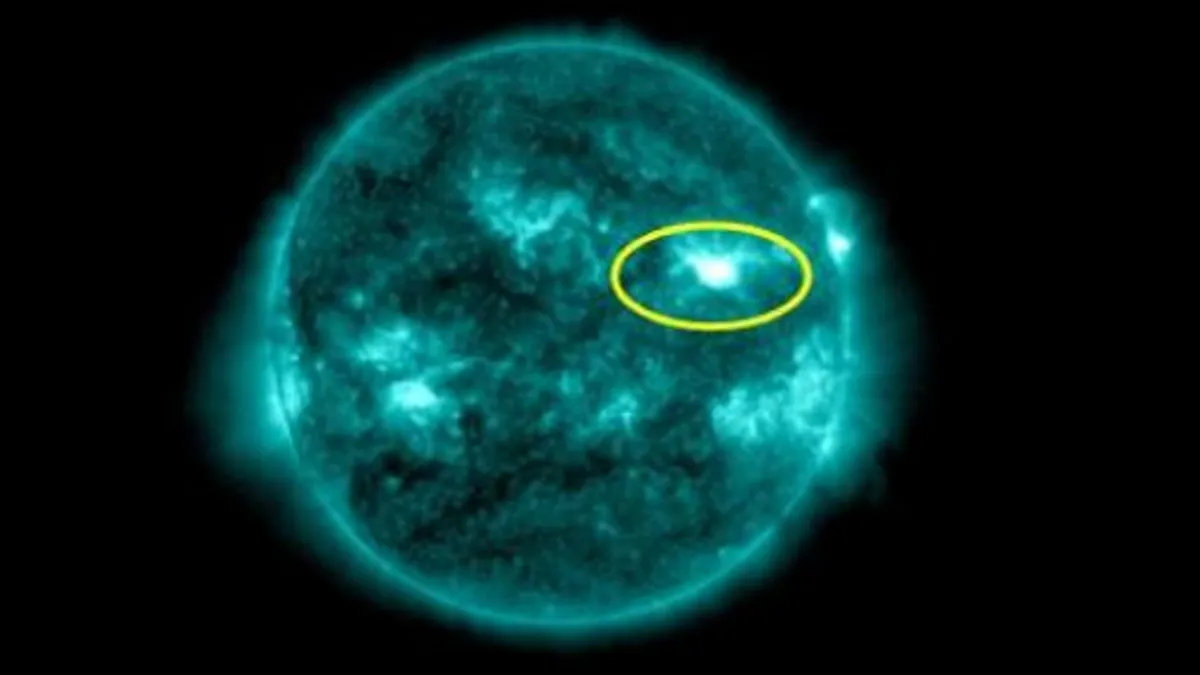
A coronal mass ejection spawned by the massive X1.1 solar flare on Dec. 29 has reached Earth and is expected to amp up the northern light overnight on Dec. 31 and Jan. 1, with space weather experts maintaining a G3 geomagnetic storm watch through the New Year.
"The anticipated CME that launched from the Sun on 29 Dec has arrived! SWPC forecast timing was very good as the shock arrival at the leading edge of the coronal mass ejection (CME) arrived at our solar wind observatory - NOAA DSCOVR and NASA ACE by 10:56am EST and reached Earth shortly afterwards," the Space Weather Prediction Center wrote in an update today. "As CME progression continues, the main magnetic “cloud” embedded within the CME should arrive and we anticipate G1-G3 potential to continue into the evening and early night hours across the U.S.."
Wednesday, Jan. 1: Northern lights ring in 2025 with stunning light shows

While many celebrated New Year's Eve with bursts of glittering fireworks, Earth joined the festivities with a natural display of its own: the northern lights.
A coronal mass ejection (CME) struck Earth's magnetic field on Dec. 31 at 11:21 a.m. EST (16:21 GMT), sparking minor geomagnetic storm conditions and painting the night sky with vivid aurora displays as far south as California, U.S, Austria, and Germany.
And it's not over yet! The sun started 2025 with a bang, hurling a new CME toward Earth, which could trigger more northern lights around Jan. 3 and Jan. 4, according to space weather physicist Tamitha Skov. "Our Sun rings in the New Year! We just had a new #solarstorm launch from Region 3939 in the Earth-Strike Zone," Skov wrote in a post on X.
Thursday, Jan. 2: High-latitude northern lights likely and mid-latitude auroras possible tonight
2025 is off to a great start in terms of northern lights and more shows could be on the horizon!
Several solar storms hit Earth over New Year's. For more than 9 hours, Earth's magnetosphere was rattled by powerful (G3 and G4) geomagnetic storms, producing widespread auroras deep into mid-latitudes.
As the current geomagnetic storm conditions begin to wane, aurora enthusiasts in high-latitude regions, such as northern Canada and Alaska, still have a strong chance of witnessing stunning auroral displays tonight. According to NOAA's Space Weather Prediction Center, the Kp index is forecasted to peak at 4 overnight.
Solar activity remains high, with several Earth-facing sunspot regions posing a potential risk of releasing solar storms, also known as coronal mass ejections (CMEs) in the coming days. Stay tuned for updates.
Colossal Earth-facing coronal hole detected

A large coronal hole has been detected on the sun and Earth is in the firing line.
This is good news for aurora chasers as coronal holes release high-speed solar wind streams. When these particles interact with Earth's magnetic field they increase geomagnetic activity which in turn can spark intense auroras.
Enhanced solar wind could arrive within about 3 days according to SpaceWeatherLive.
Aurora forecast for tonight and the weekend: Minor geomagnetic storm conditions predicted
Aurora chasers could be in for yet another treat this weekend as NOAA has issued another geomagnetic storm watch, this time for minor G1 conditions from Jan. 4 to Jan. 5. Northern lights are expected at high latitudes.
According to NOAA's Space Weather Prediction Center, the Kp index is forecasted to reach highs of 4.67 over the weekend.
The elevated conditions are due to two coronal holes spewing high-speed solar wind toward Earth. When directed at Earth these solar wind streams can interact with our planet's magnetic field and trigger geomagnetic storm conditions.

Northern Hemisphere aurora forecast courtesy of the Met Office
Monday, Jan. 6: Great chance of auroras for observers at high latitudes
Geomagnetic activity remains unsettled which is great news for aurora chasers at high latitudes.
According to NOAA's Space Weather Prediction Center, the Kp index is forecasted to reach highs of 4 over the next 24 hours.
These heightened conditions may result in visible auroras across the northern United States, while in the UK, they could be observed in the far north of Scotland.
According to the UK Met Office, Earth might experience a glancing blow from an incoming solar storm, or coronal mass ejection (CME), predicted to arrive late on January 6 or early January 7 (UTC). Should this occur, minor G1 geomagnetic storm conditions are possible.
Tuesday, Jan. 7: Unsettled conditions with strong chance of solar flares
The northern lights forecast looks promising for high-latitude observers tonight. According to NOAA's Space Weather Prediction Center, the Kp index is predicted to peak at 2.67 over the next 24 hours.
However, more unsettled space weather could be on the way. A large, active sunspot region is rotating into Earth's view and showing signs of intense activity. Just yesterday, sunspot group AR3947 unleashed a powerful M-class solar flare, accompanied by what appears to be an Earth-directed coronal mass ejection (CME).
"Region 3947 launches what looks to be an Earth-directed #solarstorm during an M4.8-flare! It is too early to tell without seeing coronagraph images, but the dimming regions around the eruption look promising (see the dark regions developing in the animation below). Stay tuned." Space Weather Physicist Tamitha Skov wrote in a post on X.
Region 3947 launches what looks to be an Earth-directed #solarstorm during an M4.8-flare! It is too early to tell without seeing coronagraph images, but the dimming regions around the eruption look promising (see the dark regions developing in the animation below). Stay tuned! pic.twitter.com/X6pAHfzdPqJanuary 6, 2025
When CMEs, also known as solar storms, hit Earth's magnetic field they can trigger geomagnetic storm conditions that can lead to dramatic aurora displays.
CMEs often accompany solar flares, but not always. Both are caused by magnetic disturbances in the sun's atmosphere, typically near active regions like sunspots. Solar flares are bursts of electromagnetic energy that travel at light speed, while CMEs are slower eruptions of plasma and magnetic fields that can take days to reach Earth. A flare may occur without a CME if no plasma is expelled, and CMEs can happen without a significant flare during gradual magnetic shifts.
According to SpaceWeatherLive's latest predictions, there's a strong chance we’ll see more powerful solar flares today. Here are the current probabilities:
M-class solar flare: 70%
X-class solar flare: 25%
Stay tuned for potential solar activity updates!
Wednesday, Jan. 8: Auroras mainly confined to high latitudes as geomagnetic activity wanes (for now)
Currently, solar activity is relatively low, with no Earth-directed solar storms. As such, tonight's northern lights will most likely be confined to latitudes above the Arctic Circle.
According to NOAA's Space Weather Prediction Center, the Kp index is predicted to peak at 2.33 over the next 24 hours.
We may experience a brief uptick in solar wind speed around Jan. 10 - Jan. 11, according to the UK Met Office. This is due to a small coronal hole in the sun, allowing solar wind to escape more readily into space.
Thursday, Jan. 9: Northern lights confined to high latitudes as geomagnetic activity remains relatively quiet
Relatively quiet geomagnetic activity will confine the northern lights primarily to high latitudes above the Arctic Circle tonight. According to NOAA's Space Weather Prediction Center, the Kp index is forecast to peak at 1.67 over the next 24 hours.
A brief uptick in solar wind speed is expected around Jan. 10–11, according to the UK Met Office. This is due to a small coronal hole in the sun, allowing solar wind to escape more readily into space. The elevated solar wind could trigger enhanced auroras at high latitudes.
The chance of powerful solar flares is decreasing as the once-active sunspot AR3947, which crackled with activity earlier this week, begins to decay. No significant sunspot regions have yet emerged over the sun's eastern limb (the left side as seen in imagery from the Solar Dynamics Observatory image below).
We’ll continue to monitor for any significant solar events that could lead to stronger northern lights displays. Stay tuned!
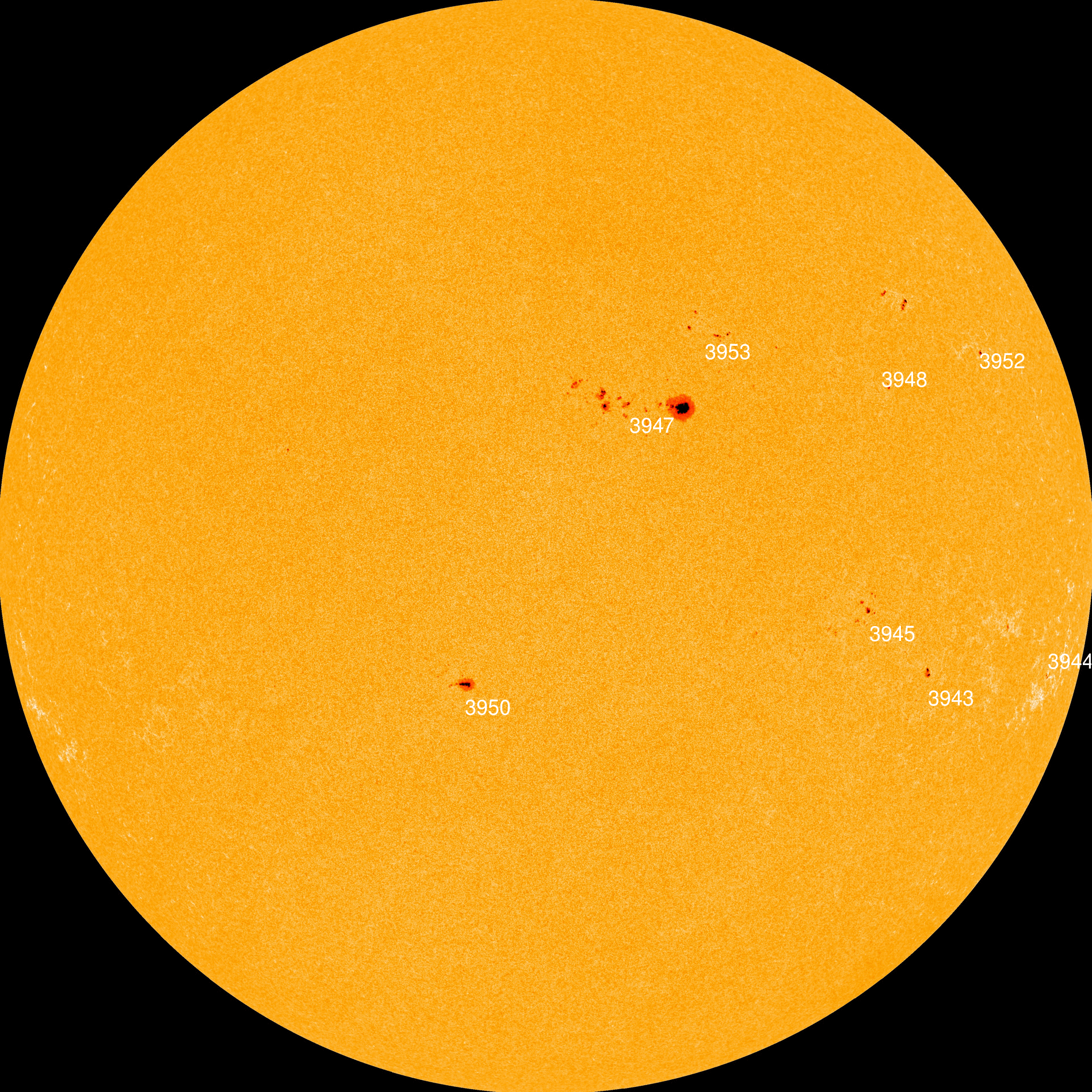
Aurora forecast for tonight and the weekend: Relatively quiet with possible unsettled conditions
Over the weekend relatively quiet geomagnetic activity will confine the northern lights primarily to high latitudes above the Arctic Circle. According to NOAA's Space Weather Prediction Center, the Kp index is forecast to peak at 3.33 over the weekend.
According to the UK Met Office, aurora activity may slightly increase on Jan.10 due to the influence of a high-speed solar wind stream emanating from a small coronal hole. A possible filament eruption from the sun might enhance geomagnetic conditions on Jan. 12.
Although things are currently looking rather quiet on the sun, two emerging sunspot regions over the sun's eastern limb might mix things up a bit should they grow rapidly in the coming days.
Thursday Jan. 16: Good chance of auroras at high latitudes with possible elevated conditions in the coming days
There is a good chance of seeing the northern lights at high latitudes tonight. According to NOAA's Space Weather Prediction Center, the Kp index is predicted to peak at 2.33 over the next 24 hours.
Aurora hunting conditions could improve in the coming days due to a giant Earth-facing coronal hole. This is great news for aurora chasers as coronal holes release high-speed solar wind streams. When these particles interact with Earth's magnetic field, they increase geomagnetic activity, which can spark intense auroras.
Enhanced solar wind could arrive within about 3 days according to SpaceWeatherLive.
A southern hemisphere coronal hole is facing Earth. Enhanced solar wind could arrive in ~3 days - Follow live on https://t.co/bsXLidnzGh pic.twitter.com/LnMFhUUSM4January 16, 2025
Aurora forecast for tonight and the weekend: Unsettled conditions possible
The northern lights will be confined primarily to high latitudes this weekend due to relatively quiet geomagnetic activity but an Earth-facing coronal hole could elevate conditions.
According to NOAA's Space Weather Prediction Center, the Kp index is forecast to peak at 3.67 over the weekend.
Although there are currently no incoming solar storms, the ongoing coronal hole influence is expected to enhance solar winds over the weekend which could lead to unsettled geomagnetic activity with isolated active intervals according to the UK Met Office. Aurora chasers keep your eyes peeled as we could experience minor geomagnetic storm conditions around Jan. 17 and Jan. 18 according to the UK Met Office.
Northern Hemisphere aurora forecast courtesy of the Met Office
Monday, Jan. 20: Good chance of northern lights at high latitudes tonight
There is a good chance of seeing the northern lights at high latitudes tonight. According to NOAA's Space Weather Prediction Center, the Kp index is forecast to peak at 2.67 over the next 24 hours.
Geomagnetic conditions have been unsettled over the last few days due to elevated solar winds from an Earth-facing coronal hole. These conditions will ease from Jan. 21 onward as the coronal hole rotates away from Earth.
Tuesday, Jan. 21: Waning geomagnetic activity confines auroras to high latitudes
Mainly quiet to unsettled geomagnetic activity confines the northern lights primarily to northern latitudes tonight.
According to NOAA's Space Weather Prediction Center, the Kp index is forecast to peak at 2.67 over the next 24 hours.
Geomagnetic conditions have been unsettled over the last few days due to elevated solar winds from an Earth-facing coronal hole. These conditions will ease from today as the coronal hole rotates away from Earth.
Potential solar storm eruption may trigger geomagnetic storm activity in the coming days
The sun erupted with an M-class solar flare, the second most powerful class of solar flare today. The flare peaked at 5:39 a.m. ET (1039 GMT) and was accompanied by a coronal mass ejection (CME), also known as a solar storm.
CMEs are vast plumes of plasma and magnetic field from the sun. If they strike Earth and the conditions are right, they can trigger geomagnetic storms, which in turn lead to spectacular aurora displays.
There’s a slight chance of minor G1-level geomagnetic storms through Jan. 24 according to the UK Met Office. However, forecasters are still waiting for an analysis to see if the incoming CME has any Earth-directed components. We'll keep you informed of any significant developments!
Spectacular CME from the M3.3 long duration flare in SUVI 304A EUV data! Still awaiting LASCO C2 imagery. https://t.co/JvkhPjdXwg pic.twitter.com/e2cyo5ZeYyJanuary 21, 2025
Wednesday, Jan. 22: Earth-directed solar storm could supercharge auroras by Jan. 24

Aurora chasers, get ready — things are looking promising! An incoming solar storm could light up the skies with northern lights potentially visible as far south as northern Michigan and Maine on Jan. 24.
NOAA's Space Weather Prediction Center forecasts that the Kp index will peak at 2 over the next 24 hours, and rise to 4.33 by Jan. 24.
The sun unleashed the solar storm, or coronal mass ejection (CME), during an eruptive M-class solar flare on Jan. 21. According to NASA models, part of the CME is expected to graze Earth on Jan. 24, potentially sparking minor G1 geomagnetic storm conditions — ideal for aurora displays beyond the regular high latitude range.
Keep an eye on the skies and your aurora alerts!
The partially Earth-directed #solarstorm from 3967 today shows some gorgeous rotational dynamics, but it will serve to keep the bulk of the storm to the East of Earth. (See the second animation.) We should get a glancing blow mid to late January 24. #Aurora possible, especially… pic.twitter.com/Vkdqu1dQkbJanuary 22, 2025
Thursday, Jan. 23: Incoming solar storm could supercharge auroras this week
A solar storm, known as a coronal mass ejection (CME), erupted from the sun on Jan. 21 and is expected to deliver a glancing blow to Earth.
This event could trigger minor geomagnetic storm activity, potentially producing northern lights visible at higher latitudes, such as northern Michigan and Maine.
The NOAA Space Weather Prediction Center projects the Kp index to peak at 5.33 within the next 48 hours, with G1 geomagnetic storm conditions possible tomorrow night (Jan. 24) between 10:00 p.m. and 4:00 a.m. EDT (0300-0900 GMT on Jan. 25).
Northern Hemisphere aurora forecast courtesy of the Met Office
Friday, Jan. 24: Possible geomagnetic storm could spark auroras at mid-latitudes
All aboard the solar storm train! Two coronal mass ejections (CMEs) are on track to strike Earth with glancing blows on Jan. 24-25.
The first CME was released during an M-class solar flare eruption on Jan. 21 and the second from a filament eruption on Jan. 22.
If both CMEs land a blow their combined result could be minor (G1) to moderate (G2) geomagnetic storm conditions according to Spaceweather.com. Skywatchers could see northern lights as far south as New York and Idaho if G2 conditions are reached.
Monday, Jan. 27: Quiet geomagnetic activity confines northern lights to high latitudes
Geomagnetic activity is expected to remain quiet over the next few days, with northern lights primarily visible at high latitudes, especially above the Arctic Circle.
The NOAA Space Weather Prediction Center projects the Kp index to peak at 1.67 within the next 24 hours.
Things could be looking up on Jan. 29 as a new coronal mass ejection (CME) could land Earth with a glancing blow and trigger minor (G1) class geomagnetic storm conditions, according to Spaceweathercom.
Tuesday, Jan. 28: Incoming coronal mass ejection may ignite stunning auroras tonight
Enhanced geomagnetic activity is expected tonight, with northern lights likely visible at high latitudes, particularly above the Arctic Circle. Earth is anticipated to experience a glancing impact from a coronal mass ejection (CME) released on January 26, which could spark minor (G1) geomagnetic storm conditions, according to Spaceweather.com.
The NOAA Space Weather Prediction Center projects the Kp index to peak at 2.67 within the next 24 hours.
Wednesday, Jan. 29: Northern lights remain confined to high latitudes tonight but unsettled conditions could spark more intense displays
Unsettled geomagnetic activity is expected tonight with a slight chance of minor G1 geomagnetic storm conditions should any incoming coronal mass ejections (CMEs) land Earth with a glancing blow.
The northern lights remain confined to high latitudes but could reach mid-latitudes if geomagnetic storm conditions intensify.
The NOAA Space Weather Prediction Center projects the Kp index to peak at 2.67 within the next 24 hours.
Thursday, Jan. 30: Auroa conditions are quiet tonight but may pick up in the coming days

While geomagnetic conditions remain quiet for now, keeping the northern lights confined to high latitudes, activity could intensify in the coming days.
A giant coronal hole is currently aiming aurora-sparking solar wind directly at Earth. The incoming solar wind is expected to arrive around Jan. 31 to Feb. 1. In doing so it could potentially spark minor (G1) geomagnetic storm conditions which could see auroras reach as far south as northern Michigan and Maine.
The NOAA Space Weather Prediction Center projects the Kp index to peak at 2.67 within the next 24 hours. Aurora chasers make sure those cameras are charged! We could be seeing Kp's of 4.33 by Feb. 1!
Aurora forecast for tonight and the weekend: Minor geomagnetic storm could supercharge northern lights this weekend
Heads up aurora chasers!
The NOAA Space Weather Prediction Center projects the Kp index to peak at 4.67 over the weekend. For an up-to-date breakdown of timings check out NOAA's 3-day forecast.
A giant coronal hole is currently aiming aurora-sparking solar wind directly at Earth. The incoming solar wind is expected to arrive around Jan. 31 to Feb. 1. In doing so it could potentially spark minor (G1) geomagnetic storm conditions which could see auroras reach as far south as northern Michigan and Maine.
Keep your cameras charged and your eyes on the skies!
Northern Hemisphere aurora forecast courtesy of the Met Office
Monday, Feb. 3: Conditions remain favorable for northern lights
Earth is still experiencing the effects of a high-speed solar wind stream from not one but two giant coronal holes. The chances of seeing the northern lights at high latitudes remain favorable.
The NOAA Space Weather Prediction Center projects the Kp index to peak at 4 over the next 24 hours. For an up-to-date breakdown of timings check out NOAA's 3-day forecast.
Quiet to unsettled geomagnetic activity conditions are expected over the next couple of days as Earth moves out of the rapid solar wind stream.
Everything could change if Earth-facing sunspot 3981 unleashes a coronal mass ejection (CME) toward our planet. The rapidly growing sunspot is crackling with powerful solar flares, including a potent M8.8-class flare that erupted last night at 10:58 p.m. EDT (0358 GMT). Space weather forecasters are closely monitoring SOHO coronagraphs to determine whether the blast was accompanied by a CME.
Tuesday, Feb. 4: Aurora spotting chances remain good for observers at high latitudes
There is a good chance of seeing the northern lights from high-latitude regions tonight as geomagnetic activity remains unsettled.
Earth is still feeling the effects of the fast solar wind stream from a coronal hole but solar wind speeds are gradually slowing down and will likely return to normal by Feb. 5.
The NOAA Space Weather Prediction Center projects that the Kp index will peak at 3.67 over the next 24 hours. For an up-to-date breakdown of timings, check out NOAA's 3-day forecast.
Wednesday, Feb. 5: Northern lights remain confined to high latitudes as geomagnetic activity slows
There is still a good chance of seeing the northern lights at high latitudes despite waning geomagnetic activity conditions.
The NOAA Space Weather Prediction Center projects that the Kp index will peak at 2.33 over the next 24 hours. For an up-to-date breakdown of timings, check out NOAA's 3-day forecast.
Thursday, Feb. 6: Unsettled geomagnetic activity mainly confines northern lights to high latitudes for now...
Generally quiet to unsettled conditions mainly confine the northern lights to high latitudes tonight, though this could change due to incoming solar storms.
Two coronal mass ejections (CMEs) are in the forecast, but their impact on Earth is uncertain. One CME from Feb. 2 might deliver a glancing blow on Feb. 6, while another from Feb. 5 has a small chance of arriving on Feb. 7-8. A high-speed solar wind stream is also expected around Feb.9. For the most part, geomagnetic activity should stay quiet to unsettled (Kp 0-3), but if a CME arrives, we could see some G1-G2 (Kp 5-6) storming. There’s also a slight chance of a minor storm (Kp 5) if the high-speed stream kicks in. Aurora chasers, watch this space!
The NOAA Space Weather Prediction Center projects that the Kp index will peak at 3.67 over the next 24 hours. For an up-to-date breakdown of timings, check out NOAA's 3-day forecast.
Aurora forecast for tonight and the weekend: Good chance of northern lights
If you're hoping to catch the northern lights this weekend, there’s some excitement in the forecast! While geomagnetic conditions have been mostly quiet, a couple of CMEs are coming.
A weak glancing blow from a Feb. 5 eruption might reach Earth late Friday into Saturday (Feb 7-8), bringing a slight chance of auroral activity. The real potential comes later in the weekend, as a high-speed solar wind stream is expected to arrive on Sunday, Feb. 9.
This could push geomagnetic conditions from unsettled to active levels, with occasional bursts of minor (G1) to moderate (G2) storming possible, according to the UK Met Office. If everything lines up just right, auroras could be visible at higher latitudes, with a chance of extending further south for brief periods.
The NOAA Space Weather Prediction Center projects that the Kp index will peak at 3 over the next 24 hours. For an up-to-date breakdown of timings, check out NOAA's 3-day forecast.
Meanwhile, solar activity remains high! Sunspot region 3981 has already fired off over 20 M-class flares this week, with two nearly reaching X-class. Could we be in for some more powerful solar flares over the weekend? Maybe! We'll have to wait and find out.
If you're in a northern location, keep an eye on space weather updates and be ready to head outside, especially on Sunday night. And as always — dark skies away from city lights will give you the best view.
Monday, Feb. 10: Great chance of Arctic auroras as solar wind picks up
Heads up aurora chasers, elevated geomagnetic activity could enhance northern lights at high latitudes.
Earth has entered a stream of fast-flowing solar wind emitted from a recent coronal hole in the sun's atmosphere. It has already sparked minor G1-class geomagnetic storm conditions, with more activity expected as Earth moves deeper into the stream.
The NOAA Space Weather Prediction Center projects that the Kp index will peak at 4 over the next 24 hours. For an up-to-date breakdown of timings, check out NOAA's 3-day forecast.
According to Spaceweather.com, Arctic auroras are likely on Feb. 10 and Feb. 11.
Northern Hemisphere aurora forecast courtesy of the Met Office
Tuesday, Feb. 11: Good aurora activity continues for the next few days
Continued elevated geomagnetic activity may enhance northern lights at high latitudes in the coming days!
Earth continues to be buffeted by a fast-flowing solar wind stream emitted from a recent coronal hole in the sun's atmosphere. It has already sparked minor G1-class geomagnetic storm conditions, with more activity expected as Earth moves deeper into the stream. Further coronal hole enhancement is likely around Feb. 12 and 13 according to the UK Met Office.
The NOAA Space Weather Prediction Center projects that the Kp index will peak at 3.67 over the next 24 hours. For an up-to-date breakdown of timings, check out NOAA's 3-day forecast.
Northern Hemisphere aurora forecast courtesy of the Met Office
Wednesday, Feb. 12: Chance of northern lights remains high due to ongoing solar wind streams
Great news aurora chasers! Geomagnetic activity is on the rise, boosting the chances of dazzling northern lights at high latitudes!
A fast solar wind stream from a coronal hole continues to influence Earth's space weather, with wind speeds ranging from 500-600 km/s.
Geomagnetic conditions have been Unsettled to Active (Kp 3-4), and another wave of fast solar wind is expected to arrive on Feb. 12-13, potentially sparking G1 Minor Storms on the evening of Feb. 13.
No Earth-directed CMEs were observed, but a new solar wind stream arriving on Feb. 14 may bring enhanced auroras, especially in Arctic regions. Stay tuned for potential Valentine's Day northern lights!
The NOAA Space Weather Prediction Center projects that the Kp index will peak at 4 over the next 24 hours. For an up-to-date breakdown of timings, check out NOAA's 3-day forecast.
Thursday, Feb. 13: Minor geomagnetic storm watch in place due to incoming solar wind stream
Geomagnetic activity continues to rise, boosting the chances of dazzling northern lights at high latitudes!
Geomagnetic conditions have been unsettled to active (Kp 3-4), due to various solar wind streams and another wave of fast solar wind is expected to arrive on Feb. 13, potentially sparking G1 Minor Storms on the evening of Feb. 13 into Feb. 14.
Stay tuned for potential Valentine's Day northern lights!
The NOAA Space Weather Prediction Center projects that the Kp index will peak at 4.67 over the next 24 hours. For an up-to-date breakdown of timings, check out NOAA's 3-day forecast.
Friday, Feb. 14: Minor geomagnetic storms expected over Valentine's Day weekend
Aurora watchers could have a great Valentine's Day weekend ahead of them as geomagnetic activity continues to rise, generating colorful northern lights at high latitudes!
Auroras have already been spotted over Iceland, SpaceWeather.com reports. Chances of minor to moderate radio blackouts will continue through the weekend as streams of solar wind flow from a hole in the sun's atmosphere towards Earth.
The NOAA Space Weather Prediction Center projects that the Kp index will peak at 4.67 over the weekend. For an up-to-date breakdown of timings, check out NOAA's 3-day forecast.
Monday, Feb. 18: Only small chances of minor geomagnetic storms
There are only small chances for minor geomagnetic storms on Monday (Feb. 18), as no significant streams of solar wind or coronal mass ejections are headed towards Earth.
While there is still a small chance of northern lights (aurora borealis) at high latitudes, low space weather activity means they could be rare. "There are no CMEs currently assessed as Earth directed, however a couple of weak ejections from 14-15 Feb may pass nearby, with glancing influence possible" on Feb. 18, the U.K.'s Met Office forecasted.
The NOAA Space Weather Prediction Center projects that the Kp index will peak at 3.67 over the next 24 hours. For an up-to-date breakdown of timings, check out NOAA's 3-day forecast.
Tuesday, Feb. 19: Aurora activity expected to subside over next 24 hours
Overnight on Tuesday (Feb. 18), some aurora watchers at mid-latitudes were fortunate enough to catch a glimpse of the northern lights much farther south than usual. "Beautiful auroras made an appearance near Lewisburg, Pennsylvania," wrote one photographer on X.
Beautiful auroras made an appearance near Lewisburg, Pennsylvania at 7:24pm EST. #PAwx pic.twitter.com/7GyWMyMbWiFebruary 19, 2025
However, aurora activity and geomagnetic effects are expected to subside over the next 24 hours as effects from a glancing coronal mass ejection (CME) subside. "As solar wind speeds slowly wane and the recent CME (Coronal Mass Ejection) effects gradually diminish, aurora activity is expected to be confined to high latitudes," the U.K.'s Met Office wrote on Wednesday (Feb. 19).
The NOAA Space Weather Prediction Center projects that the Kp index will peak at 5 over the next 24 hours. For an up-to-date breakdown of timings, check out NOAA's 3-day forecast.
Thursday, Feb. 20: Northern lights confined to high latitudes for now but possible CME could spark activity later in the week
Geomagnetic activity is currently low with northern lights confined to high latitudes.
However, things could pick up on Feb. 23 when a coronal mass ejection (CME) released from the sun on Feb. 19 may deliver Earth with a glancing blow, according to the UK Met Office. If the CME hits Earth it could trigger minor G1 level geomagnetic storms and subsequent auroras stretching further south toward northern Michigan and Maine.
The NOAA Space Weather Prediction Center projects that the Kp index will peak at 2 over the next 24 hours. For an up-to-date breakdown of timings, check out NOAA's 3-day forecast.
Aurora forecast for tonight and the weekend: Quiet with a chance of minor storms
Right now, geomagnetic activity is on the quieter side, meaning the northern lights are mostly sticking to high-latitude regions. But that could change soon! A coronal mass ejection (CME) that erupted from the sun on Feb. 19 is predicted to brush past Earth on Feb. 23, according to the UK Met Office. If this solar storm makes contact, we could see a minor G1 geomagnetic storm, potentially pushing auroras farther south — possibly reaching northern Michigan and Maine.
For now, NOAA’s Space Weather Prediction Center expects the Kp index to remain low, peaking at 1.67 over the next 24 hours. But space weather can be unpredictable, so if you’re hoping for a northern lights show, keep an eye on NOAA’s 3-day forecast for the latest updates!
Northern Hemisphere aurora forecast courtesy of the Met Office
Monday, Feb. 24: Unsettled geomagnetic activity conditions could spark aurora shows tonight
Solar activity has recently picked up with a strong X-class solar flare erupting yesterday (Feb. 24) While a coronal mass ejection accompanied the eruption, unfortunately for aurora chasers, it is unlikely to affect Earth as the CME was fired off the far Western limb. However, another CME is expected to arrive on Feb. 24, with a slight chance of triggering geomagnetic storms.
According to the U.K. Met Office, geomagnetic activity is forecast to be quiet to unsettled, with minor to moderate geomagnetic storms possible on Feb. 24.
Aurora visibility remains uncertain but could briefly reach mid-latitudes if geomagnetic activity peaks. Watch for updates, especially if solar wind conditions intensify.
The NOAA Space Weather Prediction Center projects that the Kp index will peak at 3 over the next 24 hours. For an up-to-date breakdown of timings, check out NOAA's 3-day forecast.
Tuesday, Feb. 25: Northern lights primarily confined to high latitudes as geomagnetic activity wanes
Geomagnetic activity remains relatively quiet, confining the northern lights primarily to high latitudes.
There is a possibility of G1 (Kp5) and a lower chance of G2 (Kp6) geomagnetic storms on Feb. 25, driven by weak coronal mass ejection impacts and potential effects from a coronal hole. After this, geomagnetic activity is expected to diminish to quiet or unsettled levels (Kp1-3) through Feb. 27.
Things could be looking up later this week as a high-speed solar wind stream could influence auroras from Feb. 28 when wind seeds of 600 km/s are possible, according to the U.K. Met Office.
The NOAA Space Weather Prediction Center projects that the Kp index will peak at 2.67 over the next 24 hours. For an up-to-date breakdown of timings, check out NOAA's 3-day forecast.
Wednesday, Feb. 26: Northern lights may be relatively quiet tonight but activity could be ramping up soon
Tonight’s aurora forecast suggests mostly background levels, with northern lights mainly confined to high latitudes but things could be looking up later in the week.
In the past 24 hours solar activity has been moderate, with multiple sunspot regions and some flares, but no significant Earth-directed CMEs. Solar wind speeds have weakened but are expected to increase again by Feb. 27-28, bringing a slight chance of G1 (minor) geomagnetic storms later in the week. In addition, a large 'hole' has opened up in the sun's atmosphere and is currently facing Earth, aiming aurora-sparking solar wind right at us.
The incoming solar wind is expected to arrive around March 1. In doing so it could potentially spark minor (G1) geomagnetic storm conditions which could see auroras reach as far south as northern Michigan and Maine.
The NOAA Space Weather Prediction Center projects that the Kp index will peak at 2.67 over the next 24 hours. For an up-to-date breakdown of timings, check out NOAA's 3-day forecast.
While tonight’s aurora prospects are modest, skywatchers in high-latitude regions should stay alert for brief displays, especially in clearer skies. Stay tuned for stronger activity as solar wind conditions evolve through the week.
Thursday, Feb. 27: Elevated aurora conditions possible tonight and tomorrow
Enhanced northern lights may stretch deeper into mid-latitudes tonight as Earth experiences the effects of an incoming high-speed solar wind stream. This wind originates from a coronal hole on the sun’s surface and is expected to push speeds beyond 600 km/s, enhancing the chances of auroral activity.
In addition to the solar wind, recent coronal mass ejections (CMEs) may play a role. While none are directly Earth-bound, a couple of glancing blows from filament eruptions remain possible. These could introduce brief periods of geomagnetic unrest, potentially leading to minor storm conditions (G1) tonight and tomorrow.
The NOAA Space Weather Prediction Center projects that the Kp index will peak at 4 over the next 24 hours. For an up-to-date breakdown of timings, check out NOAA's 3-day forecast.
Aurora chasers keep your eyes on the skies, we may be in for a treat.
Northern Hemisphere aurora forecast courtesy of the Met Office
Geomagnetic storm alert: Strong G2 conditions currently being observed
Earth is currently experiencing strong G2 Geomagnetic storm conditions (Kp 6). The threshold was reached at 06:10 EST (1110 GMT) on Feb. 27.
Northern lights could stretch into mid-latitudes during the current G2 geomagnetic storm.
Moderate G2 geomagnetic storm (Kp6)Threshold Reached: 11:10 UTCFollow live on https://t.co/Zkq26B89Y7 pic.twitter.com/PQ7KRkf6bnFebruary 27, 2025
Promising aurora conditions for tonight so keep your eyes on the skies
Elevated geomagnetic conditions could continue through the night, so aurora chasers, get those camera batteries charged. We could be in for a northern lights delight tonight!
If you're interested in tracking space weather and knowing when and where to spot auroras, download a space weather app that provides forecasts based on your location. One option I use is "My Aurora Forecast & Alerts," available for both iOS and Android. However, any similar app should work well. I also use the "Space Weather Live" app, which is available on iOS and Android, to get a deeper understanding of whether the current space weather conditions are favorable for aurora sightings.
Aurora forecast for tonight and the weekend: Unsettled conditions could bring minor geomagnetic storms
The northern lights may put on a show tonight (Feb. 28), but the window for strong auroras is narrowing as geomagnetic activity is expected to decline gradually through the weekend.
If you’re in northern locations such as Canada, Alaska, or Scandinavia, keep an eye on the sky tonight for the best chance at catching the northern lights before activity wanes.
By March 1, geomagnetic activity will taper off, though there’s still a small chance for minor (G1) geomagnetic storms due to elevated solar wind conditions from an Earth-facing coronal hole. As we head into March 2, the Kp index is forecasted to drop further, reducing aurora chances.
The NOAA Space Weather Prediction Center projects that the Kp index will peak at 3.67 over the next 24 hours. For an up-to-date breakdown of timings, check out NOAA's 3-day forecast.
As always, clear, dark skies away from city lights will give you the best viewing experience.
Happy aurora hunting! and Happy weekend!
Geomagnetic storm alert: Minor G1 levels reached
Here we go again! Earth is currently experiencing minor G1 geomagnetic storm levels. The threshold was reached at 9:59 a.m. EST (1459 GMT). Kp levels of 5 are currently being observed. All we need now is for the sun to go down so we can head out northern lights hunting!
Minor G1 geomagnetic storm (Kp5)Threshold Reached: 14:59 UTCFollow live on https://t.co/Zkq26B89Y7 pic.twitter.com/aZYyYcEsOVFebruary 28, 2025
Monday, March 3: Partially Earth-directed solar storm incoming! Aurora chasers keep your eyes on the skies
Great news, aurora chasers! A partially Earth-directed solar storm is on its way, and if it hits just right, we could see geomagnetic storm activity reaching G1 to G2 levels by March 5, according to space weather physicist Tamitha Skov.
Until then, northern lights will mainly be confined to high latitudes primarily above the Arctic Circle.
The NOAA Space Weather Prediction Center projects that the Kp index will peak at 2.67 over the next 24 hours. For an up-to-date breakdown of timings, check out NOAA's 3-day forecast.
Tuesday, March 4: Great chance of northern lights tonight and tomorrow
Incoming!
If you’re hoping to catch the northern lights, there is a chance of increased activity late tonight, March 4, and into March 5. A minor to moderate geomagnetic storm (G1/G2) is possible due to a glancing blow from a coronal mass ejection (CME) that erupted on March 1. High-latitude locations such as northern Europe, Canada, and the northern U.S. may have the best viewing opportunities if the storm strengthens.
The NOAA Space Weather Prediction Center projects that the Kp index will peak at 5 over the next 24 hours. For an up-to-date breakdown of timings, check out NOAA's 3-day forecast.
Wednesday, March 5: Slightly elevated geomagnetic activity continues
Enhanced geomagnetic activity from an incoming solar storm could continue to ignite northern lights tonight. According to the U.K. Met Office, a coronal mass ejection (CME) that erupted from the sun on March 1 is likely delivering a glancing blow to Earth, with its effects expected to persist through today.
The NOAA Space Weather Prediction Center projects that the Kp index will peak at 3 over the next 24 hours. For an up-to-date breakdown of timings, check out NOAA's 3-day forecast.
Thursday, March 6: Fairly quiet geomagnetic activity for now but conditions may improve by the weekend
Currently, solar wind speeds are slightly elevated but declining according to the U.K. Met Office, leading to mostly quiet to unsettled geomagnetic conditions, which are not particularly favorable for strong northern lights. However, the outlook improves later this week.
Around March 8 and 9, Earth is predicted to be impacted by a high-speed solar wind stream from a coronal hole facing our planet. The elevated solar wind conditions could spark geomagnetic storm conditions, with a chance of G1 (minor) to isolated G2 (moderate) geomagnetic storms. If conditions align, this could bring auroras to mid-latitude locations during peak activity!
The NOAA Space Weather Prediction Center projects that the Kp index will peak at 2.33 over the next 24 hours. For an up-to-date breakdown of timings, check out NOAA's 3-day forecast.
Northern lights forecast for tonight and the weekend: Geomagnetic storms possible due to Earth-facing coronal hole
A giant coronal hole in the sun's atmosphere is currently spewing high-speed solar wind toward Earth. This is great news for aurora chasers as the emerging stream should reach our planet by March 9-10, potentially sparking G1 (minor) geomagnetic storm conditions and dazzling northern lights at high latitudes.
The NOAA Space Weather Prediction Center projects that the Kp index will peak at 4.67 over the weekend. For an up-to-date breakdown of timings, check out NOAA's 3-day forecast.
Monday, March 10: Elevated conditions could bring even more auroras tonight
Wow, what a weekend!
Enhanced auroras were visible deep into mid-latitudes as Earth was hit by a fast stream of solar wind, which appeared to hide a stealthy solar storm within. One hit Earth on March 8 and sparked more than 10 hours of geomagnetic storms, according to Spaceweather.com.
Though things are quieting down, we could still be in for another treat tonight due to continued elevated conditions.
The NOAA Space Weather Prediction Center projects that the Kp index will peak at 4 over the next 24 hours. For an up-to-date breakdown of timings, check out NOAA's 3-day forecast.
Tuesday, March 11: Aurora activity nearing background levels but incoming solar winds could elevate conditions
After a flurry of activity from the northern lights, things seem to be quieting down for now.
According to the U.K. Met Office, the auroral oval is nearing background levels through March 11-12. However, an onset of fast solar wind may bring slight enhancements on March 13.
The NOAA Space Weather Prediction Center projects that the Kp index will peak at 3.67 over the next 24 hours. For an up-to-date breakdown of timings, check out NOAA's 3-day forecast.
Wednesday, March 12: Slightly elevated conditions continue, good news for aurora chasers!
Persistent fast solar winds are intensifying geomagnetic activity, driving promising auroral activity at high latitudes. Aurora chasers, keep your eyes on the skies tonight as we could be in for yet another show.
The NOAA Space Weather Prediction Center projects that the Kp index will peak at 3.67 over the next 24 hours. For an up-to-date breakdown of timings, check out NOAA's 3-day forecast.
Thursday, March 13: Elevated geomagnetic conditions continue, more auroras could be on their way tonight
More G1 (minor) geomagnetic storms could be on the horizon as Earth continues to be buffeted by a high-speed solar wind released from a coronal hole on the sun's surface. Strong northern lights displays possible at high latitudes.
The NOAA Space Weather Prediction Center projects that the Kp index will peak at 3.67 over the next 24 hours. For an up-to-date breakdown of timings, check out NOAA's 3-day forecast.
If you're interested in tracking space weather and knowing when and where to spot auroras, download a space weather app that provides forecasts based on your location. One option I use is "My Aurora Forecast & Alerts," available for both iOS and Android. However, any similar app should work well. I also use the "Space Weather Live" app, which is available on iOS and Android, to get a deeper understanding of whether the current space weather conditions are favorable for aurora sightings.
Aurora forecast for tonight and the weekend: Stormy times ahead could spark impressive northern lights at high latitudes
The aurora forecast for the weekend looks promising if the recent conditions are anything to go by!
Geomagnetic activity really picked up throughout the night, reaching G2 (moderate) geomagnetic storm levels at 9:42 p.m. EDT (0142 GMT). The sky decided to put on quite the show for those lucky skywatchers in the right place at the right time. Aurora chaser, Rj Rolden, captured an aurora corona overhead and the total lunar eclipse.
"Are you kidding me??? Whoaaaaa!!! I am one lucky guy who witnessed the perfect duo!!!" Rolden wrote in a post on X.
Are you kidding me??? Whoaaaaa!!! I am one lucky guy who witnessed the perfect duo!!! What an amazing #aurora corona sided by the beautiful #LunarEclipse blood moon!!! I cant believe I have seen it with my naked eyes!!!! Yahooooooo!!!! #northernlights #bloodmoon @StoryfulNews… pic.twitter.com/XLhI6AUT38March 14, 2025
Earth continues to be buffeted by a high-speed solar wind released from a coronal hole on the sun's surface. Strong northern lights display have been visible at high latitudes.
The NOAA Space Weather Prediction Center projects that the Kp index will peak at 4 over the next 24 hours. For an up-to-date breakdown of timings, check out NOAA's 3-day forecast.
If you're interested in tracking space weather and knowing when and where to spot auroras, download a space weather app that provides forecasts based on your location. One option I use is "My Aurora Forecast & Alerts," available for both iOS and Android. However, any similar app should work well. I also use the "Space Weather Live" app, which is available on iOS and Android, to get a deeper understanding of whether the current space weather conditions are favorable for aurora sightings.
Monday, March 17: All quiet for St. Patrick's Day
Unfortunately, quiet solar conditions mean St. Patrick's Day revelers won't be seeing any green in the skies tonight — at least not from the northern lights.
The NOAA Space Weather Prediction Center projects that the Kp index will peak at 3.67 over the next 24 hours. For an up-to-date breakdown of timings, check out NOAA's 3-day forecast.
According to NOAA, no radio blackouts have been observed in the past 24 hours, and there no active regions on the sun that we can expect to create geomagnetic storms in our neck of the cosmic woods. There is only a 5% chance over the next three days of any minor activity.
Still the U.K.'s Met Office says there is a chance that auroras could be seen as far south as northern Scotland, but geomagnetic activity is expected to be quiet.
Tuesday, March 18: Weak CMEs could produce weak geomagnetic storms this week
Things are still fairly quiet on the aurora front, but activity could pick up in the next few days thanks to some coronal mass ejections headed our way.
Minor G1 geomagnetic storms are possible on Thursday (March 20) thanks to four coronal mass ejections (CMEs) that exploded from the sun on Tuesday (March 17), according to the U.K.'s Met Office. These could make the northern lights visible as far south as northern Scotland later this week, but are expected to only make weak, glancing blows with Earth.
The NOAA Space Weather Prediction Center projects that the Kp index will peak at 3.67 over the next 24 hours. For an up-to-date breakdown of timings, check out NOAA's 3-day forecast.
If you're interested in tracking space weather and knowing when and where to spot auroras, download a space weather app that provides forecasts based on your location. One option I use is "My Aurora Forecast & Alerts," available for both iOS and Android. However, any similar app should work well. I also use the "Space Weather Live" app, which is available on iOS and Android, to get a deeper understanding of whether the current space weather conditions are favorable for aurora sightings.
Wednesday, March 19: Chance of weak geomagnetic storms this week
Things are still fairly quiet on the solar weather front, but there is a chance for weak or glancing interactions with up to three coronal mass ejections between today (March 19) and Friday (March 21).
Minor (G1) geomagnetic storms are possible on Thursday (March 20) as these three coronal mass ejections (CMEs) make their way from the sun towards Earth. Northern lights are possible as far south as Scotland and northwest Canada as these bursts of solar plasma and magnetic field interact with Earth's atmosphere.
The NOAA Space Weather Prediction Center projects that the Kp index will peak at 4.33 over the next 24 hours. For an up-to-date breakdown of timings, check out NOAA's 3-day forecast.
Thursday, March 20: First day of northern spring is good news for aurora chasers
With several coronal mass ejections — expulsions of plasma and magnetic field from the sun — heading toward Earth conditions remain favorable for good northern lights shows at high latitudes.
What's more, today is the first day of northern spring, the vernal equinox. And auroras love equinoxes! At this time of year "cracks" can form in Earth's magnetic field, so even a weak stream of solar wind can get through and spark a promising display, according to Spaceweather.com, this is known as The Russel-McPherron effect. It arises around the equinox when Earth is not tilted toward or away from the sun (as it is during the rest of the year). When there is no tilt, the solar wind's magnetic field is more attracted to Earth's magnetic field, resulting in a more substantial "funneling" of energy down into the atmosphere, resulting in stronger auroras.
The NOAA Space Weather Prediction Center projects that the Kp index will peak at 4 over the next 24 hours. For an up-to-date breakdown of timings, check out NOAA's 3-day forecast.
Aurora forecast for tonight and the weekend: Quiet for now but conditions could improve over the coming days
There is a chance of possible minor geomagnetic storms over the weekend due to the anticipated arrival of several coronal mass ejections (CMEs) and subsequent enhanced solar wind speeds which could spark good northern lights displays at high latitudes.
The NOAA Space Weather Prediction Center projects that the Kp index will peak at 3.67 over the weekend. For an up-to-date breakdown of timings, check out NOAA's 3-day forecast.
Earth is currently in a prime position for stunning auroras, thanks to our proximity to the vernal equinox, which occurred on March 20. Auroras tend to flourish around the equinoxes due to a phenomenon known as the Russell-McPherron effect. During this time of year, Earth's magnetic field can develop temporary "cracks," allowing even weak solar wind streams to penetrate and ignite dazzling light displays. This happens because, unlike other times of the year when Earth is tilted toward or away from the sun, the equinox brings a more neutral alignment. As a result, the solar wind's magnetic field interacts more efficiently with Earth's, channeling energy into the atmosphere and enhancing auroral activity.
We could be in for quite the treat this weekend, so keep your eyes on the sky!
Strong geomagnetic storm alert! Northern lights could be visible as far south as Illinois and Oregon tonight

The NOAA Space Weather Prediction Center has issued a strong (G3) geomagnetic storm watch for tonight, aurora chasers be alert!
An incoming coronal mass ejection that left the sun on March 21, could impact Earth early March 23 (UTC) and trigger a strong geomagnetic storm which may spark northern lights as far south as Illinois and Oregon.
The NOAA Space Weather Prediction Center predicts that the Kp index will peak at 7 between 11 p.m. to 2 a.m. EDT (0300 and 0600 GMT) tonight. For an up-to-date breakdown of timings, check out NOAA's 3-day forecast.
Keep your eyes on the skies, those camera batteries charged and fingers crossed! We could be in for a splendid show...
Monday, March 24: Moderate geomagnetic activity continues despite weak CME impact
A coronal mass ejection (CME) arrived at Earth early this morning (0038 UTC), but its impact was weaker than expected and did not trigger the strong geomagnetic storm that had been forecast.
However, additional weak CME glancing blows may be on the way, along with a fast stream of solar wind expected to arrive by mid-week. As a result, geomagnetic activity remains elevated, keeping the chances of northern lights high for those in high-latitude regions.
The NOAA Space Weather Prediction Center projects that the Kp index will peak at 4.67 over the next 24 hours, reaching 5.67 tomorrow night. For an up-to-date breakdown of timings, check out NOAA's 3-day forecast.
Tuesday, March 25: Active geomagnetic conditions could spark impressive northern lights tonight
Good news aurora chasers! Anticipated moderate (G2) geomagnetic storm conditions tonight could spark northern lights as far south as New York and Idaho.
The NOAA Space Weather Prediction Center projects that the Kp index will peak at 5.67 over the next 24 hours. For an up-to-date breakdown of timings, check out NOAA's 3-day forecast.
But what's driving this predicted uptick in activity? A co-rotating interaction region (CIR) is the culprit. CIRs are regions in the solar wind where fast-moving solar wind streams interact with slower wind ahead of them. CIRs contain shock waves similar to those embedded in coronal mass ejections (CMEs). The incoming CIR is powered by the colossal Earth-facing coronal hole in the sun's atmosphere.
Earth is currently in a prime position for stunning auroras, thanks to our proximity to the vernal equinox, which occurred on March 20. Auroras tend to flourish around the equinoxes due to a phenomenon known as the Russell-McPherron effect. During this time of year, Earth's magnetic field can develop temporary "cracks," allowing even weak solar wind streams to penetrate and ignite dazzling light displays. This happens because, unlike other times of the year when Earth is tilted toward or away from the sun, the equinox brings a more neutral alignment. As a result, the solar wind's magnetic field interacts more efficiently with Earth's, channeling energy into the atmosphere and enhancing auroral activity.
We could be in for a real treat tonight so keep those eyes on the skies!
If you're interested in tracking space weather and knowing when and where to spot auroras, download a space weather app that provides forecasts based on your location. One option I use is "My Aurora Forecast & Alerts," available for both iOS and Android. However, any similar app should work well. I also use the "Space Weather Live" app, which is available on iOS and Android, to get a deeper understanding of whether the current space weather conditions are favorable for aurora sightings.
Wednesday, March 26: Moderate geomagnetic activity continues, offering great northern lights viewing opportunities for high-latitude locations
Active geomagnetic conditions persist, bringing good news for those hoping to catch the northern lights tonight.
NOAA space weather forecasters predict that moderate G2-class geomagnetic storms are possible today as Earth's magnetic field continues to respond to the impact of the co-rotating interaction region (CIR) from March 25.
According to the NOAA Space Weather Prediction Center, the Kp index is expected to peak at 5 over the next 24 hours. For the latest forecast and timing details, check out NOAA's 3-day outlook.
Thursday, March 27: Northern lights possible again tonight at high latitudes as geomagnetic activity remains high
"Moderate to strong geomagnetic storm conditions fluctuated throughout the night as Earth was (and still is) buffeted by a high-speed solar wind stream.
Northern lights were detected as far south as north Italy at 45°N!
Aurora also detected as far south as Cima Pora, north Italy at 45°N (20:10 UTC)! For our North American friends, that's about as far south as Oklahoma / north Texas! @TamithaSkov https://t.co/b4T2ECPZME pic.twitter.com/2OgIv8SV9XMarch 26, 2025
Unfortunately for aurora chasers, the display could have been even more spectacular if the incoming solar wind’s magnetic polarity had been more favorable.
"Too bad the magnetic polarity is the wrong way for decent storming, or we'd be at G3-levels by now," space weather physicist Tamitha Skov wrote in a post on X.
A key ingredient of aurora activity is the Bz value of the Interplanetary Magnetic Field, which can be easily viewed on SpaceWeatherLive.com. You're ideally looking for a strong "south" Bz which means it will connect with Earth's magnetosphere which points northward. A strong southward Bz can wreak havoc with Earth's magnetic field and send particles raining down through the atmosphere along magnetic field lines. When these energized particles collide with atoms in Earth's atmosphere they release the light we see as auroras. If there is a strong southward Bz, your chances of seeing auroras increase significantly.
But we could still be in for another show tonight. According to the NOAA Space Weather Prediction Center, the Kp index is expected to peak at 4 over the next 24 hours. For the latest forecast and timing details, check out NOAA's 3-day outlook.
Aurora forecast for tonight and the weekend
Fair northern lights conditions over the weekend despite waning geomagnetic conditions.
Solar winds remain strong due to a high-speed stream from a large coronal hole, though they are gradually declining. Minor geomagnetic storm intervals are possible today (March 28), with auroral activity decreasing over the weekend. A filament eruption on March 27 produced a coronal mass ejection, but it's unlikely to be Earth-directed, according to the U.K. Met Office. While a glancing blow from a previous eruption could arrive March 29–30, confidence is low. Expect the best aurora chances tonight, fading into quieter conditions by Sunday.
According to the NOAA Space Weather Prediction Center, the Kp index is expected to peak at 4 over the weekend. For the latest forecast and timing details, check out NOAA's 3-day outlook.
Monday, March 31: Relatively low geomagnetic activity for now but some big players are entering the game...

Though geomagnetic activity looks relatively quiet for now, with the northern lights mostly confined to high latitudes, two sunspot regions could disrupt the peace.
Two sunspot regions, 4046 and 4048 are currently rotating into view and have been crackling with activity. 4046 was responsible for a colossal X-class solar flare and accompanying coronal mass ejection (CME) last week (March 28) and 4048 has been firing off a barrage of powerful M-class solar flares as it makes its presence known.
Both sunspot regions will be rotating into the 'Earth-strike zone' this week, when pointing at Earth, any CME released at that time will be more likely to impact our planet, potentially triggering geomagnetic storms and subsequent impressive auroras.
Space weather forecasters will be keeping a watchful eye on the two regions.
According to the NOAA Space Weather Prediction Center, the Kp index is expected to peak at 3 over the next 24 hours. For the latest forecast and timing details, check out NOAA's 3-day outlook -- Daisy Dobrijevic
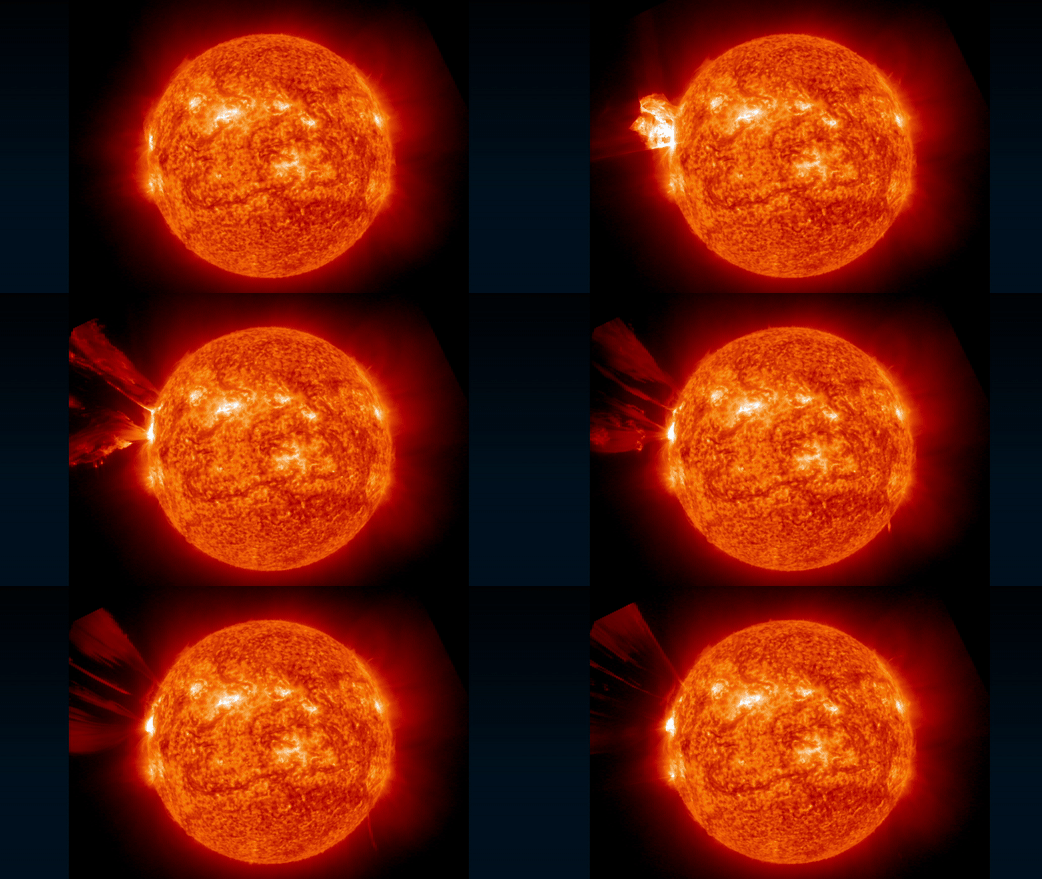
Tuesday, April 1: Geomagnetic activity is decreasing for now, with northern lights mostly limited to high latitudes
There is some potential for aurora activity over the next 24 to 48 hours but the forecast remains uncertain. A slow-moving coronal mass ejection (CME) that erupted from the sun on March 29 may give Earth a glancing blow on April 2 and spark geomagnetic disturbances, though chances are quite low.
The sun has been releasing a barrage of strong solar flares recently, but most CMEs released during these times are forecast to miss Earth, according to the U.K. Met Office. However, the two large sunspot regions crackling with activity will be turning to face Earth in the coming days, which means any CME released when they are in the "Earth-strike zone" could hit Earth directly, sparking geomagnetic storms and subsequent vivid northern lights. Space weather forecasters are watching them very closely!
According to the NOAA Space Weather Prediction Center, the Kp index is expected to peak at 2.33 over the weekend. For the latest forecast and timing details, check out NOAA's 3-day outlook.
Wednesday, April 2: Northern lights primarily confined to high latitudes tonight but more activity could be on its way
Though current geomagnetic activity looks relatively quiet with northern lights primarily confined to high latitudes, an incoming co-rotating interaction region (CIR) is on its way and expected to hit Earth on April 4.
A CIR is a turbulent area in the solar wind where fast-moving streams collide with slower wind ahead of them. CIRs can generate shock waves similar to those found in coronal mass ejections (CMEs), enhancing space weather effects.
According to the NOAA Space Weather Prediction Center, the Kp index is expected to peak at 2.67 over the next 24 hours, rising to 5 (G1 geomagnetic storm conditions) on April 4 when the CIR is expected to hit. For the latest forecast and timing details, check out NOAA's 3-day outlook.
Thursday, April 3: Auroras mainly confined to high latitudes but April 4 holds promise
Though the northern lights are primarily confined to high latitudes tonight, geomagnetic activity is starting to rise once again. As mentioned yesterday a co-rotating interaction region (CIR) is on its way and is still predicted to impact Earth overnight on April 4-5.
A CIR is a turbulent area in the solar wind where fast-moving streams collide with slower wind ahead of them. CIRs can generate shock waves similar to those found in coronal mass ejections (CMEs), enhancing space weather effects.
According to the NOAA Space Weather Prediction Center, the Kp index is expected to peak at 3.67 over the next 24 hours and rise to 5 (G1 geomagnetic storm conditions) overnight April 4, when the CIR is expected to hit. For the latest forecast and timing details, check out NOAA's 3-day outlook.
Aurora forecast for tonight and the weekend: Promising conditions over the weekend!
Aurora chasers, keep your eyes on the skies over the weekend as we could be in for a nice northern lights show.
A co-rotating interaction region (CIR) is en route and is still predicted to impact Earth overnight on April 4-5. A CIR is a turbulent area in the solar wind where fast-moving streams collide with slower wind ahead of them. CIRs can generate shock waves similar to those found in coronal mass ejections (CMEs), enhancing space weather effects.
According to the NOAA Space Weather Prediction Center, the Kp index is expected to peak at 5 over the next 48 hours. For the latest forecast and timing details, check out NOAA's 3-day outlook.
Northern Hemisphere aurora forecast courtesy of the Met Office
Monday, April 7: Fair chance of northern lights in the coming days
Aurora chasers, while things are relatively quiet for now, there's still a chance for northern lights in the coming days.
We’re seeing fast solar wind from a coronal hole keeping conditions mildly active, unsettled to active geomagnetic periods. Several brief G1 (Minor) storms were observed over the weekend, and more isolated G1 activity is possible on April 8 and again on April 10 according to the UK Met Office.
No Earth-directed CMEs have been spotted, and solar activity remains low overall, though there’s a chance of moderate flares. So, while tonight may be a bit of a waiting game, keep watch if you're in a high-latitude area.
According to the NOAA Space Weather Prediction Center, the Kp index is expected to peak at 4 over the next 24 hours. For the latest forecast and timing details, check out NOAA's 3-day outlook.
Tuesday, April 8: Modest activity at the moment but things could be heating up
While solar activity remains mostly low, with northern lights confined to high latitudes, fast solar wind from several coronal holes is expected to stir things up in the coming days. Wind speeds have eased slightly, but are still elevated, and the geomagnetic field is responding with Quiet to Active conditions.
There's a chance of isolated G1 (Minor) geomagnetic storms, especially as Earth moves deeper into these high-speed streams according to the UK Met Office. The next few nights could bring some brief aurora opportunities, especially for high-latitude observers. Even if things don't spike dramatically, unsettled and active conditions can still bring out a glow for patient stargazers.
According to the NOAA Space Weather Prediction Center, the Kp index is expected to peak at 3 over the next 24 hours. For the latest forecast and timing details, check out NOAA's 3-day outlook.
Wednesday, April 9: Fast moving solar wind sparks geomagnetic storm — northern lights likely at high latitudes
Earth is currently being buffeted by a fast stream of solar wind, sparking minor (G1) geomagnetic storms. Northern lights are likely at high latitudes, weather permitting.
Expect turbulent space weather in the coming days as Earth moves deeper into these high-speed streams, according to the U.K. Met Office. Keep your eyes on the skies and your aurora alerts switched on!
According to the NOAA Space Weather Prediction Center, the Kp index is expected to peak at 3.67 over the next 24 hours. For the latest forecast and timing details, check out NOAA's 3-day outlook.
Thursday, April 10: Solar wind continues to spark minor geomagnetic storm conditions and northern lights at high latitudes
Earth continues to feel the effects of a fast stream of solar wind, sparking minor (G1) geomagnetic storms overnight. Northern lights are likely at high latitudes, weather permitting.
According to the NOAA Space Weather Prediction Center, the Kp index is expected to peak at 3.67 over the next 24 hours. For the latest forecast and timing details, check out NOAA's 3-day outlook.
Northern lights forecast for tonight and the weekend: Effects of fast solar wind continue through the weekend
Good news aurora chasers! Elevated geomagnetic conditions will continue through the weekend as Earth continues to feel the effects of a fast stream of solar wind, sparking minor (G1) geomagnetic storms overnight. Northern lights are likely at high latitudes, weather permitting.
According to the NOAA Space Weather Prediction Center, the Kp index is expected to peak at 4 over the next 24 hours. For the latest forecast and timing details, check out NOAA's 3-day outlook.
If you're interested in tracking space weather and knowing when and where to spot auroras, download a space weather app that provides forecasts based on your location. One option I use is "My Aurora Forecast & Alerts," available for both iOS and Android. However, any similar app should work well. I also use the "Space Weather Live" app, which is available on iOS and Android, to get a deeper understanding of whether the current space weather conditions are favorable for aurora sightings.
Monday, April 14: Heads up aurora chasers... something big might be coming!
While the northern lights forecast for tonight remains relatively tame, with auroras confined primarily to high latitudes. NOAA's Space Weather Prediction Center issued a geomagnetic storm watch on April 16 as not one but two coronal mass ejections (CMEs) are expected to hit Earth's magnetic field in quick succession!
CMEs are plumes of plasma and magnetic field from the sun, when they strike Earth's magnetic field they can trigger geomagnetic storms which in turn can spark strong aurora displays deep into mid-latitudes.
According to Spaceweather.com, the forecast G2 geomagnetic storm conditions could see auroras spread across Canada and the northern-tier US States.
According to the NOAA Space Weather Prediction Center, the Kp index is expected to peak at 2.67 over the next 24 hours. The predicted Kp rises to 6 on April 16. For the latest forecast and timing details, check out NOAA's 3-day outlook.
Keep your eyes on the skies and your aurora alerts switched on!
Tuesday, April 15: Good northern lights prospects tonight and they're only getting better
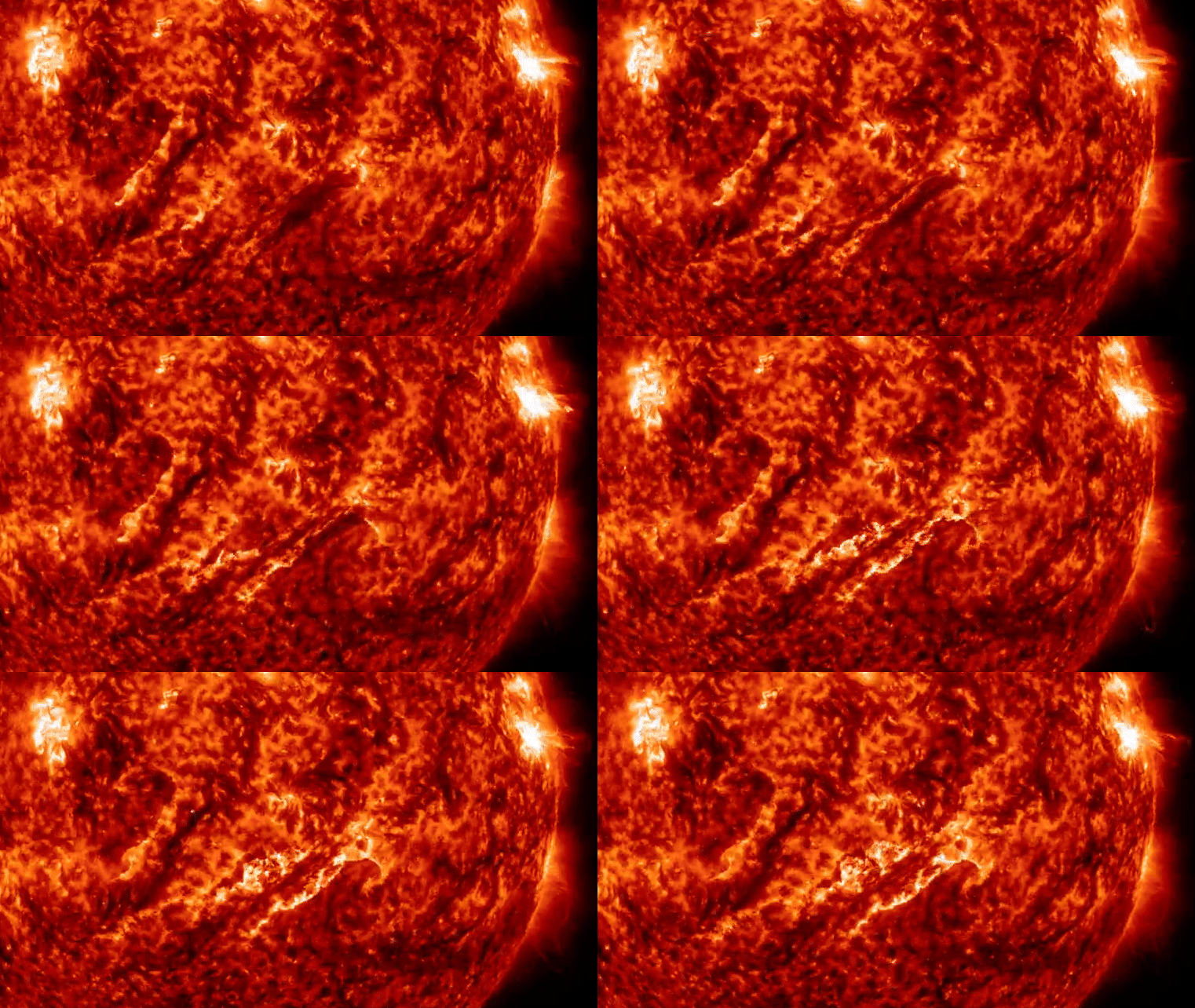
Heads up, aurora chasers! Earth's magnetic field is about to get a one-two punch from the sun — and the result could be an impressive show of northern lights stretching into mid-latitudes.
Read more: Rare double solar blast unleashes 2 CMEs towards Earth — auroras possible April 16
According to the NOAA Space Weather Prediction Center, the Kp index is expected to peak at 5 over the next 24 hours. The predicted Kp rises to 6 on April 16. For the latest forecast and timing details, check out NOAA's 3-day outlook.
Keep your eyes on the skies and your aurora alerts switched on!
Auroras incoming! G3 level Geomagnetic storm watch issued
NOAA's Space Weather Prediction Center has just increased the geomagnetic storm watch from G2 (moderate) to G3 (strong).
If G3 levels are reached on April 16, auroras could be visible as far south as Illinois and Oregon.
Keep your eyes on the skies and those aurora alerts switched on!

We have contact! CME impact detected hours earlier than expected
A CME has arrived! Arriving hours earlier than expected a CME struck Earth's magnetic field at 1 p.m. ET (1700 GMT) according to Spaceweather.com. At the time of writing it is currently too early to tell whether the impact is the first CME or maybe a combination of the two.
Currently, conditions are looking very promising for northern lights at high latitudes and even down into mid-latitudes. But space weather is fickle and conditions could change on a dime so keep your eyes on the skies when it becomes dark!
Wednesday, April 16: Great chance of northern lights at high latitudes as active geomagnetic conditions persist
Geomagnetic storms are likely to continue today after Earth received at least one CME hit on April 15 at around 1 p.m. ET (1700 GMT). The impact sparked 12 hours of minor (G1) and moderate (G2) geomagnetic storms which gave rise to some impressive northern lights at high latitudes.
A strong (G3) geomagnetic storm watch remains in place for today as conditions could intensify again, particularly if another CME arrives.
According to the NOAA Space Weather Prediction Center, the Kp index is expected to peak at 5.33 over the next 24 hours. For the latest forecast and timing details, check out NOAA's 3-day outlook.
G3 levels reached! Strong geomagnetic storm in progress
Earth is currently experiencing a strong G3 level geomagnetic storm. If conditions hold until the sun sets this could be very good news for aurora chasers, with northern lights possible deep into mid latitudes.
Strong G3 geomagnetic storm (Kp7)Threshold Reached: 14:18 UTCFollow live on https://t.co/Zkq26B89Y7 pic.twitter.com/dQhCfjsPsRApril 16, 2025
Thursday, April 17: Geomagnetic storm subsiding but still a fair chance of auroras at high latitudes
Wow! What a 24 hours it has been! Earth's magnetic field has been reverberating from the CME that struck on April 15. The impact sparked several geomagnetic storms from G1 to G3 and even a brief period of severe G4 levels, sparking northern lights deep into mid-latitudes.
Read more: Rare 'cannibal' solar eruption sparks severe geomagnetic storm, triggers stunning auroras (photos)
Though conditions are subsiding, there is still a good chance of northern lights at high latitudes tonight.
According to the NOAA Space Weather Prediction Center, the Kp index is expected to peak at 4.33 over the next 24 hours. For the latest forecast and timing details, check out NOAA's 3-day outlook.
Northern lights for tonight and the weekend
Relatively quiet skies tonight but possible geomagnetic storm Monday
After several days of auroral excitement fueled by a CME earlier this week, things have calmed down — for now. Geomagnetic activity has dropped below storm levels, and Earth's magnetic field is enjoying a breather. Over the past 24 hours, the greatest observed Kp index was 4, which is below NOAA's threshold for a G1 geomagnetic storm.
But don't pack up your camera gear just yet.
Though skies are mostly quiet, there's still a chance for auroras at high latitudes tonight as we ride out the last whispers of CME effects. The solar wind is still flowing at slightly elevated speeds (around 420 km/s), and the interplanetary magnetic field has remained moderately strong. However, a northward-pointing magnetic field has kept activity relatively tame.
According to the NOAA Space Weather Prediction Center, the Kp index is expected to hover below storm levels through April 20, peaking around 4. That's enough for northern lights near the Arctic Circle, but likely not enough to push auroras deep into mid-latitudes.
Looking ahead: A new player on the horizon
There's something brewing on the sun: a large coronal hole in the southeast. It's not Earth-facing just yet, but forecasters expect its high-speed solar wind to arrive by April 21. When it does, it could kick off another round of G1 (minor) geomanetic storm conditions — possibly even G2 (moderate) if everything lines up just right.
So while the aurora forecast is fairly quiet over the weekend, keep an eye on early next week. Monday night could bring another dance of lights to the skies — and we'll be here to keep you updated when it does.
Forecast at a glance:
- April 18–20 Kp Max: 4 (below storm level)
- Aurora potential: Moderate at high latitudes, low at mid-latitudes
- Next potential storm: April 21, due to high-speed solar wind from a large coronal hole
-- Daisy Dobrijevic
Monday, April 21: Moderate geomagnetic storm watch this week
There is a chance of moderate geomagnetic storm activity over the next three days thanks to high speed winds blowing from a hole in the sun's corona, the outermost part of its atmosphere.
These holes form when the sun's magnetic field opens, allowing streams of charged particles known as solar wind to flow towards Earth. When these particles reach earth on April 22 and 23, we could see the northern lights as far south as the northernmost parts of the United States. There is also a chance for minor to moderate radio blackouts on these days, according to NOAA.
The NOAA Space Weather Prediction Center projects that the Kp index will peak at 6 over the next 24 hours. For an up-to-date breakdown of timings, check out NOAA's 3-day forecast.
Tuesday, April 22: Geomagnetic storms likely as Earth is buffeted by fast solar winds
A stream of high-speed solar wind has arrived!
Earth is currently being buffeted by high-speed solar winds spewing from a colossal coronal hole on the sun.
The elevated solar wind conditions could spark geomagnetic storm conditions, with a chance of G1 (minor) to isolated G2 (moderate) geomagnetic storms. If conditions align, this could bring auroras to mid-latitude locations during peak activity!
The NOAA Space Weather Prediction Center projects that the Kp index will peak at 4.67 over the next 24 hours. For an up-to-date breakdown of timings, check out NOAA's 3-day forecast.
Wednesday, April 23: Possible northern lights at high latitudes tonight
There's a glimmer of aurora potential in the next 24 hours, especially for skywatchers in high-latitude regions.
Fast solar winds from a coronal hole are currently sweeping past Earth, with the added possibility of a glancing blow from a possible coronal mass ejection (CME). While geomagnetic activity has been relatively calm, there’s still a chance of G1 (Minor) geomagnetic storms through today and into tomorrow.
In the Northern Hemisphere, those in northern Scotland and similar latitudes could catch occasional auroral displays—weather permitting—though activity is expected to trend downward. The Southern Hemisphere has a similar outlook, with a chance of auroras brushing the far south of New Zealand.
The sun has been moderately active, with several sunspot regions developing, so more surprises can't be ruled out. For now, keep an eye on the northern or southern horizon if you're in the right spot — and maybe have your camera ready, just in case!
Thursday, April 24: We have contact! CME impact detected, northern lights possible at high latitudes
There's a good chance of northern lights at high latitudes tonight as Earth has just been impacted by a coronal mass ejection (CME).
CMEs are plumes of plasma and magnetic field from the sun. When they strike Earth's magnetic field, they can trigger geomagnetic storms, which in turn spark strong aurora displays deep into mid-latitudes.
In addition to the CME impact, fast solar winds are currently sweeping past Earth, fuelled by a large coronal hole on the surface of the sun.
The NOAA Space Weather Prediction Center projects that the Kp index will peak at 4 over the next 24 hours. For an up-to-date breakdown of timings, check out NOAA's 3-day forecast.
Aurora forecast for tonight and the weekend: Quiet start but weekend glimmers possible
The aurora forecast kicks off quietly, but skywatchers at higher latitudes should stay alert this coming weekend. A minor geomagnetic storm (G1) is possible, offering a flicker of hope for northern lights across northern Scotland and similar geomagnetic latitudes.
This potential activity is linked to a resurgence in fast solar wind from a southern hemisphere coronal hole, brushing past Earth over the weekend. While not a guaranteed northern lights event, conditions could become favorable for brief displays, especially under clear, dark skies.
Solar activity remains relatively low, with no major flares or Earth-directed CMEs expected in the coming days. However, a handful of complex sunspot regions continue to evolve, keeping forecasters on alert for any surprises.
The NOAA Space Weather Prediction Center projects that the Kp index will peak at 4 over the weekend. For an up-to-date breakdown of timings, check out NOAA's 3-day forecast.
Monday, April 28: Fair chance of northern lights at high latitudes tonight
Quiet solar conditions persist, leaving northern lights primarily confined to high latitudes for 24 to 48 hours.
The NOAA Space Weather Prediction Center projects that the Kp index will peak at 3 over the next 24 hours. For an up-to-date breakdown of timings, check out NOAA's 3-day forecast.
Tuesday, April 29: Quiet conditions but something big is coming...
The sun has been crackling with M-class solar flares today but current geomagnetic conditions appear to be relatively calm. Northern lights will be mainly confined to higher latitudes.
But something might be coming to shake things up! A large sunspot region is beginning to emerge from the sun's northeastern limb. According to spaceweather.com, region 4079 appears to be the "second coming of sunspot 4055," which grew considerably during its two-week voyage around the far side of the sun.
Scientists will be keeping a watchful eye on sunspot region 4079 to see if it holds any promise of powerful solar flares or CMEs, which in turn can trigger geomagnetic storms and vivid aurora displays.
The NOAA Space Weather Prediction Center projects that the Kp index will peak at 2.33 over the next 24 hours. For an up-to-date breakdown of timings, check out NOAA's 3-day forecast.
Wednesday, April 30: Relatively quiet conditions for now, but things could heat up in coming days
Keep your eyes on the skies!
While solar winds remain fairly calm, a fast stream from a coronal hole could stir up minor geomagnetic storms between May 1–2. This means there's a chance for auroras, especially at higher latitudes.
Several active sunspot regions, including a large one (region 4079) rotating into view, are firing off moderate solar flares, adding some extra spark to space weather. No major coronal mass ejections (CMEs) are headed our way, but conditions may still get lively in the coming days.
The NOAA Space Weather Prediction Center projects that the Kp index will peak at 1.67 over the next 24 hours. For an up-to-date breakdown of timings, check out NOAA's 3-day forecast.
Thursday May 1: Unsettled conditions with a chance of X-flares
Elevated solar wind streams from an Earth-facing coronal hole have arrived, sparking minor G1 geomagnetic storms. Unsettled conditions are expected to continue through May 2, northern lights likely at high latitudes.
The NOAA Space Weather Prediction Center projects that the Kp index will peak at 3 over the next 24 hours. For an up-to-date breakdown of timings, check out NOAA's 3-day forecast.
A large sunspot region continues to turn to face Earth, region 4079 now has a 10% chance of an X-flare according to Space Weather Live. Space weather forecasters are watching this region closely. If you have solar viewing accessories such as solar binoculars or even solar eclipse glasses, you may also see the sunspot for yourself! It's currently visible on the sun's northeastern limb (upper left portion) and will rotate to face us in the coming days. Remember, NEVER look at the sun without appropriate safety equipment.
Related: How to observe the sun safely (and what to look for)
Aurora forecast for tonight and the weekend: Northern lights possible tonight with more aurora chances Sunday into Monday
Heads up, aurora chasers! A fast-moving stream of solar wind from a coronal hole is currently buffeting Earth’s magnetic field. Minor G1-class geomagnetic storm levels were reached early this morning, 00:59 EDT (0459 GMT), Friday, May 2. There’s also a slight chance the storm could intensify to a moderate G2-level, boosting aurora visibility farther south than usual.
If the stronger activity materializes, northern-tier U.S. states like Montana, North Dakota, Minnesota, and parts of the Great Lakes region could catch a glimpse of the northern lights over the weekend, especially where skies are clear and light pollution is low.
What to expect this weekend:
May 2 (Friday): Minor storm conditions (G1) are likely during the early morning hours UTC, with a chance of reaching G2. Watch the skies tonight!
May 3 (Saturday): A quieter spell is expected, with geomagnetic activity likely dropping to unsettled or quiet levels.
May 4–5 (Sunday–Monday): Activity may ramp up again late Sunday into Monday as Earth connects with another high-speed solar wind stream from a second coronal hole. This could trigger isolated G1-class storm intervals and another shot at aurora sightings.
The NOAA Space Weather Prediction Center projects that the Kp index will peak at 3.67 over the weekend. For an up-to-date breakdown of timings, check out NOAA's 3-day forecast.
Tuesday, May 6: Minor geomagnetic storms possible tonight, northern lights possible at high latitudes
Good news aurora chasers, we may be in for more minor (G1) geomagnetic storms tonight. Northern lights are possible at high latitudes.
Space weather forecasters are keeping an eye on Earth's magnetic field as a fast solar wind stream continues to blow from a coronal hole. This has sparked Unsettled to Active geomagnetic conditions over the past 24 hours, with a chance of G1 (Minor) geomagnetic storms through tonight and into May 7, according to the U.K. Met Office.
While solar activity remains low overall, four sunspot regions are visible on the sun, including one with increasing magnetic complexity — a potential source of future flares. A recent filament eruption could deliver a glancing blow of plasma late on May 7, possibly enhancing auroral activity.
The NOAA Space Weather Prediction Center projects that the Kp index will peak at 4 over the next 24 hours. For an up-to-date breakdown of timings, check out NOAA's 3-day forecast.
For now, high-latitude skywatchers have the best chance of catching the northern lights tonight, especially under clear, dark skies.
Wednesday, May 7: Possible glancing blow from CME could spark auroras tonight
If you're hoping to catch a glimpse of the northern lights tonight, there's a chance, especially if you're located at high latitudes.
A combination of two events could make aurora sightings possible tonight and into early Thursday (May 8). A high-speed stream of solar wind is currently buffeting Earth's magnetic field. Though it is beginning to ease, it is still strong enough to contribute to geomagnetic activity. Earth could also receive a glancing blow from a coronal mass ejection (CME) — a vast plume of plasma and magnetic field from the sun — late tonight or early Thursday. If it does hit, it could enhance aurora visibility, though space weather forecasters caution that this impact is of low confidence.
Together, these space weather events could produce Minor Geomagnetic Storm (G1) conditions, meaning the aurora could become visible in northern parts of Canada, Alaska, Scandinavia, and other high-latitude regions.
The NOAA Space Weather Prediction Center projects that the Kp index will peak at 3 over the next 24 hours. For an up-to-date breakdown of timings, check out NOAA's 3-day forecast.
Thursday, May 8: Northern lights possible tonight but conditions look better for tomorrow
Aurora watchers at high latitudes may see the northern lights tonight, though conditions are looking quieter than earlier this week. Solar wind activity from a coronal hole high-speed stream is gradually declining, and geomagnetic activity is expected to remain mostly quiet to unsettled through tonight, with only a slight chance of G1 (Minor) storm conditions.
The best chances for aurora sightings tonight are in high-latitude regions like northern Canada, Alaska, Scandinavia, and potentially northern Scotland or Iceland — especially under clear, dark skies.
The NOAA Space Weather Prediction Center projects that the Kp index will peak at 3.67 over the next 24 hours. For an up-to-date breakdown of timings, check out NOAA's 3-day forecast.
Looking ahead, the outlook improves for Friday, May 9. A new high-speed stream from a southern coronal hole is expected to arrive, possibly boosting geomagnetic activity. Minor (G1) geomagnetic storm conditions are likely tomorrow, according to NOAA's Space Weather Prediction Center.
There's also a low chance of a glancing CME impact. Together, these could enhance aurora visibility tomorrow night, particularly at high latitudes.
Northern lights forecast for tonight and the weekend: Active conditions will taper off through the weekend
If you're hoping to see the northern lights this weekend, tonight (May 9) might be your best chance as minor (G1) geomagnetic storms are possible thanks to a possible glancing blow from a recent coronal mass ejection (CME) and enhanced solar wind from a coronal hole. The best chances will be at high latitudes under clear, dark skies.
Through the weekend (May 10–11), activity is expected to taper slightly, with conditions ranging from quiet to unsettled (Kp 1–3). Brief active periods (Kp 4) can't be ruled out as the solar wind remains elevated.
The NOAA Space Weather Prediction Center projects that the Kp index will peak at 4.67 over the weekend. For an up-to-date breakdown of timings, check out NOAA's 3-day forecast.
Solar activity remains low overall, but there's a continuing chance of moderate-class flares from a large sunspot group, which may spark short radio blackouts but are unlikely to impact auroras.
Keep your eyes on the skies and check real-time aurora trackers tonight—aurora chasers in northern regions could be in for a treat!
Forecast for the weekend courtesy of space weather physicist Tamitha Skov
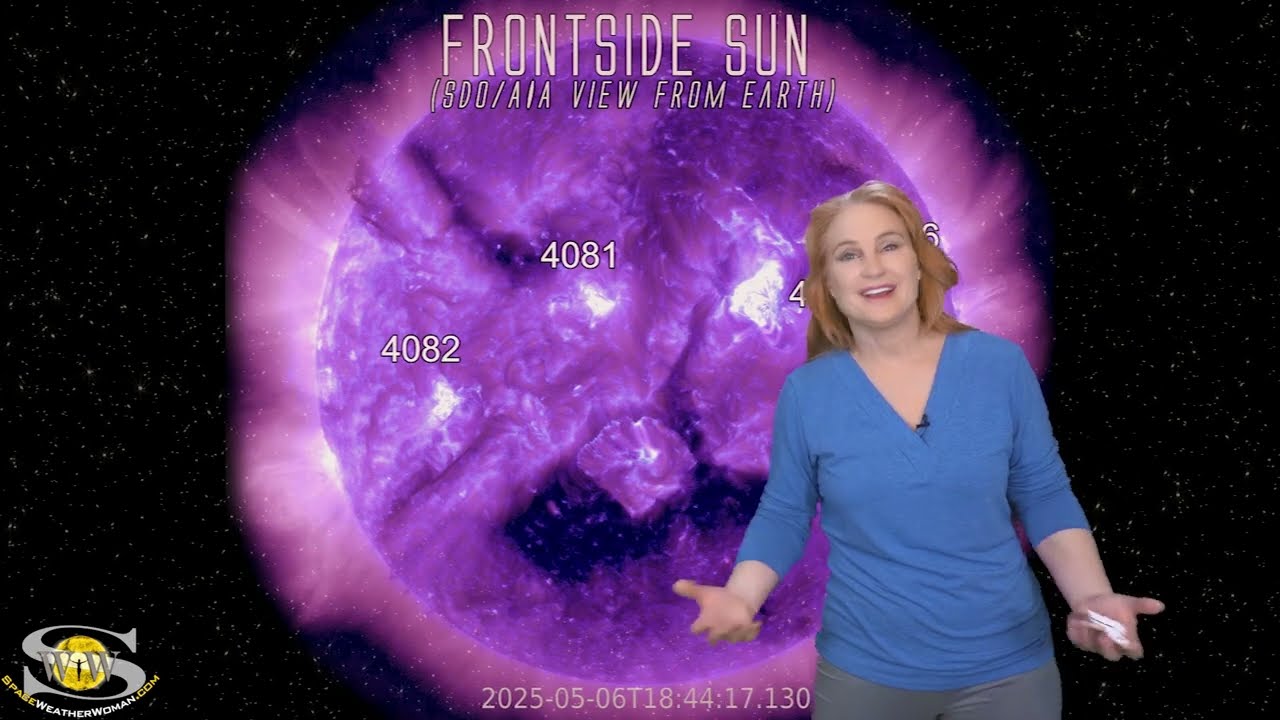
Northern Hemisphere aurora forecast courtesy of the Met Office
Monday, May 12: Mildly active conditions could spark northern lights tonight
There's a fair chance of northern lights tonight (May 12) and into tomorrow (May 13) as space weather conditions remain mildly active.
Over the past 24 hours, moderately strong solar wind and fluctuating magnetic fields sparked a minor geomagnetic storm (G1), which peaked late in the evening.
Looking ahead, more unsettled space weather is expected to continue through May 13 and into May 14, with another possible G1 storm on the horizon. That means skies could stay aurora-friendly, especially for northern-tier locations under clear, dark skies.
The NOAA Space Weather Prediction Center projects that the Kp index will peak at 3.67 over the weekend. For an up-to-date breakdown of timings, check out NOAA's 3-day forecast.
While no major solar eruptions are currently aimed at Earth, the solar wind remains enhanced due to lingering coronal hole activity, making this a good time to keep an eye out if you're in the right location. Stay tuned for updates!
Tuesday, May 13: Mostly quiet between brief enhancements
If you're hoping to catch the northern lights tonight, there’s a small chance, especially early in the evening and again later this week.
Minor geomagnetic activity may boost auroras, potentially pushing them down to northern Scotland and similar latitudes where skies are clear and dark. However, don’t expect a major show — activity is mostly quiet between these brief enhancements.
Solar wind is slowly picking up again as a new high-speed stream arrives, which could mean better chances later in the week.
Last night, around midnight GMT, a colossal filament stretching almost a million kilometers across the sun's northern hemisphere erupted. It's likely that the debris from the eruption will miss Earth but forecasters are still analyzing the trajectory. Confirmation awaits fresh data from SOHO coronagraphs, according to Spaceweather.com.
Skies clear? It’s worth a look — but manage expectations. The best may be yet to come.
Wednesday, May 14: Quiet conditions for tonight but activity may pick up later in the week
Though the sun has been erupting with several strong solar flares and filament eruptions in recent days, there are no signs of any incoming coronal mass ejections (CMEs), which can shake up geomagnetic conditions on Earth.
The northern lights will be confined to high latitudes tonight. There is a possibility of minor enhancement through May 15 and 16 when a faster solar wind stream from a coronal hole is expected to arrive, according to the U.K. Met Office.
The NOAA Space Weather Prediction Center projects that the Kp index will peak at 2.67 over the weekend. For an up-to-date breakdown of timings, check out NOAA's 3-day forecast.
Thursday, May 15: High solar activity, but not Earth-facing
The sun has been crackling with activity this week, releasing several strong solar flares and filament eruptions, but no incoming coronal mass ejections (CMEs) are expected to reach Earth and cause geomagnetic storms.
That means the northern lights will likely only be seen at high latitudes close to the poles tonight. However, we could see a slight chance of increased geomagnetic activity on May 15 and 16 when a stream of solar wind stream arrives, according to the U.K. Met Office. This could give rise to a slight change of minor (G1) geomagnetic storms, possibly causing auroras as far south as northern Scotland and similar latitudes, the Met Office writes.
The NOAA Space Weather Prediction Center projects that the Kp index will peak at 3.67 over the weekend. For an up-to-date breakdown of timings, check out NOAA's 3-day forecast.
Northern lights forecast for tonight and the weekend: Slight chance of minor activity
Minor geomagnetic storms are likely on Sunday (May 18), but aurora activity looks to be fairly normal to quiet this weekend.
A high-speed stream of solar wind from a coronal hole, a gap where the sun's magnetic field opens up and allows charged particles to flow freely into space, could reach Earth on May 18 and lead to G1 (Minor) geomagnetic storm conditions, according to NOAA.
However, active sunspot region 4087 could produce strong solar flares over the next week as it continues to rotate towards us, so could see increased northern lights activity.
The NOAA Space Weather Prediction Center projects that the Kp index will peak at 4.67 over the weekend. For an up-to-date breakdown of timings, check out NOAA's 3-day forecast.
Monday, May 19: Some aurora activity possible tonight but solar wind speeds begin to fade
Heads up, aurora chasers! There’s still a chance for northern lights tonight (May 19) as Earth remains under the influence of a high-speed solar wind stream from a coronal hole. Minor (G1) geomagnetic storm conditions are possible at high latitudes, especially in the early hours.
The NOAA Space Weather Prediction Center projects that the Kp index will peak at 3.67 over the weekend. For an up-to-date breakdown of timings, check out NOAA's 3-day forecast.
However, this storm has likely peaked. As the solar wind stream weakens, aurora chances will gradually decline through May 20–21. No Earth-directed coronal mass ejections (CMEs) are expected, and solar activity remains low overall.
Look up tonight if you’re at high latitudes — especially in clear, dark skies — but expect quieter space weather later in the week. Stay tuned for updates if anything changes!
Tuesday, May 20: Glancing CME blow could boost midweek aurora chances
A complex week of space weather could give skywatchers a slight edge in the hunt for northern lights.
A magnetic filament erupted from the sun's northern hemisphere late on May 18, hurling a coronal mass ejection (CME) into space. NOAA forecasters predict this CME may deliver a glancing blow to Earth’s magnetic field around May 23, potentially sparking minor geomagnetic activity.
In the meantime, Earth remains under the influence of a waning high-speed solar wind stream from a coronal hole in the sun's southern hemisphere. Solar wind speeds have dropped from over 600 km/s to around 450–500 km/s, keeping geomagnetic conditions mostly quiet to unsettled. Still, brief active periods remain possible through May 22.
The chances for northern lights remain modest in both hemispheres. Though no major storms are expected, the quiet-to-active range could still deliver subtle auroras, especially if the glancing CME impact arrives as predicted.
The NOAA Space Weather Prediction Center projects that the Kp index will peak at 3.67 over the next 24 hours. For an up-to-date breakdown of timings, check out NOAA's 3-day forecast.
Wednesday, May 21: Fast solar winds continue, minor geomagnetic storm possibe May 23
Today’s space weather remains relatively calm, though the sun continues to send fast solar wind our way, which is good news for those wishing to see the northern lights.
Solar wind speeds have climbed to over 600 km/s, thanks to a sprawling coronal hole in the southern hemisphere.
The real action may arrive on May 23, when a weak coronal mass ejection (CME)could deliver a glancing blow to Earth’s magnetic field. Combined with lingering high-speed winds, this could spark G1-class (Minor) geomagnetic storms, particularly at high latitudes.
Aurora visibility will be limited, especially in the Northern Hemisphere, where nights are getting shorter, but southern observers in areas like southern New Zealand or Antarctica could catch a glimpse if skies stay clear.
Thursday, May 22: Minor geomagnetic storm possible May 23
If you're hoping to catch a glimpse of the northern lights, keep your eyes on the skies over the next couple of nights — especially if you're at higher latitudes.
A glancing blow from a coronal mass ejection (CME) might reach Earth’s magnetic field on May 23, potentially triggering a G1-class (minor) geomagnetic storm, according to NOAA's Space Weather Prediction Center. But this is far from a certain forecast as the CME might miss us entirely.
The NOAA Space Weather Prediction Center projects that the Kp index will peak at 2.67 over the next 24 hours. For an up-to-date breakdown of timings, check out NOAA's 3-day forecast.
Meanwhile, Earth is still feeling the effects of fast solar wind streaming from a coronal hole, keeping solar wind speeds elevated (currently around 550 km/s). These enhanced conditions could offer brief and subtle boosts to auroral activity, especially tonight (May 22) and into Friday.
If the CME does arrive as forecast on Friday, we could see a short-lived increase in geomagnetic activity, possibly lifting auroras into slightly more southerly latitudes than usual — though not dramatically so. Active conditions (Kp 4) are the most likely outcome, with a small chance of G1 storming (Kp 5) if the timing and orientation of the solar wind are just right.
Aurora forecast for tonight and the weekend: A relatively quiet but watchful weekend ahead
The northern lights forecast for the weekend remains on the quieter side, but skywatchers at higher latitudes may still have reason to look up.
The NOAA Space Weather Prediction Center projects that the Kp index will peak at 3.67 over the weekend. For an up-to-date breakdown of timings, check out NOAA's 3-day forecast.
Earth's magnetic field still feels the lingering effects of a high-speed solar wind stream from a coronal hole, with minor enhancements expected to taper off by May 25.
The combination of waning high speed solar wind influence and a possible glancing blow of a CME from a May 17 filament eruption could produce brief auroral enhancements, especially overnight on Friday (May 23).
While this weekend may not deliver a major aurora show, those in Alaska, Canada, and parts of Scandinavia should keep an eye on the skies, especially Friday night, for a potential northern lights display.
Tuesday, May 27: Fair chance of auroras at high latitudes tonight
Solar activity is heating up, which is great news for those chasing the northern lights!
Over the past 24 hours, two moderate (M-class) solar flares erupted from the sun, with one powerful blast launching a coronal mass ejection (CME). Though it's not headed our way, the sun's surface remains active, and more M-class flares are likely through May 29, with a slight chance for even stronger X-class flares.
Meanwhile, fast solar winds from a series of coronal holes are set to buffet Earth’s magnetic field starting late May 27. This could bring unsettled to storm-level (G1/minor) geomagnetic activity on May 28–29, especially as wind speeds rise.
The NOAA Space Weather Prediction Center projects that the Kp index will peak at 3.67 over the next 24 hours. For an up-to-date breakdown of timings, check out NOAA's 3-day forecast.
There are also a few interesting sunspot regions beginning to rotate into view, which could spark active conditions in the coming days.
Aurora watchers, stay tuned! While activity is limited for now, viewing conditions may improve in high latitudes later this week.
Forecast for the week ahead courtesy of space weather physicist Tamitha Skov
Wednesday, May 28: Multiple coronal holes could bring promising aurora conditions over coming days
Multiple coronal holes are now facing Earth, including a large transequatorial coronal hole. These coronal holes are gaps in the sun's magnetic field that allow charged particles to escape into space as high-speed solar wind streams.
Fast streams from the coronal holes could stir up minor geomagnetic storms over the coming days. This means there's a chance for auroras, especially at higher latitudes.
We're already feeling the effects of some of these fast-moving streams. NOAA forecasters have issued a minor (G1) geomagnetic storm watch for today.
Additional solar wind streams — including one from the large transequatorial coronal hole — are expected to impact Earth in the next 3–4 days.
The NOAA Space Weather Prediction Center projects that the Kp index will peak at 4 over the next 24 hours. For an up-to-date breakdown of timings, check out NOAA's 3-day forecast.
Thursday, May 29: Surprise strong geomagnetic storm triggers auroras as far south as Italy
A forecasted minor (G1) geomagnetic storm briefly intensified into a strong (G3) geomagnetic storm overnight, as a fast solar wind stream triggered stronger-than-expected geomagnetic activity and striking northern lights.
This is not an unforecasted #solarstorm! It is a stronger than expected fast solar wind stream hitting Earth now! Turns out, this fast wind is causing G3 conditions, at least briefly. Expect HF #radio & #GPS issues on Earth's nightside plus sporadic #aurora down to mid latitudes! https://t.co/RFG0OfBofiMay 29, 2025
G3 storm conditions were observed at 10:16 p.m. EDT on May 28 (0216 GMT on May 29). Auroras were reported as far south as Italy (45.9°N).
Aurora visible down to north Italy! Aurora was briefly caught in the brightening morning twilight sky from Cima Pora, north Italy (45.9°N) this morning. The activity was caused by a brief period of favourable solar wind parameters within CIR and the fast solar wind stream from… pic.twitter.com/lU9TqUiDk3May 29, 2025
The culprit? A co-rotating interaction region (CIR) that struck our planet overnight.
These regions form when fast-moving solar wind catches up with slower wind, creating turbulent boundaries. CIRs can contain coronal mass ejection-like shock waves, making them surprisingly effective at triggering geomagnetic storms and stunning auroras.
Additional solar wind streams — including one from the large transequatorial coronal hole — are expected to impact Earth in the next 2-3 days.
The influence of strong solar wind is expected to continue over the coming days, so keep your eyes on the skies and your aurora alerts switched on!
The NOAA Space Weather Prediction Center projects that the Kp index will peak at 4.33 over the next 24 hours. For an up-to-date breakdown of timings, check out NOAA's 3-day forecast.
Aurora forecast for tonight and the weekend: Enhanced solar wind may bring northern lights to mid-latitudes this weekend
A fast solar wind stream from a large coronal hole on the sun is stirring up Earth’s magnetic field, increasing the chances for northern lights sightings through tonight and into the weekend.
While geomagnetic activity has already hit G2 (moderate storm) levels, forecasts suggest G1 (minor storm) conditions are likely to continue through Saturday, with a few stronger intervals possible.
For skywatchers in the Northern Hemisphere, that means a chance of auroras over northern Scotland and similar geomagnetic latitudes. If the magnetic field orientation continues to cooperate, brief displays could push farther south across Scotland during clear, dark windows. However, limited nighttime darkness at this time of year may reduce viewing opportunities, especially at higher latitudes. In the Southern Hemisphere, the auroral oval is expected to stay near Antarctica, but a faint glow could be visible from the South Island of New Zealand late Friday night, if skies are clear and conditions hold.
Solar winds remain strong, hovering between 600–800 km/s, and are likely to stay elevated into Sunday.
The NOAA Space Weather Prediction Center projects that the Kp index will peak at 4.67 over the weekend. For an up-to-date breakdown of timings, check out NOAA's 3-day forecast.
Keep an eye on the sky — this weekend could deliver.
Saturday May 31: Head's up aurora chasers CME incoming!
Get those cameras charged and those aurora notifications switched on, we could be in for a real treat tonight.
In the early hours of May 31, the sun released a giant coronal mass ejection (CME) — a plume of plasma and magnetic field — and Earth is in the firing line.
Space weather forecasters are anticipating that the incoming CME will hit tonight and could trigger strong (G3) to severe (G4) geomagnetic storm conditions.
Read more: Aurora alert: Severe geomagnetic storm could spark northern lights as far south as Alabama and northern California tonight
Sunday, June 1: Solar storm has sparked severe G4 geomagnetic storm conditions!
As predicted, a coronal mass ejection struck Earth and has sparked severe (G4) geomagnetic storm conditions during the night! Auroras are being reported deep into mid-latitudes, including northern California and New Mexico!
Severe G4 geomagnetic storm (Kp8)Threshold Reached: 08:00 UTCFollow live on https://t.co/Zkq26B89Y7 pic.twitter.com/tsIWentR3PJune 1, 2025
Call for aurora photos
If you've captured a photo of the impressive northern lights or southern lights display, please send it to spacephotos@space.com along with any comments on how it felt to see the show, along with where and when the photograph was taken. You'll then be sent our image use agreement, which you'll need to agree to before we consider using your image.
Here's hoping the promising conditions hold for tonight!
Impressive live views from Tasmania as geomagnetic storm conditions continue
While dawn may be breaking for those of us in the Western Hemisphere, impressive aurora shows are continuing down under! The livestream below from Tasmania shows a stunning red show currently underway.
Sunday, June 1: Ongoing geomagnetic storm conditions could trigger yet more auroras tonight
Great news, aurora chasers! The northern lights may once again be visible deep into mid latitudes tonight as geomagnetic storm conditions continue to wreak havoc with Earth's magnetic field.

Monday, June 2: Good chance of auroras at high latitudes again tonight
What a weekend of geomagnetic activity! But alas, all good things must come to an end.
We're now seeing the final effects of the coronal mass ejection that hit in the early hours of June 1.
High-latitude skywatchers still have a chance to catch the northern lights tonight. Space weather forecasters at the U.K. Met Office predict unsettled to active conditions overnight tonight with a chance of minor (G1) geomagnetic storm intervals.
The NOAA Space Weather Prediction Center projects that the Kp index will peak at 5 over the next 24 hours. For an up-to-date breakdown of timings, check out NOAA's 3-day forecast.
Read more: Severe G4 geomagnetic storm sparks northern lights across US and beyond (photos)
Monday, June 2: Aurora chances for tonight are improving due to ongoing geomagnetic storm
Good news aurora chasers! We might be in for another treat tonight as geomagnetic activity continues to wreak havoc on Earth's magnetic field.
The direction of the interplanetary magnetic field, especially its north-south orientation (known as Bz), plays a key role in aurora activity.
The Bz has been oriented south for quite some time, fingers crossed it holds for tonight!
When Bz points south, it links up with Earth's magnetic field, which points north, just like how opposite poles of magnets snap together. This connection can disturb Earth’s magnetic field, letting charged particles stream into our atmosphere. As these particles travel along magnetic field lines and collide with oxygen and nitrogen in the air, they create auroras.
The NOAA Space Weather Prediction Center projects that the Kp index will peak at 6.67 over the next 24 hours. For an up-to-date breakdown of timings, check out NOAA's 3-day forecast.
We will have to wait and see! Keep those fingers crossed, aurora alerts switched on and your eyes firmly fixed on the skies!
Tuesday, June 3: Geomagnetic activity winding down, but there’s still hope!
Wow, what a run it's been!
Coronal mass ejections (CMEs) kept geomagnetic storms going strong all weekend through today, lighting up skies across high latitudes with some spectacular aurora displays.
As of today, things are finally calming down. The strongest activity (Kp 7, G3) is expected to taper off through June 3. We may still see minor to moderate storm levels (Kp 4–5, G1–G2), particularly early today and again late on June 5.
There's still a chance for auroras at high latitudes tonight, thanks to a stream of fast solar wind from a coronal hole. Skywatchers in far northern locations — like Alaska, northern Canada, or Scandinavia — should keep an eye on the skies just in case.
The NOAA Space Weather Prediction Center projects that the Kp index will peak at 4.67 over the next 24 hours. For an up-to-date breakdown of timings, check out NOAA's 3-day forecast.
Wednesday, June 4: Auroras still possible as solar wind takes the reins
After a burst of geomagnetic activity and stunning northern lights earlier this week, Earth's magnetic field is starting to settle — but not completely.
As we move into tonight and tomorrow (June 4–5), the show isn't entirely over. A shift is underway from that fading CME to a stream of fast solar wind from a coronal hole — a darker region on the sun where charged particles escape more easily into space. This change could spark minor geomagnetic storms (G1 level), fueling auroras, especially at high latitudes.
Activity will likely be more subdued than recent nights, but there’s still a chance of faint auroras if skies are dark and clear. As always, the best opportunity to catch them is around local midnight — and far from city lights.
The NOAA Space Weather Prediction Center projects that the Kp index will peak at 5 over the next 24 hours. For an up-to-date breakdown of timings, check out NOAA's 3-day forecast.
Thursday, June 5: Northern lights mainly confined to high latitudes tonight
As geomagnetic activity returns to background levels, the northern lights will mainly be confined to high latitudes.
Activity may pick up again around June 7 when Earth could receive a glancing blow from a relatively slow coronal mass ejection (CME) — a vast plume of plasma and magnetic field from the sun.
The NOAA Space Weather Prediction Center (SWPC) forecasts that the CME may hit by mid to late June 7 (UTC), while the UK Met Office places the arrival time slightly earlier, on Friday night (UTC).
If the CME strikes Earth, we could see an increase in solar wind speed and the potential for minor (G1) level geomagnetic storms, which may push the northern lights as far south as northern Michigan and Maine.
The NOAA Space Weather Prediction Center projects that the Kp index will peak at 4 over the next 24 hours. For the latest breakdown, check out NOAA's 3-day forecast.
Aurora forecast for tonight and the weekend: Incoming weak solar storm could spark minor geomagnetic storm this weekend

Good news aurora chasers! A coronal mass ejection (CME) from a solar filament eruption on June 3 is on its way to Earth and could give aurora chasers a treat this weekend.
The NOAA Space Weather Prediction Center (SWPC) says Earth could receive a glancing blow from the CME by mid to late June 7 (UTC), while the UK Met Office places the arrival time slightly earlier, on Friday night (UTC).
If the CME arrives, it's expected to stir up geomagnetic activity. Both NOAA SPWPC and the U.K. Met Office predict minor (G1) geomagnetic storm conditions, but there's potential for isolated moderate (G2) storms if the CME combines with the ongoing high-speed solar wind from an Earth-facing coronal hole.
The NOAA Space Weather Prediction Center projects that the Kp index will peak at 4.67 over the weekend. For the latest breakdown, check out NOAA's 3-day forecast.
Monday, June 9: Fair chance of northern lights at high latitudes
Due to waning geomagnetic activity, the northern lights will mainly be confined to high latitudes tonight.
Earth is still feeling some of the lingering effects from the coronal mass ejection (CME) arrival on June 3, but activity is now starting to taper off.
It's possible that Earth could receive a glancing blow early on June 12 from a CME that left the sun in the early hours of June 8.
According to the U.K. Met Office, the greatest chance of a minor (G1) geomagnetic storm is on June 12.
The NOAA Space Weather Prediction Center projects that the Kp index will peak at 3.67 over the next 24 hours. For the latest breakdown, check out NOAA's 3-day forecast.

Tuesday, June 10: Minor geomagnetic storms could stir up auroras over coming days
Skywatchers, keep your eyes on the north.
A couple of coronal mass ejections (CMEs) are heading Earth's way, and combined with a persistent stream of fast solar wind, we could see minor geomagnetic storm conditions (G1) today, according to the U.K. Met Office.
Confidence is lower than usual, thanks to the complex timing and interaction of these incoming features. But if conditions are right, the northern lights could make an appearance across high-latitude skies tonight — especially over parts of Canada, Alaska, Scandinavia, and northern Russia.
This week, however, is not ideal for aurora hunting as the full moon combined with summer twilight makes for challenging aurora viewing conditions.
Solar wind speeds remain elevated (450–500 km/s), and Earth's magnetic field is feeling the squeeze, with occasional unsettled to active periods. Another faint CME is on the radar for June 12, which could bring another chance for auroras later this week.
NOAA's Space Weather Prediction Center projects that the Kp index will peak at 3 over the next 24 hours. For the latest breakdown, check out NOAA's 3-day forecast.
Wednesday, June 11: Northern lights possible at high latitudes but quiet skies for most
Mild solar wind from a coronal hole is still brushing past Earth, keeping geomagnetic conditions mostly unsettled to active. However, no strong storms are expected, and auroras will likely stay confined to high geomagnetic latitudes — think far northern Canada, Alaska, or northern Scandinavia.
Unfortunately for northern watchers, the bright summer skies near the solstice will make viewing difficult, even where activity occurs. In the Southern Hemisphere, regions like Tasmania and southern New Zealand have better dark-sky chances, but activity is still expected to be low.
A glancing coronal mass ejection may arrive later this week, and a second coronal hole could boost activity again by June 14, offering better viewing potential. We will just have to wait and see.
NOAA's Space Weather Prediction Center projects that the Kp index will peak at 4 over the next 24 hours. For the latest breakdown, check out NOAA's 3-day forecast.
Thursday, June 12: Auroras possible at high latitudes tonight, conditions improving for June 14
There is a slight chance of minor (G1) geomagnetic storm conditions tonight due to lingering effects from a coronal hole high-speed stream, according to the U.K. Met Office. The northern lights may be visible at high latitudes and could dip as far south as northern Scotland and similar regions, though short summer nights may limit visibility.
Conditions are expected to settle slightly by June 13, but activity is forecast to intensify again by June 14, when a moderate (G2) geomagnetic storm is expected as a large coronal hole rotates to face Earth. Coronal holes are regions where the sun’s magnetic field opens up, allowing solar wind to escape more easily and stream through space at high speeds. The predicted increase in geomagnetic activity on June 14 is driven by a co-rotating interaction region (CIR) — a turbulent zone in the solar wind where fast-moving streams catch up and collide with slower ones ahead of them.
NOAA's Space Weather Prediction Center projects that the Kp index will peak at 3.67 over the next 24 hours. For the latest breakdown, check out NOAA's 3-day forecast.
Aurora forecast for tonight and the weekend: Chance of geomagnetic storms due to incoming turbulent space weather
Heads up, aurora chasers! A solar wind stream from a coronal hole, possibly combined with a glancing blow from a June 8 coronal mass ejection (CME), is set to stir up Earth’s magnetic field over the next few days.
Read more: Northern lights may be visible in these 18 US states tonight and over the weekend
NOAA's Space Weather Prediction Center (SWPC) forecasts G1 (minor) to G2 (moderate) geomagnetic storm conditions early Friday, June 13, with activity possibly peaking again Saturday night. The geomagnetic Kp index could reach as high as 5.67 during the Friday overnight hours (03–06 UTC and 21–00 UTC), meaning auroras may become visible as far south as the northern U.S., Scotland, southern Canada, and similar latitudes — weather and darkness permitting.
By Saturday, activity is expected to taper slightly but could still reach G1 levels (Kp 4.67–5.67) in short bursts due to continued influence from a high-speed solar wind stream. Sunday looks quieter, though unsettled conditions may linger.
The U.K. Met Office notes that short nights in the northern hemisphere will limit visibility, so your best bet is to seek out dark skies away from city lights and check the skies in the early hours before dawn.
Auroras will be most likely between midnight and 3 a.m. local time — keep an eye on real-time data and alerts to track conditions in your area.
Monday, June 16: Quiet to active intervals confined northern lights to high latitudes... for now
Geomagnetic activity is forecast to be mostly quiet to unsettled over the next day or two, according to the U.K. Met . There is a chance of minor (G1) geomagnetic storm conditions later today as a fast solar wind stream continues to buffet Earth. Northern lights will mainly be confined to high latitudes tonight, with the long daylight hours making aurora spotting increasingly difficult.
Geomagnetic conditions could improve around June 18 due to a potential glancing blow from a coronal mass ejection (CME) released on June 15 during a powerful M8.4 class solar flare. Space weather forecasters are busy analyzing the models to gain a better idea of when the CME will hit and by how much. CME impacts can trigger powerful geomagnetic storms, which in turn can spark auroras beyond their usual high-latitude range.
NOAA's Space Weather Prediction Center projects that the Kp index will peak at 4.67 over the next 24 hours. For the latest breakdown, check out NOAA's 3-day forecast.
Tuesday, June 17: Minor auroras possible this week, but don't expect a big show
The sun is still crackling with activity, but don't expect a dramatic northern lights show this week.
Minor geomagnetic activity is possible, especially Wednesday night into Thursday (June 18–19), thanks to fast solar wind streaming from a coronal hole and a possible glancing blow from an incoming coronal mass ejection (CME). This could spark faint auroras in far northern areas like northern Scotland and southern New Zealand.
In the Northern Hemisphere, long summer days mean short nights, which will make aurora spotting even harder, even if activity picks up. In the Southern Hemisphere, where darkness lasts longer, southern New Zealand may have a better chance of catching a glimpse.
NOAA's Space Weather Prediction Center projects that the Kp index will peak at 3.33 over the next 24 hours. For the latest breakdown, check out NOAA's 3-day forecast.
Although the sun recently unleashed moderate solar flares and a few CMEs, most of the solar material is missing Earth or delivering only a glancing blow. So while the sun remains active, space weather forecasters expect only low-level geomagnetic effects for now...
Wednesday, June 18: Elevated geomagnetic storm conditions possible over coming days
A powerful X1.4-class solar flare erupted from sunspot AR4114 late on June 17, marking another surge in solar activity. Although coronal mass ejection (CME) accompanied the flare, ongoing fast solar wind from a southern coronal hole is keeping geomagnetic conditions elevated.
The UK Met Office and NOAA forecast mostly quiet to unsettled space weather for now, but a glancing blow from an earlier CME could spark brief auroral activity late today (June 18). A stronger chance for northern lights comes on June 20, when another weak CME may arrive, with a G1 (Minor) geomagnetic storm watch in effect.
While high-latitude aurora watchers may catch a glimpse, the displays are expected to be modest unless the solar wind unexpectedly strengthens. Still, with large and complex sunspot regions facing Earth, the potential for flare-driven surprises remains high.
Eyes on the skies — aurora season isn't over yet (but it is becoming increasingly difficult to spot the northern lights due to the long daylight hours).
Thursday, June 19: Quiet to unsettled geomagnetic activity confined northern lights primarily to high latitudes
The northern lights are expected to stay mostly at background levels, though brief enhancements are possible due to ongoing fast solar winds. A glancing blow from a coronal mass ejection (CME) could boost aurora activity late on June 20 or early June 21 (UTC). If that occurs, northern U.S. states may get a chance at seeing the aurora, but twilight conditions at this time of year limit visibility.
Geomagnetic conditions may reach G1 (Minor Storm) levels on June 20, with a maximum predicted Kp index of 5. While this could stir up auroras at high latitudes, chances remain modest for mid-latitude displays. Keep an eye on local skies and aurora alerts, especially overnight on June 20.
Overall, expect quiet-to-unsettled space weather with a slight chance for a photogenic surprise under clear, dark skies in the far north.
NOAA's Space Weather Prediction Center projects that the Kp index will peak at 5 over the next 24 hours. For the latest breakdown, check out NOAA's 3-day forecast.
Aurora forecast for tonight and the weekend: Waning geomagnetic activity means aurora chances are relatively lower this weekend
Space weather is looking fairly quiet overall this weekend. There is a slight chance for northern lights at high latitudes, but the long daylight hours will make aurora hunting difficult.
A large coronal hole continues to send a stream of high-speed solar wind toward Earth, which is keeping geomagnetic conditions slightly elevated. But in general, expect quiet to unsettled conditions over the weekend.
NOAA's Space Weather Prediction Center projects that the Kp index will peak at 3.67 over the weekend. For the latest breakdown, check out NOAA's 3-day forecast.
Monday, June 23: Quiet conditions for now but coronal hole could increase aurora chances later in the week
Aurora activity remains fairly low for now, but there's a change on the horizon.
A large coronal hole on the sun is turning toward Earth and is expected to send a high-speed stream of solar wind our way later this week, according to spaceweather.com. This could bring G1-class (minor) geomagnetic storms starting late June 25 and into June 26, boosting northern lights chances at high latitudes.
For tonight (June 23), conditions remain quiet to unsettled, with only slight enhancements possible at high geomagnetic latitudes. That means auroras are unlikely unless you're far north or south — and even then, the short summer nights in the north may limit visibility.
NOAA's Space Weather Prediction Center projects that the Kp index will peak at 3.67 over the next 24 hours. For the latest breakdown, check out NOAA's 3-day forecast.
Tuesday, June 24: Aurora chances are increasing as geomagnetic activity starts to pick up
Good news aurora chasers! There may be an increased chance of catching the northern lights this week as a large coronal hole rotates into a geoeffective position, meaning fast solar wind escaping from the hole is aimed directly at Earth.
The fast solar wind is expected to reach Earth late on June 25. This could trigger G1–G2-class (Minor to Moderate) geomagnetic storms through midweek, with the best chances for aurora sightings in polar to high-latitude regions, especially in the Southern Hemisphere, where winter darkness offers prime viewing conditions.
No Earth-directed coronal mass ejections (CMEs) have been spotted recently, but a few magnetically complex sunspot regions are active, keeping a small chance of radio blackouts and solar radiation storms in the forecast.
So while tonight may be calm, keep your eyes on the skies later this week — the auroras may be ready to dance!
Wednesday, June 25: Good chance of northern lights tonight due to high speed solar wind
Aurora enthusiasts, get ready — tonight (June 25) could bring a dazzling display! A high-speed stream of solar wind flowing from a coronal hole on the sun is expected to stir up G1 to G2 (Minor to Moderate) geomagnetic storms, which may trigger northern lights over 14 U.S. states.
Read more: Northern lights may be visible in these 14 US States tonight
NOAA's Space Weather Prediction Center projects that the Kp index will peak at 5.67 over the next 24 hours. For the latest breakdown, check out NOAA's 3-day forecast.
Northern Hemisphere aurora forecast courtesy of the Met Office
Thursday, June 26: Fast solar winds could spark more northern lights tonight
Heads up, aurora chasers — the northern lights could make an appearance tonight, especially at high latitudes, thanks to fast solar wind flowing from a coronal hole on the sun.
Solar wind speeds have ramped up to over 600 km/s and Earth’s magnetic field has responded with active conditions and a brief G1 (Minor) geomagnetic storm overnight. While the effects are expected to linger through Thursday (June 26), visibility will likely be limited to the far north — for example, northern Scandinavia, parts of Alaska, and northern Canada. Unfortunately, lingering twilight near the summer solstice continues to limit viewing potential across much of the Northern Hemisphere.
In the Southern Hemisphere, where long winter nights provide better contrast, the aurora may be visible from the far south of New Zealand or Tasmania.
Geomagnetic activity is expected to ease Friday into the weekend, though another brief enhancement is possible from a potential faint CME arriving June 27, according to the U.K. Met Office. So while conditions aren’t ideal everywhere tonight, it's still worth keeping an eye on the skies.
NOAA's Space Weather Prediction Center projects that the Kp index will peak at 5 over the next 24 hours. For the latest breakdown, check out NOAA's 3-day forecast.
Aurora forecast for tonight and the weekend: Waning conditions predicted as activity reduces to background levels
Fast solar wind from a coronal hole is currently sweeping past Earth, bringing a continued chance of possible G1 (Minor) geomagnetic storm conditions through Friday night (June 27). That means auroras could make a brief appearance at high latitudes, especially in the Southern Hemisphere, including Antarctica and potentially the southernmost parts of New Zealand.
In the Northern Hemisphere, skies remain bright at extreme latitudes due to the summer solstice, limiting aurora visibility even if geomagnetic activity picks up. Some auroral enhancement is still possible Friday night, but it's likely to be faint and confined to far northern regions under dark skies.
Looking ahead, space weather is expected to gradually calm over the weekend, with aurora chances decreasing into Saturday and Sunday. If you're in the right place tonight and have clear, dark skies, it's worth keeping an eye on the horizon — the auroras might still make a fleeting appearance.
NOAA's Space Weather Prediction Center projects that the Kp index will peak at 3.67 over the weekend. For the latest breakdown, check out NOAA's 3-day forecast.
Northern Hemisphere aurora forecast courtesy of the Met Office
Monday, June 30: Quiet conditions for now but auroras could pick up midweek
Don't expect a great deal of northern lights action tonight. Space weather conditions remain calm, and no significant enhancements to the auroral oval are forecast through Monday. In the Northern Hemisphere, short summer nights and limited darkness will keep visibility low, even at high latitudes.
NOAA's Space Weather Prediction Center projects that the Kp index will peak at 2.67 over the next 24 hours. For the latest breakdown, check out NOAA's 3-day forecast.
However, things may pick up midweek. A pair of coronal mass ejections (CMEs) is expected to arrive late on July 1 or early July 2 (UTC), just as Earth may connect to a fast solar wind stream. This could boost geomagnetic activity to G1–G2 (Minor to Moderate) storm levels and bring auroras to higher latitudes — especially in the Southern Hemisphere, where winter darkness favors visibility.
Tuesday, July 1: Chance of minor geomagnetic storms
The northern lights might appear at high latitudes tonight, thanks to solar wind flowing from a coronal mass ejection that left the sun on June 27.
There is a chance of minor (G1) geomagnetic storms, according to NOAA's Space Weather Prediction Center. The storms are likely to continue into July 3, as charged particles and solar magnetic field from another coronal mass ejection on July 28 reach Earth. These could produce auroras at high latitudes, but the short hours of darkness due to summer in the Northern Hemisphere mean any resulting auroras could be limited, according to the U.K. Met Office.
NOAA's Space Weather Prediction Center projects that the Kp index will peak at 5.33 over the next 24 hours. For the latest breakdown, check out NOAA's 3-day forecast.
Wednesday, July 2: Minor geomagnetic storms could spark auroras tonight
Aurora chasers, keep an eye on the skies tonight. A coronal mass ejection (CME) may brush past Earth today (July 2), possibly followed by a burst of fast solar wind from a coronal hole tomorrow.
This combo could trigger G1 (Minor) geomagnetic storm conditions, especially across high-latitude regions in both hemispheres. While short summer nights may limit aurora visibility in the Northern Hemisphere, there’s still a chance of auroras across the far north if the storms arrive on target. In the Southern Hemisphere, where winter darkness offers better conditions, skywatchers in southern New Zealand could be in luck.
The storms aren't guaranteed, and the impact is expected to be mild, but even a glancing blow from a CME can shake up Earth's magnetic field enough to spark a light show. Stay tuned to real-time aurora alerts and watch the skies tonight!
NOAA's Space Weather Prediction Center projects that the Kp index will peak at 4.67 over the next 24 hours. For the latest breakdown, check out NOAA's 3-day forecast.
Thursday, July 3: Overdue CME could spark northern lights tonight
The northern lights could make a subtle return tonight as an incoming solar storm may strike Earth.
A coronal mass ejection (CME) that left the sun on June 28 may finally arrive today (July 3), although it's significantly overdue, raising doubts about its impact.
If it does reach Earth, it could trigger minor (G1) geomagnetic storm conditions, particularly at high latitudes. However, short nights in the Northern Hemisphere may limit visibility. In the south, winter darkness offers a better chance of seeing auroras, especially in southern New Zealand, where the southern lights could put on a show.
Later in the week, fast solar wind from a coronal hole may bring another chance for activity on July 4–5, though confidence in the timing and strength remains low. For now, skies are mostly quiet, but aurora chasers should stay alert tonight, just in case the late-arriving CME still has a surprise in store.
Aurora forecast for tonight and the weekend: Minor storms could spark auroras through the weekend
A mixture of lingering solar storm effects and incoming fast solar wind could give us a northern lights show over the weekend.
There was a brief uptick in geomagnetic activity last night following a weak coronal mass ejection (CME) impact. Now, Earth is set to be buffeted by a stream of fast solar wind flowing from an Earth-facing coronal hole — a region where magnetic field lines open and allow solar particles to escape more freely into space.
This high-speed solar wind could trigger minor (G1) geomagnetic storm conditions, especially on Saturday (July 5), with a slight chance of continued activity into Sunday. High-latitude regions in both hemispheres may have the best chance at catching a glimpse of the northern or southern lights, though short summer nights in the north could limit visibility.
NOAA's Space Weather Prediction Center projects that the Kp index will peak at 3 over the weekend. For the latest breakdown, check out NOAA's 3-day forecast.
Monday, July 7: Quiet skies ahead as solar winds settle
After a brief burst of geomagnetic activity earlier today, conditions are now easing and the chances of seeing the northern lights tonight are fading.
Minor (G1) geomagnetic storm conditions were observed overnight, triggered by a glancing blow from a weak solar storm combined with fast solar wind from a coronal hole. But those effects are now subsiding. Solar wind speeds are gradually falling, and Earth's magnetic field is expected to remain mostly quiet to unsettled tonight.
NOAA's Space Weather Prediction Center projects that the Kp index will peak at 2.67 over the next 24 hours. For the latest breakdown, check out NOAA's 3-day forecast.
Tuesday, July 8: Fading solar winds keep minor geomagnetic storm potential alive
Northern lights activity is on the decline, but skywatchers at high latitudes may still get lucky tonight.
A burst of fast solar wind from a coronal hole triggered a minor (G1) geomagnetic storm early on July 8, but conditions have been gradually settling since. Solar wind speeds remain elevated — hovering around 550 km/s — and the interplanetary magnetic field has shown some moderate variability. This lingering space weather means there's still a slight chance of active conditions and possibly brief aurora displays at polar and high-latitude regions.
That said, no major solar eruptions are in the forecast, and storm potential is expected to diminish further into Tuesday night.
NOAA's Space Weather Prediction Center projects that the Kp index will peak at 3 over the next 24 hours (at time of writing). For the latest breakdown, check out NOAA's 3-day forecast.
Wednesday, July 9: Quiet aurora conditions tonight but eyes on the weekend
Don't expect much northern lights action tonight, but things could heat up again later this week.
Earth is emerging from the influence of a fast solar wind stream, which kept geomagnetic activity slightly elevated over the past couple of days. Solar wind speeds are still mildly elevated — hovering around 525 km/s — but weakening magnetic fields and erratic orientation are reducing the chance of geomagnetic storms.
Tonight’s forecast calls for quiet to unsettled conditions, with only a slight chance of active intervals (Kp4) at high latitudes according to the U.K. Met Office.
Solar activity remains low overall, though a new emerging region on the northeast limb has sparked some interest with an M-class flare. It's not yet in an Earth-facing position, but it's worth watching as it rotates into view.
Looking ahead, stronger solar wind from another coronal hole could arrive by Friday or Saturday (July 11–12), potentially bringing minor to moderate geomagnetic storms and better aurora chances.
NOAA's Space Weather Prediction Center projects that the Kp index will peak at 1.67 over the next 24 hours (at time of writing). For the latest breakdown, check out NOAA's 3-day forecast.
Thursday, July 10: Quiet skies tonight but a possible solar wind boost is on the way
For those hoping to catch the northern lights tonight, the chances are not great and conditions remain quiet. However, aurora activity could ramp up heading into the weekend.
Solar wind conditions are currently waning after recent fast wind effects, with speeds dipping to around 400 km/s. This means geomagnetic activity is expected to remain quiet to unsettled (Kp1–3) tonight, with limited chances for auroras outside of high-latitude regions. In the Northern Hemisphere, short summer nights will also restrict viewing opportunities, even if activity briefly increases.
The sun remains moderately active, with a new sunspot region rotating into view on the northeastern limb. It produced an M1.3-class flare yesterday, but no Earth-directed eruptions have been detected. Space weather scientists will be keeping a watchful eye on this new and emerging sunspot region as it turns into an Earth-facing position.
Looking ahead, a fresh burst of fast solar wind from a positive polarity coronal hole is forecast to arrive by late Friday or Saturday (July 11–12), bringing a better chance of G1-class geomagnetic storms and more widespread aurora potential, according to the U.K. Met Office.
NOAA's Space Weather Prediction Center projects that the Kp index will peak at 1.67 over the next 24 hours (at time of writing). For the latest breakdown, check out NOAA's 3-day forecast.
Aurora forecast for tonight and the weekend: Northern lights activity might be picking up soon
Aurora activity is expected to remain low tonight, but geomagnetic conditions could ramp up over the weekend as fast solar wind arrives from a large coronal hole.
According to the U.K. Met Office, the auroral oval will stay near background levels for now, meaning northern lights sightings tonight (July 11) are unlikely outside of high-latitude regions. However, a high-speed stream of solar wind is expected to arrive later tonight into Saturday (July 12), which could enhance auroral activity, particularly near the poles.
Any geomagnetic storm is expected to be minor (G1/Kp5), with a slight chance of isolated displays reaching areas like northern Scotland. Short summer nights in the north will still limit visibility.
Solar activity remains low to moderate. A new sunspot emerging in the northeast has the potential to produce M-class flares, but no Earth-directed coronal mass ejections (CMEs) have been detected, according to NOAA.
NOAA's Space Weather Prediction Center projects that the Kp index will peak at 2.67 over the weekend (at time of writing). For the latest breakdown, check out NOAA's 3-day forecast.
Monday, July 14: Geomagnetic activity is easing but still chance of minor storms and auroras
The northern lights made brief appearances overnight as Earth experienced a minor (G1-class) geomagnetic storm, driven by fast solar wind from a positive polarity coronal hole. According to NOAA's Space Weather Prediction Center, solar wind speeds peaked near 725 km/s before easing to around 575 km/s, with unsettled to active conditions persisting into today.
Tonight, there is still a slight chance of minor storm intervals (Kp 5), but the likelihood is decreasing. According to the U.K. Met Office, auroral activity will likely stay limited to high-latitude regions, such as parts of northern Canada, Alaska, and perhaps northern Scandinavia or Scotland, though short summer nights in the Northern Hemisphere continue to hamper visibility.
Tuesday, July 15: Northern lights possible at high latitudes as fast solar wind continues
The northern lights could make brief appearances tonight (July 15) at high latitudes, as Earth remains connected to a fast stream of solar wind from a large coronal hole.
The auroral oval may be slightly enhanced at times, but any visible aurora is likely to be limited to northern Scotland and similar geomagnetic latitudes, according to the U.K. Met Office. Short summer nights in the Northern Hemisphere continue to limit visibility.
Solar wind conditions are still mildly disturbed. NOAA’s Space Weather Center reported wind speeds declining from 550 to 475 km/s over the past 24 hours. Overall, geomagnetic activity is expected to remain mostly quiet to unsettled, with a slight chance of some active conditions.
NOAA's Space Weather Prediction Center projects that the Kp index will peak at 3.67 over the weekend (at time of writing). For the latest breakdown, check out NOAA's 3-day forecast.
Wednesday, July 16: Northern lights possible tonight at high latitudes
There's a slight chance of northern lights tonight, but displays will likely be limited to high-latitude regions like northern Scotland, thanks to continued fast solar wind from a coronal hole on the sun.
Solar wind speeds peaked around 730 km/s earlier this week and remain elevated, keeping Earth's magnetic field mildly unsettled. According to the U.K. Met Office, the auroral oval is expected to stay slightly enhanced during this period, though any visible aurora is expected to be faint and confined to far northern locations. Long summer days will also limit viewing opportunities in the Northern Hemisphere.
NOAA's Space Weather Prediction Center projects that the Kp index will peak at 3 over the weekend (at the time of writing). For the latest breakdown, check out NOAA's 3-day forecast.
Northern Hemisphere aurora forecast courtesy of the Met Office
Thursday, July 17: Fair chance of northern lights tonight as fast solar wind continues
There is a continued chance of minor geomagnetic storm activity tonight (July 17), which could bring northern lights to high-latitude locations, though sightings will likely be limited to far northern regions such as northern Scotland, according to the U.K. Met Office.
Short summer nights will also make viewing more difficult in the Northern Hemisphere.
The aurora boost is being driven by fast solar wind from a large coronal hole on the sun. Solar wind speeds have remained elevated, peaking briefly at strong levels near 730 km/s.
NOAA's Space Weather Prediction Center projects that the Kp index will peak at 3 over the next 24 hours (at the time of writing). For the latest breakdown, check out NOAA's 3-day forecast.
While aurora visibility may fade by the weekend, some activity could persist into July 18. Keep an eye on the skies if you're far north and have darkness on your side.
Aurora forecast for tonight and the weekend: Slim chance of northern lights this weekend as geomagnetic activity settles
The northern lights put on a brief show earlier this week, but don’t expect much aurora activity tonight or over the weekend. The auroral oval has returned to background levels, and no significant geomagnetic disturbances are expected in the coming days, according to the U.K. Met Office.
Fast solar wind from a coronal hole continues to flow past Earth, but it's gradually weakening. Solar wind speeds peaked near 789 km/s on July 17 and have since begun to ease. The resulting geomagnetic activity has quieted down, with only a slight chance of isolated active periods remaining, especially today (July 18).
NOAA's Space Weather Prediction Center projects that the Kp index will peak at 3 over the weekend (at the time of writing). For the latest breakdown, check out NOAA's 3-day forecast.
With short summer nights in the Northern Hemisphere and only background-level activity forecast, aurora sightings are unlikely unless you’re at very high latitudes. Things are similarly calm in the south, with only a slim chance of auroras brushing the skies over Tasmania or southern New Zealand.
Monday July 21: Slim chance of northern lights tonight but storm potential builds midweek
It's quiet out there tonight for aurora chasers.
Geomagnetic activity remains low, and both the U.K. Met Office and NOAA's Space Weather Prediction Center are forecasting calm conditions with no significant northern lights expected over North America — or anywhere else — tonight (July 21).
That said, solar activity is gradually increasing. A C-class solar flare and filament eruption occurred over the weekend, launching a coronal mass ejection (CME). While it's not headed directly for Earth, forecasters say it might deliver a glancing blow late on Tuesday or early Wednesday (July 22–23). At the same time, a stream of fast solar wind is expected to arrive from a coronal hole, potentially boosting auroral activity.
If everything lines up, the best chance for northern lights will come midweek, particularly late Tuesday into Wednesday night, over high-latitude locations like Fairbanks, Alaska, or northern parts of Canada such as Yellowknife and Whitehorse.
Tuesday, July 22: Northern lights possible tonight as solar wind picks up
There's a fair chance of northern lights tonight, especially for skywatchers in higher-latitude regions like Fairbanks, Alaska, northern Manitoba, or across Canada's Northwest Territories.
According to the U.K. Met Office, a stream of fast solar wind from a coronal hole is expected to reach Earth late Tuesday into Wednesday (July 22–23), bringing the chance of minor (G1) geomagnetic storm conditions. If this solar wind aligns with overnight hours and skies are clear, it could spark some auroras over northern parts of North America.
NOAA's Space Weather Prediction Center is also calling for unsettled to active geomagnetic conditions beginning tonight, with the best chance for storming peaking on Wednesday. While tonight's display could be brief or subdued, it marks the beginning of a potentially more active period for aurora hunters this week, so keep your eyes on the sky!
NOAA's Space Weather Prediction Center projects that the Kp index will peak at 5 over the next 24 hours (at time of writing). For the latest breakdown, check out NOAA's 3-day forecast.
Wednesday, July 23: Northern lights possible tonight as fast solar wind hits Earth
The northern lights could be visible tonight across high-latitude regions as Earth is hit by a stream of fast solar wind, triggering minor (G1) geomagnetic storm conditions.
If skies are clear, aurora may be spotted from locations like Fairbanks, Alaska, northern Manitoba, or along the U.S.-Canada border in North Dakota and Minnesota. While visibility is most likely at higher latitudes, stronger bursts could briefly push the aurora further south.
Both the U.K. Met Office and NOAA's Space Weather Prediction Center expect unsettled to active geomagnetic conditions to continue tonight, with a good chance of G1 storming. A weak glancing blow from a recent coronal mass ejection (CME) may also give activity an extra boost.
NOAA's Space Weather Prediction Center projects that the Kp index will peak at 4 over the next 24 hours (at time of writing). For the latest breakdown, check out NOAA's 3-day forecast.
Thursday, July 24: Slight chance of northern lights at high latitudes
A fast stream of solar wind is headed towards Earth tonight thanks to a coronal mass ejection (CME) that erupted from the sun on July 23, which means the northern lights could be visible tonight at high latitudes.
Minor (G1) geomagnetic storms are possible tonight, according to the U.K. Met Office, although NOAA's Space Weather Prediction Center disagrees. "No S1 (Minor) or greater solar radiation storms are expected," NOAA wrote in its three-day forecast. We could see auroras farther south this weekend, however, according to the Met Office.
The NOAA Space Weather Prediction Center projects that the Kp index will peak at 4.67 over the next 24 hours. For an up-to-date breakdown of timings, check out NOAA's 3-day forecast.
Aurora forecast for tonight and the weekend: Chance of northern lights this weekend
Aurora chasers at high latitudes have a good chance of seeing the northern lights on Saturday (July 26) or Sunday (July 27) as Earth could encounter a stream of plasma and magnetic field blasted from the sun.
A coronal mass ejection (CME) erupted from the sun on July 23, and forecasts from the U.K. Met Office and NOAA's Space Weather Prediction Center predict that this material could reach Earth sometime on July 26 or 27. Both offices forecast that a G1 (minor) magnetic storm is likely, possibly creating auroras as far south as northern Scotland and similar latitudes.
The NOAA Space Weather Prediction Center projects that the Kp index will peak at 5 over the next 24 hours. For an up-to-date breakdown of timings, check out NOAA's 3-day forecast.
Monday, July 28: Northern lights chances improving later this week
The northern lights are unlikely to make a grand appearance tonight, but the outlook improves over the coming days as fast solar wind from a coronal hole begins to reach Earth.
Geomagnetic activity is expected to stay mostly quiet tonight, with only a slight chance of unsettled conditions. However, both the U.K. Met Office and NOAA Space Weather Prediction Center (SWPC) forecast that a stream of enhanced solar wind could arrive late on Tuesday (July 29), bringing a better chance of aurora sightings through Wednesday and Thursday.
If that fast solar wind connects with Earth's magnetic field, the aurora could become visible at high latitudes, such as Fairbanks, Alaska, or Churchill, Manitoba. In the Southern Hemisphere, viewers in southern New Zealand may also have a chance to see the lights.
The NOAA SWPC projects that the Kp index will peak at 3 over the next 24 hours. For an up-to-date breakdown of timings, check out NOAA's 3-day forecast.
Tuesday, July 29: Quiet skies tonight but more activity on the horizon
The northern lights are expected to stay quiet tonight with just a slim chance of aurora activity reaching far northern locations like Yellowknife, Canada, or Fairbanks, Alaska.
Space weather forecasters from both the UK Met Office and NOAA report that Earth is currently experiencing calm solar wind conditions, with background geomagnetic activity. However, that could change later this week. Fast solar wind from a coronal hole is expected to begin arriving late on Wednesday (July 30), boosting the chances of minor geomagnetic storms and visible aurora at high latitudes through Thursday.
While tonight's outlook is calm, keep an eye on aurora forecasts if you're in a prime viewing location. The best chances for northern lights this week will come from late Wednesday into Thursday night, especially under clear skies and minimal light pollution.
The NOAA Space Weather Prediction Center projects that the Kp index will peak at 4 over the next 24 hours. For an up-to-date breakdown of timings, check out NOAA's 3-day forecast.
Wednesday, July 30: Northern lights possible tonight at high latitudes
The northern lights may put on a brief show tonight as Earth continues to experience slightly enhanced solar wind conditions from a coronal hole. While activity is expected to remain mostly quiet to unsettled, there is a chance of minor geomagnetic storm intervals (G1) if Earth connects to this fast solar wind stream.
Any aurora displays are likely to be confined to high geomagnetic latitudes, so if you're in places like Fairbanks, Alaska, or Churchill, Manitoba, and have clear skies, it's worth keeping an eye on the horizon once it gets dark.
Solar activity remains low, and no Earth-directed coronal mass ejections (CMEs) have been detected. However, forecasters are keeping a close eye on an evolving sunspot region that could bring a slight uptick in flare activity later in the week.
The NOAA Space Weather Prediction Center projects that the Kp index will peak at 4 over the next 24 hours. For an up-to-date breakdown of timings, check out NOAA's 3-day forecast.
Thursday, July 31: Northern lights possible tonight as solar wind speeds stay elevated
The northern lights may grace high-latitude skies again tonight thanks to ongoing effects from a coronal hole high-speed solar wind stream. While solar wind speeds have increased modestly and geomagnetic conditions remain mostly quiet to unsettled, there’s still a chance of minor G1 geomagnetic storm intervals through the night.
If these conditions align with local darkness and clear skies, aurora could become visible from locations at high geomagnetic latitudes, such as northern Canada or central Alaska.
The NOAA Space Weather Prediction Center projects that the Kp index will peak at 3 over the next 24 hours. For an up-to-date breakdown of timings, check out NOAA's 3-day forecast.
Northern lights forecast for tonight and the weekend: Slim chance of auroras as solar wind eases but a weak CME could brush Earth Saturday
There's a slight chance of seeing the northern lights in high-latitude regions over the next few nights as solar wind activity begins to settle.
Minor geomagnetic activity is possible on Friday (Aug. 1), mainly due to lingering effects from a coronal hole that recently sent fast solar wind toward Earth. But a faint coronal mass ejection (CME) observed on July 30 may deliver a glancing blow to Earth early on Saturday (Aug. 2), which could briefly enhance geomagnetic conditions and bring a slight chance of G1 (Minor) storming, according to the U.K. Met Office.
Aurora shows will likely be limited to far northern latitudes, such as northern Scotland and only if activity coincides with the short hours of darkness and clear skies. Conditions are expected to quiet further by Sunday (Aug. 3), ahead of a possible increase next week from a new coronal hole.
The NOAA Space Weather Prediction Center projects that the Kp index will peak at 3 over the weekend. For an up-to-date breakdown of timings, check out NOAA's 3-day forecast.
Northern hemisphere aurora forecast courtesy of the Met Office
Monday, Aug. 4: Chance of auroras tonight as solar wind remains elevated
There's a slight chance of seeing the northern lights tonight (Aug. 4) across far northern latitudes, including northern Canada, as high-speed solar wind continues to affect Earth.
Geomagnetic activity is expected to stay mostly quiet to unsettled, with occasional active intervals possible. There is a slight chance of minor (G1) geomagnetic storms due to the high-speed solar wind influence, according to the U.K. Met Office. This could lead to occasional minor enhancements of the auroral oval, especially in the early hours of Tuesday (Aug. 5).
The NOAA SWPC projects that the Kp index will peak at 3.67 over the next 24 hours. For an up-to-date breakdown of timings, check out NOAA's 3-day forecast.
Tuesday, Aug. 5: Glancing solar storm may spark auroras tonight
Good news aurora chasers! The northern lights might put on a show tonight (Aug. 5) if two weak coronal mass ejections (CMEs) deliver glancing blows to Earth.
If the CMEs hit, they could stir up geomagnetic storm conditions, enough to trigger auroras across high-latitude regions like Canada, Alaska, northern Scotland, and southern New Zealand.
Limited hours of darkness in the northern hemisphere may limit sightings.
In the meantime, solar wind speeds remain slightly elevated, but background geomagnetic conditions have remained quiet to unsettled.
Forecasters are also keeping an eye on an active sunspot region that has already produced M-class flares and may continue to do so in the days ahead.
Related: 3 powerful solar flares erupt in less than 24 hours, ending weeks of calm on the sun (video)
Wednesday, Aug. 6: Possible solar storm incoming!
The northern lights could get a boost later this week thanks to a solar flare and possible Earth-directed CME (coronal mass ejection) that erupted on Tuesday (Aug. 5). This CME may graze Earth late on Aug. 8, with a chance of G1–G2 (minor to moderate) geomagnetic storming and even a slight chance of something stronger, according to the U.K. Met Office.
If it arrives, auroras could become visible across high-latitude locations such as northern Scotland, Canada, Alaska, and the far south of New Zealand. That said, confidence is still low, and visibility depends on darkness and cloud cover.
In the meantime, things remain fairly quiet. Solar wind speeds are slowly decreasing, but the sun's still active; a large sunspot region has been firing off M-class flares, keeping forecasters on their toes. Stay tuned for updates as we get closer to Friday!
The NOAA SWPC projects that the Kp index will peak at 2 over the next 24 hours. For an up-to-date breakdown of timings, check out NOAA's 3-day forecast.
Thursday, Aug. 7: Incoming CME could spark auroras tonight
Heads up aurora chasers! The northern lights could get a boost late tonight thanks to an incoming coronal mass ejection (CME) that erupted earlier this week.
Read more: Northern lights may be visible in these 18 states tonight
Forecasters say a glancing blow from the CME, combined with fast solar wind from an Earth-facing coronal hole, could trigger G1 to G2-level geomagnetic storms and perhaps even something stronger!
If the timing lines up, auroras might be visible across high latitudes, including northern Scotland, Canada, Alaska and the far south of New Zealand.
The NOAA SWPC projects that the Kp index will peak at 6 over the next 24 hours. For an up-to-date breakdown of timings, check out NOAA's 3-day forecast.
Aurora forecast for tonight and the weekend: Good chance of northern lights tonight as space weather activity ramps up
Aurora alert! The northern lights could get a boost tonight (Friday, Aug. 8) and into Saturday, thanks to a cocktail of space weather headed our way.
A glancing blow from a coronal mass ejection (CME), plus fast solar wind from a coronal hole, could spark G1 to G2 (Minor to Moderate) geomagnetic storms with a slight chance of something stronger, according to space weather forecasters at the U.K. Met Office.
If the timing lines up, auroras might be visible from high latitudes including northern Scotland, Canada, Alaska, and the far south of New Zealand. There's even a slim chance for parts of northern England and Ireland. However, the predicted CME impact is expected around midday UTC (Aug. 8 ), not ideal for skywatchers in Europe or North America. That said, there's uncertainty in the forecast, and geomagnetic conditions could hold into the evening and overnight hours.
Keep your eyes on the northern (or southern!) horizon and check in with local cloud cover and aurora apps just in case the sky puts on a show.
The NOAA SWPC projects that the Kp index will peak at 6 over the next 24 hours. For an up-to-date breakdown of timings, check out NOAA's 3-day forecast.
Want to know more?
Check out the latest space weather forecast from Tamitha Skov, space weather physicist.

Monday, Aug. 11: Ongoing fast solar winds could boost auroras again tonight
The northern lights could make another appearance tonight (Aug. 11) thanks to ongoing fast solar winds from a coronal hole.
These elevated conditions could keep aurora activity enhanced with possible sightings over high-latitude regions of Canada and Alaska and northern Scotland if skies are clear.
It is possible that minor (G1) geomagnetic storm conditions could be reached again tonight, according to space weather forecasters. Solar wind speeds remain strong, currently around 550 km/s, which could keep activity going into the evening hours. The NOAA Space Weather Prediction Center projects that the Kp index will peak at 4 over the next 24 hours. For an up-to-date breakdown of timings, check out NOAA's 3-day forecast.
Tuesday, Aug. 12: Ongoing fast solar winds could boost auroras again tonight
The northern lights may put on another show tonight (Aug. 12) thanks to persistent fast solar wind streaming from a coronal hole.
These elevated winds — currently near 500–540 km/s — could keep geomagnetic activity at active levels, with a chance for G1 (Minor) geomagnetic storms through Tuesday night into early Wednesday, according to NOAA’s Space Weather Prediction Center.
This means if you live in high-latitude areas of Canada, including Yukon, Northwest Territories, and northern Quebec, as well as Alaska, you have a fair chance of catching auroras if skies are clear. There is also a slight possibility of sightings in northern Scotland and similar latitudes, though short summer nights may limit visibility, according to the U.K. Met Office.
The NOAA Space Weather Prediction Center projects that the Kp index will peak at 4 over the next 24 hours. For an up-to-date breakdown of timings, check out NOAA's 3-day forecast.
Wednesday, Aug. 13: Fast solar winds keep a slim chance of auroras in play tonight
The northern lights could make a limited appearance tonight (Aug. 13), but only for the highest latitudes.
Fast solar winds from multiple coronal holes, with speeds near 650 km/s, continue to influence Earth, according to NOAA's Space Weather Prediction Center. This could bring occasional active geomagnetic conditions, though the chance of G1 (Minor) storming is decreasing.
Skywatchers in northern Canada, especially Yukon, Northwest Territories, and Nunavut, as well as Alaska, may see auroras if skies are dark and clear. The U.K. Met Office notes that in Europe, any activity is likely confined to the far north of Scotland.
Weather Prediction Center projects that the Kp index will peak at 3.67 over the next 24 hours. For an up-to-date breakdown of timings, check out NOAA's 3-day forecast.
Thursday, Aug.14: Decreased chance of northern lights as solar winds ease
The northern lights are still possible tonight (Aug. 14), but mostly for the highest latitudes as fast solar winds begin to ease. According to NOAA’s Space Weather Prediction Center, Earth remains under the influence of a coronal hole high-speed stream, with solar wind speeds now around 500 km/s and gradually declining.
This setup could bring occasional unsettled to active geomagnetic conditions, but the odds of G1 (Minor) storming are dropping. Skywatchers in northern Canada, especially Yukon, Northwest Territories, and Nunavut, along with Alaska, have the best shot at spotting auroras if skies are dark and clear.
With conditions expected to quieten further over the next couple of days, tonight may be one of the last modest aurora opportunities before activity tapers off.
NOAA's Space Weather Prediction Center projects that the Kp index will peak at 3.67 over the next 24 hours. For an up-to-date breakdown of timings, check out NOAA's 3-day forecast.
Aurora forecast for tonight and the weekend: Northern lights unlikely tonight but watch for possible weekend boost
Aurora activity is expected to stay quiet tonight (Aug. 15) and into Saturday, with little chance of northern lights sightings away from the Arctic. According to NOAA's Space Weather Prediction Center, solar wind speeds are now around 450 km/s and continuing to ease as the influence from a coronal hole high-speed stream fades.
Any auroras in the next couple of days will likely be confined to the northernmost parts of Canada and Alaska, according to the U.K. Met Office.
But there's hope on the horizon: a new, central coronal hole is expected to send another burst of fast solar wind toward Earth late Sunday (Aug. 17). If the timing and conditions line up, that could spark G1 (Minor) geomagnetic storming and bring the aurora further south into more of Canada and possibly the northern U.S. early next week.
NOAA's Space Weather Prediction Center projects that the Kp index will peak at 2.33 over the weekend. For an up-to-date breakdown of timings, check out NOAA's 3-day forecast.
Monday, Aug. 18: Northern lights could shine across high latitudes tonight as fast solar wind hits Earth
The northern lights may return tonight (Aug. 18) as Earth connects with a burst of fast solar wind, according to NOAA's Space Weather Prediction Center and the U.K. Met Office. Solar wind speeds have been slow all day, but late tonight they’re forecast to surge toward 700 km/s, boosting the chance of G1 (Minor) geomagnetic storms. That means skywatchers in Alaska, northern Canada and other high latitudes could get a show, weather permitting.
Adding to the excitement, a coronal mass ejection (CME) launched from the sun on Aug. 17 may clip Earth between Tuesday and Wednesday, keeping aurora activity elevated through Aug. 20. For now, the best viewing prospects are in the far north, but conditions could hold for a couple of nights.
Keep those fingers crossed and those camera batteries charged!
NOAA's Space Weather Prediction Center projects that the Kp index will peak at 5 over the next 24 hours. For an up-to-date breakdown of timings, check out NOAA's 3-day forecast.
Tuesday, Aug. 19: Good chance of auroras tonight as Earth connects with fast solar wind
The northern lights may be visible across high latitudes tonight (Aug. 19) as a stream of fast solar wind sweeps past Earth, according to NOAA's Space Weather Prediction Center and the U.K. Met Office.
Forecasters expect unsettled to active geomagnetic conditions with a chance of G1 (Minor) storming as wind speeds climb toward 700 km/s.
And that's not all! A coronal mass ejection (CME) that erupted from the sun on Aug. 17 could deliver a glancing blow late tonight or into Wednesday, keeping aurora chances elevated for another night.
Skywatchers in northern Canada, Alaska, northern Scotland and similar high-latitude regions, or the far south of New Zealand, could also see some aurora displays if skies are clear. If geomagnetic storm conditions are triggered, auroras could be visible in mid-latitudes.
Wednesday, Aug. 20: Good chance of northern lights again tonight as Earth faces strong solar winds and possible CME
The northern lights may be visible across high latitudes tonight (Aug. 20) as Earth is buffeted by strong solar winds from a coronal hole, with forecasters also watching for a glancing impact from a coronal mass ejection (CME) that left the sun on Aug. 17.
NOAA's Space Weather Prediction Center reports that geomagnetic activity has already reached G1 (Minor) storm levels, with a chance of an isolated G2 (Moderate) interval later tonight.
According to the U.K. Met Office, fast solar wind speeds peaked near 720 km/s, gradually easing over the coming days, but the combination of the high-speed stream and possible CME effects tonight keeps aurora chances elevated. The best viewing prospects are for northern Scotland, Canada, Alaska, and similar high latitudes, while the far south of New Zealand could also catch displays if skies are clear.
NOAA's Space Weather Prediction Center projects that the Kp index will peak at 5 over the next 24 hours. For an up-to-date breakdown of timings, check out NOAA's 3-day forecast.
Thursday, Aug. 21: Northern lights chances are fading tonight as solar winds ease
The northern lights are less likely to make an appearance tonight (Aug. 21) as the fast solar wind that sparked earlier geomagnetic activity begins to settle down.
There is only a slight chance remaining for aurora sightings over northern Scotland and similar high-latitude locations, according to the U.K. Met Office, while NOAA notes that unsettled conditions could linger with an outside chance of a G1 (Minor) geomagnetic storm.
Solar wind speeds are currently elevated near 575–600 km/s, but are starting to ease. No Earth-directed coronal mass ejections (CMEs) have been spotted, though forecasters are keeping an eye on a possible glancing blow from an earlier eruption.
NOAA's Space Weather Prediction Center projects that the Kp index will peak at 3 over the next 24 hours. For an up-to-date breakdown of timings, check out NOAA's 3-day forecast.
Aurora forecast for tonight and the weekend: Northern lights chances slim this weekend as solar winds calm
The northern lights are expected to stay mostly quiet tonight (Aug. 22) and through the weekend, though skywatchers in northern Scotland and similar high-latitude regions may catch a rare glimpse if Earth receives a glancing blow from a coronal mass ejection (CME). The U.K. Met Office notes a "slight chance" of visible auroras on Aug. 22–23, while NOAA forecasts mostly quiet geomagnetic conditions returning by Sunday.
Solar wind speeds remain somewhat elevated, hovering between 470 and 530 km/s, but the high-speed stream from a coronal hole is waning. A pair of CMEs that erupted earlier this week are expected to miss Earth, though forecasters say there’s a small chance of a glancing blow that could briefly boost auroral activity late Friday into Saturday.
Overall, geomagnetic activity is likely to remain quiet to unsettled, with only small windows for active intervals or a G1 (Minor) geomagnetic storm if Earth does catch the edge of a CME. By Sunday, forecasters expect conditions to calm further, leaving only background chances for auroras.
NOAA's Space Weather Prediction Center projects that the Kp index will peak at 2 over the next 24 hours. For an up-to-date breakdown of timings, check out NOAA's 3-day forecast.
Monday, Aug. 25: Mostly quiet conditions, but new active regions appear
While things look quiet tonight in terms of solar activity and aurora forecast, geomagnetic activity could pick up in coming days thanks to some new active regions appearing on the sun's eastern limb.
According to NOAA's Space Weather Prediction Center, there is only a slight chance of minor geomagnetic storms within the next 72 hours, meaning northern lights might be possible tonight only at high latitudes. Despite tonight's quiet forecast, the U.K. Met Office reports that new active regions are rotating into view on the eastern side of the sun, so things might pick up later this week.
There have been minor radio blackouts today from a solar flare just out of view, space weather physicist Tamitha Skov posted on X. Imagery from NOAA shows minor radio disturbances over the Eastern Hemisphere at the time of the flare.
Big flare now! A Region just out of view has fired an M4.5-flare. Amateur radio operators & GPS users, expect short lived R2-level #RadioBlackout over Asian Pacific, India, East Africa, and Eastern Europe (see colored regions in map). This is likely our old friend, Region 4168,… pic.twitter.com/2iUyOYvcArAugust 25, 2025
The NOAA Space Weather Prediction Center projects that the Kp index will peak at 3.67 over the next 24 hours. For an up-to-date breakdown of timings, check out NOAA's 3-day forecast.
Tuesday, Aug. 26: Fast solar winds could give auroras a slight boost tonight
The northern lights may get a slight boost tonight (Aug. 26) as fast solar winds from a coronal hole reach Earth. According to the U.K. Met Office, any aurora activity will likely stay confined to high latitudes, with only a small chance of visibility as far south as northern Scotland or similar locations.
Forecasters at NOAA’s Space Weather Prediction Center also expect unsettled to active geomagnetic conditions as Earth is buffeted by high-speed solar wind. That means auroras will mostly favor the usual high-latitude regions such as Canada, Alaska and the Arctic.
While this isn’t shaping up to be a major storm, short bursts of auroral activity can’t be ruled out if conditions line up. The elevated solar wind is expected to persist into midweek before gradually easing.
The NOAA Space Weather Prediction Center projects that the Kp index will peak at 3.67 over the next 24 hours. For an up-to-date breakdown of timings, check out NOAA's 3-day forecast.
Wednesday, Aug. 27: Limited aurora chances tonight but we could be in for a treat later in the week
The northern lights are expected to stay fairly quiet tonight (Aug. 27), with only very limited chances of visibility at the highest latitudes. The auroral oval will mostly remain at background levels, meaning displays are likely confined to the far north — such as the Arctic, northern Canada, Alaska, or northern Scotland if skies are clear, according to the U.K. Met Office.
Earth is currently under the influence of a coronal hole high-speed stream, which could bring unsettled to active geomagnetic conditions, but not enough for widespread aurora activity according to NOAA's Space Weather Prediction Center. While the sun has produced multiple M-class flares in recent days, none have launched Earth-directed CMEs, so geomagnetic storming is not expected (for now).
There are also some interesting sunspot regions emerging on the sun that could begin to influence geomagnetic activity later this week, so it’s worth keeping an eye on the forecast.
The NOAA Space Weather Prediction Center projects that the Kp index will peak at 2.67 over the next 24 hours. For an up-to-date breakdown of timings, check out NOAA's 3-day forecast.
Thursday, Aug. 28: Northern lights mainly confined to high latitudes tonight
The northern lights are expected to stay fairly subdued tonight (Aug. 28), with only limited auroral activity likely at the highest latitudes. That means visibility will mostly be restricted to places like northern Canada, Alaska, northern Scandinavia, or the far north of Scotland, according to the U.K. Met Office.
Solar activity remains on the moderate side, with several active sunspot regions capable of producing more M-class flares, and even a slight chance of stronger X-class flares later this week. For now, though, aurora visibility will be minimal outside of high latitudes, but with those emerging sunspot groups, forecasters are keeping an eye on potential activity in the days ahead.
The NOAA Space Weather Prediction Center projects that the Kp index will peak at 2.67 over the next 24 hours. For an up-to-date breakdown of timings, check out NOAA's 3-day forecast.
Aurora forecast for tonight and the weekend: Relatively quiet skies this weekend
The northern lights aren't expected to put on much of a show tonight (Aug. 29) or over the weekend, with aurora activity forecast to remain mostly quiet and limited to the highest latitudes, for example, Alaska, northern Canada, and Scandinavia, according to the U.K. Met Office.
NOAA's Space Weather Prediction Center also predicts mostly quiet geomagnetic conditions through Saturday, with only a slight uptick possible on Sunday (Aug. 31) as a high-speed stream from a coronal hole brushes past Earth. That could bring unsettled intervals, but nothing major.
More activity could be on the horizon as the sun is staying busy. Several active sunspot regions are producing M-class flares, with a slight chance of an even stronger X-class flare. No Earth-directed coronal mass ejections (CMEs) have been observed, but those emerging regions could bring more action later.
Watch this space!
Monday, Sept. 1: CME arrival could trigger strong auroras tonight

The northern lights could put on a major show tonight (Sept. 1) as a coronal mass ejection (CME) from the sun barrels toward Earth. Forecasters at the U.K. Met Office expect the impact to arrive late tonight into early tomorrow, bringing a strong chance of G2–G3 (Moderate to Strong) geomagnetic storms, with even a small possibility of G4 (Severe) conditions.
Read more: Northern lights may be visible in these 18 US states Sept. 1-2
That means skywatchers at high latitudes — including Canada, Alaska, and northern parts of Europe — could have a good shot at catching auroras if skies are clear. According to NOAA's Space Weather Prediction Center, storming could intensify overnight, with the best chances for dazzling aurora displays coming after dark in North America.
The timing of the CME's arrival remains uncertain, but if it hits as predicted, tonight could be one to remember.
The NOAA Space Weather Prediction Center projects that the Kp index will peak at 6.67 over the next 24 hours. For an up-to-date breakdown of timings, check out NOAA's 3-day forecast.
CME impact detected!
A potent cannibal solar storm has hit Earth and could put on a spectacular northern lights display across the U.S tonight.
A fast-moving coronal mass ejection (CME), launched by a long-duration M2.7 flare from sunspot AR 4199 on Aug. 30, slammed into Earth's magnetic field around 5 p.m. EDT (2100 GMT) on Sept. 1, according to NOAA's Space Weather Prediction Center (SWPC).
Read more: Northern lights may be visible in these 18 US states tonight
Tuesday, Sept. 2: Auroras possible again tonight
The northern lights could put on a big display tonight (Sept. 2) as Earth continues to feel the impact of a coronal mass ejection (CME) that erupted from the sun on Aug. 30. The storm hit late last night, briefly sparking G2 (Moderate) geomagnetic storming, and forecasters expect activity could extend into tonight.
That means auroras could be visible across much of Canada, Alaska, and possibly dipping into the northern U.S. under dark, clear skies. In Europe, northern Scotland and Scandinavia have the best chance for a show. A bright waxing gibbous moon may wash out fainter displays, but stronger auroras should still shine through.
The NOAA Space Weather Prediction Center projects that the Kp index will peak at 5.67 over the next 24 hours. For an up-to-date breakdown of timings, check out NOAA's 3-day forecast.
Wednesday, Sept. 3: Geomagnetic activity declining, with chances for strong flares
The impacts from a coronal mass ejection (CME) that erupted from the sun on Aug. 30. continue to wane.
NOAA's Space Weather Prediction Center (SWPC) has forecasted G1 (Minor) geomagnetic storm levels tonight (Sept. 3) as the effects of solar weather that sparked widespread auroras earlier in the week continue to die down.
However, radio disturbances could be experienced on some parts of Earth due to a likely chance of M-class solar flares, with a slight chance for X-class flares from an active region on the sun designated AR 4197, according to SWPC.
The NOAA Space Weather Prediction Center projects that the Kp index will peak at 4.67 over the next 24 hours. For an up-to-date breakdown of timings, check out NOAA's 3-day forecast.
Thursday, Sept. 4: 'Mainly quiet' geomagnetic activity, but with chances for a more lively weekend
Things look mostly quiet on the space weather front for the next 24 hours, but this weekend could see a chance of slightly increased aurora activity thanks to high speed solar wind flowing from a hole in the sun's corona, the outermost layer of its atmosphere.
On Thursday (Sept. 4), things look to be "mainly quiet," but Moderate (G2) geomagnetic storms could be possible this weekend, according to the U.K. Met Office.
Other forecasters including from NOAA's Space Weather Prediction Center say the resulting geomagnetic storms on Sept. 5 and 6 are likely to be Minor (G1).
The next opportunity for activity will be from the recurrent, southern coronal hole. 💨Fast solar wind leaving this region should connect with Earth in the next 2-3 days, likely resulting in periods of minor (G1) storming, consistent with that from last rotation (27 days ago). pic.twitter.com/TwwW8B3AqjSeptember 3, 2025
The NOAA Space Weather Prediction Center projects that the Kp index will peak at 3.00 over the next 24 hours. For an up-to-date breakdown of timings, check out NOAA's 3-day forecast.
Aurora forecast for tonight and the weekend: Fairly quiet, but chance of moderate geomagnetic storm on Sept. 7
A coronal mass ejection (CME) on Thursday (Sept. 4) could lead to increased aurora activity on Sunday (Sept. 7), but things look fairly quiet until then.
Fast solar winds and the arrival of charged particles from the coronal mass ejection could bring see visible auroras as south as the northern parts of the United Kingdom and similar latitudes on Sept. 7, according to the U.K. Met Office. But until then, "Low activity is forecast".
NOAA's Space Weather Prediction Center (SWPC) forecasts a chance for G2 (Moderate) levels on Sept. 7 due to the CME. SWPC projects that the Kp index will peak at 5 over the next 24 hours. For an up-to-date breakdown of timings, check out NOAA's 3-day forecast.
Wednesday, Sept. 10: Auroras possible at high latitudes tonight
The northern lights are expected to stay fairly quiet tonight (Sept. 10), though forecasters say there’s a small chance of brief auroral enhancements. According to the U.K. Met Office, any visibility will likely be limited to the far north of Scotland and similar high latitudes.
Earth experienced a G2 (moderate) geomagnetic storm late on Sept. 9 according to NOAA's Space Weather Prediction Center, but conditions are now waning. Solar wind speeds remain elevated from a coronal hole high-speed stream, which could keep activity a little unsettled through tonight, with isolated G1 (Minor) storming possible early.
In North America, aurora visibility is most likely confined to Canada and Alaska under clear, dark skies. Elsewhere, expect mostly quiet conditions, with only the occasional chance of a fleeting show at very high latitudes.
Thursday, Sept. 11: Relatively quiet skies tonight but more auroras could be on the cards later this week
The northern lights are expected to stay mostly quiet tonight (Sept. 11), with only a slim chance of brief auroral activity across the northernmost parts of Canada and Alaska. According to the U.K. Met Office, the auroral oval remains weak, meaning any displays will be confined to high latitudes, with little chance of visibility farther south.
For most of North America, including the northern U.S., aurora chances are minimal tonight according to NOAA's Space Weather Prediction Center. Forecasters are watching for stronger activity later in the weekend (Sept. 13–14), when a large coronal hole rotating to face Earth could boost solar wind speeds again. If the timing lines up with the Russell-McPherron effect — a seasonal alignment that makes Earth's magnetic field more susceptible to solar wind — conditions could be even more favorable for aurora displays.
The NOAA Space Weather Prediction Center projects that the Kp index will peak at 2.33 over the next 24 hours. For an up-to-date breakdown of timings, check out NOAA's 3-day forecast.
Aurora forecast for tonight and the weekend: Aurora chances rise this weekend
The northern lights are expected to stay mostly quiet tonight (Sept. 12), but things could be looking up this weekend as Earth is in position to connect with a stream of fast solar wind from a large coronal hole on the sun.
Aurora activity will likely remain at background levels tonight, according to both the U.K. Met Office and NOAA's Space Weather Prediction Center, with only a slim chance of brief displays in the far north of Canada or Alaska. From Saturday into Sunday (Sept. 13–14), however, solar wind speeds are expected to strengthen, raising the chance of G1 (Minor) geomagnetic storm conditions, with a small possibility of G2 (Moderate) storms at peak. That could bring auroras farther south than usual, although bright moonlight may reduce visibility.
Aurora visibility will depend heavily on timing, local cloud cover, and whether the interplanetary magnetic field turns southward to let solar wind energy more easily connect with Earth (look for a southward Bz on your aurora forecast apps!). If everything lines up, weekend skywatchers across high latitudes of North America — including much of Canada and possibly the northern U.S. states — could catch a display.
Monday, Sept. 15: Northern lights possible tonight as minor storm continues
The northern lights could make an appearance tonight (Sept. 15) thanks to fast solar wind from a large coronal hole and a possible near miss from a recent CME, according to forecasts from NOAA and the U.K. Met Office. Periods of G1 (Minor) geomagnetic storming are likely, with a very small chance of reaching G2 (Moderate) levels.
That means auroras may be visible across high-latitude North America, particularly Canada and Alaska, with a slim chance of extending farther south if conditions line up. The Met Office notes that parts of northern Scotland and similar latitudes could also see activity, though confidence is low.
Geomagnetic activity is expected to taper off into Tuesday (Sept. 16), but unsettled to active conditions could still bring brief aurora sightings before things calm further midweek.
The NOAA Space Weather Prediction Center projects that the Kp index will peak at 3.67 over the next 24 hours. For an up-to-date breakdown of timings, check out NOAA's 3-day forecast.
Tuesday, Sept. 16: Northern lights possible at high latitudes tonight as solar wind stays strong
The northern lights could still make an appearance tonight (Sept. 16) as Earth remains under the influence of fast solar winds, according to both NOAA's Space Weather Prediction Center and the U.K. Met Office. Forecasters say unsettled to G1 (Minor) geomagnetic storm conditions are likely, with a chance of G2 (Moderate) storms if conditions line up. That means auroras could be visible across high-latitude regions, including Canada and Alaska tonight.
Aurora activity has already eased since last night's stronger storming, but lingering fast solar wind from a coronal hole continues to buffet Earth's magnetic field. Geomagnetic activity will gradually decline in the coming days, returning to quieter levels after tonight.
The NOAA Space Weather Prediction Center projects that the Kp index will peak at 4 over the next 24 hours. For an up-to-date breakdown of timings, check out NOAA's 3-day forecast.
Wednesday, Sept. 17: Northern lights chances fading tonight as solar wind eases
The northern lights may still be spotted at high latitudes tonight, but activity is on the decline as fast solar wind from a coronal hole slowly eases, according to both NOAA's Space Weather Prediction Center and the U.K. Met Office. Forecasters expect unsettled to active geomagnetic conditions, with only a small chance of G1 (Minor) storming early on. That means aurora visibility will likely be limited to high latitudes, including northern Canada and Alaska, with only a slim chance of reaching farther south.
Solar wind speeds remain high, between 600 and 750 km, but are gradually easing. There are currently no Earth-directed CMEs in the mix, so geomagnetic activity should continue to quieten, dropping back to mostly calm conditions by Sept. 18–19.
The NOAA Space Weather Prediction Center projects that the Kp index will peak at 3 over the next 24 hours. For an up-to-date breakdown of timings, check out NOAA's 3-day forecast.
Thursday, Sept. 18: Aurora chances fading tonight as solar wind calms
The northern lights are expected to be quiet tonight (Sept. 18–19) as the effects of a recent high-speed solar wind stream continue to ease. NOAA forecasters say geomagnetic activity should hold at quiet to unsettled levels, while the U.K. Met Office also expects no significant aurora activity.
That means any northern lights will likely be confined to the highest latitudes such as northern Canada, Alaska and Greenland, with little chance of dipping farther south. By the weekend, forecasters expect solar wind conditions to return to background levels, further reducing aurora chances.
The NOAA Space Weather Prediction Center projects that the Kp index will peak at 2.33 over the next 24 hours. For an up-to-date breakdown of timings, check out NOAA's 3-day forecast.
Aurora forecast for tonight and the weekend: Fairly quiet but eyes on a coronal hole turning toward Earth
The northern lights will stay relatively quiet tonight and through most of the weekend, with only unsettled conditions possible at times, according to NOAA's Space Weather Prediction Center.
According to the U.K. Met Office, no significant aurora activity is expected over the weekend, but things could change as we head into early next week. A persistent coronal hole — now turning to face Earth — is expected to send a fresh wave of fast solar wind our way around Sept. 21-22, which could bring minor geomagnetic storming (G1) and slightly better aurora chances.
For now, auroras will be confined to high latitudes like northern Canada, Alaska and Greenland, with little chance of reaching farther south. But with the autumn equinox approaching, when Earth's magnetic field is more receptive to solar wind, even modest disturbances can sometimes spark stronger aurora displays than expected.
The NOAA Space Weather Prediction Center projects that the Kp index will peak at 4 over the weekend. For an up-to-date breakdown of timings, check out NOAA's 3-day forecast.
Monday, Sept. 22: Possible uptick in aurora activity tonight as fast solar wind stream arrives
The northern lights could get a boost tonight (Sept. 22–23) as Earth connects with a stream of fast solar wind flowing from a coronal hole on the sun.
Skywatchers can expect unsettled to active conditions, with a good chance of G1 (Minor) geomagnetic storming and even a slight possibility of G2 (Moderate) levels if conditions line up just right, according to NOAA's Space Weather Prediction Center.
Forecasters expect the activity to taper off after tonight, with quiet to unsettled conditions likely by Tuesday and Wednesday. Still, with the equinox window now open — a time when Earth's magnetic field is more responsive to the solar wind — even minor disturbances can sometimes deliver surprising aurora shows.
NOAA's Space Weather Prediction Center projects that the Kp index will peak at 3.67 over the next 24 hours. For an up-to-date breakdown of timings, check out NOAA's 3-day forecast.
Tuesday, Sept. 23: Fast solar wind could spark auroras at high latitudes tonight
The northern lights may get a small boost tonight (Sept. 23–24) as Earth continues to feel the effects of fast solar wind from a coronal hole.
Unsettled to active geomagnetic conditions are expected, with solar wind speeds holding around 500–550 km/s. That means there's a slight chance of G1 (Minor) storming, according to NOAA's Space Weather Prediction Center.
Auroras may be visible at high latitudes such as northern Canada, Alaska, and Greenland, with only a very slim chance of extending far enough south to reach northern Scotland. Any activity should ease later Tuesday as solar wind conditions begin to decline, according to the U.K. Met Office.
NOAA's Space Weather Prediction Center projects that the Kp index will peak at 3 over the next 24 hours. For an up-to-date breakdown of timings, check out NOAA's 3-day forecast.
Wednesday, Sept. 24: Quiet skies as solar wind eases
The northern lights will stay mostly quiet tonight (Sept. 24–25) as Earth moves out of the influence of a fast solar wind stream.
Both NOAA's Space Weather Prediction Center and the U.K. Met Office report that solar wind speeds, which peaked near 600 km/s earlier this week, are now declining toward background levels. That means aurora activity will likely stay confined to the polar regions — with only faint displays possible over northern Canada, Alaska, and Greenland.
Conditions should continue to ease into Thursday, with mainly quiet geomagnetic activity expected. Looking ahead, forecasters are watching a small coronal hole rotating into view that could bring a slight bump in activity around Sept. 27, but until then, aurora chances remain relatively low.
NOAA's Space Weather Prediction Center projects that the Kp index will peak at 2 over the next 24 hours. For an up-to-date breakdown of timings, check out NOAA's 3-day forecast.
Thursday, Sept. 25: Calm skies tonight with eyes on the weekend
The northern lights are expected to remain quiet tonight as Earth drifts out of the influence of recent fast solar winds.
Solar wind speeds are easing toward background levels, currently around 480–520 km/s, and geomagnetic conditions should stay mostly quiet according to both NOAA's Space Weather Prediction Center and the U.K. Met Office. Any aurora activity will likely be restricted to the polar regions, with only faint displays possible over the northernmost parts of Canada, Alaska, or Greenland.
Solar activity remains low to moderate, with a few C-class flares and two M-class flares detected, but no Earth-directed coronal mass ejections (CMEs) have been confirmed.
Looking ahead, forecasters expect mostly quiet conditions through Friday, but by the weekend (Sept. 27–28) the arrival of a coronal hole high-speed stream, possibly boosted by a faint, slow-moving CME, could bring unsettled to active conditions, with a chance of minor G1 geomagnetic storms. This could be good news for aurora chasers.
NOAA's Space Weather Prediction Center projects that the Kp index will peak at 1.67 over the next 24 hours. For an up-to-date breakdown of timings, check out NOAA's 3-day forecast.
Aurora forecast for tonight and the weekend: Quiet tonight but activity could be on the rise this weekend
The northern lights are expected to remain quiet tonight (Sept. 26), with mostly calm geomagnetic conditions as Earth moves further away from the influence of recent fast solar winds. Aurora activity will stay mainly confined to locations above the Arctic Circle, according to NOAA's Space Weather Prediction Center and the U.K. Met Office.
Over the weekend, conditions could begin to change. A weak enhancement in the solar wind is forecast to arrive, likely from the onset of a coronal hole high-speed stream. This may push geomagnetic activity to unsettled or even active levels, with a chance of minor G1 storms. If that happens, auroras could dip farther south than usual, perhaps reaching northern Scotland and other high-latitude regions, as well as expanding visibility across northern North America.
Solar activity overall remains low to moderate, with several C-class flares over the past day and a small but continuing chance of isolated M-class flares. No Earth-directed CMEs have been confirmed, though forecasters note that a very slow eruption observed earlier this week could enhance conditions if any of its material interacts with Earth.
Prediction Center projects that the Kp index will peak at 3.67 over the weekend. For an up-to-date breakdown of timings, check out NOAA's 3-day forecast.
Monday, Sept. 29: Small chance of auroras tonight as solar winds ease
The northern lights could make a brief appearance tonight (Sept. 29) at very high latitudes, across parts of northern Canada, Alaska, Greenland and possibly the far north of Scotland, if skies are clear.
Unsettled to active geomagnetic conditions are possible, with only a slight chance of minor G1 storming before activity settles back down, according to both NOAA's Space Weather Prediction Center and the U.K. Met Office.
A few recent solar flares have launched fast-moving coronal mass ejections, but current modeling shows they will miss Earth. That means aurora activity will likely remain subdued over the next couple of days.
NOAA's Space Weather Prediction Center projects that the Kp index will peak at 2.67 over the next 24 hours. For an up-to-date breakdown of timings, check out NOAA's 3-day forecast.
Tuesday, Sept. 30: Aurora chances ease after surprise storm
The northern lights put on a stronger-than-expected display overnight, with a series of geomagnetic storms reaching G1 (Minor) and briefly G3 (Strong) levels. These were triggered by a sustained period of southward-pointing magnetic fields in the solar wind, which allowed energy from the sun to couple efficiently with Earth's magnetic field.
Geomagnetic activity is now at unsettled to active levels, with only a slight chance of a minor G1 storm tonight according to NOAA's Space Weather Prediction Center and the U.K. Met Office. That means aurora visibility will mostly be confined to high latitudes such as Canada, Alaska, Greenland, and perhaps the far north of Scotland if skies are clear.
The sun remains restless, with several active regions producing multiple M-class flares over the past 24 hours. A large, complex sunspot cluster in the northeast has the potential to release stronger flares. So far, no Earth-directed CMEs are expected to arrive tonight, though forecasters are watching closely.
NOAA's Space Weather Prediction Center projects that the Kp index will peak at 3.67 over the next 24 hours. For an up-to-date breakdown of timings, check out NOAA's 3-day forecast.
Wednesday, Oct. 1: Possible geomagnetic storming to continue tonight
The northern lights could continue to put on a good show tonight, after a surprising burst of geomagnetic activity over the past 48 hours. Strong solar wind conditions from a coronal hole, possibly coupled with a glancing blow from a coronal mass ejection (CME), pushed Earth's magnetic field into storming levels. Minor to moderate (G1 to G2) geomagnetic storm levels were reached with an isolated G3 (strong) storm early on Tuesday.
As of today, solar wind speeds remain elevated, ranging from 600–700 km/s, and forecasters expect geomagnetic activity to stay enhanced into tonight. Both NOAA's Space Weather Prediction Center and the U.K. Met Office predict active conditions with a good chance of G1 (Minor) storms, and even the possibility of G2 (Moderate) intervals if Earth continues to see strong southward magnetic fields. That means auroras may be visible across Canada, Alaska, Greenland, Iceland, and possibly dipping into northern parts of Scotland or Scandinavia if skies are clear.
The sun itself remains busy, with several active regions producing M-class flares and even the chance of an X-class event in the coming days. No Earth-directed CMEs are currently in the forecast, but the ongoing fast solar winds from a positive-polarity coronal hole should keep geomagnetic activity unsettled to active into Oct. 2, before conditions gradually ease later in the week.
NOAA's Space Weather Prediction Center projects that the Kp index will peak at 3.67 over the next 24 hours. For an up-to-date breakdown of timings, check out NOAA's 3-day forecast.
Thursday, Oct.2: Aurora shows remain possible after impressive G3 storming
The northern lights could remain active tonight (Oct. 1–2) after several consecutive days of dramatic geomagnetic activity. Overnight, Earth's magnetic field was hit by fast solar wind streams that pushed storming levels as high as G3 (Strong) in places, sparking dazzling auroras at high latitudes.
Solar wind speeds are still elevated at 700–800 km/s thanks to a large coronal hole spewing fast solar wind toward Earth. Both NOAA and the U.K. Met Office expect unsettled to active geomagnetic conditions through Thursday night. That means G1 (Minor) storms are likely, with a chance of brief G2 (Moderate) activity if conditions align. Auroras may be visible across Canada, Alaska, Greenland, Iceland, and occasionally dipping into northern Scotland and Scandinavia where skies are clear.
Read more: Northern lights may be visible in these 12 US states tonight
Forecasters say activity should gradually ease toward the weekend as solar wind streams weaken, but for now, the ongoing stormy space weather means there's still a fair chance of catching the northern lights tonight.
NOAA's Space Weather Prediction Center projects that the Kp index will peak at 4.67 over the next 24 hours. For an up-to-date breakdown of timings, check out NOAA's 3-day forecast.
Aurora forecast for tonight and the weekend: Aurora chances could linger into the weekend
The northern lights could stay active tonight (Oct. 3) and into the weekend after a stormy start to the month. Over the past couple of days, Earth has been under the influence of fast solar wind streams that pushed geomagnetic conditions as high as G3 (Strong), bringing spectacular auroras to high-latitude skies.
Solar wind speeds remain fast, hovering between 700–800 km/s, and both NOAA's Space Weather Prediction Center and the U.K. Met Office expect ongoing unsettled to active conditions through Friday night. That means G1 (Minor) storms are likely, with the possibility of brief stronger bursts. Auroras may be visible across Canada, Alaska, Greenland, Iceland, and occasionally reach into northern Scotland or Scandinavia when skies are clear.
Looking ahead, conditions should gradually ease through the weekend. Saturday and Sunday (Oct. 4–5) are likely to bring mostly quiet to unsettled activity, with just a chance of isolated active or minor storm intervals. That means the best chances for aurora sightings will remain at higher latitudes, but the ongoing fast solar wind means it's still worth keeping an eye on the sky if you're in aurora territory.
NOAA's Space Weather Prediction Center projects that the Kp index will peak at 4.33 over the weekend. For an up-to-date breakdown of timings, check out NOAA's 3-day forecast.
Northern hemisphere aurora forecast courtesy of the Met Office
Monday, Oct. 6: Incoming CMEs could recharge auroras this week
The northern lights could get a boost tonight as a pair of slow-moving coronal mass ejections (CMEs) released from the sun on Oct. 3 and Oct. 4 are expected to brush past Earth.
These CME impacts could bring periods of geomagnetic storming over the next couple of nights, with a chance of minor (G1) to moderate (G2) conditions possible according to space weather forecasters at NOAA. There is even a chance of strong (G3) storm intervals should the CMEs pack a bigger punch than expected, according to the U.K. Met Office.
After a week of fast solar winds, conditions are beginning to ease, but the incoming CMEs could recharge aurora activity. This boost could see auroras become visible at high-latitude locations and even dip into mid-latitudes.
NOAA's Space Weather Prediction Center projects that the Kp index will peak at 3.67 over the next 24 hours. For an up-to-date breakdown of timings, check out NOAA's 3-day forecast.
Tuesday, Oct. 7: Auroras possible at high latitudes tonight
The northern lights could make another appearance tonight (Oct. 7–8) as a pair of slow-moving coronal mass ejections (CMEs) released from the sun on Oct. 3 and 4 are expected to reach Earth.
Space weather forecasters predict these weak CME arrivals could bring unsettled to active geomagnetic conditions, with a chance of minor (G1) storms and perhaps brief moderate (G2) periods if the impacts are stronger than forecast.
There's still some uncertainty though, as the CMEs are slow and faint and it's possible their effects will be minimal.
NOAA's Space Weather Prediction Center projects that the Kp index will peak at 4.67 over the next 24 hours. For an up-to-date breakdown of timings, check out NOAA's 3-day forecast.
Wednesday, Oct. 8: Relatively calm skies tonight with auroras confined primarily to high latitudes
The northern lights are expected to be confined primarily to high latitudes tonight as geomagnetic activity is expected to mostly say quiet to unsettled levels.
Solar wind speeds are hovering around 400 km/s and slowly easing, suggesting any aurora tonight will likely be confined to northern Canada, Alaska, Greenland and Scandinavia. Scotland may see a slim chance if the skies are clear, but conditions aren't looking particularly strong.
There's still a small chance of a surprise glow, especially around the equinox when even modest solar activity can spark short-lived auroras, but for most skywatchers, it's shaping up to be a quiet night.
NOAA's Space Weather Prediction Center projects that the Kp index will peak at 3 over the next 24 hours. For an up-to-date breakdown of timings, check out NOAA's 3-day forecast.
Thursday, Oct. 9: Relatively quiet skies tonight before solar wind picks up this weekend
The northern lights are forecast to stay mostly quiet tonight as Earth remains under relatively calm solar wind conditions.
Geomagnetic activity is expected to remain at quiet to unsettled levels, which means auroras are likely to be limited to the highest latitudes, across northern Canada, Alaska, Greenland, Iceland and Scandinavia.
Space weather forecasters say the next round of activity could arrive this weekend, when a fast stream of solar wind from a large coronal hole is expected to reach Earth. This speedy solar wind could trigger minor (G1) geomagnetic storm conditions.
NOAA's Space Weather Prediction Center projects that the Kp index will peak at 1.67 over the next 24 hours. For an up-to-date breakdown of timings, check out NOAA's 3-day forecast.
Aurora forecast for tonight and the weekend: Relatively quiet tonight but could become more active this weekend
The northern lights are expected to stay fairly quiet tonight, but a fast solar wind stream from an Earth-facing coronal hole could bring livelier skies over the weekend.
Space weather forecasters from NOAA's Space Weather Prediction Center and the U.K. Met Office forecast mostly calm geomagnetic conditions tonight, with a rise in activity levels on Saturday and possible minor (G1) storming on Sunday.
NOAA's Space Weather Prediction Center projects that the Kp index will peak at 5 over the weekend. For an up-to-date breakdown of timings, check out NOAA's 3-day forecast.
Monday, Oct. 13: Weekend storms ease, but some aurora still possible tonight
Geomagnetic activity is forecast to calm after a relatively stormy weekend, but the northern lights may still be visible at high latitudes tonight.
Earth remains under the lingering effects of a high-speed solar wind stream from a coronal hole, with speeds still between 650 and 750 km/s!
A coronal mass ejection (CME) released on Oct. 12 could have an Earth-directed component, though confidence in its potential impact remains low. If it does arrive, models suggest any effects would likely occur around Oct. 16.
NOAA's Space Weather Prediction Center projects that the Kp index will peak at 3.67 over the next 24 hours. For an up-to-date breakdown of timings, check out NOAA's 3-day forecast.
Tuesday, Oct. 14: Relatively calm tonight before a possible midweek boost
The northern lights are expected to stay mostly quiet tonight as the effects of last week's speedy solar wind continue to ease.
Geomagnetic activity is expected to remain generally active to unsettled, with a small chance of minor (G1) storm conditions tonight, according to NOAA's Space Weather Prediction Center and the U.K. Met Office.
Exciting things might be coming midweek as forecasters are keeping an eye on several coronal mass ejections (CMEs) released over the weekend. One or more could deliver a glancing blow around Oct. 15-16. The impact could spark minor (G1) conditions and impressive aurora displays for those at high latitudes and maybe even down to mid latitudes. Keep your eyes on the skies and the latest aurora forecasts!
NOAA's Space Weather Prediction Center projects that the Kp index will peak at 2.67 over the next 24 hours. For an up-to-date breakdown of timings, check out NOAA's 3-day forecast.
Wednesday, Oct. 15: Northern lights could brighten tonight as solar storms approach
We could see a slight boost to the northern lights tonight, building into more activity Thursday night (Oct. 16) as several coronal mass ejections (CMEs) approach Earth.
According to NOAA's Space Weather Prediction Center, multiple CMEs released between Oct. 11 and Oct 13 are expected to reach Earth between Oct. 16 and Oct. 17.
Their impact could possibly spark minor (G1) or moderate (G2) geomagnetic storms late Thursday into early Friday, with the best viewing window likely between 2 p.m. and 2 a.m. EDT (1800-0600 GMT).
NOAA's Space Weather Prediction Center projects that the Kp index will peak at 4 over the next 24 hours. For an up-to-date breakdown of timings, check out NOAA's 3-day forecast.
Thursday Oct. 16: Northern lights possible across the U.S. tonight as multiple solar storms expected to hit Earth
The northern lights are forecast to intensify tonight as several recent coronal mass ejections (CMEs) are expected to reach Earth's magnetic field.
Space weather forecasters predict minor (G1) to moderate (G2) geomagnetic storm conditions late tonight through early Friday, roughly between 6 p.m. and 2 a.m. EDT (2200-0600 GMT on Oct. 17), when the first wave of CMEs is expected to arrive.
Additional glancing blows are possible and could keep geomagnetic activity elevated into Friday night. So get those camera batteries charged! We could be in for a treat.
NOAA's Space Weather Prediction Center projects that the Kp index will peak at 5.67 over the next 24 hours. For an up-to-date breakdown of timings, check out NOAA's 3-day forecast.
Monday, Oct. 20: Auroras possible at high latitudes tonight as solar wind influence wanes
The northern lights may make an appearance tonight for skywatchers at high latitudes. However, activity is expected to gradually decline as Earth moves out of the influence of a fast solar wind stream.
Space weather forecasters from NOAA's Space Weather Prediction Center and the U.K. Met Office predict conditions will settle to quiet to unsettled levels overnight into Tuesday as the influence from the coronal hole weakens.
Solar wind speeds remain elevated but are expected to decrease in the coming days.
NOAA's Space Weather Prediction Center projects that the Kp index will peak at 3.67 over the next 24 hours. For an up-to-date breakdown of timings, check out NOAA's 3-day forecast.
Tuesday, Oct. 21: Northern lights mainly confined to high latitudes tonight as effects of fast solar wind fade
The northern lights are expected to stay mostly quiet tonight and confined to high latitudes as Earth moves out of range of the fast solar wind stream that fueled minor storming earlier this week.
Space weather forecasters predict quiet to unsettled geomagnetic conditions as the influence of the coronal hole's high-speed solar wind stream begins to wane.
NOAA's Space Weather Prediction Center projects that the Kp index will peak at 2.67 over the next 24 hours. For an up-to-date breakdown of timings, check out NOAA's 3-day forecast.

Wednesday, Oct. 22: Northern lights confined to high latitudes tonight
The northern lights are expected to remain mostly quiet tonight as Earth continues to move away from the influence of a high-speed solar wind stream.
Space weather forecasters predict quiet to unsettled geomagnetic conditions, with solar wind speeds easing slightly.
No new Earth-directed coronal mass ejections (CMEs) have been observed, and solar activity remains low.
NOAA's Space Weather Prediction Center projects that the Kp index will peak at 2 over the next 24 hours. For an up-to-date breakdown of timings, check out NOAA's 3-day forecast.
Thursday, Oct. 23: Northern lights remain mostly quiet tonight
The northern lights are expected to stay quiet tonight as space weather conditions remain calm and solar wind speeds continue to decline, according to forecasters at NOAA's Space Weather Prediction Center.
NOAA's Space Weather Prediction Center projects that the Kp index will peak at 1.67 over the next 24 hours. For an up-to-date breakdown of timings, check out NOAA's 3-day forecast.
Aurora forecast for tonight and the weekend: Quiet tonight with possible weekend boost
The northern lights are forecast to remain relatively quiet tonight before a weak solar wind stream could slightly increase geomagnetic activity later in the week.
Space weather forecasters at NOAA and the U.K. Met Office predict mostly quiet to unsettled geomagnetic conditions over the weekend.
A stream of fast solar wind could give geomagnetic conditions a boost, but forecasters emphasize that any auroral enhancements are expected to be minor and short-lived, with only a slim chance of minor (G1) geomagnetic storm conditions developing.
NOAA's Space Weather Prediction Center projects that the Kp index will peak at 2.67 over the weekend. For an up-to-date breakdown of timings, check out NOAA's 3-day forecast.
Monday, Oct. 27: Northern lights could ramp up midweek due to Earth-facing coronal hole
The northern lights may put on a modest show tonight, but things could ramp up tomorrow and into midweek.
Space weather forecasters from NOAA's Space Weather Prediction Center and the U.K. Met Office predict mostly quiet geomagnetic conditions tonight, but could strengthen over the next couple of days as a large coronal hole turns to face Earth, spewing a fast stream of solar wind our way.
If forecasts hold, this could lead to minor (G1) to possibly moderate (G2) geomagnetic storming from Tuesday night through Wednesday (Oct. 28–29), bringing a better chance of visible auroras across northern-tier U.S. states such as Montana, North Dakota, and Minnesota, and farther north into Canada and Alaska.
NOAA's Space Weather Prediction Center projects that the Kp index will peak at 4.67 over the next 24 hours. For an up-to-date breakdown of timings, check out NOAA's 3-day forecast.
Tuesday, Oct. 28: Northern lights could put on a show at high latitudes tonight
The northern lights could get a nice boost tonight as fast solar wind from a large coronal hole sweeps past Earth.
Space weather forecasters at NOAA and the U.K. Met Office predict minor (G1) to moderate (G2) geomagnetic storm conditions tonight and into Wednesday as Earth moves into the high-speed solar wind stream.
If such conditions are reached, auroras could be visible across parts of Canada, Alaska and northern U.S. states, including Montana, North Dakota and Minnesota.
NOAA's Space Weather Prediction Center projects that the Kp index will peak at 5 over the next 24 hours. For an up-to-date breakdown of timings, check out NOAA's 3-day forecast.
Wednesday, Oct. 29: Good chance of northern lights again tonight
There is a good chance of seeing the northern lights at high latitudes again tonight as Earth continues to be buffeted by a high-speed solar wind stream.
Space weather forecasters from NOAA and the U.K. Met Office still predict minor (G1) geomagnetic storm conditions for tonight with a slight chance of moderate (G2) conditions through into Thursday.
NOAA's Space Weather Prediction Center projects that the Kp index will peak at 4.67 over the next 24 hours. For an up-to-date breakdown of timings, check out NOAA's 3-day forecast.
Thursday, Oct. 30: Northern lights could linger at high latitudes tonight as fast solar wind continues
The northern lights may remain fairly active tonight as fast solar wind continues to buffet Earth.
Space weather forecasters expect unsettled to minor (G1) geomagnetic storm conditions tonight (Oct. 30) with conditions easing over the next couple of days to become quiet to active levels.
A weak coronal mass ejection left the sun on Oct. 29 and may deliver a glancing blow on Friday (Oct. 31), potentially giving auroras a short-lived boost on Halloween!
Watch this space!
Aurora forecast for tonight and the weekend: Northern lights confined to high latitudes
After a week of elevated space weather conditions, the northern lights are expected to quieten down over Halloween and into the weekend as the effects of a high-speed solar wind stream begin to wane.
NOAA's Space Weather Prediction Center forecasts unsettled or quiet levels through the weekend with auroras primarily confined to high latitudes.
NOAA projects that the Kp index will peak at 3.33 over the weekend. For an up-to-date breakdown of timings, check out NOAA's 3-day forecast.
Monday, Nov. 3: Northern lights confined to high latitudes as fast solar wind stream wanes
The northern lights are possible tonight, but activity will likely be limited to high latitudes s the effects of a high-speed solar wind stream continue to wane.
Space weather forecasters at NOAA and the U.K. Met Office expect unsettled to active geomagnetic conditions, with only a small chance of brief G1 (minor) storm levels.
NOAA's Space Weather Prediction Center projects that the Kp index will peak at 3.67 over the next 24 hours. For an up-to-date breakdown of timings, check out NOAA's 3-day forecast.
Tuesday, Nov. 4: Northern lights still possible at high latitudes but enhanced activity may come later in the week
High-latitude skywatchers may still catch a glimpse of the northern lights tonight. Still, forecasters are watching for a potential uptick in activity later this week when a coronal mass ejection (CME) and a new speedy solar wind stream could reach Earth.
For now, geomagnetic conditions are expected to stay mostly quiet to unsettled, according to NOAA's Space Weather Prediction Center (SWPC). The SWPC projects that the Kp index will peak at 2.33 over the next 24 hours. For an up-to-date breakdown of timings, check out NOAA's 3-day forecast.
Meanwhile, the sun is showing signs of waking up after a relatively quiet few days. A large and magnetically complex sunspot region (AR4274) unleashed several moderate (M-class) solar flares yesterday, some accompanied by CMEs. While these CMEs are not expected to impact Earth directly, they could land us with a glancing blow. The combination of a possible CME arrival and a new high-speed solar wind stream could boost geomagnetic activity around Nov. 6-7, potentially sparking stronger auroras later this week.
Wednesday, Nov. 5: Northern lights mainly confined to high latitudes but more activity possible later in the week
The northern lights are likely to remain confined to high latitudes tonight as geomagnetic conditions remain quiet to unsettled. But forecasters are watching for a possible boost in activity later in the week when a coronal mass ejection (CME) and a new high-speed solar wind stream are expected to reach Earth.
Space weather forecasters at NOAA have issued a minor (G1) geomagnetic storm watch for late Thursday into Friday (Nov. 6-7), when the combined effects of the coronal hole's high-speed solar wind stream and the outer edge of several recent CMEs could give aurora a noticeable boost.
In the last 24 hours, the sun has been very active. A large magnetically complex sunspot, AR4274, that is turning to face Earth, unleashed an X1.8-class solar flare on Nov. 4 while another X1.1 flare erupted from a sunspot region still hidden just beyond the sun's southeastern limb. Both eruptions were accompanied by CMEs, but neither is expected to directly impact Earth. The edge of these CMEs may interact with an incoming solar wind stream arriving later this week, which could perhaps set the stage for stronger geomagnetic activity and auroras around Nov. 6-7. We shall just have to wait and see!
Thursday, Nov. 6: Auroras surge overnight with more geomagnetic storming on the way!
HEADS UP AURORA CHASERS, we could be in for something special tonight.
The northern lights already surprised forecasters overnight (Nov. 5-6) as Earth was brushed by earlier coronal mass ejections (CMEs), sparking strong (G3) geomagnetic storm conditions far sooner than expected. But the main event may still be on the way, with even stronger activity possible tonight (Nov. 6) into Friday.
The overnight storm was likely triggered by a glancing CME arrival that combined with lingering effects from a high-speed solar wind stream, according to NOAA's Space Weather Prediction Center. The strongest activity, however, is expected later tonight when a CME associated with the M7.4 solar flare eruption yesterday is forecast to reach Earth.
Space-weather physicist Tamitha Skov described the unfolding event in a post on X as “an aurora photographer’s dream starting now and lasting at least through the weekend," adding that "G3 to G4 storm levels are possible by Friday."
If forecasts hold, auroras could once again spill far beyond the polar regions tonight and Friday, lighting skies across Canada, Alaska, northern Europe and Scandinavia, with possible sightings extending farther south. Auroras are likely from Scotland and similar latitudes, with a chance of glimpses from northern England or Northern Ireland under clear skies, according to the U.K. Met Office.
NOAA's G3 geomagnetic storm watch remains in effect through Nov. 7 as multiple CMEs and a coronal-hole-driven solar wind stream continue to interact with Earth’s magnetic field.
Get those camera batteries charged and those eyes on the skies! If you captured a photo of the northern lights or southern lights and would like to share it with Space.com readers, please email it to spacephotos@space.com.

Aurora forecast for tonight and the weekend: Strong geomagnetic storms possible through the weekend
The northern lights could put on another show tonight (Nov. 7) and into the weekend as Earth remains under the influence of multiple solar eruptions and a fast solar wind stream.
A coronal mass ejection (CME) from Wednesday's M7.4 solar flare likely arrived earlier today, but so far, geomagnetic activity has remained fairly subdued, compared to the strong (G3) levels reached overnight Wednesday. But these things can change so quickly, so keep your eyes on the forecasts!
G1-G3 geomagnetic storms are possible tonight (Nov. 7) as the CME continues to interact with the high-speed solar wind stream, according to NOAA's Space Weather Prediction Center (SWPC). G1-G2 levels could be reached Saturday (Nov. 8) as another CME from the M8.6 solar flare approaches. Conditions should begin to ease on Sunday, though elevated activity may linger.
The SWPC projects that the Kp index will peak at 6.33 over the weekend. For an up-to-date breakdown of timings, check out NOAA's 3-day forecast.
For an in-depth solar storm forecast and what to expect in the coming days, check out space weather physicist Tamitha Skov's informative video below.
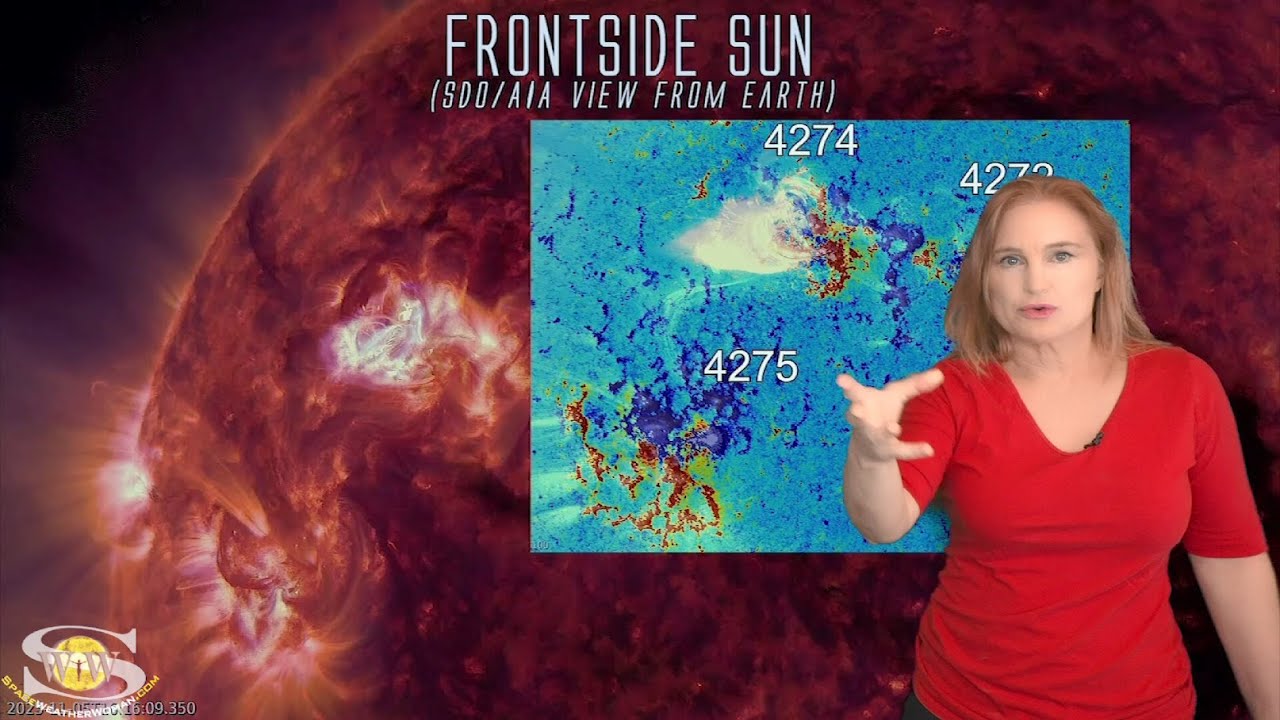
Monday, Nov. 10: Incoming CME could bring geomagnetic storms this week
The northern lights will stay mostly quiet tonight, but could receive a boost on Tuesday (Nov. 11) when a coronal mass ejection (CME) from Sunday's X1.7 solar flare is due to arrive.
The CME released from sunspot region AR4274 could spark minor to moderate (G1-G2) geomagnetic storms with a slight chance of strong (G3) levels late Tuesday into early Wednesday, according to NOAA's Space Weather Prediction Center (SWPC) and the U.K. Met Office.
Auroras could be possible over the northern U.S., Canada and northern Europe under clear skies if such geomagnetic storm levels are reached.
The SWPC projects that the Kp index will peak at 3.67 over the next 24 hours. For an up-to-date breakdown of timings, check out NOAA's 3-day forecast.
Tuesday, Nov. 11: 2 CMEs could spark strong geomagnetic storms tonight
The northern lights could put on quite a show tonight as two coronal mass ejections (CMEs) are expected to arrive in quick succession, according to NOAA's Space Weather Prediction Center and the U.K. Met Office.
The first CME, launched on Nov. 9, is forecast to reach Earth late tonight (UTC), followed closely by a second rapid CME released yesterday. Together, they could trigger minor to strong (G1-G3) geomagnetic storm conditions, depending on how their magnetic fields interact with Earth's.
Auroras could be visible across the northern U.S., Canada and northern Europe with a chance of glimpses farther south if skies are clear.
The SWPC projects that the Kp index will peak at 7.33 over the next 24 hours. For an up-to-date breakdown of timings, check out NOAA's 3-day forecast.
Wednesday, Nov. 12: Severe geomagnetic storm possible again tonight as fast CME hits Earth
If you missed the northern lights last night, you might get another great chance tonight (unless you're like me and facing 100% cloud and rain forecasts all week!). A speedy CME released during yesterday's X5.1 solar flare is expected to hit Earth today and could potentially drive one of the strongest geomagnetic storms of the year.
Multiple CMEs launched since Nov. 9 are now bombarding Earth. Forecasters predict strong to severe (G3 to G4) geomagnetic storm conditions tonight with a slight chance of extreme (G5) levels if conditions align, according to the U.K. Met Office.
Auroras are likely across northern Europe, Canada and the Northern U.S., possibly as far south as Iowa and Oregon, according to NOAA.
If you have clear skies tonight, make sure you look up! You might be in for a treat.
Thursday, Nov. 13: Strong geomagnetic storms could continue tonight
After two incredible nights of auroras lighting up skies across North America and as far south as Mexico, geomagnetic activity remains elevated tonight (Nov. 13-14). The latest CME from the Nov. 11, X5.1 solar flare is still influencing Earth's space environment, keeping solar wind speeds high for now.
Strong to severe (G3 to G4) geomagnetic storm conditions are still possible through early Friday, with activity gradually easing by the weekend, according to NOAA and the U.K. Met Office.
If the skies are clear, the northern lights could be possible across the northern U.S., Canada and northern Europe tonight.
Northern hemisphere aurora forecast courtesy of the Met Office
Aurora forecast for tonight and the weekend: Activity waning after energetic week but another boost could arrive this weekend
After several unforgettable nights of dazzling northern lights across the U.S., geomagnetic conditions are finally beginning to settle, according to NOAA's Space Weather Prediction Center (SWPC) and the U.K. Met Office
The flurry of coronal mass ejections (CMEs) that struck Earth earlier this week, triggering severe (G4) geomagnetic storms, has now passed.
That said, the show might not be completely over yet. A high-speed solar wind stream from a coronal hole could reach Earth around Sunday night (Nov. 16), possibly sparking an uptick in aurora activity. And just this morning, the sun fired off an X4-class solar flare from region AR4274. Early coronal imagery shows that a CME was launched and it may contain an Earth-directed component, although further modelling is needed to determine whether or when it might reach Earth.
Watch this space!
Monday, Nov. 17: Auroras retreat to high latitudes as geomagnetic activity fades
The burst of aurora activity we saw last week is finally calming down. After multiple CME impacts, including several that delivered G3-G4 geomagnetic storms, conditions are now easing and only minor aurora activity is expected tonight.
Tonight, the northern lights will mainly be confined to high latitudes such as northern Canada, Alaska and the Arctic, according to NOAA's Space Weather Prediction Center (SWPC) and the U.K. Met Office.
The SWPC projects that the Kp index will peak at 3.67 over the next 24 hours. For an up-to-date breakdown of timings, check out NOAA's 3-day forecast.
Tuesday, Nov. 18: Northern lights confined to high latitudes tonight
The northern lights will be confined to high latitudes tonight as geomagnetic activity continues to quieten down after last week's flurry of activity.
A high-speed solar wind stream from a coronal hole is still brushing Earth, keeping wind speeds slightly elevated but not enough for a widespread show into mid-latitudes.
NOAA's Space Weather Prediction Center projects that the Kp index will peak at 2.67 over the next 24 hours. For an up-to-date breakdown of timings, check out NOAA's 3-day forecast.
Thursday, Nov. 20: Auroras mainly confined to high latitudes again tonight
Aurora activity remains relatively quiet tonight as space weather settles into a calm phase.
However, a new high-speed solar wind stream from a coronal hole is expected to reach Earth mid to late evening, which could enhance geomagnetic conditions into unsettled or briefly active range (Kp 3-4) and spark diffuse northern lights across northern Canada, Alaska, Greenland, Iceland and far-northern Scandinavia.
NOAA's Space Weather Prediction Center projects that the Kp index will peak at 4 over the next 24 hours. For an up-to-date breakdown of timings, check out NOAA's 3-day forecast.
Aurora forecast for tonight and the weekend: Generally quiet with auroras confined to high latitudes
Aurora activity remains generally quiet as Earth continues to move through waning streams of high-speed solar wind. Any northern lights over the weekend are likely to be confined to high latitudes, with only limited enhancements possible according to NOAA's Space Weather Prediction Center.
The weekend outlook stays calm:
- Nov. 21: Quiet–unsettled, with a chance of briefly active periods as the high-speed stream peaks.
- Nov. 22: Activity wanes further; mostly quiet.
- Nov. 23: Continued quiet, with no significant geomagnetic disturbances expected.
NOAA's Space Weather Prediction Center projects that the Kp index will peak at 3.33 over the weekend. For an up-to-date breakdown of timings, check out NOAA's 3-day forecast.
Monday, Nov. 24: Auroras limited to high latitudes tonight as solar activity stays low
The northern lights will stay fairly quiet tonight with visibility mostly limited to high latitudes as a coronal hole's high-speed solar wind stream begins to reach and influence Earth.
Geomagnetic conditions are expected to remain quiet to unsettled according to NOAA's Space Weather Prediction Center (SWPC)and the U.K. Met Office.
NOAA's SWPC projects that the Kp index will peak at 2.33 over the next 24 hours. For an up-to-date breakdown of timings, check out NOAA's 3-day forecast.
Tuesday, Nov. 25: Northern lights possible tonight as high speed solar winds continue
Heads up aurora chasers! Northern lights may be visible at high latitudes tonight as Earth continues to feel the effects of a fast solar wind stream from an Earth-facing coronal hole.
According to space weather forecasters, geomagnetic activity will remain unsettled to active with a chance of brief minor (G1) storm intervals tonight.
NOAA's Space Weather Prediction Center projects that the Kp index will peak at 5 over the next 24 hours. For an up-to-date breakdown of timings, check out NOAA's 3-day forecast.
Wednesday, Nov. 26: Northern lights possible again tonight as fast solar wind continues
The northern lights may put on a show again tonight across high latitudes as fast solar wind from a coronal hole continues to buffet Earth.
Space weather forecasters at NOAA and the U.K. Met Office expect geomagnetic conditions to remain elevated, with minor (G1) geomagnetic storming still possible through tonight.
Conditions are expected to slowly return to background levels by Nov. 28, as the coronal hole influence wanes.
NOAA's Space Weather Prediction Center projects that the Kp index will peak at 4.67 over the next 24 hours. For an up-to-date breakdown of timings, check out NOAA's 3-day forecast.
Thursday, Nov. 27: Northern lights possible again tonight as geomagnetic activity lingers
The northern lights may still be visible at times across high northern latitudes tonight as fast solar wind from a coronal hole continues to disrupt Earth's magnetic field.
Geomagnetic conditions are expected to remain unsettled to active through the night, with isolated minor (G1) storm conditions possible as solar wind speeds remain high.
Overall, aurora visibility will be mainly limited to high-latitude regions, with mid-latitude sightings possible if G1 levels are reached.
NOAA's Space Weather Prediction Center projects that the Kp index will peak at 5 over the next 24 hours. For an up-to-date breakdown of timings, check out NOAA's 3-day forecast.
Aurora forecast for tonight and the weekend: Chance of northern lights at high latitudes as activity slowly wanes
The northern lights could make a brief appearance at high latitudes tonight, but geomagnetic activity is beginning to wane.
Space weather forecasters at NOAA and the U.K. Met Office anticipate unsettled to active activity by Nov. 30 with auroras limited to high latitude regions before returning to background levels over the weekend.
Monday, Dec. 1: Northern lights confined to high latitudes as activity wanes for now
The northern lights will be confined to high latitudes tonight as activity remains at background levels, as the effects of a recent high-speed solar wind stream continue to wane.
But the good news is another stream of fast solar wind is on the way and expected to rotate into a geoeffective position by Dec. 3, which could bring a fresh uptick in solar wind and a chance of minor (G1) storming mid-week.
NOAA's Space Weather Prediction Center projects that the Kp index will peak at 1.67 over the next 24 hours. For an up-to-date breakdown of timings, check out NOAA's 3-day forecast.
Tuesday, Dec. 2: Northern lights quiet tonight but stormier conditions expected from Dec. 3
The northern lights are expected to stay close to high latitudes tonight, with mostly quiet to unsettled geomagnetic conditions, according to NOAA and the U.K. Met Office. Activity is subdued for now as the effects of the recent high-speed solar wind stream continue to fade.
That calm won't last long. Both agencies expect geomagnetic conditions to increase on Dec. 3–4, when three space-weather drivers arrive in quick succession: a sector boundary crossing, a co-rotating interaction region (CIR), and a fast solar wind stream from a negative-polarity coronal hole. NOAA has already issued G2 geomagnetic storm watches for Dec. 3–4, with the possibility of G3 if the CIR and a potential glancing CME arrive close together.
Wednesday, Dec. 3: Auroras could strengthen tonight with a chance of G2–G3 storming
Good news aurora chasers! The northern lights could become quite active tonight due to the arrival of a fast stream of solar wind alongside a possible glancing blow from a coronal mass ejection (CME) released during Monday's X1.9 solar flare.
This combination could push geomagnetic conditions to moderate (G2) levels with a brief chance of strong (G3) if both the fast solar wind and CME arrive close together.
The exact timing of the CME is uncertain, so aurora intensity may fluctuate through the night and into Thursday (Dec. 4). If activity strengthens, auroras could reach lower latitudes than usual. However, the best chances remain across Alaska, northern Canada, Iceland, and Scandinavia.
Mid-latitude visibility remains uncertain but not impossible if the CME arrives with strong southward magnetic fields. Otherwise, the show will stay confined to higher latitudes until the next wave of fast wind arrives.
Keep your eyes on the skies tonight! We could be in for a treat.
Aurora forecast for tonight and the weekend: Small boost possible this weekend
The northern lights may make brief appearances at high latitudes over the next few nights as fast solar winds continue to buffet Earth and a weak blow from a coronal mass ejection (CME) could become possible this weekend, according to NOAA's Space Weather Prediction Center and the U.K. Met Office.
Space weather forecasters predict active geomagnetic conditions with a slight chance of minor (G1) level storming tonight (Dec. 5) and Saturday (Dec. 6) as the influence of the incoming high-speed solar wind stream wanes. Meanwhile, on Sunday, a glancing impact from a CME launched on Dec. 4 could add another small boost to activity, though confidence remains low.
Overall, expect periods of unsettled to active geomagnetic activity through the weekend, with the best chances for auroras occurring late Saturday into Sunday if the CME arrives on time (or at all!).
Northern hemisphere aurora forecast courtesy of the U.K. Met Office
Monday, Dec. 8: Northern lights could surge tonight as two solar storms approach Earth
The northern lights could intensify tonight (Dec. 8) into tomorrow as multiple coronal mass ejections (CMEs) are expected to reach Earth, according to NOAA's Space Weather Prediction Center and the U.K. Met Office.
Geomagnetic activity is likely to reach minor (G1) storm levels tonight, increasing to strong (G3) storm levels on Dec. 9 as the faster of the CMEs is expected to arrive. As such, the U.K. Met Office has issued a G3 geomagnetic storm watch from Monday night through Tuesday.
If the CMEs deliver as expected, auroras may be visible much farther south than usual, potentially reaching the northern U.S., Canada, Scotland and similar latitudes, where skies are clear.
Keep those camera batteries charged and those eyes on the skies!
Tuesday, Dec. 9: CME still inbound, geomagnetic storms possible tonight
The northern lights could put on a show later tonight as Earth awaits the arrival of a coronal mass ejection (CME) launched by the sun on Dec. 6, according to NOAA's Space Weather Prediction Center. Geomagnetic activity is still expected to rise once the CME shock front reaches Earth, with strong (G3) geomagnetic storm conditions likely when it does, according to the U.K. Met Office. So far, the CME has not yet arrived and solar wind conditions remain relatively quiet.
Space weather forecasters expect storming to develop at some point today (Dec. 9) with elevated activity potentially lasting through the night into tomorrow as CME effects wane.
Wednesday, Dec. 10: Northern lights stay quiet as CME fails to arrive
The northern lights are expected to remain confined to high latitudes tonight as the solar storm that was forecast for yesterday (Dec. 9) failed to deliver.
According to space weather forecasters at NOAA's Space Weather Prediction Center and the U.K. Met Office, the anticipated CME either missed Earth or only brushed our planet weakly, resulting in no significant response.
Geomagnetic conditions are expected to stay quiet through Dec. 11, with only a slight chance of brief enhancements if any of the recent small, non-direct CMEs happen to glance Earth.
Thursday, Dec. 11: Northern lights pick up after late-night CME arrival
The northern lights may be active again tonight after the long-delayed coronal mass ejection (CME) finally hit Earth late on Dec. 10, sparking moderate (G2) geomagnetic storming, according to NOAA's Space Weather Prediction Center.
NOAA and the U.K. Met Office say G1–G2 activity may continue into Dec. 11, especially if any of the recent smaller CMEs give a glancing blow. After that, geomagnetic conditions should trend back toward unsettled levels, though another rise in activity is possible late Dec. 12 as Earth moves toward a coronal hole high-speed stream expected on Dec. 13.
Aurora forecast for tonight and the weekend: Active conditions possible so keep your eyes on the skies
The northern lights may be active tonight and through the weekend as Earth moves through an unsettled space weather pattern, according to NOAA's Space Weather Prediction Center and the U.K. Met Office. Lingering solar wind disturbances and the arrival of a high-speed solar wind stream from a coronal hole could deliver intermittent geomagnetic activity in the coming days.
NOAA space weather forecaster forecasts unsettled to active conditions, with minor (G1) geomagnetic storming possible, especially late Dec. 12 into Dec. 13.
If aurora activity picks up, it will favour high-latitude regions such as Alaska, northern Canada, Iceland and Scandinavia.
Monday, Dec. 15: Northern lights confined to high latitudes tonight
The nothern lights will remain limited to high latitudes tonight according to NOAA space weather forecasters.
Geomagnetic conditions are currently quiet to unsettled, following the gradual fade of an earlier coronal hole fast wind stream. However, forecasters are also watching the approach of another high-speed solar wind stream from a transequatorial coronal hole, which could begin to influence near-Earth space later tonight or into the next couple of days.
NOAA's Space Weather Prediction Center projects that the Kp index will peak at 2.67 over the next 24 hours. For an up-to-date breakdown of timings, check out NOAA's 3-day forecast.
Tuesday, Dec. 16: Northern lights remain limited to high latitudes
The northern lights are expected to be confined to high latitudes again tonight with geomagnetic activity ranging from quiet to unsettled, according to NOAA's Space Weather Prediction Center and the U.K. Met Office.
A fast stream of solar wind from a trans-equatorial coronal hole on the sun is starting to reach Earth, but it hasn't fully arrived yet. For tonight, that means aurora activity is possible but likely to be brief and limited, rather than a strong, widespread display. The bulk of the fast solar wind is expected to arrive over the next couple of days.
NOAA's Space Weather Prediction Center projects that the Kp index will peak at 3 over the next 24 hours. For an up-to-date breakdown of timings, check out NOAA's 3-day forecast.
Wednesday, Dec. 17: Northern lights limited despite fast solar wind
The northern lights could put on a subtle show tonight as Earth continues to feel the effects of fast solar wind flowing from a coronal hole on the sun.
While those solar wind speeds are up, the magnetic conditions haven't been perfectly aligned, which can limit how much energy actually feeds into auroras. That means any displays tonight are most likely to stay close to higher latitudes and could be faint or brief. The main burst of this fast solar wind is expected to arrive over the next couple of days, though, so aurora chances may improve.
NOAA's Space Weather Prediction Center projects that the Kp index will peak at 5 over the next 24 hours. For an up-to-date breakdown of timings, check out NOAA's 3-day forecast.
Thursday, Dec. 18: Fast solar winds could spark faint auroras tonight
The northern lights could make another appearance tonight for skywatchers at high latitudes as Earth remains under the influence of fast solar wind flowing from a coronal hole on the sun.
Forecasters expect this fast solar wind stream to gradually ease into Dec. 19, meaning aurora activity should slowly quiet down. While a brief G1-level uptick is still possible, widespread or vivid displays are unlikely, making this a subtle night best suited for northern locations and patient skywatchers.
NOAA's Space Weather Prediction Center projects that the Kp index will peak at 4 over the next 24 hours. For an up-to-date breakdown of timings, check out NOAA's 3-day forecast.
Aurora forecast for tonight and the weekend: Quiet nights ahead, with a watch on late-weekend changes
The northern lights could make a brief and fairly subtle appearance tonight as Earth remains under the fading influence of fast solar winds flowing from a coronal hole on the sun. While solar wind speeds are still elevated, the magnetic conditions have been variable, which limits how efficiently that energy can power auroras.
For Friday night into Saturday (Dec. 19–20), aurora activity is most likely to stay confined to higher latitudes, with only short-lived or faint displays possible if conditions briefly align, according to space weather forecasters at the NOAA Space Weather Prediction Center.
Looking ahead to Sunday (Dec. 21), forecasters are watching for the possible arrival of another fast solar wind stream. If it connects with Earth as expected, aurora chances could tick up slightly late Sunday or beyond.
Monday, Dec. 22: Minor geomagnetic storms keep aurora chances alive
The northern lights could put on a show tonight as Earth moves deeper into a fast stream of solar wind flowing from a coronal hole on the sun.
Solar wind speeds are elevated and geomagnetic conditions have already reached minor (G1) levels last night. Space weather forecasters predict these conditions could continue through Tuesday, so keep your eyes on the skies, especially if you're at high latitudes!
NOAA's Space Weather Prediction Center projects that the Kp index will peak at 4.67 over the next 24 hours. For an up-to-date breakdown of timings, check out NOAA's 3-day forecast.
Tuesday, Dec. 23: Northern lights possible tonight amid lingering space weather
The northern lights may be visible at times tonight as Earth remains embedded in a fast solar wind stream flowing from a coronal hole on the sun.
Space weather forecasters at NOAA at the U.K. Met Office expect solar wind speeds to remain elevated with minor (G1) geomagnetic storm conditions possible again tonight.
NOAA's Space Weather Prediction Center projects that the Kp index will peak at 4.67 over the next 24 hours. For an up-to-date breakdown of timings, check out NOAA's 3-day forecast.
Wednesday, Dec. 24: Fast solar winds keep aurora activity possible Christmas Eve
The northern lights remain possible at high latitudes tonight as Earth continues to experience fast solar winds flowing from a large coronal hole on the sun.
Space weather forecasts from NOAA and the U.K. Met Office show solar wind speeds staying high and keeping geomagnetic activity unsettled to occasionally active through Christmas Eve into early Christmas Day.
There is also a wildcard at play.
Forecasters are keeping an eye on the low-confidence passage of a coronal mass ejection (CME) that left the sun on Dec. 20. Current modelling shows it may pass close to Earth, but any associated geomagnetic enhancement is expected to be minor.
Finally, we'd like to wish all our readers a very merry Christmas and happy holidays. Regular updates to this live blog will resume on Jan. 2, but if any significant space weather events occur before then, we'll bring you a dedicated article covering everything you need to know.

Incoming CME could spark northern lights as far south as New York
Heads up aurora chasers! The northern lights could make sporadic appearances tonight and over the weekend as space weather conditions turn more unsettled.
Geomagnetic activity may increase late tonight or early Saturday (Jan. 3) as a slow-moving coronal mass ejection (CME) is expected to brush past Earth.
A CME is a large plume of magnetic field and plasma from the sun. When it reaches Earth and interacts with our planet's magnetic field, it can trigger geomagnetic storms, which in turn can produce more intense and widespread aurora displays.
If the CME arrives as predicted, space weather forecasters anticipate minor (G1) to moderate (G2) geomagnetic activity throughout the night (Jan. 2 - Jan. 3).
If G2 levels are reached, northern lights may be visible in northern parts of the U.S., including Idaho and New York.
Activity is expected to gradually ease by Sunday as solar wind conditions settle down, although sporadic aurora activity may linger early in the night!
Monday, Jan. 5: Northern lights retreat to high latitudes tonight as space weather calms
The northern lights will be mainly confined to high latitudes tonight as overall conditions are calming down after the geomagnetic storms seen over the weekend. A weak coronal mass ejection (CME) that arrived late Sunday is still affecting Earth's magnetic field, which could briefly elevate geomagnetic activity early tonight, according to NOAA's Space Weather Prediction Center.
However, solar wind speeds are now slowing to near-background levels and forecasters expect geomagnetic conditions to remain quiet to unsettled. This means any aurora activity tonight is likely to be limited, short-lived and largely confined to high latitudes such as northern Canada, Alaska and parts of northern Scandinavia.
NOAA's Space Weather Prediction Center projects that the Kp index will peak at 3.67 over the next 24 hours. For an up-to-date breakdown of timings, check out NOAA's 3-day forecast.
Tuesday, Jan. 6: Northern lights remain quiet tonight as geomagnetic activity eases
The northern lights are unlikely to put on much of a show tonight as geomagnetic conditions continue to settle following recent activity.
While a weak solar eruption was spotted earlier this week, there's no clear sign yet that it will significantly affect Earth. As a result, any aurora activity tonight is most likely to stay close to background levels and confined to higher latitudes, with visibility mainly limited to far northern regions.
Looking ahead, forecasters are keeping an eye on a fast stream of solar wind expected to arrive later this week. The speedy solar wind could bring a renewed chance of auroras around Jan. 9, so it's worth keeping an eye on updated forecasts over the coming days.
NOAA's Space Weather Prediction Center projects that the Kp index will peak at 1.67 over the next 24 hours. For an up-to-date breakdown of timings, check out NOAA's 3-day forecast.
Thursday, Jan. 8: Northern lights could return tonight as solar activity picks up
The northern lights could make a return late tonight into early Jan. 9, as geomagnetic conditions begin to respond to an incoming stream of fast solar wind from a coronal hole on the sun.
Space weather forecasters from NOAA's Space Weather Prediction Center and the U.K. Met Office suggest conditions may shift from quiet to unsettled tonight, with a chance of minor (G1) geomagnetic storms early Friday.
NOAA's Space Weather Prediction Center projects that the Kp index will peak at 5 over the next 24 hours. For an up-to-date breakdown of timings, check out NOAA's 3-day forecast.
Aurora forecast for tonight and the weekend: Northern lights possible this weekend as fast solar winds linger
Good news aurora chasers! The northern lights could remain active at times this weekend as Earth remains under the influence of fast solar winds flowing from a coronal hole, with possible effects from one or more weak coronal mass ejections (CMEs).
Space weather forecasters at NOAA and the U.K. Met Office suggest unsettled to active geomagnetic conditions on Jan. 9, with minor (G1) geomagnetic storm levels possible.
Solar wind speeds are expected to remain elevated into Saturday (Jan. 10), which could help fuel aurora activity at higher latitudes. By Sunday (Jan. 11), conditions are forecast to ease as the influence from the coronal hole weakens gradually.
Monday, Jan. 12: Northern lights remain possible at high latitudes tonight
The northern lights could still make an appearance tonight, particularly across high-latitude regions, as Earth remains under the waning influence of disturbed space weather.
Over the weekend, a cannibal CME — formed when multiple solar eruptions merged en route to Earth — arrived and helped spark periods of geomagnetic storming. While the most active conditions have now passed, elevated solar wind speeds and lingering magnetic disturbances are expected to persist into tonight.
Forecasters at the U.K. Met Office indicate that unsettled geomagnetic activity may persist through Jan. 14 due to "further re-enhancement from the easternmost portion of a coronal hole".
Tuesday, Jan. 13: Northern lights could delight at high latitudes tonight
The northern lights could remain visible at high latitudes tonight (Jan. 13-14) as Earth continues to feel the effects of fast solar winds flowing from a coronal hole on the sun.
While geomagnetic conditions have eased from the stronger storming seen over the weekend, space weather remains unsettled to active, keeping aurora chances alive for far northern regions.
According to NOAA's Space Weather Prediction Center and the U.K. Met Office, elevated solar wind speeds are continuing as coronal hole fast wind influence becomes the dominant driver. These conditions could support occasional G1 (minor) geomagnetic storm levels, though activity is expected to be weaker and more variable than earlier this week.
As a result, any auroras tonight are most likely to stay confined to higher latitudes, with the best chances across northern Canada, Alaska, and parts of northern Europe, including northern Scotland, if skies are clear.
Wednesday, Jan.14: Northern lights begin to ease tonight as geomagnetic activity wanes
The northern lights will be mainly confined to high latitudes tonight as space weather conditions continue to calm (for now).
Although solar wind speeds are still elevated, they are beginning to slow; as a result, geomagnetic conditions are forecast to range from unsettled to briefly active with only a low chance of isolated minor (G1) storm intervals, according to space weather forecasters at NOAA's Space Weather Prediction Center and the U.K. Met Office.
Any aurora displays tonight are most likely to be subtle and short-lived, confined to higher geomagnetic latitudes such as northern Canada, Alaska, and parts of northern Europe. Visibility farther south appears unlikely.
But that could all change later in the week as a new fast stream of solar wind is forecast to arrive along with some 'big flare players' as several active sunspot regions turn to face Earth.
Thursday, Jan. 15: Northern lights confined to high latitudes tonight but activity could pick up over the weekend
The northern lights are forecast to remain relatively quiet tonight (Jan. 15-16) as geomagnetic conditions continue to ease following a recent surge in fast solar wind activity.
Geomagnetic conditions are forecast to remain from quiet to unsettled tonight, according to NOAA's Space Weather Prediction Center. Any aurora activity is likely to be confined to high latitudes such as Alaska, northern Canada and northern Scandinavia.
Looking ahead, forecasters are keeping an eye on a new stream of fast solar wind expected to arrive on Jan. 17 that could give geomagnetic activity a boost.
NOAA's Space Weather Prediction Center projects that the Kp index will peak at 2.33 over the next 24 hours. For an up-to-date breakdown of timings, check out NOAA's 3-day forecast.
Aurora forecast for tonight and the weekend: Northern lights chances rise as fast solar wind arrives
The northern lights could become more active again tonight through the weekend as space weather conditions gradually pick up.
Earth is now being buffeted by a fast solar wind stream flowing from a coronal hole on the sun.
The speedy solar wind could trigger minor (G1) geomagnetic storm conditions with a chance of isolated moderate (G2) storming at times through Jan. 18, according to NOAA's Space Weather Prediction Center.
If G2 levels are reached, auroras could extend farther south than usual, with possible visibility as far south as parts of the northern U.S., including states like Idaho and New York, as well as Canada and northern Europe.
Keep your eyes on the skies this weekend, you might be in for a treat.
Monday, Jan. 19: Northern lights could surge as powerful solar storm approaches
Heads up aurora chasers! The northern lights could put on a show late tonight (Jan. 19) into Jan. 20 as Earth braces for the arrival of a powerful solar storm.
Read more: Northern lights may be visible in 24 states tonight as massive CME races toward Earth
Speedy solar winds are already buffeting Earth and a full halo coronal mass ejection (CME) launched by a colossal X1.9 solar flare on Jan. 18 is expected to arrive late tonight or tomorrow. More detailed analysis and modeling are still underway to narrow down the CME's exact arrival window.
The U.K. Met Office has issued a geomagnetic storm watch, warning that this incoming CME could trigger strong (G3) storm conditions with a chance of severe (G4) levels depending on the storm's exact timing and magnetic orientation.
If these conditions occur, auroras could be pushed well into mid-latitudes, so keep your eyes on the skies and your aurora alerts switched on!
Aurora alert! Severe G4 geomagnetic storm triggered as CME arrives

A colossal coronal mass ejection (CME) slammed into Earth earlier this afternoon (Jan. 19), triggering a G4 (severe) geomagnetic storm, according to NOAA's Space Weather Prediction Center.
The impact was confirmed at 2:38 p.m. EST (1938 GMT) and the storm is still ongoing. This means auroras could become visible much farther south than usual tonight, potentially reaching into parts of the central U.S. — and possibly even lower if conditions hold.
Read more: Northern lights may be visible in 24 states tonight as a massive CME slams into Earth
Tuesday, Jan. 20: Northern lights still possible following severe G4 geomagnetic storm
The northern lights remain active tonight after an extraordinary night of geomagnetic storming, with G4 (severe) conditions repeatedly observed overnight as a powerful coronal mass ejection (CME) slammed into Earth's magnetic field. Widespread auroras were reported across high and mid-latitudes, marking one of the strongest displays in recent years.
While storm intensity is expected to ease gradually through tonight (Jan. 20), forecasters say elevated geomagnetic activity could persist, meaning auroras may still be visible across higher latitudes, with lingering chances farther south if conditions briefly intensify again.
As always, visibility will depend on cloud cover and how Earth's magnetic field responds as the CME continues to pass.
Wednesday, Jan. 21: Northern lights still possible as storms slowly subside
The northern lights remain possible tonight, but aurora activity is gradually easing as the effects of this week's powerful coronal mass ejection (CME) continue to wane.
Last night saw highly variable geomagnetic storm conditions, with activity fluctuating between moderate (G2) and strong (G3) levels as Earth continued to move through different parts of the CME's structure.
Space weather forecasters predict geomagnetic conditions should continue to settle through tonight, dropping from storm levels toward active and unsettled conditions. Auroras are most likely to be confined to higher latitudes tonight.
Thursday, Jan. 22: Northern lights retreat north as geomagnetic activity eases
The northern lights are continuing to ease tonight as Earth steadily recovers from the powerful geomagnetic storms triggered by the coronal mass ejection that struck on Jan. 19.
While geomagnetic conditions remain unsettled, activity is beginning to wane as the CME effects give way to weaker coronal hole fast winds, according to space weather forecasters at the U.K. Met Office.
Auroras are still possible at high latitudes, but are expected to return to near-background levels as space weather continues to calm.
If you haven't quite had enough of all the incredible photos from the recent aurora shows during this week's geomagnetic storms, might I suggest checking out these jaw-dropping photos captured by a pilot at 37,000 feet... they are quite possibly the best aurora photos I've ever seen!
Friday, Jan. 23 - Sunday Jan. 25: Northern lights still possible at high latitudes as geomagnetic activity settles
Space weather activity continues to settle down this weekend as Earth moves further away from the powerful CME-driven geomagnetic storms earlier this week.
While residual fast solar wind may keep geomagnetic conditions unsettled at times on Friday (Jan. 23), with a small chance of isolated G1-G2 storming, activity on the whole is expected to steadily ease through Saturday and Sunday.
The northern lights may still be visible at high latitudes and will return to near-background levels by Saturday and Sunday.
Monday, Jan. 26: Northern lights likely to stay quiet tonight, but more activity could be on the horizon
The northern lights are expected to stay largely quiet tonight as space weather conditions continue to ease following last week's intense geomagnetic storms.
Quiet to unsettled geomagnetic conditions are expected tonight, according to space weather forecasters at NOAA and the U.K. Met Office.
But conditions could pick up again Tuesday night (Jan. 27) as Earth connects to another fast stream of solar wind from a coronal hole, which could allow auroras to spread into high latitudes if skies are clear.
Tuesday, Jan. 1: Northern lights remain relatively subdued tonight ahead of possible midweek uptick
The northern lights are expected to stay mostly quiet tonight, with geomagnetic conditions ranging from quiet to unsettled.
Earth is currently under the fading influence of a fast solar wind stream from a coronal hole, with solar wind speeds gradually easing, according to NOAA's Space Weather Prediction Center.
An uptick later this week cold bring minor (G1) geomagnetic storm conditions Jan. 28-29 when a fresh burst of fast solar wind is forecast to arrive.
Wednesday, Jan. 28: Northern lights may brighten tonight as minor geomagnetic storm conditions develop
The northern lights could become slightly more active tonight (Jan. 28) as Earth connects with fast solar wind flowing from a coronal hole.
Space weather forecasters at NOAA and the U.K. Met Office anticipate isolated minor (G1) storm levels today, which could help boost auroras.
If this fast solar wind couples effectively with Earth's magnetic field, auroras may be visible across higher latitudes, if skies are clear.
Thursday, Jan.29: Northern lights may continue tonight as fast solar winds fuel minor storm conditions
The northern lights may remain active again tonight as Earth continues to move through a stream of fast solar wind flowing from a coronal hole on the sun.
Space weather forecasters at NOAA's Space Weather Prediction Center and the U.K. Met Office indicate geomagnetic conditions could hover between unsettled and minor (G1) storm levels, which is enough to spark auroras at higher latitudes.
Activity is expected to be patchy and variable, rather than widespread, but conditions could stay favorable into Thursday evening before gradually calming.
Northern hemisphere forecast courtesy of the U.K. Met Office
Monday, Feb. 2: Northern lights calm tonight, but X-class solar flares could change conditions midweek
The northern lights are expected to remain relatively quiet tonight, with both NOAA's Space Weather Prediction Center and the U.K. Met Office forecasting near-background geomagnetic conditions.
That said, the sun has been far from quiet. A rapidly growing sunspot region (AR4366) unleashed an X8.1 solar flare, along with several other X-class and M-class eruptions over the past 24 hours. While no Earth-directed coronal mass ejections (CMEs) have been confirmed so far, some of these powerful eruptions may have launched CMEs that are still being modelled and analyzed.
This behemoth sunspot is still growing and is becoming more geoeffective and it turns to face Earth. If it produces an Earth-directed CME in the coming days, geomagnetic activity (and aurora chances) could increase later this week.
Tuesday, Feb. 3: Auroras confined to high latitudes again tonight but recent solar activity could shake up chances midweek
The northern lights are expected to remain relatively quiet and confined to high latitudes tonight, with Earth currently experiencing calm solar wind conditions. While the sun has been extremely active, firing off multiple X-class and M-class solar flares from a rapidly growing sunspot region, there are no immediate impacts expected to hit Earth.
That said, forecasters are closely monitoring a complex coronal mass ejection (CME) linked to an X8.1 solar flare late on Feb. 1. Current modeling suggests a glancing blow is possible around Feb. 5, which could potentially raise geomagnetic activity to minor (G1) levels and improve aurora chances later in the week, especially at high latitudes.
Wednesday, Feb. 4: Northern lights could be quiet tonight but a glancing CME could stir geomagnetic activity
The northern lights are expected to remain relatively quiet for most of tonight, as Earth is still sitting under largely calm conditions. Auroras will be confined to high latitudes.
Though the sun has been very busy firing off multiple solar flares, there has yet to be a major impact on Earth's magnetic field. The volatile sunspot region spewing out all these flares appears to be all bark and no bite ... for now.
Space weather forecasters are currently tracking an incoming coronal mass ejection (CME) released during the X8 flare earlier in the week. Current modeling suggests a glancing blow could arrive late tonight or on Feb. 5, potentially pushing geomagnetic storm conditions up to minor (G1) levels.
If that happens, the northern lights could be more visible at high latitudes, including Canada, northern Scandinavia and parts of Scotland, pending clear skies.
Monday, Feb. 9: Northern lights mainly confined to high latitudes tonight
Aurora activity remains at background levels tonight with geomagnetic conditions expected to sit between quiet and unsettled.
That said, space weather forecasters at NOAA's Space Weather Prediction Center note that unsettled to active conditions are possible tonight as weak coronal mass ejection (CME) effects combine with ongoing high-speed solar wind. If those factors align just right, we could experience brief active aurora conditions at high latitudes tonight.
Tuesday, Feb. 10: Mostly calm conditions with a slim chance of aurora activity
The northern lights will remain relatively quiet again tonight as geomagnetic conditions hover between quiet and unsettled. Earth is still feeling the effects of a weak fast solar wind from a coronal hole along with the fading effects of a glancing coronal mass ejection (CME), but those influencing continue to wane.
Space weather forecasters expect any lingering disturbances in the solar wind to diminish through today, allowing mostly quiet space weather to persist through the night.
Wednesday, Feb. 11: Northern lights confined to high latitudes tonight
The northern lights are expected to remain fairly quiet tonight as geomagnetic conditions continue to ease.
Both NOAA's Space Weather Prediction Center and the U.K. Met Office forecast mainly quiet to unsettled levels with only a slight chance of minor (G1) geomagnetic storm conditions. This means auroras will likely stay confined to high latitudes, such as Alaska and northern Scandinavia.
Things could change in a few days due to a recent filament eruption from Feb. 10. It is being analysed to see if it launched a CME, but for now, space weather remains relatively calm.
Thursday, Feb. 12: Northern lights calm tonight ahead of possible weekend activity
The northern lights are expected to stay mostly quiet tonight (Feb. 12) as geomagnetic conditions settle down.
Both NOAA's Space Weather Prediction Center and the U.K. Met Office forecast quiet to unsettled levels tonight with only a slight chance of brief active periods. That means aurora activity will mainly be confined to high latitudes, with little chance of widespread visibility.
Looking ahead, forecasters are monitoring a high-speed solar wind stream from a coronal hole expected to arrive later this week, which could bring a minor uptick in activity and a small chance of minor (G1) geomagnetic storm conditions over the weekend.
Monday, Feb. 19: Northern lights mostly quiet but minor storming possible tonight
The northern lights could see a slight uptick tonight (Feb. 19) due to a small chance of minor (G1) geomagnetic storm activity as lingering fast solar winds brush past Earth.
According to space weather forecasters at NOAA's Space Weather Prediction Center, there is also a chance of weak, glancing influences from a Feb. 16 coronal mass ejection (CME), though no direct Earth impacts have been confirmed.
If brief G1 geomagnetic storm conditions develop, auroras will likely be confined to high latitudes, including northern Scotland, Northern Canada, Alaska and similar high latitude regions of Scandinavia.
Friday, Feb. 20 - Sunday, Feb. 22: Northern lights mostly quiet through the weekend as solar winds ease
The northern lights are forecast to remain fairly subdued tonight and through the weekend as the lingering fast solar wind from a coronal hole on the sun gradually fades, according to NOAA's Space Weather Prediction Center.
Over the weekend, northern lights sightings will mostly be confined to high latitudes such as northern Canada, Alaska, northern Scotland and northern Scandinavia.
NOAA's Space Weather Prediction Center projects that the Kp index will peak at 3 over the weekend. For an up-to-date breakdown of timings, check out NOAA's 3-day forecast.
Monday, Feb. 23: Northern lights could intensify tonight as geomagnetic storms develop
The northern lights could put on a show tonight (Feb. 23) as geomagnetic storm conditions ramp up due to a fast stream of solar wind.
According to both NOAA's Space Weather Prediction Center and the U.K. Met Office, Earth is currently being buffeted by enhanced solar wind speeds of 600-700 km/s from a coronal hole high-speed stream (normal 'background' speeds are usually around 400 km/s). As a result, minor (G1) geomagnetic storms are likely again tonight, with a chance of moderate (G2) storming!
What does this mean?
Auroras could push farther south than usual, particularly across northern Canada, Alaska, northern Scotland and northern Scandinavia, weather permitting.
Tuesday, Feb. 24: Northern lights could remain active tonight as fast solar winds linger
The northern lights may remain lively tonight (Feb. 24) as strong solar winds continue to buffet Earth.
Solar winds are still flowing at 600-700 km/s, according to NOAA's Space Weather Prediction Center and the U.K. Met Office. As a result, geomagnetic conditions are predicted to remain unsettled to active with a chance of isolated minor (G1) geomagnetic storms tonight.
Where will the northern lights be visible tonight?
Aurroas could push farther south than usual if G1 storm conditions are reached, particularly across northern Canada, Alaska, northern Scotland and northern Scandinavia, weather permitting.
Wednesday, Feb. 25: Northern lights could ease off tonight as fast solar winds wane
The northern lights are forecast to quiet down tonight (Feb. 25) as lingering fast solar winds gradually weaken.
Geomagnetic activity is expected to range from quiet to active tonight, according to NOAA's Space Weather Prediction Center. Solar wind speeds continue to fall to near background levels.
Any aurora displays tonight will likely stay confined to high latitudes such as Alaska, northern Canada and northern Scandinavia.
Thursday, Feb. 26: Northern lights could flare again tonight due to active geomagnetic conditions
The northern lights could put on another lively but fleeting display tonight (Feb. 26) after active geomagnetic conditions and substorms were observed last night.
The fast solar wind stream from a coronal hole is still buffeting Earth, with solar wind speeds holding around the 500-600 km/s range (background levels are approximately 400 km/s), according to NOAA's Space Weather Prediction Center.
Geomagnetic activity is expected to range from quiet to active, meaning additional aurora bursts are possible if the magnetic field is favorable!
Auroras will be most likely across high latitudes, including northern Canada, Alaska, northern Scandinavia and northern Scotland.
Aurora forecast for tonight and the weekend: Northern lights may stay active into the weekend as CME approaches
The northern lights could remain unsettled tonight (Feb. 27) and into the weekend, with another possible uptick late Saturday into Sunday (March 1).
The lingering fast solar wind from a coronal hole is still influencing Earth, keeping geomagnetic conditions unsettled to active tonight, according to NOAA's Space Weather Prediction Center.
But looking ahead to the weekend, forecasters are keeping an eye on the possible arrival of a weak coronal mass ejection (CME) that launched from the sun on Feb. 25. If it arrives, the CME could spark more sustained active conditions and a chance of minor (G1) geomagnetic storming, particularly on Sunday, according to the U.K Met Office.
Auroras are most likely confined to high latitudes, including Alaska, northern Canada and northern Scotland. If the CME delivers even a weak glancing blow, we could see a brief uptick in activity this weekend.
Keep your eyes on the skies and your aurora alerts switched on!
Monday, March 2: Northern lights will be mostly quiet tonight, but a brief uptick in activity is possible
The northern lights are expected to remain mostly quiet tonight (March 2) into early March 3 with only a slight, minor boost in activity.
According to space weather forecasters at NOAA and the U.K. Met Office, geomagnetic conditions will hover around quiet to unsettled levels as a new high-speed stream of solar wind from a coronal hole begins to influence Earth.
Tuesday, March 3: Northern expected to stay quiet tonight as solar winds remain calm
The northern lights are likely to remain subdued tonight (March 3) as geomagnetic conditions sit at quiet to unsettled levels with no significant auroral displays in the forecast, according to NOAA's Space Weather Prediction Center.
A brief uptick in activity is possible on Friday (March 6) if Earth connects to a minor coronal hole fast solar wind stream, bringing a slight chance of minor (G1) geomagnetic storm conditions according to the U.K. Met Office.
Wednesday, March 4: Northern lights likely quieter tonight after brief G1 storm
The northern lights may appear quieter tonight (March 4) after a brief minor (G1) geomagnetic storm was observed last night.
According to space weather forecasters at NOAA's Space Weather Prediction Center and the U.K. Met Office, geomagnetic conditions are expected to settle to quiet to unsettled levels as the influence of a coronal hole fast wind stream begins to ease.
The next possible uptick may arrive later this week, around March 6-7, when another stream of fast solar wind could spark active conditions.
Thursday, March 5: Northern lights will be relatively quiet tonight before a possible uptick later this week
The northern lights are expected to remain mostly quiet tonight (March 5-6) as geomagnetic conditions settle.
Any aurora sightings will likely remain confined to high latitudes such as Alaska, northern Canada and northern Scandinavia.
However, forecasters are carefully watching a new stream of fast solar wind expected to arrive around March 6-7, which could push geomagnetic activity back to minor (G1) storm levels and increase northern lights visibility as we head into the weekend, according to space weather forecasters at NOAA's Space Weather Prediction Center and the U.K. Met Office.
Aurora forecast for tonight and the weekend: Northern lights possible at high latitudes as fast solar wind reaches Earth
The northern lights could see a slight increase in activity late tonight (March 6) through to the early hours of March 7 as fast solar winds arrive at Earth with the potential to trigger minor G1 geomagnetic storm conditions, according to NOAA's Space Weather Prediction Center.
Should the G1 activity manifest, auroras would most likely be limited to higher latitudes over Canada and Alaska, along with parts Scandinavia and Russia, though it's possible that the northern lights could be spotted as far south as Montana, North Dakota and Minnesota.
Geomagnetic conditions are expected to be unsettled throughout the weekend, with minor isolated storm intervals possible, according to the U.K. Met Office.
Monday, March 9: Northern lights could dance tonight as solar winds linger
The northern lights could remain active tonight (March 9-10) as lingering fast solar winds continue to buffet Earth's magnetic field.
Space weather forecasters are also monitoring a coronal mass ejection (CME) launched on March 6, which is expected to pass close to Earth today or tonight. While it is most likely to miss, a weak glancing blow could still briefly boost geomagnetic activity.
Geomagnetic conditions could reach active levels tonight, though they are expected to ease toward quiet to unsettled levels tomorrow (March 10), according to space weather forecasters at NOAA and the U.K. Met Office.
Tuesday, March 10: Northern lights could appear at high latitudes tonight
The northern lights are expected to remain mostly quiet tonight (March 10-11) and confined to high latitudes such as Alaska and northern Scandinavia.
However, space weather forecasters at NOAA's Space Weather Prediction Center are still monitoring a coronal mass ejection (CME) that launched on March 6, which may pass close to Earth. While it is expected to miss, a weak glancing blow could briefly nudge geomagnetic activity higher.
Looking ahead, another burst of fast solar wind is expected later this week and could bring a better chance of auroras around March 13, according to the U.K. Met Office.
Wednesday, March 11: Northern lights fairly quiet tonight as solar wind influence wanes
The northern lights are expected to remain fairly subdued tonight (March 11) as the geomagnetic conditions continue to wane.
Geomagnetic activity is forecast to sit at quiet to unsettled levels with little chance of significant aurora outside the usual high latitudes, according to NOAA's Space Weather Prediction Center.
Looking ahead, forecasters are watching for another flurry of fast solar wind expected around March 13-14, which could trigger minor (G1) geomagnetic storm conditions and improve aurora visibility later in the week, according to the U.K. Met Office.
Thursday, March 12: Northern lights fairly quiet tonight before uptick in activity tomorrow
The northern lights are expected to remain mostly quiet tonight (March 12-13) as geomagnetic conditions stay relatively calm before a new burst of fast solar wind is due to arrive tomorrow.
According to NOAA's Space Weather Prediction Center and the U.K. Met Office, solar wind speeds are currently easing toward near-normal levels, leaving quiet to unsettled geomagnetic conditions in place tonight.
However, space weather forecasters expect a high-speed solar wind stream from an Earth-facing coronal hole to arrive on March 13, which could push geomagnetic activity higher and trigger minor (G1) geomagnetic storm conditions through March 13-14.
If G1 conditions are reached, the northern lights could become visible across high-latitude regions such as northern Canada, Alaska, northern Scandinavia and northern Scotland. The best chances begin late Friday and continue into the weekend.
Tonight and the weekend: Northern lights could put on a show this weekend as fast solar winds arrive
The northern lights could become more active tonight and through the weekend (March 13-15) as a stream of fast solar wind from a coronal hole sweeps past Earth.
The enhanced solar winds are expected to arrive later today or early Saturday, according to NOAA's Space Weather Prediction Center and the U.K. Met Office, increasing geomagnetic activity and giving aurora chasers a better chance of seeing the northern lights!
Space weather forecasters say minor (G1) geomagnetic storm conditions are likely on March 13-14, with active geomagnetic conditions continuing into March 15 as the high-speed solar wind stream persists.
Should conditions be favorable, the northern lights could become visible across high-latitude regions such as Alaska, northern Canada, northern Scotland and northern Scandinavia, with the best chances tonight and Saturday night while the solar wind stream is strongest. Conditions may remain somewhat elevated into Sunday before gradually easing.
Monday, March 16: Northern lights possible tonight as strong solar winds continue
The northern lights may remain visible tonight (March 16-17) as strong solar winds continue to buffet Earth's magnetic field.
While these winds are gradually easing, they may still trigger quiet to active geomagnetic conditions, with a slight chance of isolated minor (G1) geomagnetic storm intervals early in the period, according to NOAA's Space Weather Prediction Center.
If geomagnetic activity intensifies again, the northern lights could become visible across high-latitude regions such as Alaska, northern Canada, northern Scandinavia and northern Scotland.
Tuesday, March 17: Northern lights fairly quiet tonight but could surge March 19 as solar storm arrives
The northern lights may still be visible tonight (March 17-18) as lingering speedy solar wind continues to brush past Earth, though activity is expected to gradually ease.
Tonight, geomagnetic conditions are expected to sit at quiet to unsettled levels, with only a slight chance of active periods according to NOAA's Space Weather Prediction Center and the U.K. Met Office. Any aurora displays will likely remain confined to high latitudes such as Alaska, northern Canada and northern Scandinavia.
But that's not all! Keep your eyes on the skies in the coming days, as we could be in for a treat. A coronal mass ejection (CME) launched on March 16 is forecast to hit Earth on March 19 and could trigger moderate (G2) geomagnetic storm conditions, with a chance of even stronger G3 intervals, according to the U.K. Met Office.
If the storm does materialize, it could significantly boost aurora visibility, we'll keep you updated on what to expect here on Space.com. Watch this space!
Wednesday, March 18: Northern lights may put on a show tonight as solar storm approaches
The northern lights could put on a good show tonight (March 18-19), as geomagnetic activity begins to ramp up with the anticipated arrival of the first of several coronal mass ejections (CMEs) — huge bursts of solar plasma and magnetic field from the sun — heading for Earth.
According to space weather forecasters at NOAA's Space Weather Prediction Center, minor (G1) geomagnetic storm conditions could develop as early as around 11 p.m. EDT (0300 GMT) tonight, which favors overnight viewing across the U.S., where skies will be dark as the predicted activity begins to build.
But this is just the beginning! Forecasters anticipate moderate (G2) geomagnetic storm conditions likely later on March 19, with additional activity possible into March 20-21 as we await further analysis of several more CMEs released yesterday and heading toward Earth.
What does this mean?
If you're located in high to mid latitudes, I recommend keeping those aurora alerts switched on for the next couple of nights, as we could be in for a treat. Considering the favorable time of year, around the spring equinox, which can give a seasonal boost (a phenomenon known as the Russell-McPherron effect) and the fact that we have multiple CMEs en route, we could see geomagnetic activity jump to higher than G2 levels. We shall have to wait and see!
But space weather can be fickle. It is possible that the incoming CMEs don't carry the right magnetic orientation to strongly interact with Earth's magnetic field. If that's the case, we could all end up sitting in the dark with not a wisp of impressive aurora. It's all part of the fun of the chase!
Stay alert!
For real-time forecasts based on your location, consider using a space weather app. A great option is "My Aurora Forecast & Alerts" (available for iOS and Android). For a deeper dive into space weather conditions, "Space Weather Live" is another excellent choice (available for iOS and Android)
Thursday, March 19: Northern lights may surge overnight if solar storm arrives
Heads up aurora chasers! The northern lights could ramp up overnight (March 19-20) as Earth awaits the delayed arrival of a powerful coronal mass ejection (CME), with conditions expected to improve as the night goes on.
Geomagnetic conditions have remained relatively quiet so far as the first CME from the March 16 eruption has yet to arrive, according to NOAA's Space Weather Prediction Center and the U.K. Met Office.
However, that could all change late tonight when the first CME is expected to hit. Once it does, geomagnetic activity could rise to G1-G2 (minor to moderate) storm levels with a chance of G3 (strong) intervals.
If storm levels are reached, the timing favors North American skywatchers, where darkness will coincide with the likely arrival window. The northern lights could become visible much farther south than usual.
And this is just the beginning! Multiple additional CMEs are expected to arrive through March 20-21, which could prolong and intensify aurora activity over the coming nights, so make sure those camera batteries are charged!
Aurora forecast for tonight and the weekend: Northern lights may intensify this weekend as solar storm arrives
The northern lights could put on a strong show tonight and through the weekend (March 20-22) as the long-awaited solar storms begin to arrive.
The first coronal mass ejection (CME) appears to have struck Earth, sparking active geomagnetic conditions and aurora displays across parts of North America in the early hours.
Love this! So glad you are getting a decent show in Alberta. Thanks for reporting! https://t.co/vQ3QSJf4dJMarch 20, 2026
This may just be the beginning! Geomagnetic activity is expected to increase to minor to moderate (G1 to G2) storm levels on March 20, with conditions likely to strengthen further on March 21 when an additional CME and fast solar wind stream are forecast to arrive, according to NOAA's Space Weather Prediction Center.
Forecasters say G2 storms are likely with a chance of stronger G3 (strong) intervals, which could push the northern lights much farther south than usual.
What does this mean?
Friday and Saturday nights look especially promising for aurora chasers, with the potential for the northern lights to be visible farther south than usual, including vast swathes of northern U.S., Canada and northern England if conditions peak.
By March 22, activity is expected to ease slightly but could still remain elevated at minor (G1) levels, meaning aurora chances may continue, particularly at higher latitudes.
Aurora forecast for the Northern Hemisphere courtesy of the U.K. Met Office
Monday, March 23: Northern lights still possible tonight after strong geomagnetic storms over the weekend
The northern lights could still be visible tonight (March 23-24) after a weekend of impressive geomagnetic storming and dazzling aurora shows.
Strong (G3) geomagnetic storm conditions were reached over the weekend, according to NOAA's Space Weather Prediction Center, delivering northern lights deep into mid-latitudes.
Conditions should remain somewhat active tonight, but any aurora displays are likely to be confined to higher latitudes than over the weekend.
Looking ahead, space weather forecasters say active conditions are expected to continue through to March 24-25. A possible incoming solar storm that erupted from the sun on March 22 could impact Earth sometime on March 25 and could bump conditions up to G2, even G3, as Earth's magnetosphere is still pretty rattled after the weekend's activity.
Tuesday, March 24: Northern lights may be waning but a surprise uptick is possible tonight
The northern lights may still be visible tonight (March 24-25), though activity is continuing to ease following a recent geomagnetic storm surge.
According to space weather forecasters at NOAA's Space Weather Prediction Center, geomagnetic activity is expected to remain unsettled to active, with isolated minor (G1) storm conditions possible early tonight as lingering fast solar winds continue.
But there could be a brief uptick overnight tonight as there is currently a low-confidence chance that Earth could receive a glancing blow from a coronal mass ejection (CME) that left the sun on March 22. If it arrives at the right time and with favorable conditions, it could briefly enhance aurora activity. As Earth's magnetic field is still reverberating from the weekend's activities, even a small nudge could make a noticeable difference.
Keep those camera batteries charged just in case!
Wednesday, March 25: Northern lights mostly quiet but a possible CME could spark a show
The northern lights could show a small uptick tonight (March 25-26), though overall activity is expected to remain fairly subdued as geomagnetic conditions continue to ease following a recent surge in activity.
According to space weather forecasters at NOAA's Space Weather Prediction Center, quiet to unsettled conditions are expected tonight with isolated active periods possible as lingering fast solar wind from a coronal hole continues to fade.
But there is a slight chance that Earth could receive a glancing blow from a coronal mass ejection (CME) launched on March 22. If that does arrive and conditions align, we could briefly experience minor (G1) geomagnetic storm conditions. Aurora chasers, keep those fingers and toes crossed (and those camera batteries charged) just in case!
Thursday, March 26: Northern lights primarily confined to high latitudes tonight
The northern lights could still make a brief appearance tonight (March 26-27), though activity is expected to continue easing after recent solar storm influences.
Geomagnetic conditions are expected to sit at unsettled to active levels tonight with a small chance of isolated minor (G1) geomagnetic storm conditions, according to NOAA's Space Weather Prediction Center.
Looking ahead, activity is expected to dip further into March 27, before the next potential uptick arrives later in the weekend due to the arrival of another stream of fast solar wind.
Aurora forecast for tonight and the weekend: Relatively quiet tonight but a weekend uptick is possible
The northern lights are forecast to remain mostly quiet tonight with limited aurora chances outside of high-latitude regions.
According to space weather forecasters at NOAA's Space Weather Prediction Center, geomagnetic conditions are likely to remain unsettled to mostly quiet levels as lingering solar wind influences wane.
However, conditions could shift as we enter the weekend, as forecasters are currently monitoring the possible arrival of a new stream of fast solar wind late on March 28 into March 29, which could trigger a gradual uptick in geomagnetic activity.
Monday, March 30: Solar flare sparks growing storm with auroras possible
The northern lights could make a return tonight as geomagnetic activity begins ramping up following a powerful solar flare and possible incoming coronal mass ejection (CME).
Read more: Powerful X-class solar flare triggers radio blackout ahead of Artemis 2 launch (video)
Minor (G1) geomagnetic storm conditions are expected tonight (March 30), with conditions forecast to intensify to moderate (G2) storm levels on March 31, according to NOAA's Space Weather Prediction Center.
This follows an X1.4 solar flare that erupted last night and triggered strong radio blackouts on the dayside of Earth at the time and launched a CME with a possible Earth-directed component.
Space weather forecasters are keeping a close eye on the CME and are awaiting the latest models.
If conditions align, auroras could become visible farther south than usual, potentially reaching parts of the northern U.S., including states like New York, Wisconsin and Washington.
Tuesday, March 31: Northern lights could dazzle tonight as solar storm heads for Earth
The northern lights could put on a good show tonight (March 31-April 1), as geomagnetic activity is forecast to ramp up following a powerful solar eruption earlier this week. A coronal mass ejection (CME) is currently heading toward Earth and may land our planet with a glancing blow. If it does hit and conditions align, we could be in for some active conditions.
Minor (G1) to moderate (G2) geomagnetic storm conditions are expected tonight according to NOAA's Space Weather Prediction Center. There is a slight chance of stronger G3 conditions, which may significantly boost aurora activity.
Activity is expected to gradually ease into April 1, dropping toward G1 levels as the CME's influence wanes.
Wednesday, April 1: Solar storm is running late but tonight could still deliver
The northern lights could remain active tonight (April 1-2), as geomagnetic activity continues in the wake of a recent solar eruption.
Minor (G1) to moderate (G2) geomagnetic storm conditions are possible tonight due to the combined effects of a possible coronal mass ejection (CME) impact that has yet to arrive and a fast stream of solar wind from an Earth-facing coronal hole, according to the U.K. Met Office.
Aurora forecast for tonight and Easter weekend
Northern lights could return this weekend as solar winds boost geomagnetic activity (April 2-6)
The northern lights could make a return over the Easter weekend, with geomagnetic activity picking up again tonight (April 2) following the recent arrival of a coronal mass ejection (CME) and the onset of fast solar winds.
Unsettled to minor (G1) geomagnetic storm conditions are likely tonight, as well as possible isolated moderate (G2) storm conditions, according to NOAA's Space Weather Prediction Center.
This activity is expected to continue into Friday night before gradually easing through the rest of the weekend.
The CME impact on April 1 has already "primed" Earth's magnetic field and now the incoming speedy solar wind could keep conditions lively.
Auroras are likely at high latitudes tonight and over the weekend.
Northern Hemisphere aurora forecast courtesy of the U.K. Met Office
Tuesday, April 7: Quiet skies tonight but activity may rise later this week
The northern lights are expected to remain fairly quiet tonight (April 7-8), as geomagnetic activity settles following recent solar wind enhancements.
According to forecasters at NOAA's Space Weather Prediction Center, conditions are expected to stay quiet to unsettled levels with no major geomagnetic storms currently forecast.
Aurora activity is expected to remain confined to high latitudes, with little chance of widespread displays further south.
Looking ahead, things could pick up later in the week as forecasters keep an eye on the arrival of faster solar winds around April 9-10 which could bring a return of minor (G1) geomagnetic storm conditions and improved chances of aurora sightings!
Wednesday, April 8: Auroras relatively quiet tonight before speedy solar winds return
The northern lights are expected to remain mostly quiet again tonight and confined to high latitudes.
There are currently no solar storms directed toward Earth, but this quiet spell may not last.
Forecasters are tracking the arrival of fast solar winds late on April 9 through April 10, which could ignite minor (G1) geomagnetic storm conditions according to NOAA's Space Weather Prediction Center, improving chances for aurora chasers.
Thursday, April 9: Northern lights could intensify tonight as speedy solar winds arrive
The northern lights could become more active again tonight (April 9-10), as faster solar winds begin to reach Earth and could stir up geomagnetic conditions.
We could see minor (G1) geomagnetic storm levels reached overnight according to NOAA's Space Weather Prediction Center. Meanwhile, the U.K. Met Office notes a slight chance of stronger (G2) intervals if conditions align.
If G1 or G2 levels are reached, aurora chasers at high latitudes could get an impressive show tonight, so make sure those camera batteries are charged!
Aurora forecast for tonight and the weekend: Northern lights could return this weekend as speedy solar winds arrive
The northern lights could make a modest return tonight and into the weekend (April 10-12) as fast solar winds sweep past Earth, stirring up geomagnetic activity.
Minor (G1) geomagnetic storm conditions are likely April 10-11, according to NOAA's Space Weather Prediction Center, driven primarily by the arrival of a speed solar wind stream from an Earth-facing coronal hole on the sun. Active conditions are expected to linger over the weekend.
This weekend offers a decent window for aurora activity for those at high latitudes such as Canada, Alaska and northern Scandinavia.
Northern Hemisphere aurora forecast courtesy of the U.K. Met Office
Monday, April 13: Northern lights remain relatively quiet tonight
The northern lights are expected to remain quiet tonight (April 13-14) as geomagnetic activity continues to wane following recent solar wind enhancements.
Conditions are expected to hover around quiet to unsettled levels according to NOAA's Space Weather Prediction Center.
Tuesday, April 14: Northern lights remain subdued before possible late-week surge
The northern lights are expected to remain mostly quiet tonight (April 14-15).
Conditions are forecast to stay quiet to unsettled at first, with a chance of active periods developing into April 15, according to NOAA's Space Weather Prediction Center. There is currently a small chance of a brief uptick to minor (G1) geomagnetic storm conditions tonight, which could enhance aurora activity at higher latitudes.
But looking ahead, a more noticeable uptick is expected later this week, with stronger solar winds forecast to arrive around April 17, potentially improving aurora spotting chances over the weekend.
Wednesday, April 15: Quiet skies tonight ahead of weekend solar wind boost
The northern lights are forecast to remain quiet tonight (April 15-16), as geomagnetic activity stays subdued under calm solar wind conditions.
Auroral activity will remain at background levels, with any displays confined to high latitudes.
This lull may not last long. Forecasters are currently tracking an incoming stream of fast solar wind expected to arrive around April 17, which could ramp up geomagnetic activity and bring a much better chance of seeing auroras heading into the weekend.
Thursday, April 16: Quiet tonight before possible geomagnetic surge tomorrow!
The northern lights may be quiet tonight (April 16-17), but don't get too comfortable...because a possible geomagnetic storm surge is on the way!
An incoming stream of speedy solar wind from an Earth-facing coronal hole is expected to slam into Earth's magnetic field tomorrow, possibly sparking minor to moderate (G1 to G2) geomagnetic storms, with activity building throughout the night, according to NOAA's Space Weather Prediction Center.
Aurora chasers make sure those camera batteries are charged and your aurora alerts are switched on! We could have quite the treat heading into the weekend.
Aurora forecast for tonight and the weekend: Northern lights activity could ramp up tonight with a strong weekend ahead
The northern lights could be gearing up for a strong weekend show (April 17-19), with geomagnetic activity expected to ramp up significantly starting tonight.
A surge of fast solar wind is currently racing toward Earth at 600-700 km/s and set to arrive mid to late April 17, according to NOAA's Space Weather Prediction Center.
This could trigger minor to moderate (G1 to G2) geomagnetic storms, and even a slight chance of stronger G3 bursts if conditions align just right, according to the U.K. Met Office.
What does this mean?
Well, tonight could mark the start of a multi-night aurora window, so make sure you've got your camera batteries charged and your aurora alerts switched on!
Auroras may be visible across the Northern U.S, Canada and northern Europe, so keep your eyes on the skies!
Monday, April 20: Lingering aurora activity after weekend geomagnetic storms
The northern lights could still make an appearance tonight for those at high latitudes, but activity is beginning to fade after a more active weekend that saw geomagnetic storm levels briefly reach G2 (moderate).
Conditions are now expected to settle into unsettled to active levels as the stream of fast solar wind that fueled the weekend's display gradually weakens, according to NOAA's Space Weather Prediction Center.
If you're in a favorable location with clear skies, there's still a chance of catching a subtle display tonight, just don't expect the same punch we saw over the weekend.
Tuesday, April 21: Aurora activity lingers as geomagnetic activity continues to ease
The northern lights could still make an appearance tonight (April 21-22), as geomagnetic activity continues to fade after the weekend's stronger displays.
Space weather forecasters at NOAA's Space Weather Prediction Center and the U.K. Met Office say conditions are waning to quiet to unsettled levels, though isolated minor (G1) storm activity has already been observed today, showing that auroras are still very much possible.
As the lingering fast solar wind weakens, aurora chances will become increasingly limited to higher latitudes and displays are likely to be fainter and shorter-lived.
Geomagnetic activity may be fading, but it's not over yet.
Wednesday, April 22: Aurora forecast low due to a lull in geomagnetic activity
Things are looking slow for the northern lights today.
That's because fast solar winds that buffeted Earth's atmosphere last weekend are expected to decline over the next three days, meaning the aurora borealis will be confined to their usual high latitudes where they will be likely to be faint and short-lived.
NOAA's Space Weather Prediction Center (SWPC) forecasts that no minor geomagnetic storms can expected in the next three days. Likewise, the U.K. Met Office predicts that geomagnetic activity is expected to be "Quiet to Unsettled."
The NOAA SWPC projects that the Kp index will peak at 3 over the next 24 hours. For an up-to-date breakdown of timings, check out NOAA's 3-day forecast.
Thursday, April 23: Northern lights remain relatively subdued under quiet geomagnetic conditions
The northern lights are expected to remain mostly quiet tonight (April 23-24) as geomagnetic activity continues to wane following activity earlier this week.
Forecasters at both NOAA's Space Weather Prediction Center and the U.K. Met Office say conditions will stay quiet to unsettled tonight with only isolated active periods possible as lingering solar wind effects fade.
Looking ahead, things could pick up around April 25 with the arrival of another fast stream of solar wind, which could nudge activity into active levels with the slight chance of minor (G1) storm conditions, according to the U.K. Met Office.
Aurora forecast for tonight and the weekend: Northern lights relatively quiet tonight ahead of possible weekend boost
The northern lights will remain mostly quiet tonight but conditions could pick up into the weekend, with a chance of a minor (G1) geomagnetic storm by Sunday night (April 26).
Space weather forecasters at NOAA's Space Weather Prediction Center and the U.K. Met Office anticipate quiet to unsettled activity through Friday (April 24).
A fast stream of solar wind is expected to arrive on April 25, which could nudge geomagnetic activity into unsettled to active levels over the weekend. Scientists are also keeping an eye on a possible glancing blow from a coronal mass ejection (CME) launched on April. If it lands Earth with a glancing blow, it could provide an additional boost to activity on April 26.
If conditions align, aurora activity could briefly strengthen over the weekend but at the current forecast, the best displays will likely stay confined to high latitudes such as Alaska, Canada and northern Scandinavia.
Monday, April 27: Solar flares surge but aurora activity stays muted for now
The northern lights are expected to remain fairly subdued tonight (April 27-28), even as the sun continues to fire off strong flares.
Space weather forecasters at NOAA's Space Weather Prediction Center and the U.K. Met Office say geomagnetic conditions may briefly reach active levels tonight but are unlikely to intensify into a significant geomagnetic storm.
This means aurora sightings will likely stay confined to higher latitudes with only a small chance of brief, faint displays further south if conditions align.
Despite a recent flurry of solar activity, including multiple M-class solar flares, there are no confirmed Earth-directed coronal mass ejections (CMEs) at this time.
Tuesday, April 28: Quiet conditions tonight but activity could build tomorrow night
The northern lights are expected to remain quiet tonight (April 28-29) but conditions could begin to build again tomorrow night as solar wind speeds increase.
Forecasters from NOAA's Space Weather Prediction Center and the U.K. Met Office say geomagnetic conditions will stay mostly quiet to unsettled tonight, limiting aurora visibility to higher latitudes.
However, things could be changing soon!
A stream of fast solar wind from a coronal hole is forecast to arrive by mid to late April 29, which could push geomagnetic activity up to unsettled or active levels, with a possible chance of minor (G1) geomagnetic storm conditions developing.
Wednesday, April 29: Aurora activity could build tonight as solar wind speeds increase
The northern lights could begin to pick up again tonight (April 29-30) as faster solar wind starts arriving at Earth.
Space weather forecasters from NOAA's Space Weather Prediction Center and the U.K. Met Office expect quiet conditions at first, which may possibly rise to unsettled or active levels later tonight.
This is due to a fast stream of solar wind from a coronal hole, which is expected to arrive today and could bring a chance of minor (G1) geomagnetic storming overnight.
Aurora visibility will still remain predominantly at higher latitudes, though brief activity could push the northern lights slightly further south if conditions strengthen.
Thursday, April 30: Northern lights may strengthen tonight
The northern lights could appear tonight for observers at high latitudes as faster solar wind begins to impact Earth.
NOAA's Space Weather Prediction Center and the U.K. Met Office forecast quiet conditions at first. Still, they may rise to unsettled or active levels later tonight, with a chance of minor (G1) geomagnetic storms due to the anticipated arrival of fast solar wind from an Earth-facing coronal hole.
Conditions are expected to ease again by May 1.
Aurora forecast May 1-3 — Northern lights activity may linger before fading into the weekend
Aurora activity is expected to remain slightly elevated into May 1 before easing into the weekend, as the current burst of speedy solar wind gradually fades.
This means aurora sightings may still be possible at higher latitudes tonight (May 1), while solar wind speed remains elevated.
Forecasters at NOAA's Space Weather Prediction Center and the U.K. Met Office say unsettled to active geomagnetic conditions could persist tonight but will gradually calm through May 2-3, returning to mostly quiet to unsettled levels.
Tuesday, May 5: Aurora window narrows after G2 geomagnetic storm
The northern lights could still make an appearance tonight for viewers at high latitudes following a recent moderate (G2) geomagnetic storm.
Forecasters from the NOAA Space Weather Prediction Center and the U.K. Met Office predict active conditions with isolated G1-G2 storm periods still possible early May 5, driven by the tail end of a weak coronal mass ejection (CME) that swept past on May 4.
This means there is still a short window for aurora sightings at higher latitudes. However, aurora activity is expected to drop off into quiet to unsettled levels by late May 5 into May 6.
Looking ahead, another small boost to activity could arrive around May 7, due to the anticipated fast solar wind stream from an Earth-facing coronal hole.
Wednesday, May 6: Northern lights activity is quiet tonight before another solar wind boost arrives
The northern lights could stay fairly quiet tonight, but forecasters say conditions could pick up again late May 7 as another stream of fast solar wind sweeps past Earth.
According to NOAA's Space Weather Prediction Center and the U.K. Met Office, geomagnetic conditions are currently easing after this week's CME impact. Tonight's activity is expected to remain mostly quiet to unsettled, meaning aurora sightings will likely stay limited to high latitudes.
However, with the high-speed stream of solar wind arriving around May 7, we may see renewed chances of active geomagnetic conditions and isolated minor (G1) storm periods.
Thursday, May 7: Northern lights could return tonight as speedy solar wind hits
The northern lights could make an appearance tonight as a fast stream of solar wind from a coronal hole begins sweeping past Earth.
Forecasters at NOAA's Space Weather Prediction Center and the U.K. Met Office say geomagnetic conditions are expected to strengthen from quiet levels later tonight, with active conditions and isolated minor to moderate (G1-G2) geomagnetic storm periods possible through late May 7 into May 8.
If skies are clear, auroras may be visible across parts of Alaska, Canada and northern U.S., as well as northern Scandinavia and Scotland.
Aurora forecast for tonight and the weekend: Northern lights could brighten skies through the weekend
The northern lights could be visible in high latitude regions this weekend as fast solar wind continues to sweep past Earth.
Forecasters at NOAA's Space Weather Prediction Center and the U.K. Met Office anticipate active geomagnetic conditions and isolated minor (G1) storm periods through Friday night and into Saturday.
By May 10, geomagnetic conditions are expected to gradually settle back toward quieter levels as the fast solar wind influence weakens.
Meanwhile, solar scientists are monitoring an active region rotating onto the sun's northeastern limb after it unleashed an M2.6 solar flare on May 7.
Aurora forecast for the Northern Hemisphere courtesy of the U.K. Met Office
Monday, May 11: Relatively quiet skies now, but possible CME impact on May 13 could spark activity
The chances of seeing the northern lights tonight remain fairly low, with both NOAA's Space Weather Prediction Center and the U.K. Met Office forecasting mainly quiet geomagnetic conditions. However, space weather forecasters are closely monitoring a possible Earth-directed component from a fast-moving CME launched during an M5.7 solar flare on May 10.
The powerful flare erupted from sunspot region AR4436 and produced an impressive large partial halo coronal mass ejection (CME) — expulsion of plasma and magnetic field from the sun.
While most of the solar material appears to be heading east of Earth, early modelling suggests a glancing blow remains possible sometime early on May 13.
Tuesday, May 12: Northern lights possible tonight as CME glances past Earth
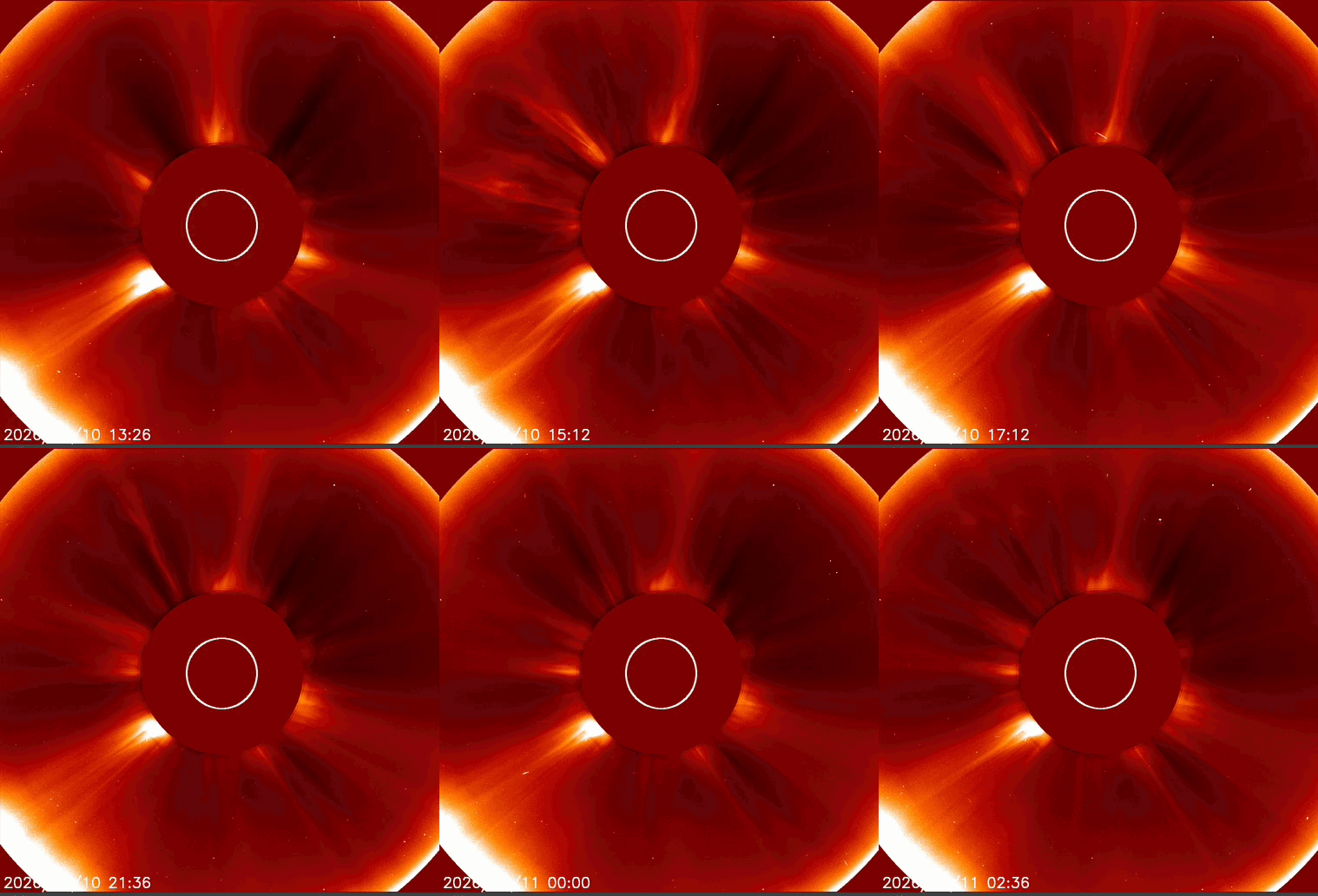
The northern lights could get a boost tonight (May 12-13) as forecasters monitor the possible arrival of a glancing coronal mass ejection (CME) launched from the sun on May 10.
Geomagnetic conditions are expected to remain mostly quiet through much of today, then potentially intensify late tonight and into early May 13 if the CME clips Earth, according to NOAA's Space Weather Prediction Center.
The incoming solar storm could trigger active geomagnetic conditions and isolated minor (G1) storm periods, briefly enhancing the auroral oval and increasing northern lights visibility at high latitudes.
The forecast remains somewhat uncertain because the CME is only expected to deliver a glancing blow at best, meaning impacts could end up weaker than currently predicted.
Looking ahead, auroras could get another boost around May 15 when a fast stream of solar wind arrives from an Earth-facing coronal hole.
Wednesday, May 13: Northern lights may get a boost this week as a giant coronal hole turns toward Earth
The northern lights may get a slight boost tonight (May 13-14) if the expected glancing CME arrives, but it's possible it could miss us altogether.
However, space weather forecasters are now watching a large coronal hole rotating into an Earth-facing position that could spark fresh aurora activity later this week.
Geomagnetic conditions are expected to stay mostly quiet to unsettled tonight, with only limited chances for aurora visibility at high latitudes, according to NOAA's Space Weather Prediction Center and the U.K. Met Office. However, around May 15, a high-speed solar wind stream is forecast to sweep past Earth and could trigger minor (G1) geomagnetic storm conditions.
If these conditions are met, the northern lights could be visible in the northern U.S., Canada and Scandinavia, clear skies pending.
Thursday, May 14: Geomagnetic storm could boost northern lights visibility tonight
Heads up, aurora chasers! The northern lights could ramp up tonight (May 14-15) due to an incoming fast stream of solar wind from a coronal hole on the sun. The speedy solar wind could trigger minor to moderate (G1-G2) geomagnetic storm conditions during the early hours of May 15 UTC, which lines up with tonight for North American skywatchers.
G2 storm conditions are possible between 11 p.m. and 2 a.m. tonight (0300-0600 UTC May 15) with lingering G1 conditions possible afterward, according to NOAA's Space Weather Prediction Center.
Though auroras will likely remain confined to high latitudes, stronger geomagnetic conditions such as G1 and G2 could briefly push the northern lights farther south, and auroras could be visible as far south as New York and Idaho.
Northern Hemisphere aurora forecast courtesy of the U.K. Met Office
Aurora forecast for tonight and the weekend: Prolonged geomagnetic activity could fuel northern lights this weekend
The northern lights could put on decent displays tonight and over the weekend as Earth is hit by a fast-moving stream of solar wind from a colossal hole in the sun's atmopshere.
NOAA's Space Weather Prediction Center forecasts active to minor (G1) geomagnetic storm conditions through May 15-17.
If these storm levels are reached, auroras could become visible across high-latitude U.S. states, including Alaska, northern Michigan and Maine, while skywatchers in Canada, Scotland and similar latitudes may also have a chance to spot the northern lights, clear skies pending.
Northern Hemisphere aurora forecast courtesy of the U.K. Met Office
Monday, May 18: Northern lights possible tonight as glancing solar storms approach Earth
The northern lights could become more active over the next few nights as forecasters monitor possible glancing blows from not one but three coronal mass ejections (CMEs) launched by the sun late last week.
Minor (G1) geomagnetic storm conditions are possible through May 18-19, with a slight chance of moderate (G2) storm levels if any CME material clips Earth's magnetic field, according to NOAA's Space Weather Prediction Center.
Up to three glancing impacts are possible between May 18 and 20, according to the U.K. Met Office, which could enhance aurora activity across northern U.S., Scandinavia and Scotland.
Tuesday, May 19: Northern lights possible again tonight as speedy solar winds continue
The northern lights could be visible at high latitudes again tonight as forecasters monitor possible glancing blows from two coronal mass ejections (CMEs), and a speedy stream of solar wind.
Isolated minor (G1) geomagnetic storm conditions are possible through May 19-20, according to the U.K. Met Office, due to the lingering CME effects combined with elevated solar wind speeds from a coronal hole.
This may be our last night of promising activity, as conditions are gradually easing after several days of enhanced geomagnetic activity.
Wednesday, May 20: Northern lights may linger tonight as solar storm conditions ease
The northern lights could still be visible at high latitudes tonight as geomagnetic activity gradually calms following several days of enhanced activity.
Forecasters say conditions are easing, though isolated minor (G1) geomagnetic storm conditions remain possible tonight as lingering effects from earlier CMEs and elevated solar wind continue to fade.
While current activity is fading, space weather forecasters are watching a large sunspot region on the far side of the sun that will begin rotating into view early next week. There could be some fireworks ahead!
Aurora forecast May 21-25: Quiet skies expected through the weekend
The northern lights are expected to remain relatively quiet tonight and through the weekend as geomagnetic activity wanes.
No significant geomagnetic storms are expected through the weekend, with activity likely staying quiet to unsettled, according to NOAA's Space Weather Prediction Center and the U.K. Met Office.
But things could get more interesting next week. Space weather forecasters are watching multiple active sunspot regions on the far side of the sun that are expected to rotate into view in the coming days. If there are any big solar flare players still standing by the time they rotate into the "Earth strike zone!" there could be some solar fireworks ahead!
Tuesday, May 26: Northern lights unlikely for most tonight, but the sun could be waking up
The northern lights are expected to remain fairly quiet tonight as geomagnetic activity stays subdued.
According to NOAA's Space Weather Prediction Center and the U.K. Met Office, geomagnetic activity will remain mostly at background levels tonight, although some minor high-latitude aurora enhancements are possible as a weak high-speed solar wind stream from a coronal hole begins to arrive at Earth.
Any northern lights displays are expected to remain limited and largely confined to northern regions. However, the longer summer daylight hours will hinder most viewing efforts.
While aurora chances remain modest for now, space weather forecasters are keeping a close eye on several increasingly active sunspot regions rotating into view on the sun. There could still be some solar fireworks ahead!
Wednesday, May 27: Northern lights could brighten slightly tonight as solar wind speeds increase
The northern lights could become slightly more active tonight as a weak high-speed solar wind stream from a coronal hole brushes past Earth, though widespread aurora displays are not expected.
According to space weather forecasters at NOAA's Space Weather Prediction Center and the U.K. Met Office, geomagnetic conditions are expected to rise from quiet to unsettled and possibly active levels on May 27 and into the early hours of May 28 as solar wind speeds increase.
Meanwhile, several increasingly active sunspot regions rotating into view on the sun are continuing to attract attention, with forecasters noting a growing chance of strong M-class solar flares in the days ahead.
Thursday, May 28: Northern lights remain possible at high latitudes as weak solar wind lingers
The northern lights could still make a limited appearance at high latitudes tonight as a weak coronal hole influence continues to brush past Earth.
According to space weather forecasters at NOAA's Space Weather Prediction Center and the U.K. Met Office, geomagnetic conditions are expected to remain mostly quiet to unsettled tonight. Any aurora activity is likely to stay confined to far northern regions. However, shorter hours of darkness at high latitudes will limit aurora hunting efforts.
Aurora forecast for tonight and the weekend: Northern lights may remain limited through the weekend despite growing sunspot activity
The northern lights are expected to remain largely subdued through the weekend as geomagnetic activity stays at mostly quiet to unsettled levels, according to NOAA's Space Weather Prediction Center and the U.K. Met Office
However, some brief enhancements are possible at high latitudes due to weakened solar winds from a coronal hole, but no significant geomagnetic activity is forecast.
While aurora chances remain modest for now, solar activity continues to build slowly.
Several active sunspot regions are now rotating into view, and both NOAA and the U.K. Met Office note an ongoing chance of M-class solar flares in the days ahead.
As I wrote that sentence above, the sun just released an M-1.19 solar flare!
Monday, June 1: Northern lights could make a brief appearance tonight under lingering solar wind effects
The northern lights could make a limited appearance at high latitudes tonight as lingering solar wind enhancements continue to influence Earth's magnetic field, according to NOAA's Space Weather Prediction Center and the U.K. Met Office.
However, even if auroras do develop, viewing opportunities remain limited at this time of the year. The long daylight hours and persistent twilight across many high-latitude locations can make the northern lights difficult to spot, even when geomagnetic conditions are favorable.
Final note to our readers
As summer takes hold across the Northern Hemisphere, the northern lights season is drawing to a close. While auroras can still occur, the short nights and lingering twilight across high latitudes make them increasingly difficult to see.
We'll be pausing our forecast updates until darker skies return around September. In the meantime, don't worry about missing any major space weather events — if the sun launches a significant coronal mass ejection, or spectacular solar flare, we'll continue covering it here on Space.com with dedicated news and forecast articles throughout the summer.
Thanks for joining us for another aurora season and we'll see you again under dark skies this fall.
