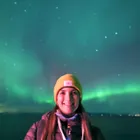
The National Oceanic and Atmospheric Administration's (NOAA) Space Weather Prediction Center (SWPC) has issued a geomagnetic storm warning for tonight (March 25) due to incoming turbulent solar weather.
This is exciting news for aurora enthusiasts, as the expected G2-level storm could bring northern lights as far south as New York and Idaho.
NOAA's SWPC forecasts the Kp index to peak at 5.67 over the next 24 hours, signaling strong geomagnetic activity. For the latest aurora forecast and timing updates, check NOAA's 3-day space weather outlook.
The predicted increase in geomagnetic activity is driven by a co-rotating interaction region (CIR) — a turbulent area in the solar wind where fast-moving streams collide with slower wind ahead of them. CIRs can generate shock waves similar to those found in coronal mass ejections (CMEs), enhancing space weather effects.
This particular CIR is fueled by a massive Earth-facing coronal hole in the sun's atmosphere. Coronal holes are regions where the sun's magnetic field opens up, allowing high-speed solar wind to escape freely into space. In ultraviolet images, these areas appear darker because they lack the hot, glowing gases typically trapped by magnetic fields, according to spaceweather.com.

In more great news for aurora enthusiasts, this surge in geomagnetic activity comes at the perfect time. That's because Earth is currently in an ideal position for dazzling auroras, thanks to its proximity to the vernal equinox, which occurred on March 20.
Auroras tend to be stronger around the equinoxes due to a phenomenon known as the Russell-McPherron effect. During this period, Earth's magnetic field can develop temporary "cracks," allowing even weak solar wind to penetrate and spark brilliant displays. Unlike other times of the year when Earth is tilted toward or away from the sun, the equinox brings a more neutral alignment. This allows the solar wind's magnetic field to interact more efficiently with Earth's, channeling energy into the atmosphere and enhancing auroral activity.

We could be in for a spectacular show tonight, so keep your eyes on the skies!
To stay updated on aurora activity, consider using a space weather app that provides real-time forecasts based on your location. A great option is "My Aurora Forecast & Alerts" (available for iOS and Android). For a deeper dive into space weather conditions, "Space Weather Live" is another excellent choice (available for iOS and Android)