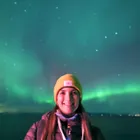
All aboard the solar storm train! Two coronal mass ejections (CMEs) are on track to strike Earth with glancing blows on Jan. 24-25.
The first CME was released during an M-class solar flare eruption on Jan. 21 and the second from a filament eruption on Jan. 22.
If both CMEs land a blow their combined result could be minor (G1) to moderate (G2) geomagnetic storm conditions according to Spaceweather.com. Skywatchers could see northern lights as far south as New York and Idaho if G2 conditions are reached.
NOAA's Space Weather Prediction Center forecasts that the Kp index will peak at 5.33 over the next 24 hours, with G1 geomagnetic storm conditions possible tonight night (Jan. 24) from 10:00 p.m. EDT through 4:00 a.m. EDT on Jan. 25 (0300-0900 GMT on Jan. 25).
The Kp index is a scale from 0 to 9 that measures geomagnetic activity with higher values indicating stronger disturbances and increased chances of auroras. NOAA classifies geomagnetic storms using a G-scale, which ranks their intensity from G1 (minor) to G5 (extreme). The recent geomagnetic storm predictions are rated G1, indicating minor storm conditions. However, the combined result of both incoming CMEs could spark moderate G2 conditions.
When CMEs strike Earth's magnetosphere, they bring electrically charged particles called ions that collide with our planet's magnetic field. These collisions can spark geomagnetic storms. During these storms, ions collide with atmospheric gases, releasing energy as light. This creates the stunning displays known as the northern lights, or Aurora Borealis, in the Northern Hemisphere, and the southern lights, or Aurora Australis, in the Southern Hemisphere.
"More potential for #aurora with this latest #solarstom launch," space weather physicist Tamitha Skov wrote in a post on X.
We could experience G1 to G2 level geomagnetic storms by Jan. 25 according to Skov.
More potential for #aurora with this latest #solarstom launch. A filament near Region 3961 we've been watching cross through the Earth-strike zone finally let go! Much of it will go south of Earth, but we could see G1-G2 level storming by January 25. NASA shows impact by 10a UTC. pic.twitter.com/6SI8cih0K3January 22, 2025
When will the geomagnetic storm occur?
Current forecasts predict possible G1 conditions overnight on Jan. 24-Jan. 25. Check out NOAA's 3-day forecast for the latest timings.
Remember that space weather is inherently unpredictable and challenging to forecast much like Earth's weather. While geomagnetic storm warnings at this level are relatively common, they sometimes result in minimal activity. However, they can also exceed initial predictions and intensify to higher geomagnetic storm levels. Stay optimistic, and be prepared to keep an eye on the skies—you never know when the auroras might put on an extraordinary display!
If you're interested in tracking space weather and knowing when and where to spot auroras, download a space weather app that provides forecasts based on your location. One option I use is "My Aurora Forecast & Alerts," available for both iOS and Android. However, any similar app should work well. I also use the "Space Weather Live" app, which is available on iOS and Android, to get a deeper understanding of whether the current space weather conditions are favorable for aurora sightings.
Editor's note: This article was updated at 5:00 a.m. EDT (1000 GMT) on Jan. 24 to include details of the second incoming CME from the solar filament eruption on Jan. 22.