You wait years for a TV show about an isolated subterranean community after the end of the world, then two come along at once… Yes, unless you've been living in an actual bunker for the last couple of years, you'll know that post-apocalyptic stories set in underground habitats are all the rage right now. And yet despite the similar premises, these shows take radically different approaches to living below ground level.
First up was "Silo" (2023), Apple TV's compelling, slow-burn drama about the residents of an underground settlement who realize their entire existence is built on lies. Then came the fun side of armageddon, as "Fallout" (2024) revealed a more primary-colored end of the world, built on '50s Americana and larger-than-life heroes, antiheroes, and villains.
So, now that Prime Video has opened the giant metal door on "Fallout" season 2 and we've seen the whole thing, we decided to dig down into both shows' foundations to see what life is like inside — and outside — their respective bunkers.
Silo vs Fallout: Inspiration

"Silo" is based on a series of novels (originally self-published) by US author Hugh Howey — "Wool" (2011), "Shift" (2013), and "Dust" (2013). He's also written three short stories in the same universe: "In the Air" (2014), "Into the Mountains" (2014), and "In the Woods" (2015).
"Fallout", meanwhile, is inspired by a long-running series of role-playing video games, the first (developed and published by Interplay Productions) landing on PC back in 1997. A sequel followed a year later, before Bethesda took over the reins when the franchise moved to consoles with 2008's "Fallout 3".
"Fallout: New Vegas" (a major influence on the TV show's second season) arrived in 2010, with "Fallout 4" debuting in 2015. There have also been several spin-off games, while a fifth game in the main series is in development. Bethesda development chief Todd Howard told BBC Newsbeat that this "will be existing in a world where the stories and events of the show happened or are happening".
Silo vs Fallout: Setting

"Silo"'s dates are a little fuzzy. In season 2, mayor/head of IT Bernard Holland (Tim Robbins) revealed that Silo 18 is at least 352 years old, though it's unclear — in the TV show, at least — exactly when it was built. The flashback in the Silo season 2 finale shifted the storytelling to Washington, DC, in what looked very much like our present, though the radiation scans, reference to a dirty bomb attack on New Orleans, and speculation about American plans to retaliate against the alleged aggressor Iran suggest the show exists in an alternative timeline.
Even if the Silo were built tomorrow, however, we're looking at somewhere in the late 24th century.
The timing on "Fallout" is rather more clear-cut. Even though the pre-apocalypse United States resembles the 1950s — albeit with advanced robotics and unconventional flying machines — this is actually an alternative, retro-futuristic version of 2077. The TV show picks up the story of Lucy MacLean (Ella Purnell) and the Ghoul/Cooper Howard (Walton Goggins) 219 years later, placing the action in 2296.
In other words, even though "Fallout" feels more futuristic, it's set at least a century before "Silo".
Silo vs Fallout: Architecture, décor, & clothing

In "Silo", Silo 18 is one of 50 (or 51, depending on who you speak to) similar, possibly identical bunkers. It's home to 10,000 people, and its architecture prioritises depth over width, with 144 subterranean levels — for reference, the Empire State Building has 102 floors.
Décor is drab, with very little color, while residents tend to prioritize functional "Alien"-style fashion. Everything is run by what looks like 1980s era PCs (remember greenscreens?), though there's clearly some more sophisticated tech — possibly even artificial intelligence — working behind the scenes. Information about the world outside — before and after the Silo's construction — is heavily suppressed.
"Fallout"'s Vaults are spread across the United States and, in the games at least, there are over 120 of them. Lucy Maclean (Ella Purnell)'s home, Vault 33, is located in California and boasts 12 levels built around a spacious atrium. This offers projections of idyllic countryside to create the illusion of being outdoors.
Different Vaults have different functions: Vault 4 is a scientific facility for experimenting on surface dwellers, while Vaults 31, 32, and 33 co-exist in a triangle linked by underground tunnels. Vaults 32 and 33 trade with each other every three years — as well as goods, they exchange potential spouses to reduce the risk of in-breeding — and both unknowingly serve as "breeding pools" for Vault 31. The latter houses the cryogenically frozen employees of Vault-Tec, a corporation that made a lot of money out of underground bunkers before the Great War.
The Vaults look like rather nicer places to live than their "Silo" counterparts, with their homely '50s stylings, wall-to-wall easy-listening, and Nuka-Cola machines. Standard-issue clothing is a bright blue jumpsuit emblazoned with your Vault number. Residents are also allocated a wrist-mounted computer — essentially a massively oversized smartwatch — known as a Pip-Boy. The educational curriculum is based around the beliefs of the Vaults' founders.
Silo vs Fallout: Why no one ever leaves

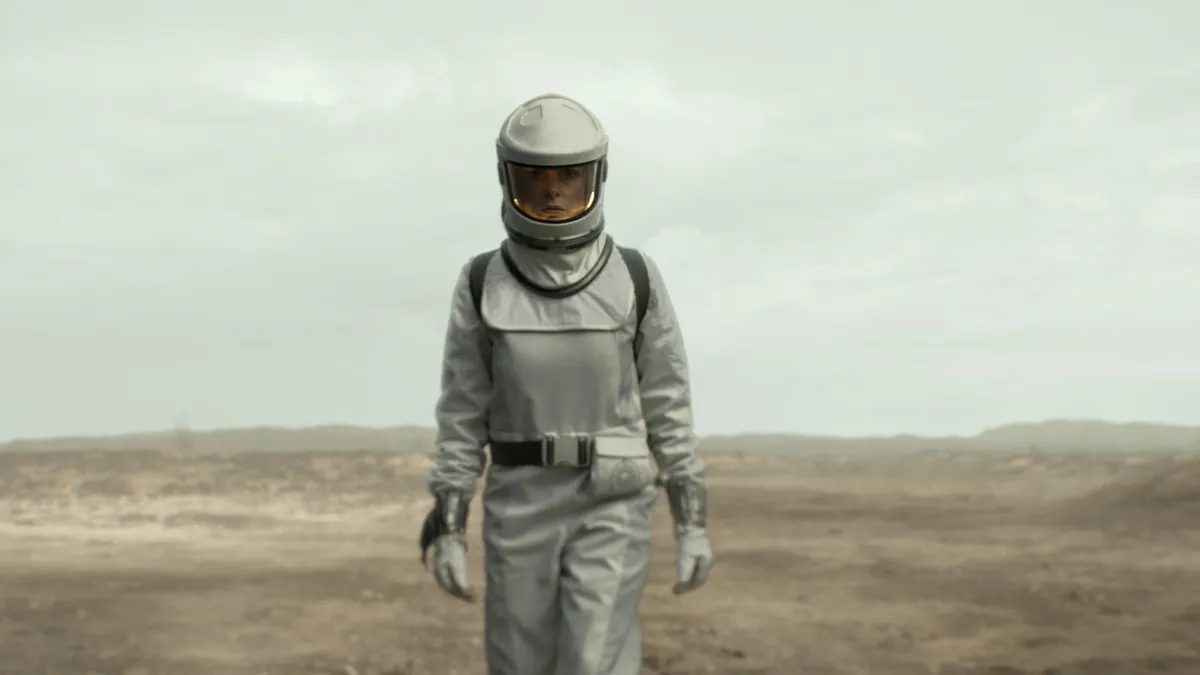
In "Silo", heading outside the confines of the bunker is totally forbidden by the "Pact", the facility's equivalent of a constitution. This rule is enforced by fear, as residents know that time on the (presumably?) toxic surface means almost-instant death — a fact they're reminded of by the constant live video feed of the wasteland outside.
Banishment is used as a punishment for major crimes, but even saying the words "I want to go outside" is enough to get you sent out to "clean" the cameras relaying footage inside. These walks tend to be so short that most Siloers would never dream of stepping beyond the front door. (It's worth noting, however, that the system is rigged, with the exiled routinely given faulty sealing tape to render their protective suits redundant.)
In "Fallout", opening the door to the outside is simply something they've never done before — most of the Vault dwellers are quite happy with their subterranean existence and petrified of what they might find outside.
Silo vs Fallout: The world outside

Silo residents have little idea what's outside, because their video feed shows nothing but scrub, dead trees, and the corpses of deceased cleaners — everything else is obscured by the incline strategically placed around the entrance to the bunker.
Although virtual reality tech inside the helmets of the banished portrays the outside world as a birdsong-filled paradise, the truth is rather bleaker. Silo 18 is surrounded by many other Silos in a nondescript desert near the remains of a major city, widely believed (though not confirmed) to be Atlanta. The atmosphere is believed to be lethally toxic, though this is not known for certain.
There's rather more going on in "Fallout"'s great outdoors, though you wouldn't mention much of it in a tourist brochure. Mutated animals can be found in both land and water, while radiation has created a new species of long-lived ex-humans known as Ghouls — former Western movie star Cooper Howard (Walton Goggins) now has a noseless, skull-like appearance.
The wasteland is a dangerous, anarchic place, where citizens have to do whatever they can to survive, even if it means eating flea soup for dinner. Organizations like the Knights of San Fernando — who run around in sophisticated mech armor — supply their own brand of law and order. Las Vegas remains surprisingly intact, apparently because tech boss Robert House kept the bombs away.
Silo vs Fallout: Reasons for living underground
The first rule of both shows? Never trust an '80s/'90s movie star who's been elevated to a position of power, as both Mayor Bernard Holland ("The Player" and "The Shawshank Redemption"'s Robbins) and Overseer Hank MacLean ("Blue Velvet" and "Dune"'s Kyle MacLachlan) know rather more about their underground existence than they're letting on — often to the detriment of the citizens under their jurisdiction. That said, neither man is at the top of the chain of command — although Bernard admits that he “knows the who”, even he’s in the dark when it comes to the why.
In Silo, references to a toxic world imply that half a million people were sent underground to protect them from the horrors of a nuclear holocaust. Things may not be quite as they seem, however.
It certainly appears that the Silos' priority is not so much keeping everyone inside safe as making sure they don't leave. If prolonging the human race really was the order of the day, why would the architects have installed the so-called "Safeguard", a device capable of annihilating everybody inside? Besides, if you really wanted to ensure thousands of people remained compliant in a giant pit, what better way to do it than telling them that going outside will kill them?
In Fallout, the answers are much more simple — a dangerous combo of eugenics and out-of-control capitalism. It's clear that tensions between nuclear powers the US and China reached dangerous levels in the (fictional) 2070s, but that didn't stop multinational bosses from giving armageddon a bit of a helping hand. The likes of Vault-Tec (bunkers), RobCo (robots), and Big MT (defence) all saw money-making opportunities in firing the first shot in a thermonuclear war. They also leapt on the opportunity to socially engineer their vision of a new "perfect" society, putting their kind of people into those aforementioned Vaults, and instructing them to interbreed until their descendants are ready to recolonize the surface of the Earth.
The Season 2 finale of 'Fallout' just aired on Prime Video. The first two seasons of 'Silo' are on Apple TV now.