US lawmakers call for a permanent moon base. Will it ever happen?

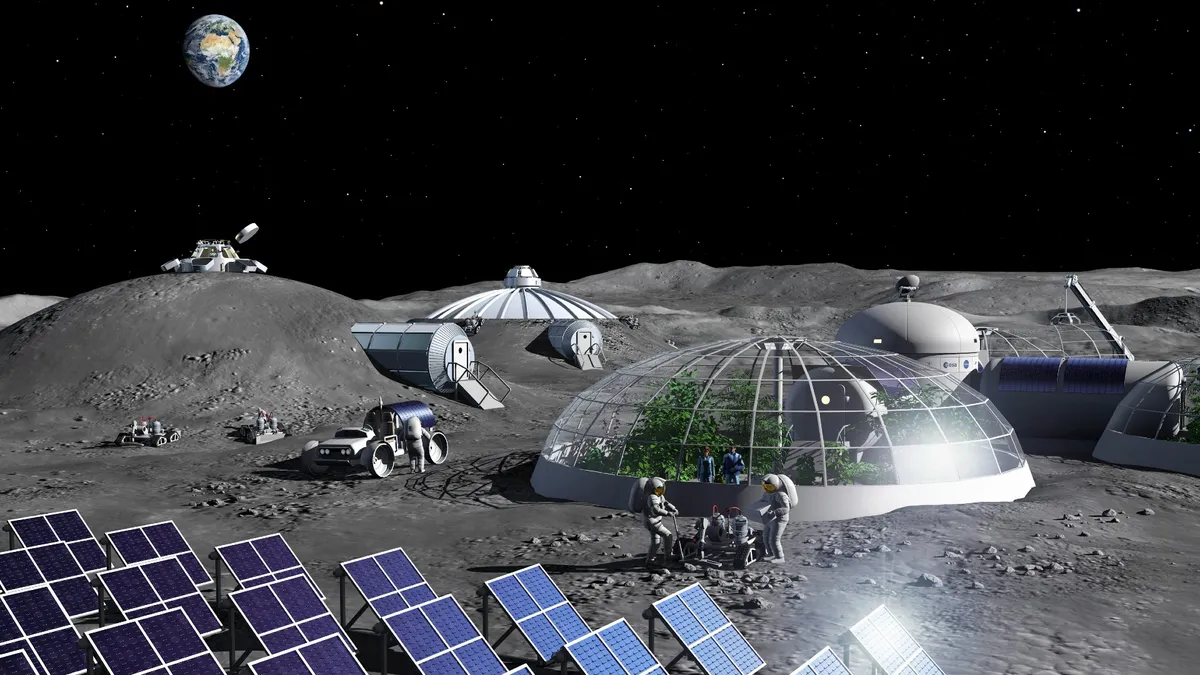
For the first time, legislation has been unanimously passed that gives the go-ahead for NASA to establish a permanent moon base as part of a push for a sustained American presence on the lunar surface.
While not a done deal — both the U.S. Senate and House chambers must agree on the language — the impetus for establishing a "Lunar Surface Moon Base" is that America is in a space race with China.
On March 4, the U.S. Senate Committee on Commerce, Science and Transportation passed the NASA Authorization Act of 2026, led by U.S. Senators Ted Cruz, (R-Texas), chairman of the committee, and Maria Cantwell (D-Wash.), ranking member of the committee. The legislation calls for establishing a Lunar Surface Moon Base "to develop a permanent crewed United States presence on the moon capable of long-duration habitation, robotic and industrial operations to advance science, technology, and strategic interests."
Enduring lunar presence
In its final form, the lunar base is to be designed, constructed, and operated to enable meaningful and robust scientific research and technology demonstrations on the lunar surface.
To that end, the Act calls for the U.S. to have an "enduring lunar presence." Furthermore, to the maximum practical extent, capabilities honed at the base are to be scalable to Mars missions and adaptable to evolving national exploration and science needs.
Ted Cruz, (R-Texas), Chairman of the Committee, issued a one-pager focusing on the NASA Authorization Act of 2026, titled "Securing American Dominance in the New Space Race."
"The United States is in an intensifying strategic space race with the People's Republic of China, spanning Earth's orbit, the moon, and the broader expanse of deep space," Cruz stated. "Beijing is rapidly advancing its lunar ambitions, expanding its on-orbit capabilities, constructing supporting infrastructure beyond Earth, and promoting alternative governance frameworks such as the International Lunar Research Station [ILRS] — all with a clear objective."
China's aim, Cruz added, is to dominate the moon, control strategic terrain in space, and write the rules of the 21st century.
Path forward
The comprehensive bipartisan bill sets the stage for decades of continued U.S. leadership in outer space, observes Senator Maria Cantwell, the committee's ranking member.
"For the first time, it authorizes NASA to establish a permanent moon base as part of sustained American presence on the lunar surface," said Cantwell.
The authorization act also requires NASA to evaluate existing and potential crew rescue capabilities from the moon in emergency and non-emergency scenarios.
"This legislation supports a path forward for our safe return to the moon that will get us there as soon as possible. And for the first time, our bill establishes a program to develop a permanent moon base and reinforces existing efforts related to lunar surface power and lunar exploration vehicles," Cantwell said.
Executive orders
The call for an American moon base was previously announced by U.S. President Donald Trump's "Ensuring American Space Superiority" executive orders back on Dec. 18, 2025.
President Trump said his administration would focus its space policy on achieving a number of priorities, including:
- "Returning Americans to the moon by 2028 through the Artemis Program, to assert American leadership in space, lay the foundations for lunar economic development, prepare for the journey to Mars, and inspire the next generation of American explorers."
- "Establishing initial elements of a permanent lunar outpost by 2030 to ensure a sustained American presence in space and enable the next steps in Mars exploration"
- "Enabling near-term utilization of space nuclear power by deploying nuclear reactors on the moon and in orbit, including a lunar surface reactor ready for launch by 2030"
Strategic high ground
As for why all this matters, lawmaker Cruz says "the nation that leads in space will shape the global economy, define international norms, and secure the ultimate strategic high ground. China understands this and is moving rapidly to claim it."
The NASA Authorization Act of 2026, Cruz said, "ensures that America — not China — leads the next era of exploration. It strengthens the U.S. presence from low-Earth orbit into deep space, protects sensitive technologies from adversaries, restores accountability, and positions the United States to lead from the Moon to Mars."
Cruz emphasizes that space is not symbolic; it is strategic.
"Leadership in space underpins national security, economic strength, technological innovation, and global influence. If America hesitates, China will fill the void," Cruz concluded.