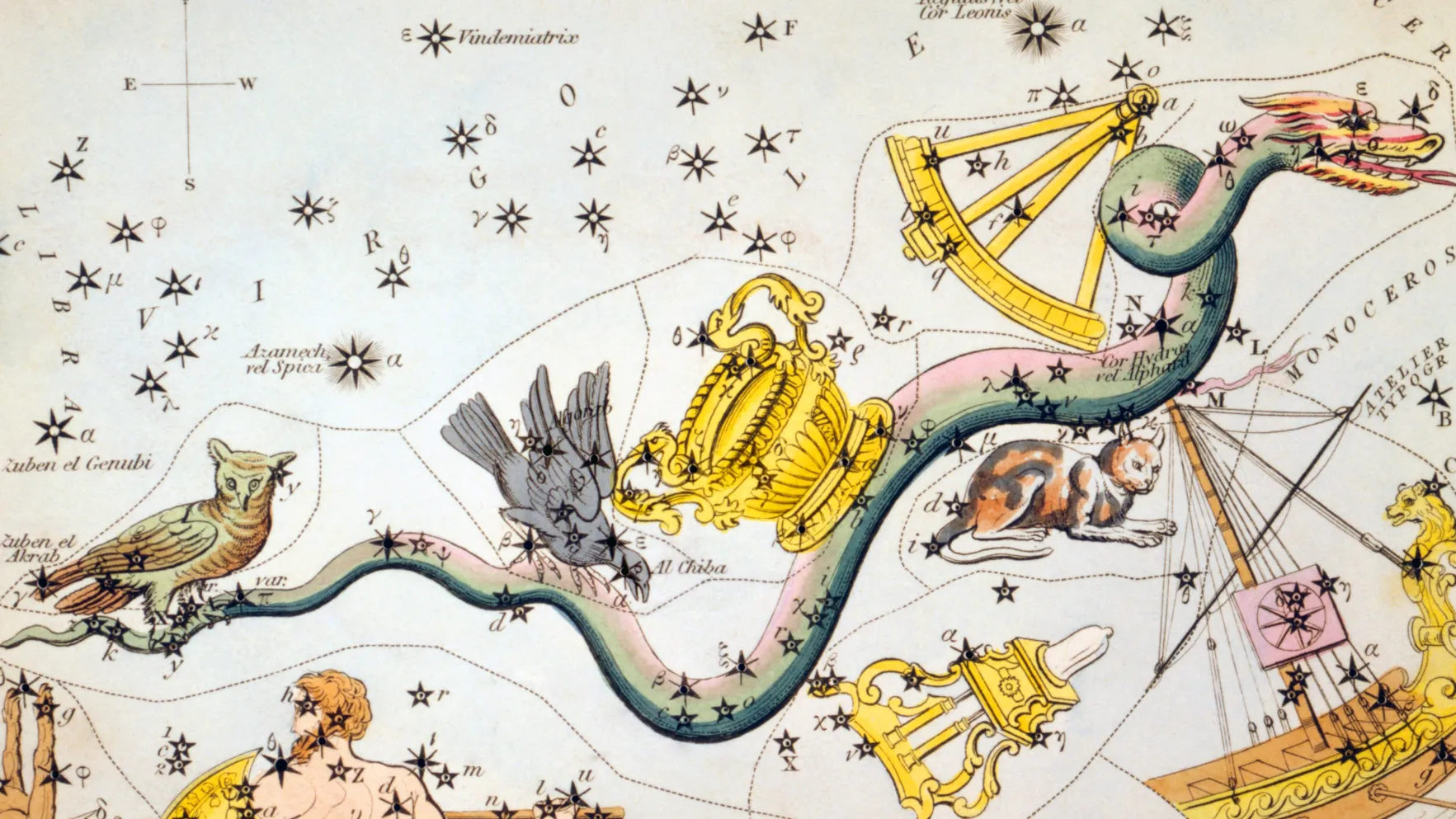
Spring is here and with it, a new set of sparkling constellations rises to prominence! But what are the stories behind these mesmerizing stellar citadels and how can you find them in the night sky?
Humanity's relationship with the stars stretches back for several millennia. In the modern day, we know the bright specks of their light to be incandescent orbs of glowing plasma powered by nuclear fusion, but in ancient times, the true nature of these stellar lanterns was a mystery.
Rather than allow the sea of stars to remain aloof, our ancestors chose to make them part of their world by linking them with storytelling and mythology. Countless cultures have imprinted their own cultural beliefs in the constellations, seeing mighty heroes, fantastic beasts and eclectic objects in the stars.
Read on to discover the mythology underpinning four popular spring constellations, along with tips on how to find them in the night sky. Be sure to check out our roundup of the best smartphone astronomy apps if you're new to the night sky, which can help you find everything from galaxies and nebulas to constellations and individual stars in the night sky.
BOOTES
Bootes has been associated with countless myths over the centuries. In Greek mythology, Bootes is often seen as a herdsman driving a great plow in the form of the nearby "Big Dipper" asterism. The constellation is also sometimes known as Arcturus — which is also the name of its brightest star — which translates roughly to "guardian of the bears", in reference to the constellations of Ursa Major and Ursa Minor, according to the Chandra Space Telescope website.
Ancient Chinese astronomers saw Bootes and Virgo as part of a larger formation of stars representing the horn of a great azure dragon, with Arcturus serving as its shining tip.

You can find the constellation Bootes using the famous stars of the Big Dipper asterism, which are located above the northern horizon throughout the year. Next, locate the three stars representing its "handle", and follow their curve out into space — a trick known to stargazers as the "arc to Arcturus". Follow that curve for roughly the length of the Big Dipper and you'll find Arcturus, the fourth brightest star in the night sky.
CORONA BOREALIS
The great arc of stars in the constellation Corona Borealis represents the crown of Ariadne in Greek mythology, who, in some tellings, marries the god Dionysus following the defeat of the bull-like minotaur in the labyrinth below the Aegean island of Crete by the demigod Theseus.
Australian aboriginal peoples, meanwhile, saw a great boomerang in the stellar formation, while the Native American Shawnee tribe envisioned dancing star maidens. The constellation was known as Al Fakkah to medieval Arabian astronomers, who saw in it a celestial bowl, per the University of Chicago.
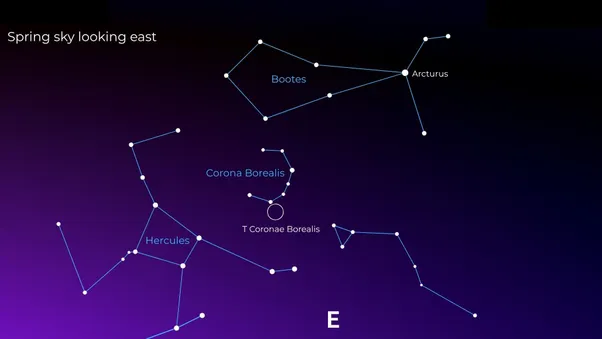
The constellation can be found glittering roughly 20 degrees to the lower left of Arcturus in spring — about the width of two clenched fists held at arm's length against the night sky.
Corona Borealis may soon have a "new" jewel in its crown-like formation of stars, in the form of the symbiotic binary star system T Corona Borealis (T CrB), which periodically erupts in a powerful nova explosion, briefly rendering it visible to the naked eye in the night sky. T CrB could erupt any time now, with one study pointing at June 25 as a possible date for the anticipated nova outburst.
LEO
Many western stargazers now associate the stars of Leo with the Nemean Lion — a mythological beast that the ancient Greek hero Heracles was ordered to slay in penance for the killing of his family during a fit of madness, according to the telescope manufacturer Celestron.
Heracles swiftly discovered that the lion's pelt rendered it invulnerable to weapons, leaving him no option but to strangle the lion with his bare hands to end its reign of terror over the nearby town of Nemea. Zeus later placed the creature in the stars.
The ancient Persians, Babylonians, Syrians and Egyptians also drew comparisons between the stars of Leo and a mighty lion, according to the University of Chicago. The latter held Leo in particular high regard thanks to its association with the flooding of the river Nile, as the sun shone close to the constellation as the waterway broke its banks each year, according to EarthSky.
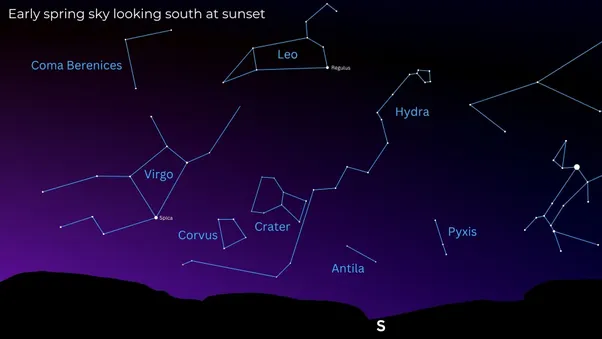
Leo is visible as a prominent sickle, or question mark-like formation of stars that can be found glowing in the southwestern sky at sunset in spring, with the bright star Regulus marking its lowest point for stargazers in the U.S.
HYDRA
Finally, we come to Hydra, the longest constellation in the night sky that, like the Nemean Lion before it, was brutally killed by Heracles over the course of his twelve labors, per the Chandra website. Heracles discovered the Hydra's den in the Lernaean Swamps with the aid of the goddess Athena and was able to break or sever its many necks — while using fire to prevent them from growing back — until only a single immortal head remained.

The Nikon Prostaff P3 8x42 binoculars offer up great optics at a modest price, allowing you to focus on constellations with ease at 8x magnification. They are even reinforced with strong fiberglass and have a shockproof design making them resistant to accidental drops and bumps. Why not check out more of their features on our full Nikon Prostaff P3 8x42 binoculars review?
During the struggle, a giant crab came to the aid of the water snake and attacked Heracles, only to be crushed by the irate demigod! The goddess Hera — who despised Heracles — later set the crab in the heavens in the form of the constellation Cancer as a reward for its bravery.
It is thought that the Greek myth could be a retelling of an older Babylonian tale, in which the hero Gilgamesh slayed a colossal dog-headed, winged serpent known as a Mush-dragon.
To find Hydra, first locate the bright stars Chertan and Regulus in the constellation Leo and draw an imaginary line from the former to the latter, extending 20 degrees into open space. Here, you'll find a faint circlet of stars representing the head of the monster, along with a line of stars that weave their way towards the east, finishing not far below the blue-white light of the star Spica in the constellation Virgo.
Want to get a closer look at the treasure trove of wonders populating the night sky? Then be sure to check out our roundups of the best binoculars and telescopes available in 2026. If you're new to astronomy, our guide on beginning your amateur astronomy journey may come in useful.