


Since its launch in 1990, the Hubble Space Telescope (HST) has provided a dazzling array of images that have awed and inspired the public.
But Hubble's about far more than just pretty pictures. The mission has gathered dozens of terabytes of data over the decades, providing key insights into the universe, from objects as close as the moon to the most remote galaxies, with observations of supernovas and nebulas in between.
Here we explore the history of the telescope and its many discoveries, provide interesting Hubble facts and link to some of the orbiting observatory's best images.
Related: The best Hubble Space Telescope images of all time!
Getting Hubble off the ground
— Hubble is 43.5 feet (13.2 meters) wide with a maximum diameter of 14 feet (4.2 m). On Earth, it would weigh 24,500 pounds (11,110 kilograms).
— The solar-powered telescope launched on April 24, 1990 on board the space shuttle Discovery and was deployed one day later.
— Hubble orbits about 340 miles (547 kilometers) above Earth, on a path inclined 28.5 degrees to the equator. Its average speed is 17,000 mph (27,000 kph), and it takes 95 minutes to complete one orbit.
— Hubble transmits about 120 gigabytes of science data every week. That would be roughly 3,600 feet (1,097 m) of books on a shelf. The collection of pictures and data is stored on magneto-optical disks.
— The telescope's primary mirror is 94.5 inches (2.4 m) wide and weighs 1,825 pounds (828 kg). Its secondary mirror is 12 inches (0.3 m) wide and weighs 27.4 pounds (12.3 kg).
— Astronauts have serviced Hubble five times, on missions that launched in December 1993, February 1997, December 1999, February 2002 and May 2009.
When Galileo Galilei first turned a spyglass to the heavens in 1610, he had trouble making out the rings of Saturn that are visible in inexpensive telescopes today. Advances in optics eventually improved scientists' views of the planets, stars and distant galaxies, but Earth's atmosphere still blocked or distorted much of the light for observers on the ground. Larger telescopes were, and still are, placed atop mountains, where the thinner atmosphere at higher elevations allows clearer pictures.
In 1946, soon after World War II, astronomer Lyman Spitzer proposed launching a space telescope, which could overcome the limitations of ground-based observatories. It took a couple more decades before the idea garnered enough support for the U.S. National Academy of Sciences to organize a committee of scientists to evaluate the potential of a "Large Space Telescope." With Spitzer at the helm, the committee published a document in 1969 that outlined the scientific uses of a Large Space Telescope and advocated for its construction, according to a Hubble history written by Gabriel Olkoski for NASA.
The National Academy of Sciences took the pitch to NASA — the only agency capable of making the Large Space Telescope a reality. NASA was already considering a space telescope of some type, but the agency was undecided about how big to make it and where to start. In 1971, George Low, the agency's acting administrator at the time, greenlit the Large Space Telescope Science Steering Group, and NASA soon began lobbying Congress for funding for the endeavor.

The expensive project was a tough sell, and funding was initially denied by the House Appropriations Subcommittee in 1975. NASA then upped its lobbying efforts and got buy-in from European Space Agency, which shared the costs. Congress eventually granted funding for NASA's portion of the Large Space Telescope in 1977.
Development began almost immediately. NASA planned to launch the telescope in 1983, but various production delays pushed the launch date back to 1986.
In the meantime, the Large Space Telescope was renamed Hubble in honor of Edwin Hubble, an American astronomer who, among other things, determined that the universe extended beyond the borders of the Milky Way.
Hubble's planned liftoff was delayed again after the space shuttle Challenger exploded a minute after takeoff on Jan. 28, 1986, killing all seven astronauts on board. It was more than 2.5 years before shuttle flights resumed and NASA could begin planning Hubble's launch again.
Hubble finally launched aboard the space shuttle Discovery on April 24, 1990 and a day later was deployed into low Earth orbit, about 340 miles (545 kilometers) above our planet. Getting Hubble developed and launched cost $1.5 billion, but there would be ongoing costs as well — both expected and unexpected.

Blurry initial images — and a much-needed fix
Initial instruments on Hubble included the Wide Field Planetary Camera, the Goddard High Resolution Spectrograph (GHRS), the Faint Object Camera (FOC), the Faint Object Spectrograph (FOS) and the High Speed Photometer.
Hubble experienced equipment issues right off the bat. For example, the telescope's first images came back so blurry that they were close to useless scientifically. It turned out that Hubble's 7.9-foot-wide (2.4 meters) main mirror had a defect — a spherical aberration caused by a manufacturing error. The flaw was minute, at just 1/50th the thickness of a sheet of paper, but that was big enough to cause major imaging problems.
Hubble became a laughingstock, the butt of jokes that spread through popular culture. For instance, the 1991 film "Naked Gun 2 1/2: The Smell of Fear" features a photo of Hubble. It appears on the wall of an establishment called Loser's Bar, along with pictures of the Hindenburg, the 1906 San Francisco earthquake, the Ford Edsel and other famous disasters.
But all was not lost, for Hubble was designed to be serviced by astronauts. On Dec. 2, 1993, the space shuttle Endeavour ferried a crew of seven to fix Hubble during five days of spacewalks. Two new cameras, including the Wide-Field Planetary Camera 2 (WFPC-2), which later took many of Hubble's most famous photos, were installed during the fix. In December 1993, the first new images from Hubble reached Earth, and they were breathtaking.
Spacewalking astronauts repaired, maintained and upgraded Hubble on four additional servicing missions, which took place in February 1997, December 1999, March 2002 and May 2009.
The 1997 mission replaced some failed or degraded hardware and installed two new instruments, the Space Telescope Imaging Spectrograph (STIS) and the Near Infrared Camera and Multi-Object Spectrometer. The new instruments, which replaced the GHRS and FOS, extended Hubble's vision into the near-infrared wavelength range, NASA officials wrote in a servicing mission explainer.
The next astronaut visit was originally intended to be a relatively routine maintenance trip that lifted off in June 2000. But the fourth of Hubble's orientation-maintaining gyroscopes failed in November 1999, sending the observatory into a protective "safe mode." (Hubble has six gyros but needs at least three functioning ones to collect science data.) In response, NASA revised its servicing mission plans, splitting the next one into two parts, the first of which launched in December 1999.
On that 10-day mission, astronauts replaced all of Hubble's gyros, as well as one of its three fine guidance sensors, and performed other maintenance work as well.
The next crewed Hubble visit, known as Servicing Mission 3B (following from 1999's Servicing Mission 3A), occurred in December 2002. During that 11-day trip, "astronauts replaced Hubble's solar panels and installed the Advanced Camera for Surveys (ACS), which took the place of Hubble's Faint Object Camera, the telescope's last original instrument," NASA officials wrote in the servicing mission explainer.
Like Hubble's launch, the fifth and final servicing mission was delayed by a shuttle tragedy — the February 2003 breakup of Columbia during its reentry to Earth's atmosphere, which killed all seven astronauts on board. That tragic accident ended up pushing the servicing flight back from its initial 2005 target date to May 2009. During the mission, astronauts put in new batteries and gyroscopes and installed two new instruments, the Cosmic Origins Spectrograph and the Wide Field Camera 3. Among other tasks, the spacewalkers also revived the ACS and STIS, both of which had failed. "With these efforts, Hubble was brought to the apex of its scientific capabilities," NASA officials wrote.
Ever since, Hubble has continued to provide unprecedented information about our universe and inspire curious minds around the world.
Related: Hubble quiz: How well do you know the famous telescope?

Hubble discoveries
Hubble's elevated perspective and advanced optics allow it to peer farther away than ground-based optics are able to see.
Because light takes time to travel long distances, Hubble functions like a time machine: the light it views from remote objects reveals how those objects appeared when the light left them, not how they appear today. For example, when we look at the Andromeda galaxy, which lies about 2.5 million light-years from Earth, we see it as it was 2.5 million years ago.
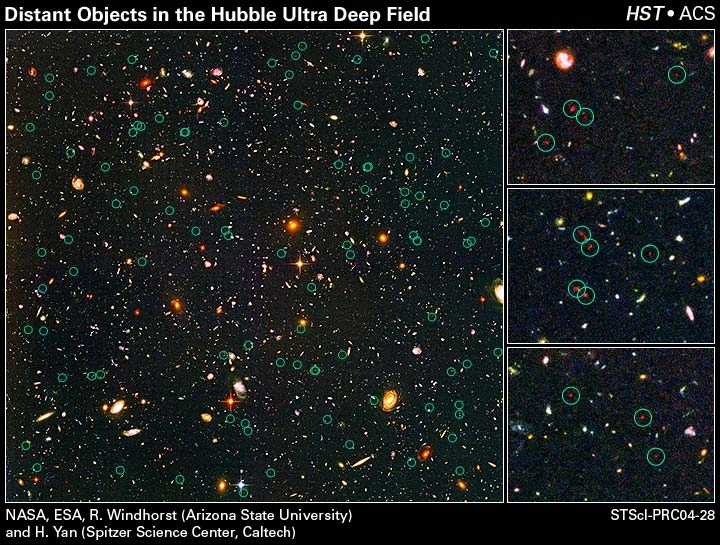
And with Hubble, distant objects are revealed that otherwise can't be seen at all.
When astronomers pointed the HST to a seemingly empty patch of sky in Ursa Major in 1995, for instance, they captured an image of over 3,000 galaxies too distant to be detected by other telescopes. (This was later called the Hubble Deep Field). Some of the galaxies were so young, they had not yet begun serious star formation. Other deep field observations in the same area were performed, peering deeper into space each time. These were called the Hubble Ultra-Deep Field (released in 2004) and the Hubble eXtreme Deep Field (released in 2012).
In addition to gazing at the early universe, Hubble also helped astronomers gauge how much time had passed since the Big Bang. By measuring a special kind of pulsing star known as a Cepheid variable, researchers were able to narrow down the age of the universe from its pre-HST range of 10 to 20 billion years to a more precise 13.7 billion years.
And in the late 1990s, Hubble observations of supernovas helped astronomers make a startling find — the universe's ongoing expansion is accelerating, apparently driven by a mysterious force known as dark energy. We still don't know what dark energy is, even though it makes up most of the universe.
Astronomers have used Hubble to create a 3D map of dark matter, which remains mysterious even though it's six times more abundant than the "normal" matter that makes up stars, planets and everything else we can see and touch. The iconic scope has also discovered that most, if not all, major galaxies harbor supermassive black holes at their cores.
Hubble also examines individual stars in various stages of their evolution, from the clouds of dust that form infant stars to the corpses of those long since detonated. It has even been able to study stars beyond our own galaxy, the Milky Way, and into its neighbors, the Magellanic Clouds and Andromeda Galaxy.
Related: The most amazing Hubble Space Telescope discoveries
Hubble has even photographed planets orbiting other suns. In 2008, for example, Hubble captured imagery of the exoplanet candidate Fomalhaut b, the first time such an object had been directly imaged in visible light. Fomalhaut b has since been reclassified as a likely dust cloud, but Hubble has snapped photos of a number of other alien worlds since then.
Most of Hubble's exoplanet observations, however, have been more indirect. As alien worlds pass in front of their suns from Hubble's perspective, their atmospheres filter out certain wavelengths of starlight, a change that the observatory can detect. This information can reveal key details of the atmospheres' composition.
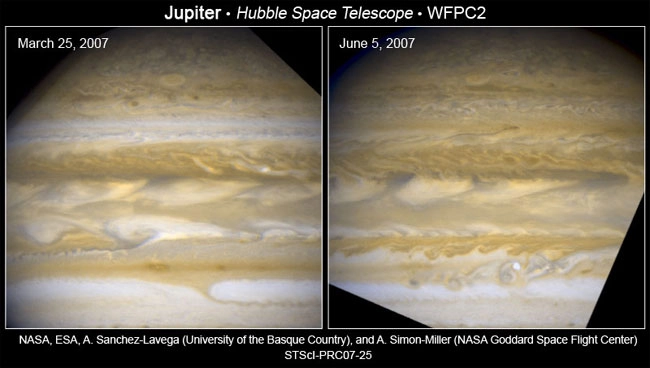
Hubble may spend much of its time peering light-years from Earth, but astronomers also use it to study objects in our own solar system. High-resolution images taken of Jupiter, Saturn and Pluto have provided insights that can only be topped by planetary probes circling the planets. Four of Pluto's five moons were discovered using Hubble observations, for example.
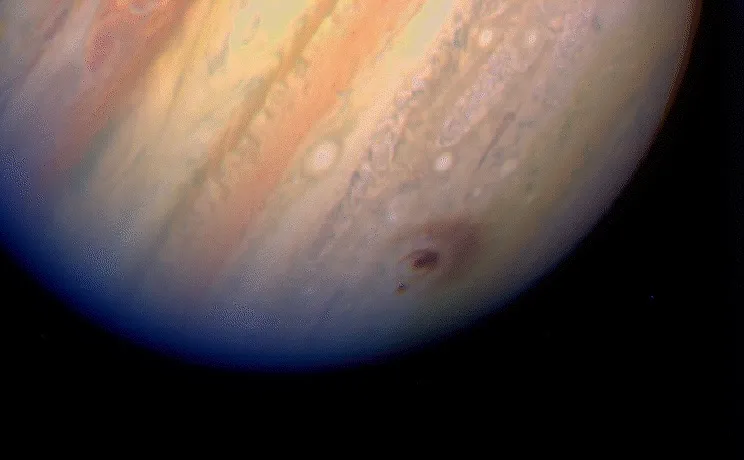
Images from the HST also allow scientists on Earth to monitor changes in planets' atmospheres and on their surfaces. When fragments of the comet Shoemaker-Levy 9 crashed into Jupiter in 1994, for example, Hubble photographed the fatal collision. The aftermath revealed a great deal about the gas giant's atmosphere.
Further, Hubble has seen what appear to be water plumes erupting from Europa, a potentially life-hosting moon of Jupiter. The telescope made an initial observation in March 2014 and then saw a follow-up candidate plume in the same location in February 2016.
That's just a taste of what Hubble has done over the past three decades. To give you a better sense of the breadth and depth of the observatory's achievements, here's a brief rundown of some Hubble highlights from recent years:
- 2021: Observed a bizarre, 250-light-year-wide "superbubble" inside a nebula, spotted a galaxy with surprisingly little dark matter and saw a Jupiter-size exoplanet being born.
- 2020: Spotted evidence for a mysterious star-eating black hole at the edge of another galaxy, and celebrated its 30th birthday.
- 2019: Took a close-up photo of a spiral galaxy that may help demystify black holes, showed us the colorful demise of a dying star and captured incredible images of the interstellar Comet Borisov.
- 2018: Spied the enormous 'El Gordo' galaxy cluster, watched a giant storm on Neptune disappear and caught a great look at the leftovers of a supernova explosion.
- 2017: Found a stratosphere on a huge exoplanet, spotted ultrabright galaxies, watched the farthest known active comet, and accidentally discovered several asteroids when they snuck into observations of a galaxy cluster.
- 2016: Made close-up observations of Comet 252P/LINEAR), spotted the farthest galaxy then known, showed that the universe likely has 10 times the number of galaxies previously thought to exist and observed a dark vortex on Neptune.
- 2015: Made fresh observations of the "Pillars of Creation" to see how they changed over time, captured the sharpest view ever of the Andromeda Galaxy, and got the best 3D view of the deep universe.
- 2014: Watched asteroid P/2013 R3 falling apart, observed a rare, close supernova called SN 2014J, found an extremely distant "cosmic magnifying glass" and released an image, the Ultraviolet Coverage of the Hubble Ultra Deep Field, that showed the universe's evolution.
- 2013: Performed several observations of the spectacular Comet ISON before the comet broke up near the sun, examined an explosion on a distant star, discovered a new moon of Neptune and revealed details about the Milky Way's history based on images of 400 galaxies in various stages of evolution.
Showing its age
Hubble has been showing signs of its advanced age. For example, the telescope went offline for a month in the summer of 2021 after experiencing an issue with its main payload computer. The Hubble team fixed the problem by switching to backup hardware.
But just a few months later, in October 2021, a problem arose with the synchronization of Hubble's internal messaging, sending all five of the observatory's science instruments into a protective "safe mode." The mission team managed to get all of the instruments back online over the next few months.
If you're a pessimist, you can look at such glitches and conclude that Hubble may be on its last legs. If you're an optimist, you can focus on the success of the troubleshooting efforts and the fact that the Hubble team has faced many such challenges over the past three decades and overcome them all.
The truth is, nobody knows for sure how much longer Hubble will be able to keep studying the cosmos. Engineering studies suggest that Hubble's various systems will endure through 2025 and perhaps beyond, but that's just an estimate.
Hubble's highly anticipated successor, the $10 billion James Webb Space Telescope, is already aloft. Webb launched on Dec. 25, 2021 and arrived at its final destination, the Earth-sun Lagrange Point 2, a month later.
Webb is expected to begin science operations in the summer of 2022. Astronomers are excited to use Webb and Hubble in tandem. Webb will view the universe in infrared light whereas Hubble is strongest in optical and ultraviolet wavelengths, so studying the same objects and phenomena with both observatories will provide a wealth of insight and information, NASA officials have said.
Spectacular Hubble pictures
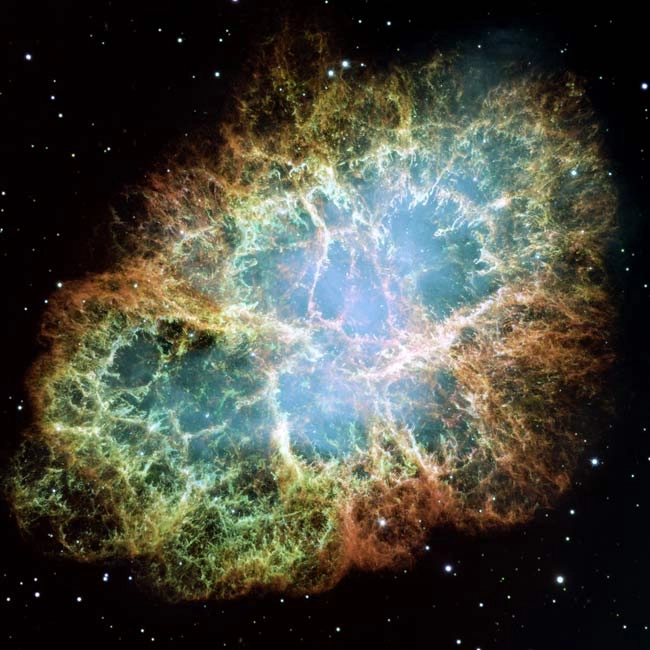
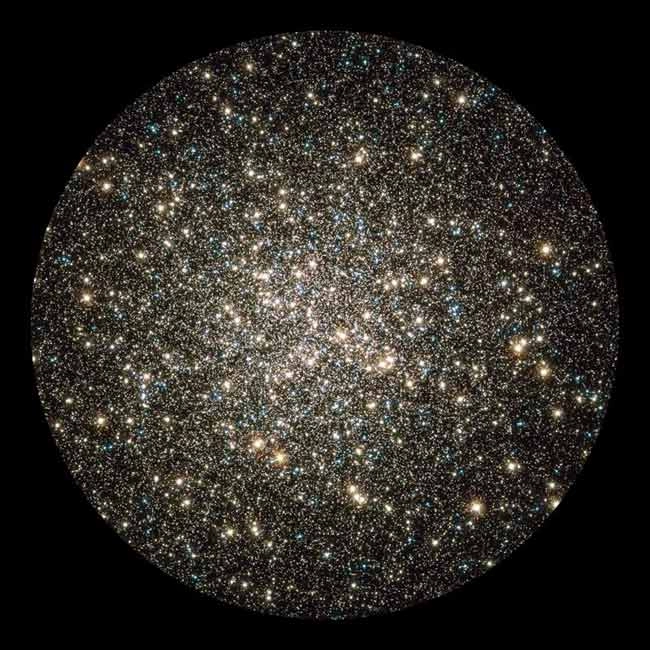
Below are some of the best images taken by Hubble over the years. You can find many more in this gallery of awesome Hubble pictures.




Additional resources
Here are 30 incredible Hubble photos in honor of the telescope's 30th anniversary, from NASA. On the agency's Hubble page, you can find out what Hubble saw on your birthday. And it's definitely worth following Hubble on Twitter @NASAHubble — you'll see lots of pretty pictures and get updates about the observatory's latest activities and discoveries.
Bibliography
- Bell, J. "Hubble Legacy: 30 Years of Discoveries and Images." Sterling, 2020. https://www.amazon.com/Hubble-Legacy-Years-Discoveries-Images/dp/1454936223
- English, N. "Hubble: The People's Telescope." Pp. 47-61 in "Space Telescopes: Capturing the Rays of the Electromagnetic Spectrum," Springer, 2017. https://doi.org/10.1007/978-3-319-27814-8_3
- Gainor, C. "Not Yet Imagined: A Study of Hubble Space Telescope Operations." NASA Office of Communications, NASA History Division, 2021. https://www.nasa.gov/sites/default/files/atoms/files/not_yet_imagined_tagged.pdf
- Okolski, G. "A brief history of the Hubble Space Telescope." NASA. https://history.nasa.gov/hubble/
This article was updated on April 20, 2020 by Space.com Reference Editor Kimberly Hickok and again on Jan. 30, 2022 by Space.com Senior Writer Mike Wall.
