
Watch SpaceX launch US Space Force's classified X-37B space plane today
Launch of secretive spacecraft will be streamed live Thursday night.
Breaking space news, the latest updates on rocket launches, skywatching events and more!
You are now subscribed
Your newsletter sign-up was successful
Want to add more newsletters?
Delivered daily
Daily Newsletter
Breaking space news, the latest updates on rocket launches, skywatching events and more!
Once a month
Watch This Space
Sign up to our monthly entertainment newsletter to keep up with all our coverage of the latest sci-fi and space movies, tv shows, games and books.
Once a week
Night Sky This Week
Discover this week's must-see night sky events, moon phases, and stunning astrophotos. Sign up for our skywatching newsletter and explore the universe with us!
Twice a month
Strange New Words
Space.com's Sci-Fi Reader's Club. Read a sci-fi short story every month and join a virtual community of fellow science fiction fans!
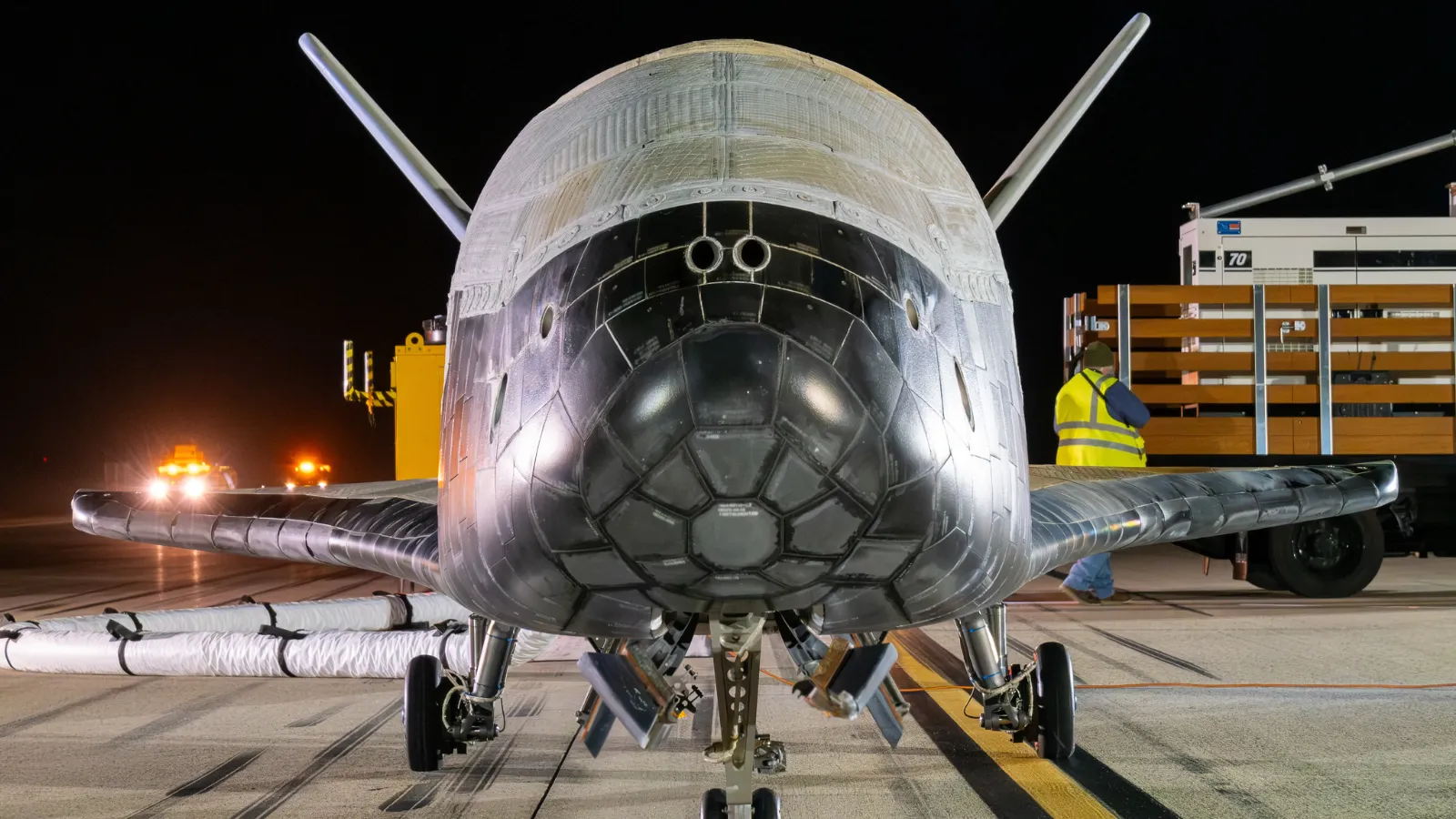
In the dark of night, SpaceX will launch the mysterious X-37B space plane for the U.S. Space Force (USSF).
A Falcon 9 rocket will launch the mission, USSF-36, from Pad 39A, at NASA's Kennedy Space Center (KSC), in Florida, carrying the Boeing-built X-37B on the orbital transfer vehicle's eighth flight (OTV-8). Launch is scheduled for Thursday, Aug. 21, at 11:50 p.m. EDT (0350 GMT, Aug. 22).
SpaceX will broadcast the launch beginning at about 11:30 p.m. EDT (0330 GMT, Aug. 22), with streams available on the USSF-36 mission website and SpaceX's profile on X.
It is the sixth flight for the Falcon 9 booster supporting the USSF-36 launch, B1092, which previously launched NROL-69, CRS-32, GPS III-7, and Starlink groups 12-13 and 10-34. The booster is expected to return to the Space Coast for recovery at SpaceX's Landing Zone-2, located at Cape Canaveral Space Force Station, a few miles downrange from the launchpad.
OTV-8 will focus X-37B's mission on two primary technology demonstrations: a laser communications system and a quantum inertial sensor to test a new type of in-space positioning system, like GPS, according to a July 28 statement Space Force statement.
These technologies represent major advancements in their respective fields. Laser communications capable of supporting heavier data loads and tougher security safeguards, compared to traditional radio.
And, instead of traditional GPS, X-37B's quantum sensor will measure the inertia of nearby atoms to help inform the space plane's navigational position on orbit, without reliance on existing satellite infrastructure.

Breaking space news, the latest updates on rocket launches, skywatching events and more!

Josh Dinner is the Staff Writer for Spaceflight at Space.com. He is a writer and photographer with a passion for science and space exploration, and has been working the space beat since 2016. Josh has covered the evolution of NASA's commercial spaceflight partnerships and crewed missions from the Space Coast, as well as NASA science missions and more. He also enjoys building 1:144-scale model rockets and human-flown spacecraft. Find some of Josh's launch photography on Instagram and his website, and follow him on X, where he mostly posts in haiku.
You must confirm your public display name before commenting
Please logout and then login again, you will then be prompted to enter your display name.
