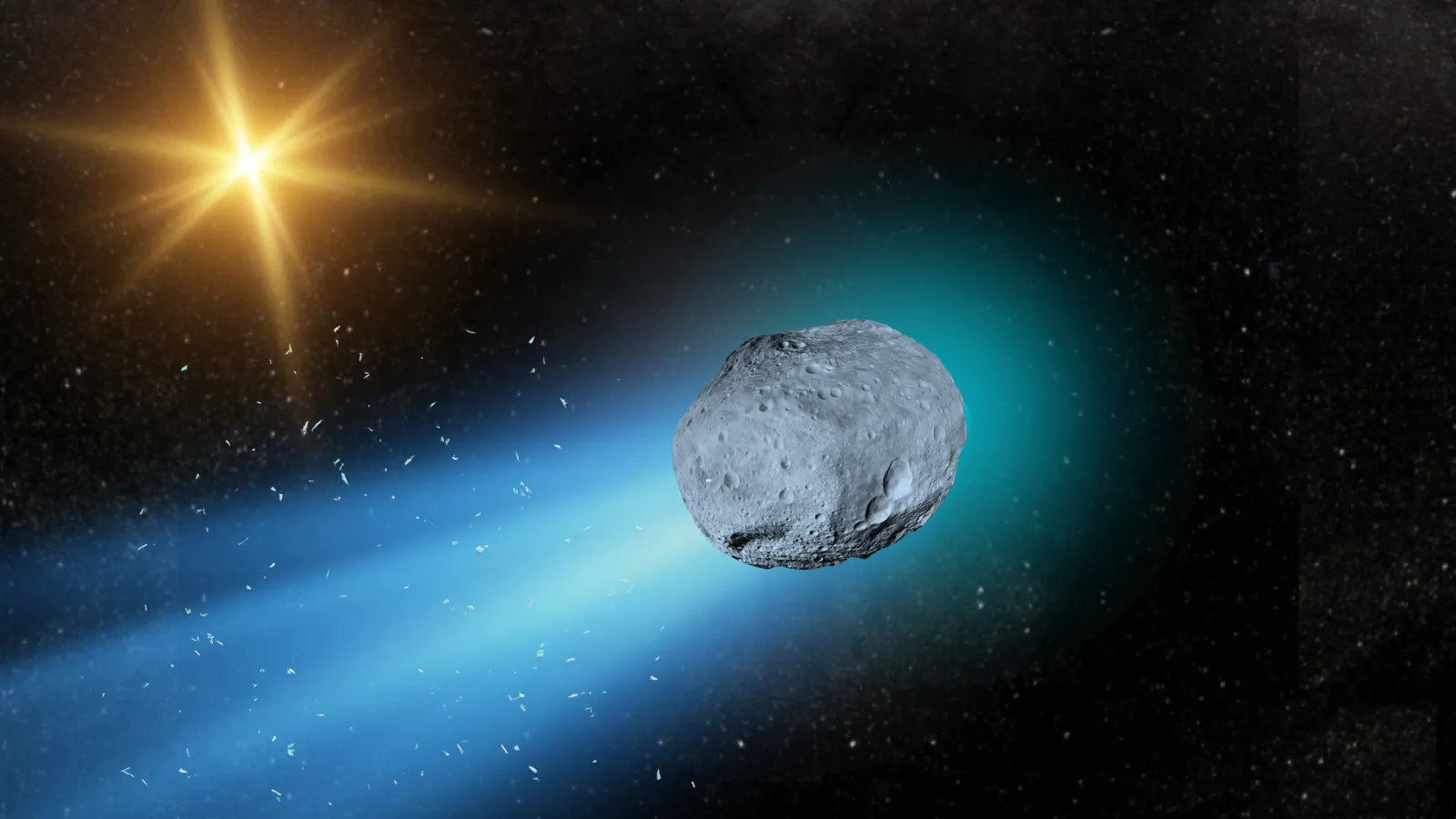
Space fans hoping that the intruder from beyond the solar system known as Comet 3I/ATLAS is actually an alien spacecraft may be disappointed by new research that could close the book on this speculation once and for all.
Astronomers used the Green Bank Telescope, employed in the Breakthrough Listen extraterrestrial signal-hunting astronomy project, to search 3I/ATLAS for measurable signs of technology from extraterrestrial civilizations, or "technosignatures."
Though this hunt came up empty, the fact that 3I/ATLAS is only the third known object found in the solar system after entering from interstellar space (the others being 1I/'Oumuamua, seen in 2017, and 2I/Borisov, detected in 2019) means that it is still an object of great fascination, albeit a natural one.
"We all would have been thrilled to find technosignatures coming from 3I/ATLAS, but they're just not there," lead researcher Benjamin Jacobson-Bell from the University of California, Berkeley, told Space.com. "Finding no signals was the result we expected, due to the significant evidence for 3I/ATLAS being a comet with only natural features.
"The evidence was against 3I/ATLAS being one such probe, but we would have been remiss not to check."
Jacobson-Bell explained that scientists have even discussed conducting this exact kind of exploration using probes of our own. An example of this is the Breakthrough Starshot initiative, a concept that proposes to launch thousands of extremely lightweight probes toward Alpha Centauri, the nearest star system to our sun.
"There are compelling reasons to think a spacefaring species would send probes to other star systems as a way to learn more about their stellar neighborhood," Jacobson-Bell added.
Tuning in to radio 3I/ATLAS
The team behind this research theorized that if we find them, the brightest extraterrestrial technosignatures are likely to be narrowband radio signals, because these take comparatively little energy to produce and travel well over long distances.
"Breakthrough Listen searches for life beyond Earth in a variety of ways. The Green Bank Telescope is a radio dish 100 meters wide, situated in a zone federally regulated to be free of most radio interference," Jacobson-Bell said. "Its sensitivity enables us to verify the absence of transmitters down to 0.1 watts, the strongest evidence against technology of any 3I/ATLAS observation to date."
For comparison, modern cell phones typically emit radio waves at roughly the 1-watt level.
"This is to say that if there were any transmitters on 3I/ATLAS up to ten times weaker than a cell phone, we would have found them," Jacobson-Bell continued.
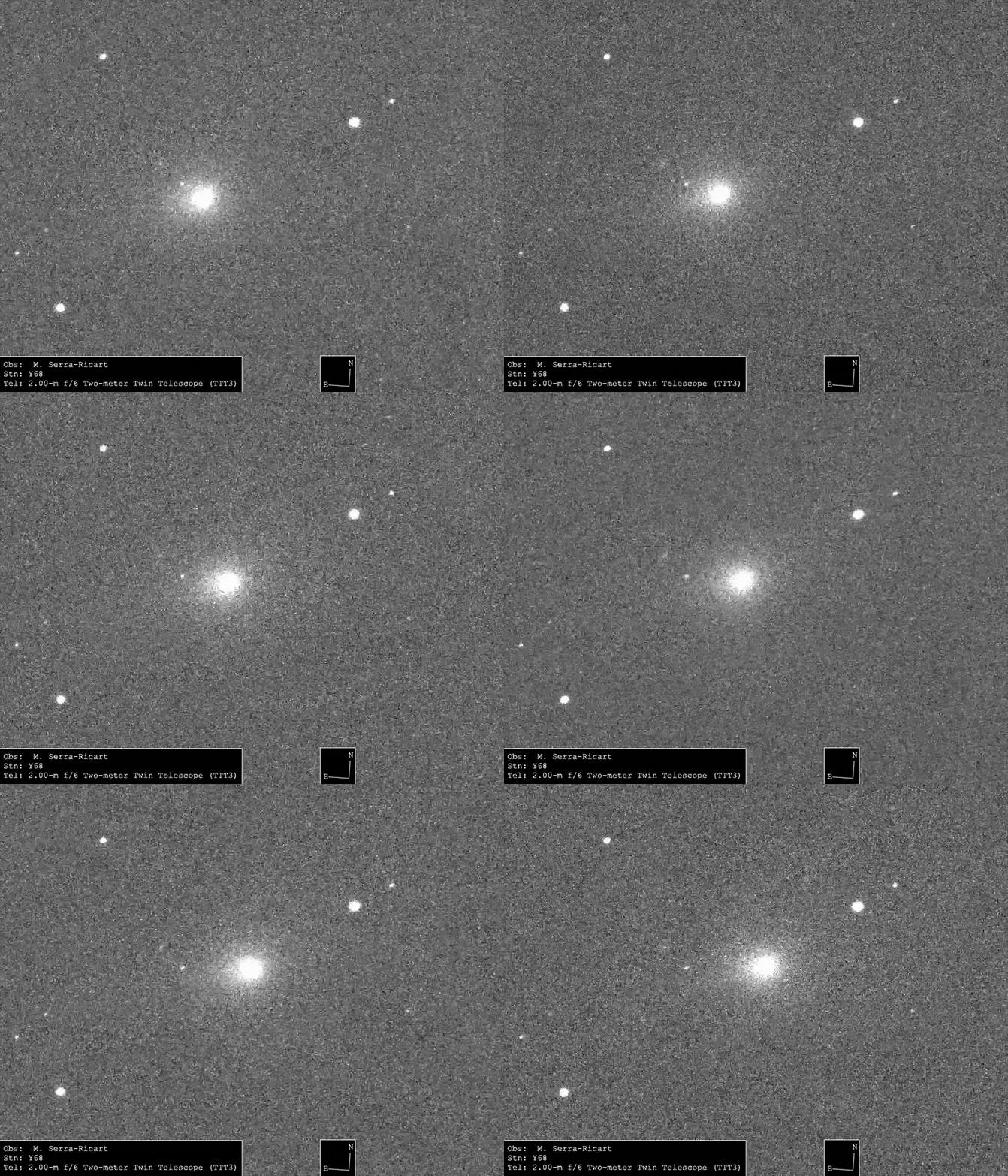
"Humans produce a lot of narrowband radio signals, including for communication with our own spacecraft," Jacobson-Bell said. "However, by modeling our search strategy on human technological output, we end up detecting a lot of human-made signals! Therefore, we run any detections through filters to distinguish probable human-made interference from possible extraterrestrial signals."
The Green Bank Telescope covers a very broad range of radio frequencies, meaning the team is unlikely to have missed any signals purely because they were looking in the wrong part of the electromagnetic spectrum.
"We did find nine 'events,' which is our term for signals that pass certain filters in our search strategy, but on closer inspection, we could readily attribute all nine of them to known radio transmitters here on Earth," Jacobson-Bell said. It's very common to find, then discard, false alarms like this.
"Past work has shown that 3I/ATLAS looks like a comet and behaves like a comet, and our observations show that, like a comet, 3I/ATLAS is not a source of technological signals. In the end, there were no surprises."
As Jacobson-Bell pointed out, this may be perhaps slightly disappointing, but it doesn't mean that 3I/ATLAS isn't still hugely scientifically significant.
"There is considerable excitement around 3I/ATLAS because it's only the third-ever discovery of an interstellar object within our solar system," he continued. "Sending spacecraft to other star systems could be very informative, so it's tempting to imagine that some interstellar objects might be intentional probes."

Jacobson-Bell believes that discoveries of interstellar objects are likely to become much more common as the recently completed Vera C. Rubin Observatory begins its 10-year-long Legacy Survey of Space and Time (LSST).
"Whereas each individual interstellar object is currently an anomaly, future surveys will amass such a population of interstellar objects that we'll start to be able to tell which are typical and which are actually anomalous," he said. "Some of these objects will merit follow-up observations — could their anomalies be due to technology?"
This new research and its findings regarding 3I/ATLAS thus pave a path toward answering that question.
"We hope our search helps dispel the idea that this object is artificial, but likewise we hope that public interest in interstellar objects remains strong — they're very interesting whether they're spacecraft or comets, and it's entirely possible that one day, one of them will indeed be transmitting technological signals," Jacobson-Bell concluded. "If we don't look, we'll never know."
The team's research is available as a pre-peer-reviewed paper on the repository site arXiv.