Meteor showers appear when crumbs of dust (meteoroids) from asteroids or comets enter Earth's atmosphere at very high speeds. During their journey through the atmosphere, meteors rub against air particles, creating friction and heat. The heat then vaporizes most meteors, resulting in bright streaks of light across the sky, or shooting stars.
Dust and particles perpetually bombard Earth from all directions occasionally resulting in solitary meteors. There also are regularly timed "meteor showers" when astronomers can make better predictions about how many meteors will hit Earth's atmosphere, and from what direction.
Depending on where the trail of particles falls in a particular year, meteor showers can be spectacular, or a total bust. The moon can also play a significant role in the visibility of a meteor shower, with a bright full moon outshining fainter meteors and a new moon providing dark skies ideal for shooting star hunters.
Related: Comets vs asteroids, how do these rocky objects compare?
Meteor characteristics
Most meteors become visible at around 60 miles (96.5 kilometers) up. Some larger meteors can shine even brighter than Venus, are visible during the day and can be heard up to 30 miles (48 km) away, we call these "fireballs."
On average, meteors can speed through the atmosphere at about 30,000 mph (48,280 kph) and reach temperatures of about 3,000 degrees Fahrenheit (1,648 degrees Celsius).
Related: How to tell the difference between meteor and satellite streaks in photos
Most meteors are very small, some as tiny as a grain of sand, so they disintegrate in the air. Larger ones that manage to survive the trip through the atmosphere and reach the Earth's surface are called meteorites — these are rare. That being said, scientists estimate that approximately 48.5 tons (44,000 kilograms) of meteoritic material arrives on Earth every day, according to NASA.
Whether an object breaks apart depends on its composition, speed and angle of entry. A faster meteor at an oblique angle (slanting rather than straight-on) suffers greater stress. Meteors made of iron withstand stress better than those of stone. Even an iron meteor will usually break up as the atmosphere becomes denser, around 5 to 7 miles (8 to 11 km) up.
Annual meteor showers

Meteors are often spotted making a solitary fall to Earth. But at particular times of the year, dozens, even hundreds of meteors can light up the sky in a stunning meteor shower. These showers appear to come from one part of the sky — known as the radiant — and streak out in all directions.
Meteor showers are named after the constellations from where the shower appears to be coming from. For example, the Orionids appear to originate from the mighty Orion constellation, while Perseid meteors seem to be coming from the Perseus constellation.
There are several periodic meteor showers that astronomers and amateur observers wait for every year. To find out what meteor showers are coming your way and when check out our comprehensive meteor shower viewing guide.
Leonids: The brightest and most impressive is the Leonid meteor shower, which can produce a meteor storm that showers the sky with thousands of meteors per minute at its peak. In fact, the term "meteor shower" was coined after astronomers observed one of the Leonids' most impressive displays in 1833. The Leonids occur every November, but the shower's most beautiful display happens at intervals of about 33 years, with the last one lighting Earth's sky in 2002; it is not expected to be repeated until 2028.
Related: The most amazing Leonid meteor shower photos
Perseids: Another shower that is worth keeping awake for is the Perseid meteor shower, which is associated with the Comet Swift-Tuttle, which takes 133 years to orbit the sun. Earth passes through the comet's orbit during the month of August every year. It is not as active as the Leonids, but it is the most widely watched meteor shower of the year, peaking on Aug. 12 with more than 60 meteors per minute.
Related: Amazing photos of the 2021 Perseid meteor shower
Orionids: The Orionid meteor shower produces meteors from Halley's comet, which orbits the sun every 75 to 76 years. The Orionid shower happens every October and can last for a week, treating patient observers to a show of 50 to 70 shooting stars per hour at its peak.
Related: Orionid meteor shower thrills skywatchers! See the photos
Quadrantids: The Quadrantid meteor shower comes from the debris of an asteroid called 2003 EH1, which some astronomers think was part of a comet that broke apart centuries ago. The debris enters Earth's atmosphere in early January and offers astronomers and other observers a brief show.
Related: The most amazing Quadrantid meteor shower photos
Geminids: Like the Quadrantids, the Geminid meteor shower also came from dust particles of an asteroid, this time a near-earth asteroid called 3200 Phaeton. Meteor showers are mostly from comets, so having an asteroid as parents make the Quadrantids and Geminids different from other meteor showers. The Geminids happen in December and spray up to 40 meteors per hour out of the Gemini constellation at its peak.
Related: See stunning pictures of the Geminid meteor shower of 2021
Other meteor showers to watch out for are the Eta Aquarids, also remnants of Halley's comet, in May; and the Lyrids, which have been chronicled for more than 2,000 years, in late April.
Meteor shower observing tips
People living in the Northern Hemisphere are in the best position to observe the most beautiful meteor showers. For example, North America is right below the region of the sky where the January Quadrantids shower appears.
A bright moon can dim the prospect of seeing a good meteor shower, drowning out all but the brightest meteors. Local light pollution dampens prospects, too, so the best place to view a meteor shower is from out in a rural location.

Most meteor showers are best viewed in the pre-dawn hours when the part of Earth you are standing on is facing the direction of Earth's orbit. In the late evening hours, on the other hand, the meteors are less frequent.
Meteor showers can be seen at different times of the year depending on when Earth is going to pass through the comet's or asteroid's path. Some meteor showers happen annually; others only appear over a period of several years, while some of the best shows — meteor storms — happen just once or twice in a lifetime.
Related: The greatest meteor storms of all time
Weather can also hamper a good view of meteor showers. A clear sky is a gift to night gazers, which is why meteor showers during the summer are more anticipated than those that fall in the winter months. If you want to try and capture a meteor shower yourself, we have a guide to how to photograph meteors and meteor showers as well as a review of the best cameras for astrophotography and the best lenses for astrophotography, to get you all started.
Meteors in history
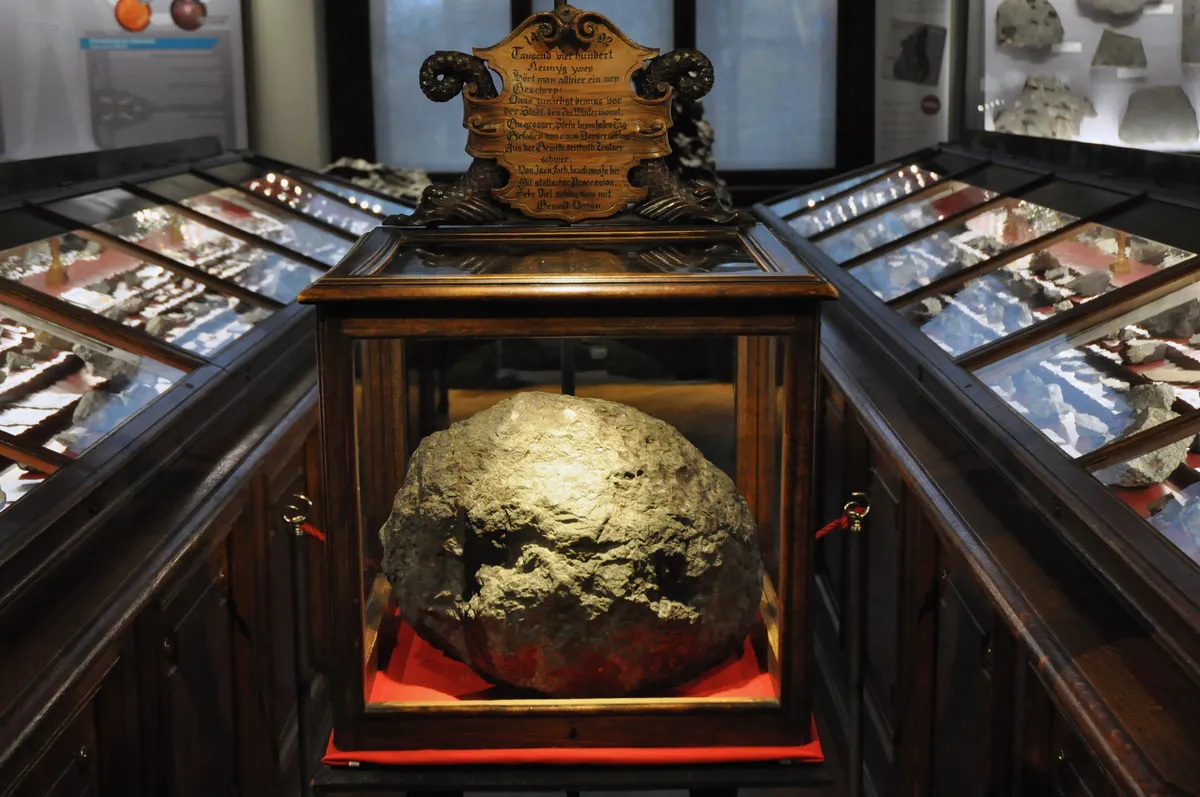
In ancient times, objects in the night sky conjured superstition and were associated with gods and religion. But misunderstandings about meteors lasted longer than they did about most other celestial objects.
Meteorites (the pieces that make it to Earth) were long ago thought to be cast down as gifts from angels. Others thought the gods were displaying their anger. As late as the 17th century, many believed they fell from thunderstorms (they were nicknamed "thunderstones"). The "Thunderstone of Ensisheim" is a famous example of a stony meteorite that impacted Earth on November 7, 1492, making it the oldest known recorded and still preserved meteorite in Europe, according to Forbes.
Many scientists were skeptical that stones could fall from the clouds or the heavens, and often they simply didn't believe the accounts of people who claimed to have seen such things.
In 1807, a fireball exploded over Connecticut, and several meteorites rained down, according to the New England Historical Society. By then the first handful of asteroids had been discovered, and a new theory emerged suggesting meteorites were broken bits off asteroids or other planets. (A theory that still holds.)
Earth impact
When meteorites do hit the ground, their speed is roughly half what it was upon entry, and they blast out craters 12 to 20 times their size. Craters on Earth form much as they would on the moon or any rocky planet. Smaller objects create bowl-shaped craters. Larger impacts cause a rebound that creates a central peak; slipping along the rim forms terraces. The largest impacts form basins in which multiple rebounds form several inner peaks.
The largest meteorite recovered in the United States fell in a wheat field in southern Nebraska on Feb. 18, 1948. Witnesses saw a giant fireball in the afternoon accompanied by a roaring sound like that of a jet engine, according to the meteorite recovery company Meteorite Recon. The meteorite was found buried 10 feet (3 meters) deep in the ground. It weighed 2,360 lbs. (1,070 kilograms).
The most famous meteorite crater in the United States is misnamed Meteor Crater, or Barringer Crater, and is found in Arizona. The crater formed relatively recently (geologically speaking) just 50,000 years ago when a large iron meteor measuring 98-feet (30-meter) to 164-feet (50-meter) in diameter, crashed into the Colorado Plateau in northern Arizona, according to the Lunar and Planetary Institute
Related: 10 Earth impact craters you must see
Large meteors can explode above the surface, causing widespread damage from the blast and ensuing fire. This happened in 1908 over Siberia, in what's called the Tunguska event. On June 30, 1908, across hundreds of miles, witnesses saw a ball of fire streak through the sky, suggesting the meteor entered the atmosphere at an oblique angle. It exploded, sending out hot winds and loud noises and shook the ground enough to break windows in nearby villages. Small particles blown into the atmosphere lit the night sky for several days. No meteorite was ever found, and for years many scientists thought the devastation was caused by a comet. Now, the prevailing theory holds that a meteor exploded just above the surface.

A similar event occurred over Chelyabinsk, Russia, when a 17-meter rock exploded 12 to 15 miles above the Earth's surface on Feb. 15, 2013, damaging buildings and injuring more than 1,000 people. According to a statement by Peter Brown of the University of Western Ontario in Canada, "The energy of the resulting explosion exceeded 470 kilotons of TNT" — 30 to 40 times more powerful than the atomic bomb dropped on the Japanese city of Hiroshima during World War II.
Although the Russian event brought into focus the possible danger Earth could suffer from space rocks, most meteors don't cause nearly as much damage. Still, NASA and other entities keep careful track of all asteroids visible from Earth, and are actively engaged in discovering as many asteroids as possible — especially the ones that are larger and would pose more of a (theoretical) threat to Earth. Asteroid orbits are plotted and tracked to see if they will intersect with Earth in the future. While no imminently threatening object has been found, NASA continues the search and posts the results publicly on the Small-Body Database Browser.
Additional information
Learn more about how ancient cultures explained comets and meteors with this article published in The Conversation. Stay up to date with meteor sightings with the Global Meteor Network. Explore the historical significance of meteors and meteorites with this Google Arts and Culture resource.
Bibliography
Bressan, D. (2015, June 30). This meteorite has been preserved for over 520 years. Forbes. Retrieved August 11, 2022, from https://www.forbes.com/sites/davidbressan/2015/06/30/this-meteorite-has-been-preserved-for-over-520-years/?sh=4ffc7d1811f2
Lunar and Planetary Institute. Barringer meteor crater and its environment. Barringer Meteor Crater and its environmental effects. Retrieved August 11, 2022, from https://www.lpi.usra.edu/science/kring/epo_web/impact_cratering/enviropages/Barringer/barringerstartpage.html
MacDonald, E. (2018, August 7). How ancient cultures explained comets and meteors. The Conversation. Retrieved August 11, 2022, from https://theconversation.com/how-ancient-cultures-explained-comets-and-meteors-100982
NASA. Leonid meteor storms: NASA's leonid multi-instrument aircraft campaign. NASA. Retrieved August 11, 2022, from https://leonid.arc.nasa.gov/
NASA. meteors and Meteorites. NASA. Retrieved August 11, 2022, from https://solarsystem.nasa.gov/asteroids-comets-and-meteors/meteors-and-meteorites/in-depth/
Norton County. Meteorite Recon. Retrieved August 11, 2022, from https://www.meteorite-recon.com/portfolio_page/norton-county
Phillips, T. (2013, February 26). What exploded over Russia? NASA Science. Retrieved August 11, 2022, from https://science.nasa.gov/science-news/science-at-nasa/2013/26feb_russianmeteor
The Weston Meteorite of 1807 brings scientific research to America. New England Historical Society. (2021, December 14). Retrieved August 11, 2022, from https://www.newenglandhistoricalsociety.com/weston-meteorite-1807/