Meteor showers are among the most beautiful phenomena to brighten Earth's sky, but could the fast moving space rocks that accompany major events threaten or delay future Artemis moon missions as NASA and its partners plan for a lunar landing attempt?
NASA estimates that approximately 48.5 tons (44,000 kilograms) of naturally occurring space debris falls into Earth's atmosphere each day. These fragments range in size from tiny micrometeoroids a fraction of a millimeter in diameter to larger particles that create spectacular shooting stars and fireballs as they burn up during atmospheric entry.
The space around Earth gets even more crowded during meteor showers, as Earth careens through one of the many debris streams continuously shed by asteroids and comets as they make lazy circuits around the sun.
Can micrometeoroids endanger a spacecraft?
Micrometeoroids travel through space at hypervelocity speeds averaging 22,000 miles per hour (34,405 kilometers per hour), according to NASA. At that pace, even a tiny micrometeoroid has the ability to impart a significant kinetic blow upon striking a spacecraft en route to the moon, with potentially disastrous results for the astronaut crew inside.
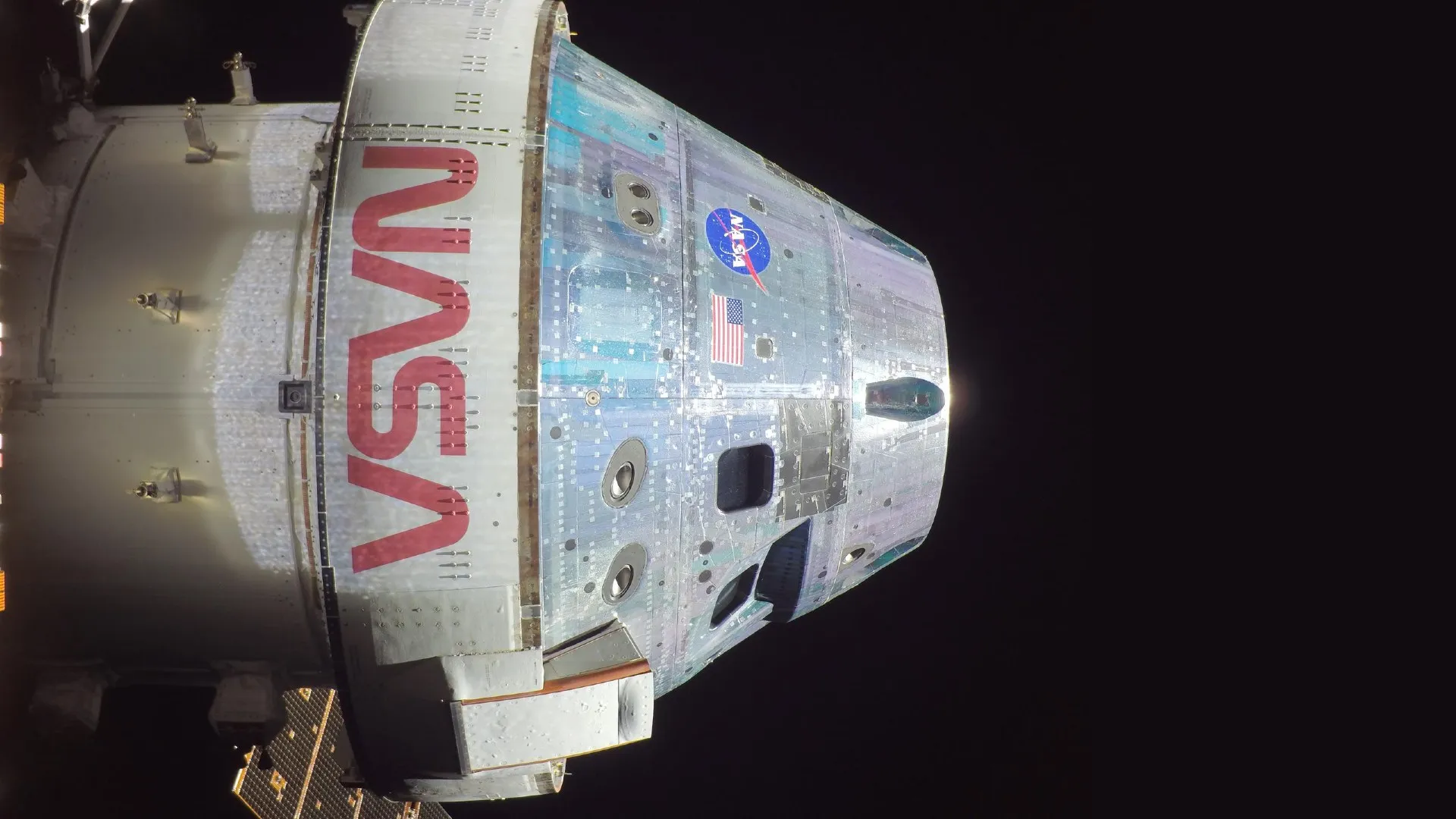
Fast moving debris has the potential to penetrate or deform a spacecraft's hull, damaging critical systems or even triggering a catastrophic rupture. There is also the risk that a micrometeoroid could punch a hole in one of the heat-resistant outer tiles on the Orion spacecraft, NASA's crew capsule for the agency's Artemis moon missions, undermining its ability to survive the intense furnace of reentry, per NASA.

The Chinese Space Agency was given a stark reminder of the dangers posed by space debris in November last year, when taikonaut Chen Dong discovered a crack in the viewport of his Shenzhou-20 spacecraft, which forced the three person crew to use a different return craft for their journey.
Thankfully, modern spacecraft such as the Orion capsule used for NASA's Artemis moon missions have been designed to mitigate the threat posed by micrometeoroid impacts, in so far as is possible. "Orion spacecraft material selection and thicknesses have been optimized for [micrometeoroid and orbital debris] (MMOD) protection and risk balancing," said Mike Heckwolf, Orion crew and mission risk integrator at Lockheed Martin's in an email to Space.com.
"Hypervelocity impact testing is conducted to confirm impact physics, to characterize damage survivability, and verify performance of the Orion spacecraft MMOD design," continued Heckwolf. "The Artemis mission trajectory and Orion flight attitude are carefully assessed to minimize MMOD risk."
Meteor storms and outbursts raise the stakes
As is so often the case, the best protection against disaster is prevention. NASA and its partners regularly perform risk assessments on the micrometeoroid environment both ahead of and during a mission, though only the most severe events present cause for concern.

"Only a handful of the more than 1,000 known meteor showers exceed the sporadic background by more than 5% — like the Geminids, for example — [which is] the strongest annual shower," explained NASA Meteoroid Environments Office lead Bill Cooke, in an email to Space.com.
The major mission disrupters come in the form of meteor storms and outbursts, which see a dramatic increase in the quantity of interplanetary debris choking the Earth-moon environment. "If a major meteor shower outburst or storm is forecast during a mission or crew activity, the mission would be delayed or the crew kept inside until the outburst or storm is over," said Cooke.
Storm forecasts on the horizon
Hundreds or even thousands of shooting stars may be seen burning through Earth's skies each hour during one of these intense meteor storm events, though the distance separating micrometeoroids in space would still likely be measured on the order of miles.
Thankfully, forecasters are able to predict when meteor storms or outbursts are likely to occur, many years before they brighten our skies.

Robert Lunsford is the fireball report coordinator, newsletter editor and treasurer at the American Meteor Society, one of the leading sources of information on meteor showers.
"Currently there are four possible meteor outbursts predicted to occur during the next ten years," said Robert Lunsford of the American Meteor Society in an email to Space.com. "These involve the Perseids (August 12, 2028) and the Leonids (November 17, 2033 and November 18 & 19, 2034. The strongest of these appears to be the Perseid outburst, which could range from 500 to 1000 meteors per hour."
Artemis 4 — NASA's first crewed mission to the lunar surface since the Apollo-era — is currently slated to launch in early 2028, though it's possible that an unforeseen delay could push that window backwards.
In the unlikely event that Artemis 4, or any subsequent mission's launch should fall close to a projected outburst, they could well be delayed in the name of safety, and it wouldn't be the first time that NASA has postponed a mission to ensure its success in the face of a micrometeoroid risk.

As noted by Cooke, the STS-51 space shuttle Discovery mission was delayed in 1993 to avoid the peak of the Perseid meteor shower, and an uncrewed science mission out of Vandenberg Space Force Base was delayed in 2000 to sidestep a Leonid meteor shower outburst.
The agency also has protocols in place to reduce the threat of micrometeoroid impacts to its flagship orbital telescopes during major meteor showers. The James Webb Space Telescope and Hubble Space Telescope, for example, routinely point their large primary mirrors away from meteor showers radiants (the points in space from which they originate) during intense events.
NASA's strategies for dealing with micrometeoroid impacts will be further tested in the coming decade, as the agency and its partners seek to establish a permanent presence on and around Earth's moon.
Would you like to know more? Then be sure to read our explainer article on NASA's Artemis Program, along with the latest on the agency's upcoming Artemis 3 mission to test vital technologies for the Artemis 4 landing near the lunar south pole.