Just before daybreak on Wednesday morning (May 6), is the peak of the annual Eta Aquarid meteor shower. This meteor display is active in the first week of May and produces long streaks whose paths are aimed away from the "Water Jar" of Aquarius.
Their streaks are long for a good reason, which we'll explain in a moment.
The Eta Aquarids have a most interesting lineage. Unlike some of the other annual meteor displays whose history can be traced back for many centuries, the Eta Aquarids were not "officially discovered" until the late 19th century. In 1870, while sailing in the Mediterranean Sea, Lieutenant Colonel G.L. Tupman (1838-1922) sighted 15 meteors on the morning of April 30, and another 13 a few mornings later. All the meteors Tupman sighted appeared to emanate from the zodiacal constellation of Aquarius the Water Bearer. Then in 1876, Professor Alexander Stewart Herschel (1836-1907) pointed out that the orbit of Halley's Comet nearly coincided with Earth's orbit during the first week of May and that if we encountered any comet debris capable of producing meteors, those streaks of light would appear darting from the vicinity of Aquarius.
Herschel immediately noted that Tupman's observations were very close to his prediction. In the years that followed, increasing numbers of other astronomers and observers also noted similarities between the orbits of Halley's Comet and the Eta Aquarid stream.
Like other comets, Halley's is a cosmic litterbug; about every three-quarters of a century as it sweeps closest to the sun, it leaves a "river of rubble" in its wake along its orbit. When Earth interacts with that rubble river, those comet bits race through our atmosphere at high speeds to produce the effect of "shooting stars."
As it turns out, Halley is responsible for not one, but two annual meteor displays:
The dusty material that the comet releases into space on its way toward the sun produce the Orionid meteors of late October, while the material that is released after the comet has rounded the sun and is heading back to the outer limits of the solar system produces the Eta Aquarids of early May.
Moon muscles in
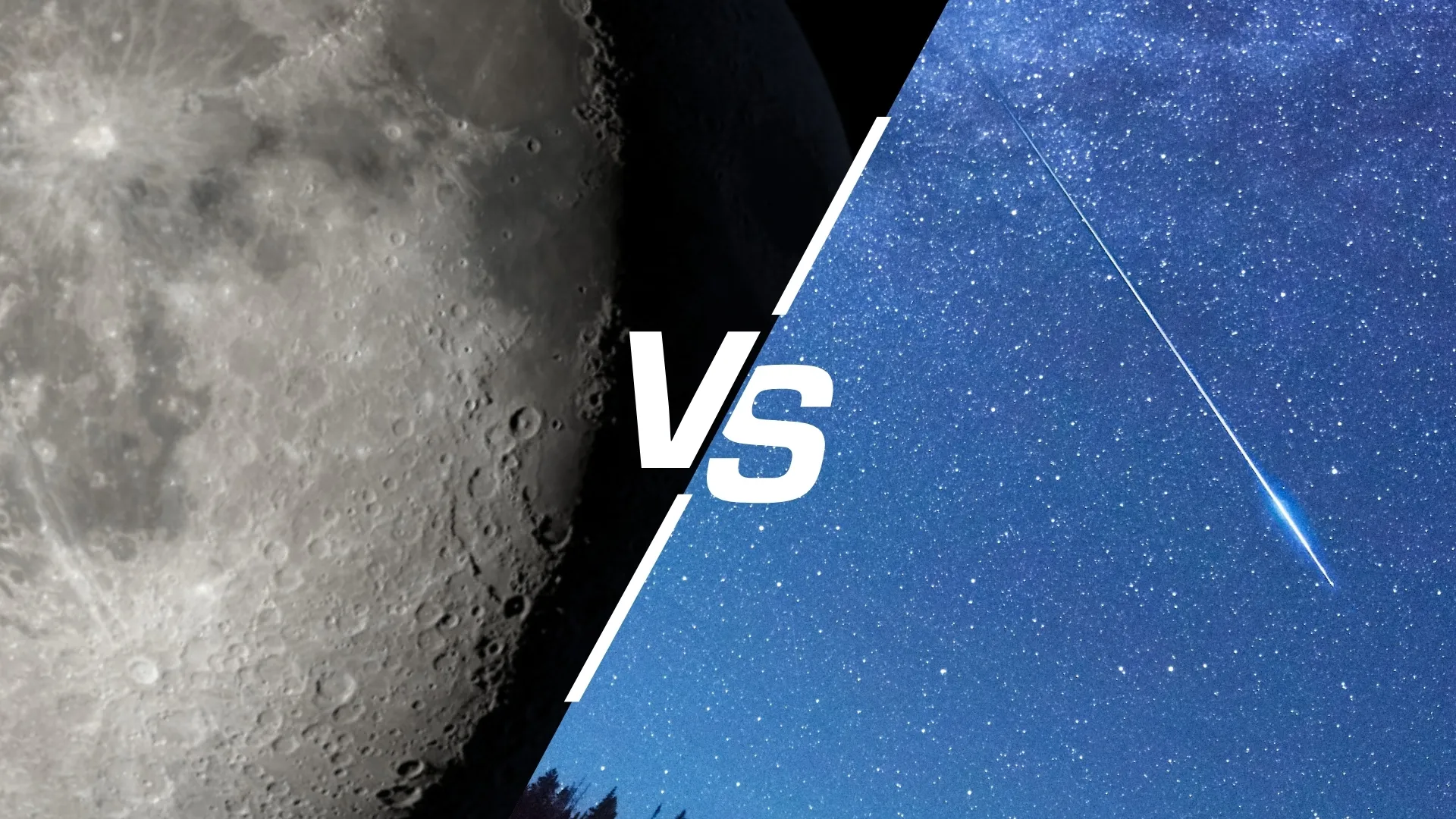
But to curb your enthusiasm, it is necessary to also tell you that this year the Eta Aquarids will be poorly seen, because of glare from a waning gibbous moon, which turned full on May 1. Although not as bright (81% illuminated) as when it was full, it will still serve to significantly light up the morning sky and likely squelch most of the fainter streaks from being visible. In other years — without a bright moon — the Eta Aquarids are usually the richest meteor display for observers in the Southern Hemisphere, producing up to 60 meteors per hour.
Too low
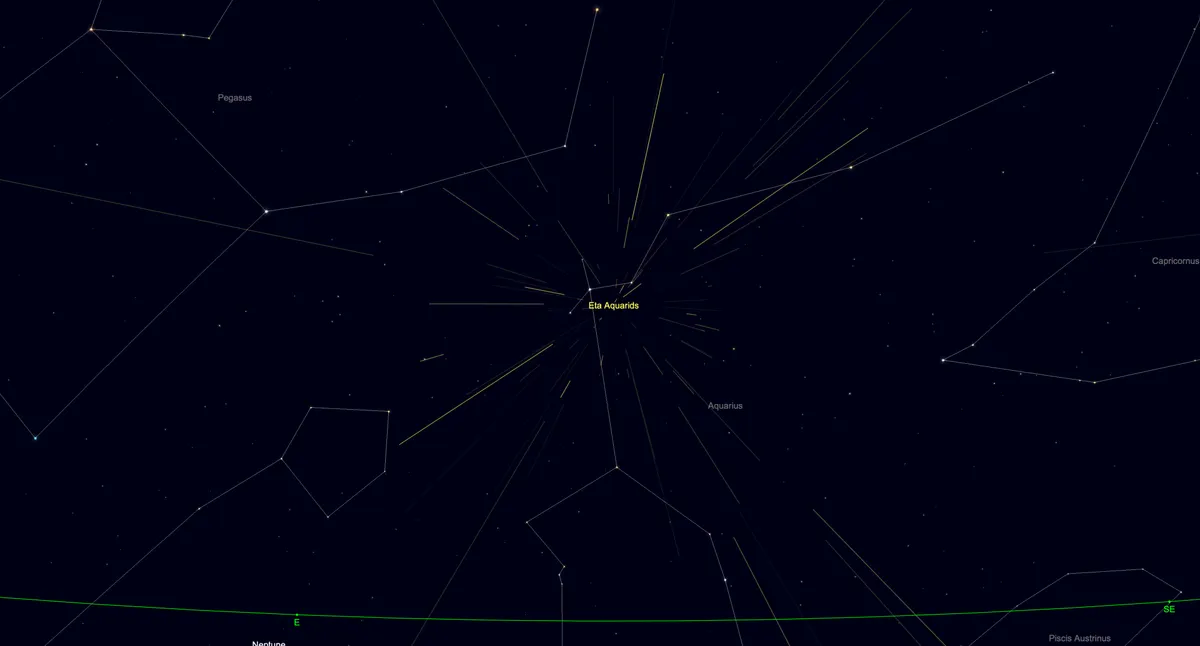
But bright moonlight is only one of two obstacles in viewing this shower. The other problem is that if you live north of the equator, hourly meteor rates drop off rather rapidly. This is especially true for north temperate latitudes because the Eta Aquarid radiant, where the meteors appear to dart from, never reaches a high altitude above the southeast horizon (it rises around 3 a.m. local daylight time), so rates are correspondingly low. Because these meteors appear to radiate from a position low on the eastern horizon for mid-northern latitudes, watchers in the tropics are best placed. Under the most favorable conditions, a dozen or more meteors per hour can be seen from the Eta Aquarid swarm. Observers from mid-northern latitudes, however, may only see about half as many.
Hope for a "grazer"
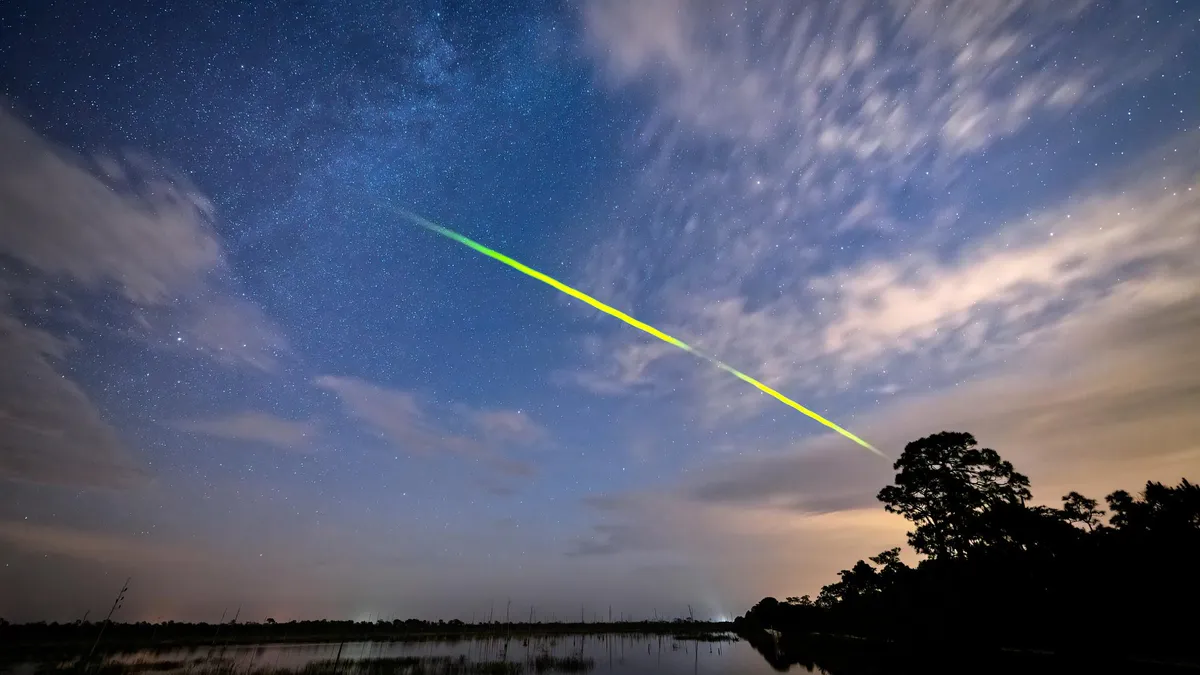
Still . . . even if you live in a far northern location, there is still reason to head outside and take a look, for it is possible that you just might luck out and sight an "Earthgrazer." These are bright meteors emerging from the Aquarid radiant that will skim the atmosphere horizontally — much like a bug skimming the side window of an automobile. They also sometimes leave colorful, long-lasting trails.
Remember earlier when we said that the Aquarid meteor trails are long? Well . . . Earth-grazing meteors tend to be extremely long and usually appear to hug the horizon rather than shooting overhead where most cameras are aimed. "Earthgrazers are rarely numerous," cautions Bill Cooke, a member of the Space Environments team at the Marshall Space Flight Center. "But even if you only see a few, you're likely to remember them."
Comet crumbs
And if for nothing else, remember that if you catch sight of an Aquarid meteor, you will have seen a piece of space debris that was shed by the famous Halley's Comet in past centuries. They remain traveling more or less along the comet's 75-year orbit around the sun. Each meteoroid collides with Earth's upper atmosphere at 41 miles (66 km) per second, creating an incandescent trail of shocked, ionized air. It is this hot trail and not the tiny meteoroid itself that is what you see. These particles are not very large and likely range in size from sand grains to pebbles, and they have the consistency and texture of cigar ash or copier toner — debris that astronomers believe dates back nearly five billion years to the birth of the solar system; primordial material which happens to intersect the orbit of Earth about this time in early May every year.
And just in case you're wondering, Halley's Comet itself will return to the sun's vicinity during the summer of 2061. So based on life expectancy statistics, if you were born anytime after 1982, you have a better than 50-50 chance to see the comet itself. Until then, we'll have to be satisfied with catching sight of shooting stars that are really the traces of that famous visitor from the depths of space . . . and quite possibly the dawn of creation.
Joe Rao serves as an instructor and guest lecturer at New York's Hayden Planetarium. He writes about astronomy for Natural History magazine, Sky and Telescope, The Old Farmer's Almanac and other publications.