For enthusiastic meteor watchers, it has been a long stretch — nearly 16 weeks to be exact — since there has been a good opportunity to catch sight of a reasonably good meteor shower. There are ten displays during the year that are generally considered reliable and worth looking for. But the last of these peaked in early January — the Quadrantid meteors. Since then, we've gone through the rest of winter and into the first month of spring with not much in the way of significant meteor activity.
That drought will come to an end before dawn on Wednesday (April 22) with the appearance of one of the oldest known meteor showers.
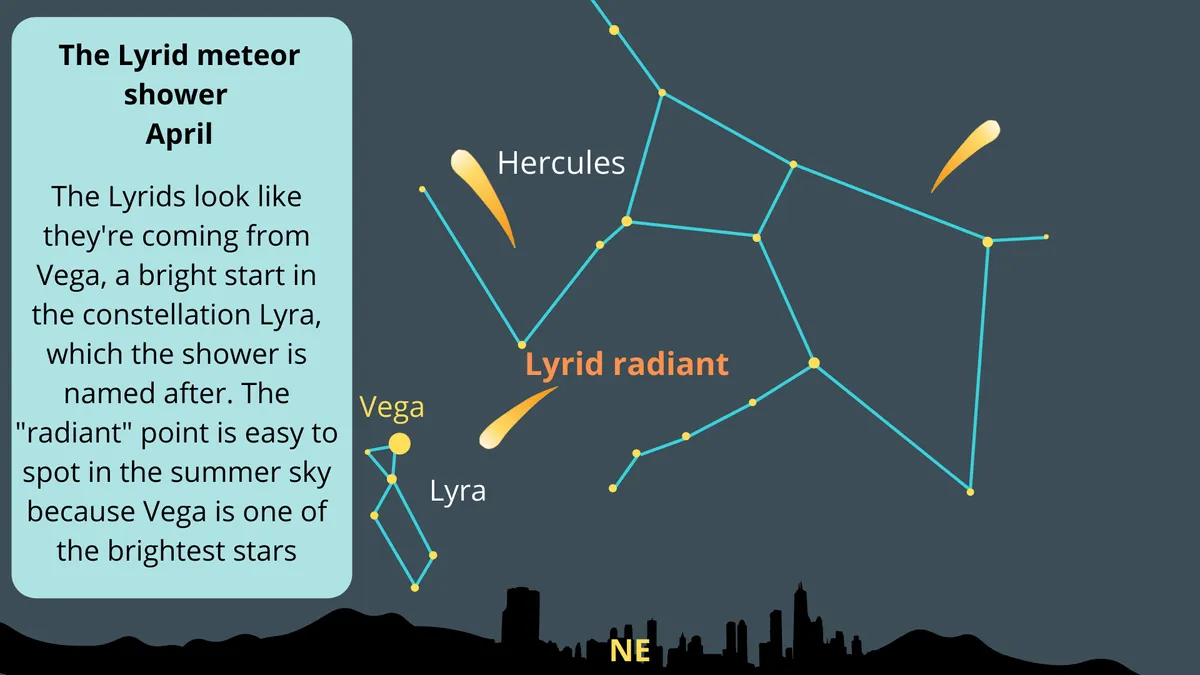
The meteors are called "Lyrids" because their paths, if extended backward, appear to diverge from a spot in the sky about 9 degrees to the lower right of the brilliant bluish-white star Vega, in the constellation of Lyra, the Lyre. To give you a good idea of how far that is, your clenched fist held at arm's length measures 10 degrees. Within a day on either side of the maximum, about 5 to 10 Lyrids can usually be seen each hour by a single observer under good skies.
Good viewing circumstances
At the peak, which comes on Wednesday morning, the Lyrid rate is roughly 10 to 20 per hour.
Vega appears to rise from the northeast around 9 p.m. local daylight time, but by 4 a.m., it has climbed to a point in the sky nearly overhead. By that time, you might want to lie down on a long lounge chair where you can get a good view of the sky. Bundle up too, for while it probably won't be as cold as on a winter's night, nights (and especially early mornings) in April can still be quite chilly.
Finally, while the moon will arrive at first quarter phase on April 23, it will have set by 1:15 a.m. on Wednesday, leaving the sky dark and moonless for at least 3 and a quarter hours before the first light of dawn, providing a good backdrop for viewing this faithful meteor display.
Crumbs from Comet Thatcher
While hardly a rich display like the famous August Perseids or December Geminids, the April Lyrids are brilliant and appear to move fairly fast, appearing to streak through our atmosphere at 30 miles (48 km) per second. About 20-25% leave persistent trains. Their orbit strongly resembles that of C/1861 G1 (Thatcher), a comet which appeared in 1861 and has an orbital period of about 415 years; it's due to return sometime around the year 2276. The Earth's orbit nearly coincides with Comet Thatcher around April 22 each year. When we pass that part of our orbit, we ram through the dusty debris left behind by the comet.
Thus, the Lyrids are this comet's legacy: they represent the tiny bits and pieces shed by this comet on previous visits to the sun. None of us, of course, has any chance of seeing this comet's return engagement with the sun, but we will certainly be able to enjoy the sight of tiny bits and pieces that broke off its nucleus hundreds or thousands of years ago, blaze through our atmosphere in a fiery flash to create the effect of a "shooting star."
An ancient meteor shower
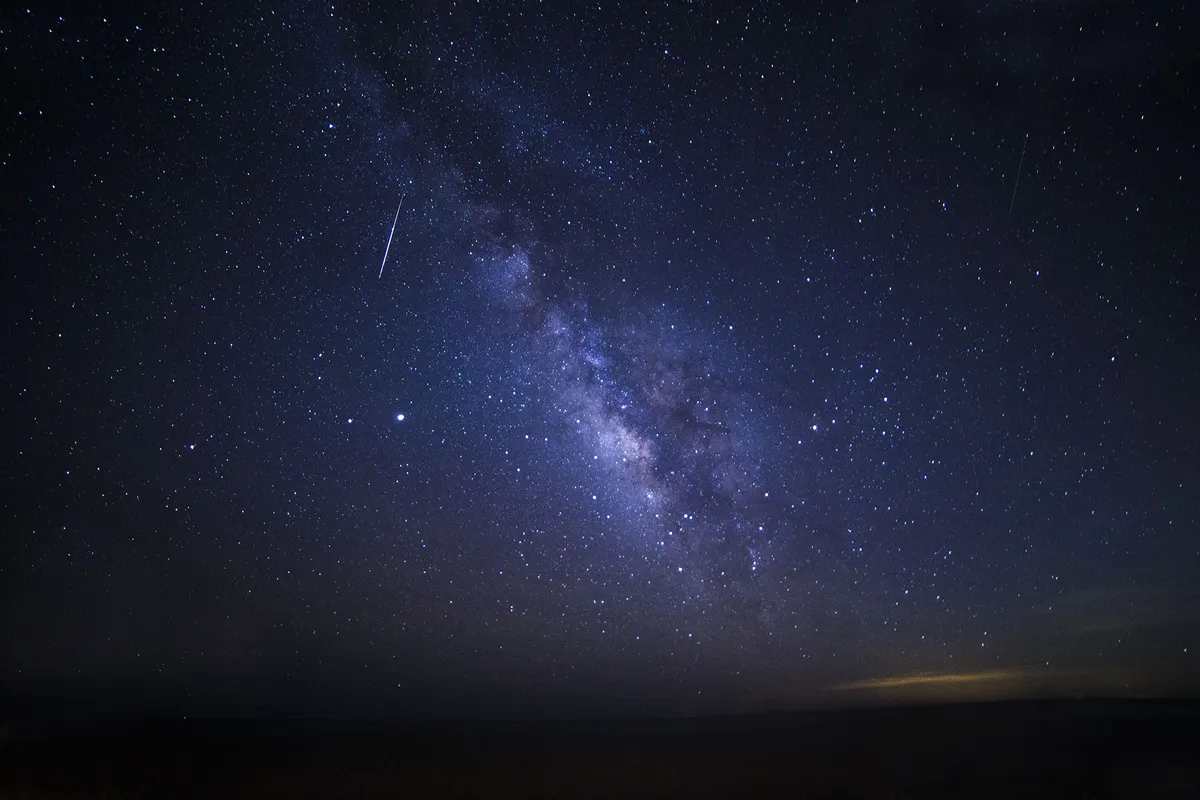
The Lyrid meteor shower has been observed for more than 2,600 years; Chinese records say "stars fell like rain" in the shower of 687 B.C. Quite spectacular displays have also been witnessed at least a dozen times since. On April 20, 1803, residents of Richmond, Virginia, after being roused out of bed by a fire bell, were surprised to see great numbers of meteors in all parts of the sky.
In 1922, an unexpected Lyrid rate of 96 per hour was recorded, and in 1982 rates unexpectedly reached 80 per hour, so although it is usually a weak display, the Lyrids have had a history to surprise observers, so it's always one to watch.
Joe Rao serves as an instructor and guest lecturer at New York's Hayden Planetarium. He writes about astronomy for Natural History magazine, Sky and Telescope, The Old Farmer's Almanac and other publications.