SpaceX rocket debris could slam into the moon: Here's what you need to know

Earth's moon is to be on the receiving end of a spent rocket stage in early August - the leftovers from a SpaceX Falcon 9 launch last year.
Firefly's Blue Ghost Mission 1, named Ghost Riders in the Sky, launched on Jan. 15, 2025 and performed the first fully successful commercial lunar landing on March 2 at the moon's Mare Crisium. That lander went on to mark the longest commercial operation on the moon to date.
Meanwhile, the Falcon 9's leftover upper stage, labeled 2025-010D that lobbed the two private spacecraft into space is now headed for a run in with the moon. "We've been tracking it since launch. The orbit has changed a bit over the last year or so, and is now headed for a lunar impact," said Bill Gray of Project Pluto. Gray is the creator of Guide,an astronomy and telescope-tracking application used worldwide by professional and amateur astronomers alike to keep tabs on asteroids, comets, and other near-Earth objects.
Project Pluto provides software tools useful for astronomers to identify satellites in their data, and has published a page of data about the Falcon 9 upper stage.
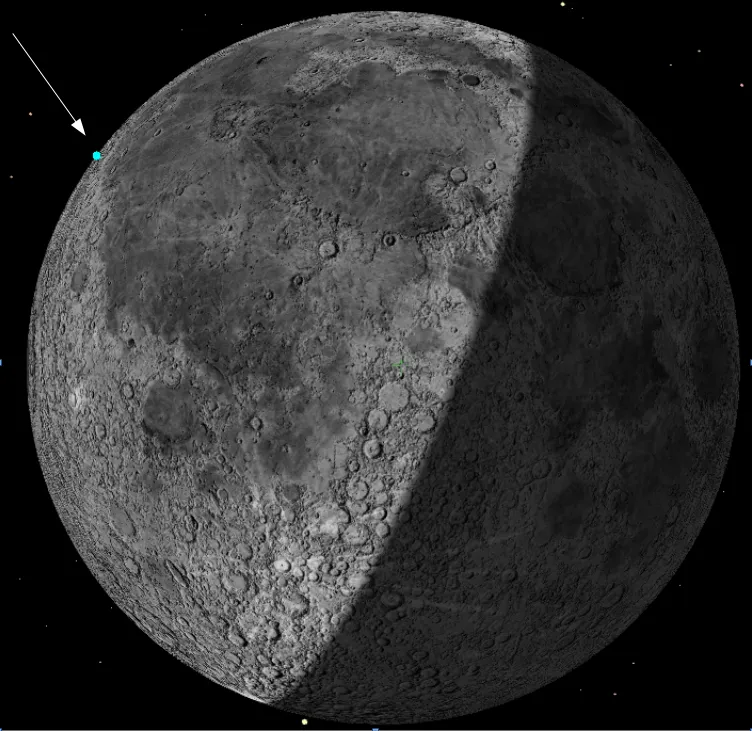
"We now have another upper stage due to hit the moon, this one on Aug. 5 and (just barely) on the near side of the moon," Gray said.
Also riding onboard that SpaceX rocket was Japan's HAKUTO-R M2 lunar lander, called Resilience. However, that probe was lost roughly 90 seconds before touchdown, plowing into the stark lunar terrain due to a laser rangefinder malfunction.

Hit and miss
Gray told Space.com that he thought that the impact might stand a good chance of being visible. It will be close to the edge ("limb") of the moon as seen from Earth, on the sunlit part, he reports. The moon will be a little more than half illuminated at the time.
He recalls, however, that NASA's Lunar Crater Observation and Sensing Satellite (LCROSS) mission back years ago did something very similar.
As planned, LCROSS and its Centaur stage impacted the moon on Oct. 9, 2009. But it crashed on the un-illuminated side of the moon despite hopes it would stand out against the background.
"Even with that, nothing was seen," Gray said. "It'll be above the horizon for me in Maine, and I expect to go out with my small telescope and take a look. But I can't come up with a reason why this would be much brighter than LCROSS. And this object will be hitting in bright sunlight," he added.
A certain carelessness
This human-created impact may be of some — probably minor — scientific interest, and we may learn some things from the moon crash, Gray advised.
"It doesn't present any danger to anyone," said Gray, "though it does highlight a certain carelessness about how leftover space hardware is disposed of."
Gray said he doesn't expect this particular object to cause any trouble.
"There's lots of room between it and the nearest Chinese rovers. I could imagine that if I were operating a moon-orbiting spacecraft, I might check to see if it would be really close to going over that part of the moon at that time," Gray said. "If it was, I'd think about tweaking my trajectory a little to be somewhere else."
The chance that rubble kicked up by the impact would hit a moon-circling spacecraft is quite small, said Gray, but he would factor that into any planned maneuvers.
"In a few years, things may be different," Gray said, given humans tromping about on the lunar surface.
"That raises the stakes considerably. If I were sending an upper stage to high orbit, I would think about where it was going," said Gray. You might launch an upper stage today, and then years later see a real problem, he said.