The first Starship launch from Florida may be just a few months away.
All 14 of the SpaceX megarocket's test flights to date have lifted off from the company's Starbase site in South Texas — including the most recent, on Sept. 28, which saw Starship reach orbit for the first time.
But SpaceX is working hard to get three pads on Florida's Space Coast ready for Starship. And one of them, historic Pad 39A at NASA's Kennedy Space Center (KSC), is nearly there, according to the company.
"Things are going super well at 39A," Julianna Scheiman, director of NASA science and Dragon programs at SpaceX, said during a briefing on Oct. 1 that primarily discussed that day's launch of the Crew-13 astronaut mission to the International Space Station.
The pad's new Starship launch tower is nearly complete, as is most other essential construction at the site, according to Scheiman.
"We've essentially done a lot of the initial build of the structures and the systems needed for launching Starship, and we're beginning to step into the sort of acceptance testing and operational testing prior to activation," she said. "So, we're kind of through the main construction and going into the proofing, testing — activation testing."
The work at Pad 39A began in late 2021. The fact that it's taken so long shouldn't be surprising, for Starship requires some very specialized infrastructure. After all, it's the biggest rocket ever built, standing about 408 feet (124 meters) tall. For comparison, SpaceX's Falcon 9 and Falcon Heavy vehicles — the only rockets that have flown out of Pad 39A since SpaceX started leasing it from NASA in 2014 — are both about 230 feet (70 m) tall.
Starship is also designed to be fully and rapidly reusable, and its recovery operations are very different than those of the Falcon 9 and Falcon Heavy. The first stages of those two rockets touch down either on a ship at sea or on a designated landing pad close to the launch site. But Starship's two stages — its Super Heavy booster and Ship spacecraft — are designed to come back to the launch pad, where they will be caught by the giant tower's "chopstick" arms. So finishing construction of Pad 39A's new Starship tower will be a very big deal.
Starship also employs different engines than the Falcon 9 and Falcon Heavy — Raptors rather than Merlins. Raptors burn liquid methane and liquid oxygen (LOX), rather than rocket-grade kerosene and LOX like Merlins, so the new Starship-friendly 39A needs a new tank farm to feed in this different mix of propellant.
SpaceX plans to launch at least one more Starship test flight from Starbase before flying the megarocket out of KSC, Scheiman said on Oct. 1 — meaning the first Florida Starship launch come come as soon as Flight 16.
The company has not yet announced target dates for upcoming Starship launches, but provisional planning documents identify Oct. 19 and Oct. 30 as possible "no earlier than" dates for Flight 15 and Flight 16, respectively. Those dates may be a bit aspirational, but they suggest that SpaceX aims to fly Starship again soon, and to launch two missions in relatively quick succession. (For perspective: Starship has flown three times so far this year — on May 22, July 24 and Sept. 28.)
Whenever Starship breaks in the new Pad 39A, it will be something of a blast from the past. The launch complex was originally built in the 1960s to host launches of a different megarocket — NASA's Saturn V, which sent the Apollo moon missions skyward. Pad 39A was the jumping-off point for some of the most iconic Apollo flights, including Apollo 8 in December 1968 and Apollo 11 in July 1969.
This tradition will continue, if all goes according to plan: NASA picked Starship's Ship upper stage to be the first crewed lunar lander for its Artemis program, which aims to build a base near the moon's south pole over the next five years or so.
Ship is scheduled to fly for the Artemis program for the first time on Artemis III, a planned 2027 docking test in Earth orbit between the vehicle and NASA's Orion capsule. And that Ship liftoff will take place from Pad 39A, Scheiman said.
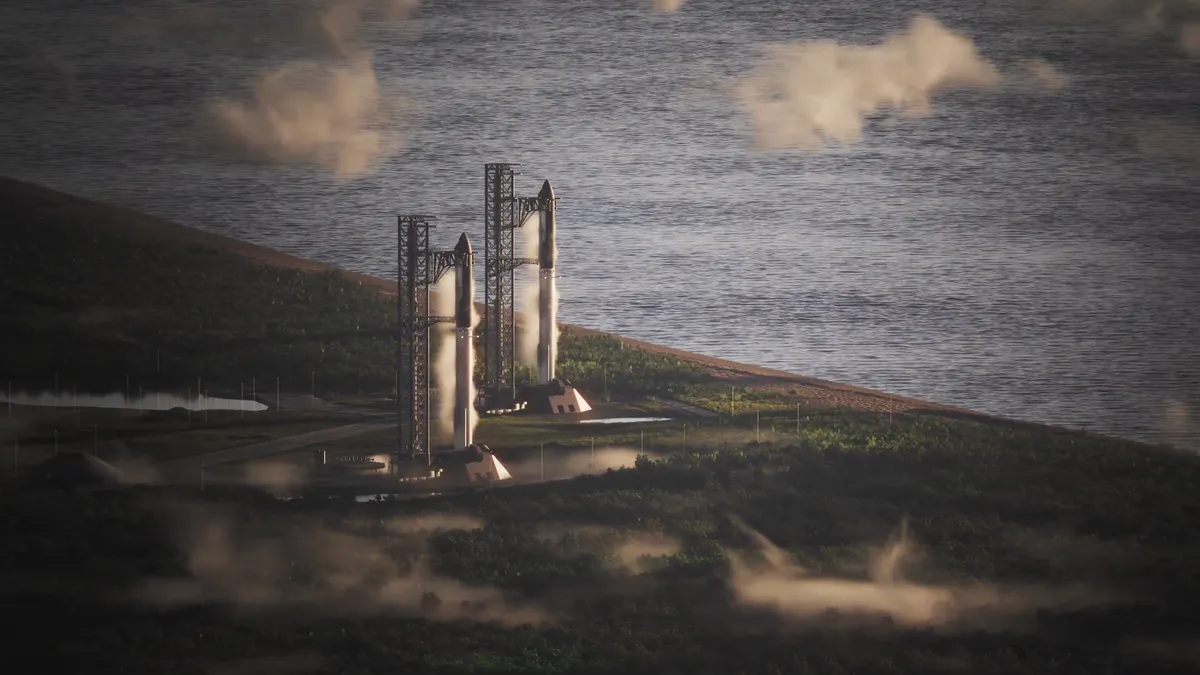
There's more pad work going on in Florida as well. Late last year, the U.S. Air Force gave SpaceX permission to fly Starship from two pads at Cape Canaveral Space Force Station, which is next-door to KSC. Those two pads — SLC (Space Launch Complex)-37A and SLC-37B — could eventually host 76 Starship liftoffs per year between them.
SpaceX has already made considerable progress on SLC-37A and SLC-37B, according to Scheiman. "If you look towards Launch Complex 37, you can see the beginnings of that Starship tower," she said on Oct. 1.
And SpaceX plans to break ground next year on an even bigger Starship launch site — the $100 billion, 12-pad Starbase Louisiana complex. Twelve new pads seems like overkill, unless you know that SpaceX aims to launch more than 10,000 Starship missions per year by 2030.
The vast majority of those liftoffs will serve to assemble two SpaceX megaprojects in Earth orbit: the next-gen Starlink broadband network, which will consist of about 100,000 satellites, and Starmind, an AI data center constellation that will feature a million spacecraft, according to Elon Musk.