The sun may not be green, but it turns out to be adept at recycling.
NASA's Parker Solar Probe has captured the clearest view yet of solar material billowing away from the sun before some of it makes a "U-turn," falling back toward the star after an eruption.
The snapshots reveal how the sun recycles its magnetic energy — a process that helps shape the next solar storm and could allow scientists to forecast space weather farther in advance.
The video below stitches together images taken during Parker's record-setting close approach to the sun on Christmas Eve 2024, when the spacecraft swooped within 3.8 million miles (6.1 million kilometers) above the solar surface. During that flyby, Parker observed a solar flare erupting from the sun, just as scientists had hoped, capturing a bright blob of superheated material bursting into space.
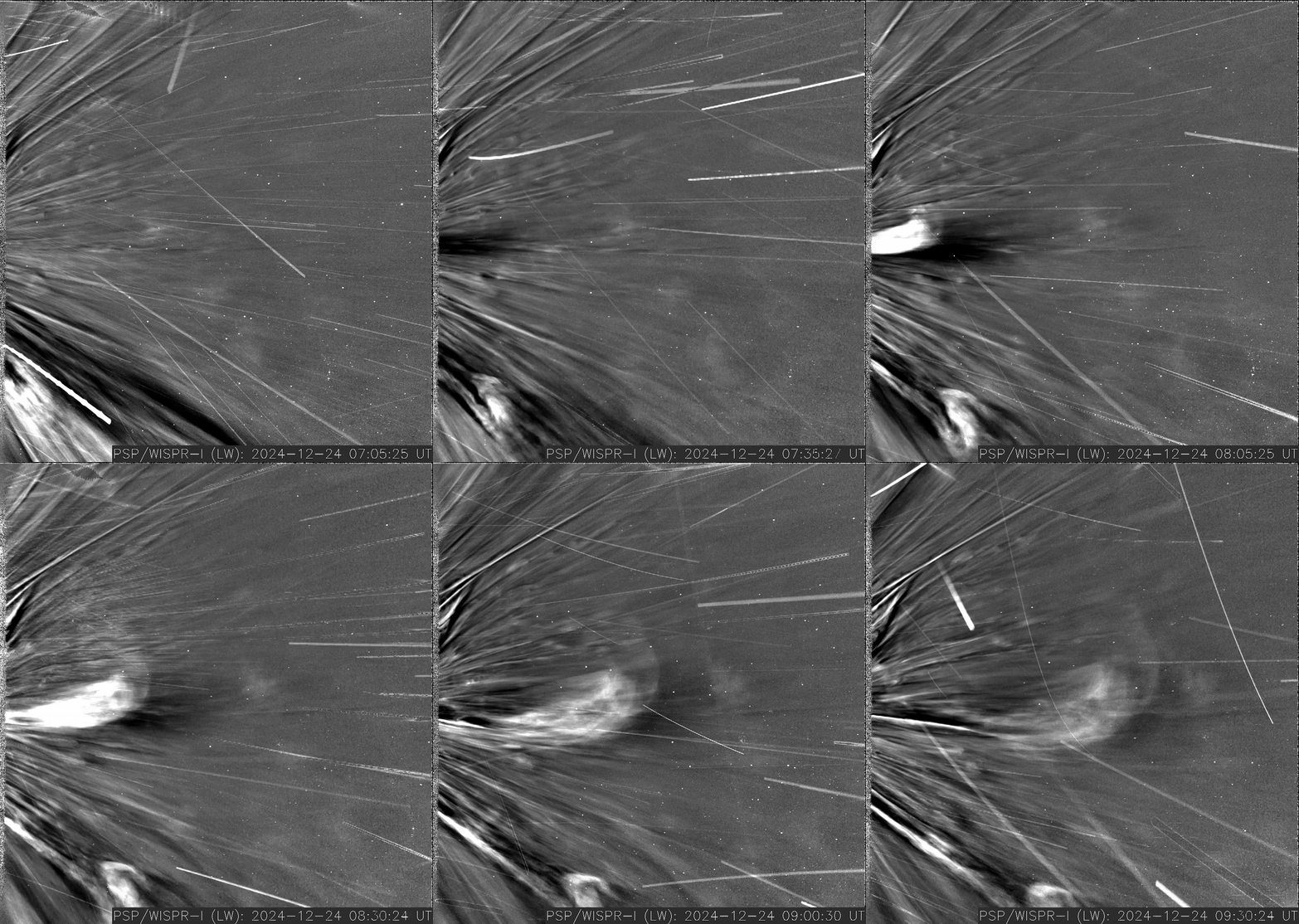
Like a puff of breath on a cold winter day, the cloud of solar material can be seen coasting outward from the sun before thinning, with some of it curling back inward. That returning material was pulled back by powerful magnetic field lines that snap and rapidly realign into looping structures, some of which continue outward into space, while others stitch back to the sun, according to a NASA statement.
"We've previously seen hints that material can fall back into the sun this way, but to see it with this clarity is amazing," Nour Rawafi, the project scientist for Parker Solar Probe at the Johns Hopkins Applied Physics Laboratory in Maryland, said in the statement.
"This is a really fascinating, eye-opening glimpse into how the sun continuously recycles its coronal magnetic fields and material."
What Parker observed was a coronal mass ejection, or CME, which is an eruption of superheated plasma from the sun that, if directed toward Earth, can trigger powerful geomagnetic storms capable of disrupting power grids, radio communications and satellite navigation systems, while also igniting breathtaking auroras.
In the video above, as the CME expanded outward from the sun, nearby magnetic field lines stretched until they snapped apart "like the threads of an old piece of cloth pulled too tight," the NASA statement read. The torn magnetic fields quickly reconnected, forming giant loops, some of which continued traveling outward while others retracted back toward the sun, dragging blobs of solar material along in a process known as inflows.
As that material falls back, it interacts with and reshapes the magnetic fields closer to the sun's surface — changes that potentially alter the paths of future CMEs emerging from that region.
"That's enough to be the difference between a CME crashing into Mars versus sweeping by the planet with no or little effects," Angelos Vourlidas, who is the project scientist for WISPR, the instrument onboard Parker that captured the snapshots, and a researcher at Johns Hopkins Applied Physics Laboratory, said in the same statement.
Such inflows have previously been observed before from a distance by missions, including the sun-watching SOHO observatory. But Parker's close-up close-up images revealed the returning material on scales never seen before, scientists say.
For the first time, scientists were able to directly measure the speed and size of the blobs falling back toward the sun, findings that they are currently using to refine models of space weather and the sun's complex magnetic environment, the statement read.
"Ultimately, this work may help scientists better predict the impact of space weather across the solar system on longer timescales than currently possible."