


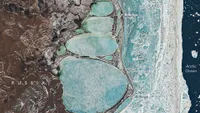
A colossal Antarctic iceberg that first broke free in the 1980s is now soaking up the summer warmth, and from orbit seems to be turning a shade of aquamarine. In this recent image from NASA's Earth Observatory, iceberg A-23A is streaked with blue meltwater ponds and surrounded by a halo of fractured ice, signs that the long-lived "megaberg" is perhaps in its final days.
What is it?
Iceberg A-23A is considered a tabular iceberg, essentially a giant floating slab that calved Antarctica's Filchner Ice Shelf in 1986, the same year as the Chernobyl explosion and the Space Shuttle Challenger disaster. Scientists have been tracking the iceberg for decades, making it one of the largest and longest-observed icebergs on record.
The "blue stripes" cutting across the iceberg are meltwater ponds: pools of liquid water that collect in low spots on the ice surface when air temperatures rise and sunlight intensifies during the austral summer. NASA's Terra satellite captured this image on Dec. 26, 2025 and the next day an astronaut aboard the International Space Station snapped an even closer view of the meltwater ponds using a Nikon Z9 camera to do so.

The Nikon Z9 is a mirrorless powerhouse, one of the top-performing digital cameras ever made and delicious overkill for astrophotography and landscapes and is even used by astronauts aboard the International Space Station. For a more in-depth look, read our Nikon Z9 review.
Where is it?
This image was taken from low Earth Orbit by NASA's Terra satellite. As of early January 2026, iceberg A-23A is drifting in the South Atlantic Ocean, between the eastern tip of South America and South Georgia Island.

Why is it amazing?
Given how large and how long Iceberg A-23A has been around, there's no guarantee it will exist much longer. Satellites like Terra help scientists capture in real time the mechanics of how big ice slabs break apart. When water gathers inside the meltwater ponds and fractures in an iceberg, its weight can pry the slab apart, causing a rapid breakup of events on ice shelves and icebergs, like A-23A. Seeing these features can help scientists test and refine models of how floating ice fails.
When an iceberg as large as A-23A melts, it injects significant cold freshwater into the ocean, which can affect mixing and local circulation. This can lead to upwelling of deeper nutrient rich waters that can help fuel phytoplankton growth, which is a key foundation in the marine food web.
While icebergs are a natural part of how ice shelves and glaciers shed mass, the effects of climate change and global warming are speeding up these processes, making it a key time for researchers to watch from space and track these icy giants.


Want to learn more?
You can learn more about icebergs and Earth-observing satellites.
