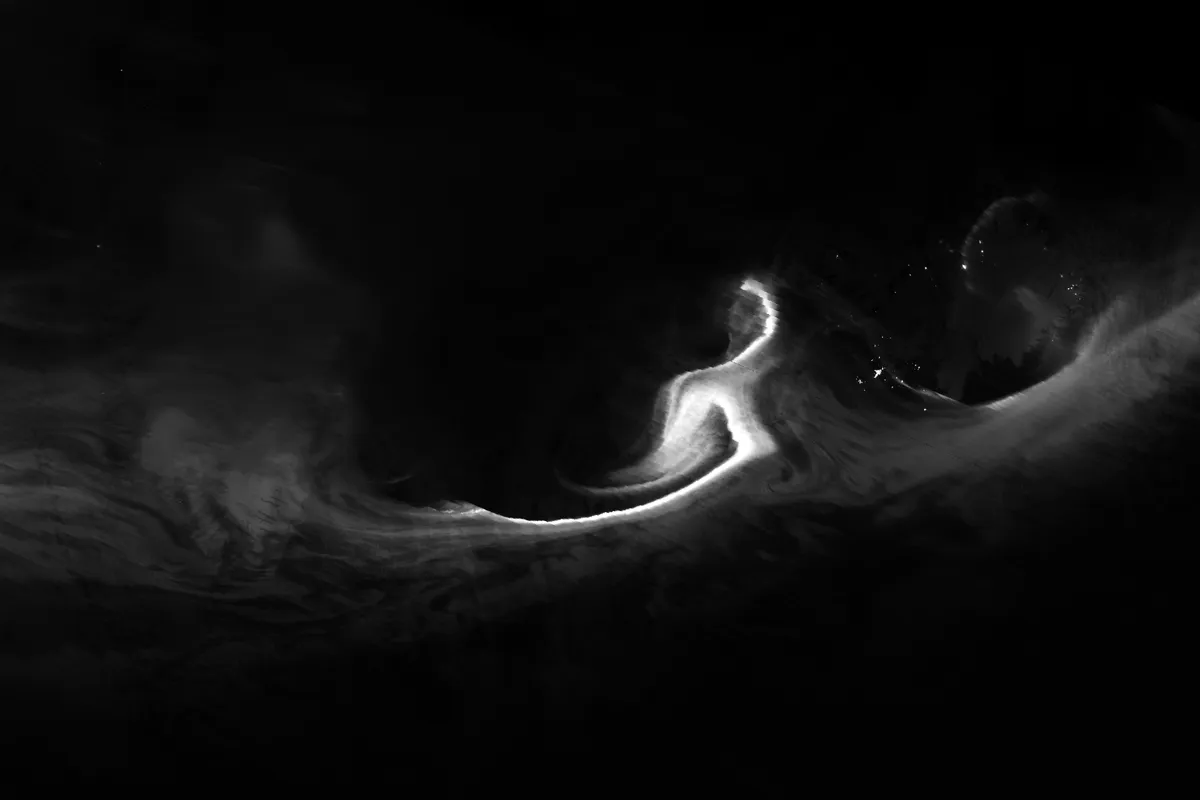
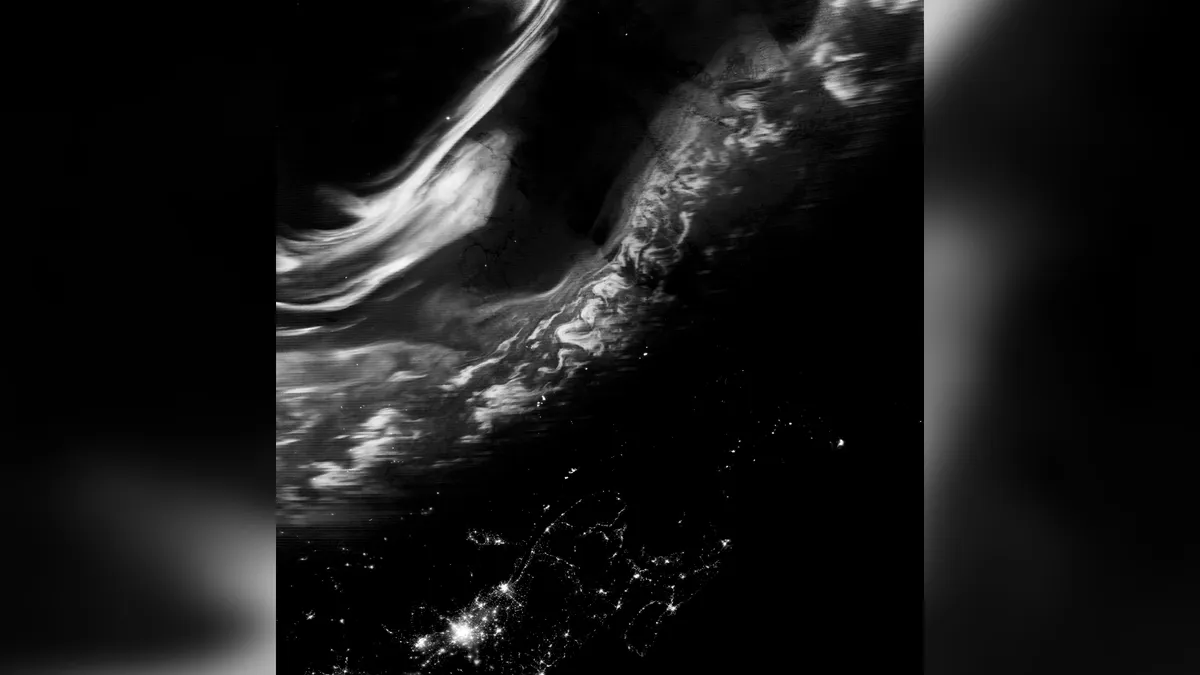
A minor geomagnetic storm painted the night skies over Iceland and eastern Canada with glowing ribbons of aurora on Feb. 16, 2026, and one eagle-eyed satellite spotted the show from above.
These striking nighttime views were captured by the Visible Infrared Imaging Radiometer Suite (VIIRS) on the Suomi NPP satellite, a joint mission between NASA and the National Oceanic and Atmospheric Administration (NOAA).
What is it?
The images show the northern lights shimmering over the Denmark Strait and across parts of Canada during a minor (G1) geomagnetic storm. On a five-level scale that tops out at G5 (severe), G1 is the weaker of the geomagnetic storms but can still produce vivid auroras at high latitudes if the conditions are right.
Geomagnetic storms arise when incoming charged particles from the sun — from fast solar wind or coronal mass ejections (CMEs) hit Earth's magnetic field, causing a temporary disturbance in Earth's magnetosphere. During such storms, the energetic particles are funneled toward the poles via Earth's magnetic field lines, where they then collide with gases in the upper atmosphere and release energy in the form of light, giving us auroras.
Though this satellite imagery is in grayscale, lucky skywatchers on the ground would have likely seen curtains of green light with possible magentas and reds rippling overhead.
The color of auroras is caused by the gases in the atmosphere that the energetic particles collide with. Green is the most common color (and the most easily spotted with our eyes), and is caused when particles collide with oxygen molecules at a height of around 60 to 90 miles (100 to 300 kilometers). Red auroras occur when solar particles collide with oxygen at higher altitudes, generally around 180 to 250 miles (300 to 400 km). Blue and purple auroras are less common and tend to appear during strong geomagnetic storms. They are produced when solar particles collide with nitrogen at altitudes of around 60 miles (100 km) or less.
Where is it?
The first image shows bright auroras stretching from Greenland to Iceland at 11:45 p.m. EST (0445 GMT Feb. 16). The second image, captured around 1:30 a.m. EST (0630 GMT) shows the northern lights stretching above the Canadian provinces of Québec, Newfoundland and Labrador. City lights from Montreal can be seen sprawling in the lower portion of the image.