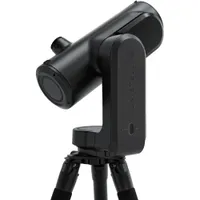
As telescopes go, the Unistellar Odyssey Pro really is something special. Between its image quality, ease of use and ability to remove skyglow, we think it's one of the best smart telescopes. And, if you're fast, you can get it for nearly $700 off for Unistellar's Earth Day offer, where they are offering 15% off their entire smart telescope range, including the eQuinox 2 and eVscope 2 models.
The Unistellar Odyssey Pro smart telescope is on sale right now at Unistellar for $3,909.
Available in black or, if you don't mind waiting till May, red, the Unistellar Odyssey Pro is a fantastic tool for any beginner skywatcher or astrophotographer. It's an absolute breeze to use with its simple controls and you can be capturing the cosmos in minutes.
We awarded it four-and-a-half stars in our review, praising, amongst other things, how its built-in light pollution removal feature made our pictures of nebulas and galaxies clearer and richer than ever. It's not cheap but it offers superb image quality and this deal takes it below the $4,000 mark.

Jase Parnell-Brookes is the Managing Editor for e-commerce for Space and Live Science. Previously the Channel Editor for Cameras and Skywatching at Space, Jase has been an editor and contributing expert across a wide range of publications since 2010. Based in the UK, they are also an award-winning photographer and educator winning the Gold Prize award in the Nikon Photo Contest 2018/19 and named Digital Photographer of the Year in 2014. After completing their Masters degree in 2011 and qualifying as a teacher in 2012, Jase has spent the last two decades studying and working in photography and publishing in multiple areas, and specializes in low light optics, camera systems and smart telescopes.
- We've got you covered with reviews and rankings of the best telescopes, binoculars, star projectors, cameras, drones, Lego, streaming and more.


With a 3.3-inch (85 mm) aperture and 4.1MP image sensor, this smart telescope is a dream for capturing galaxies and nebulas. By using the "enhanced vision" mode, your telescope builds up a stronger image of the deep sky target by stacking 4-second exposures to develop more detail.
Boasting superb image quality (though it's less ideal for planets), it's powerful but also portable enough that you can transport and pack it away with ease. It's the lightest smart telescope that Unistellar offers so it is good for taking to dark sky sites but we also used it to beat light pollution when using it from a city centre balcony.
In our Unistellar Odyssey Pro, we praised its ease of use. As powerful as it is, beginners can take quality images with just a couple of button presses and the smartphone app offers all the control you could want with a database of over 5,000 night sky objects.
Key features: 3.3-inch (85 mm) aperture, 4.1 MP image sensor, 320 mm focal length, motorized alt-azimuth mount, 5 hr battery life, 8.8 lbs (4 kg) weight.
Product launched: January 2024
Price history: This is the cheapest the Unistellar Odyssey Pro has been all year. We've seen it drop further early last year but this is still a major reduction from its $4,599 retail price.
Price comparison: Unistellar: $3909 | B&H Photo: $3909 | Amazon: $3909
Reviews consensus: We think this is one of the best smart telescopes. It's easy to use and offers amazing quality images, even reducing light pollution to an impressive degree.
Featured in guides: Best smart telescopes
✅ Buy it if: You want a powerful but portable smart telescope that takes the work out of stargazing and handles light pollution admirably.
❌ Don't buy it if: You're averse to automation, either on principle or because you like getting to grips with the night sky yourself.