We didn't find answers in 2025, but UFO researchers say the search continues

After years of making headlines, air vehicles of nameless origin, unknown intent, and seemingly odd capabilities are still being reported within America's national airspace, allegedly flying over sensitive facilities and interfering with commercial air traffic.
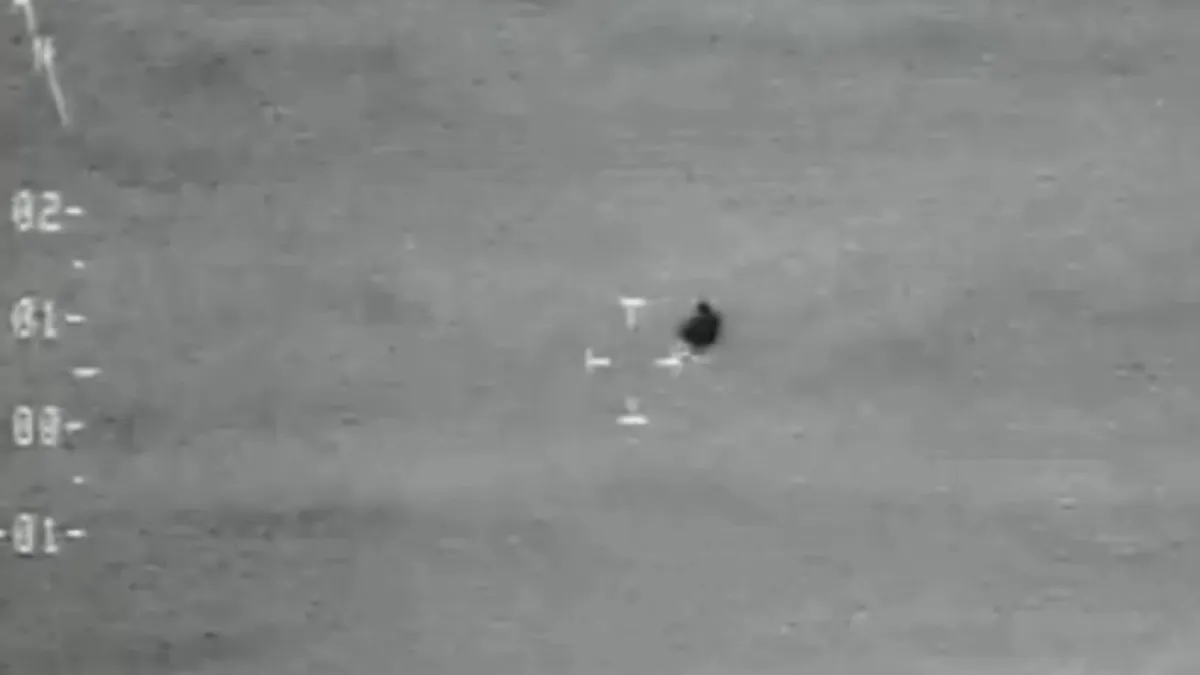
All of this aerial weirdness involves unidentified anomalous phenomena, or UAP for short. Whatever they are, UAP continue to be seen, reported and even documented through various sensor technologies. However, despite years of whistleblowers testifying before Congress, there seems to have been a bottleneck in getting to the bottom of the UAP issue in 2025. Why so?
Key specialists appraising the issue UAP have yet to untangle the mystery, but do appear to agree on what needs to be done now to further resolve what UAP are and from where they might originate.
Plurality of minds
The UAP phenomenon benefits from having a plurality of minds engaged in disciplined debate, suggests Michael Cifone, founding executive director and President of the Society for UAP Studies, based in Los Angeles, California.
Today, there's a division emerging between classical Unidentified Flying Object (UFO), aka "flying saucer," incidents and studying UAP from the point of view of observational and experimental science. But engaging scientific methods and instruments turns out to be neither trivial nor cheap, Cifone said.
"Perhaps the holdup is reluctance to dump time, energy and money into what looks to some like a wild goose chase," said Cifone.
Cold cases
"Like any other scientific venture, both funding and institutional support is required," Cifone said. "Given the historical stigma associated with the topic that has been hard to achieve. But now with the emphasis no longer on chasing forensic cold cases, and relying on reports of UAP, serious scientists and student researchers are getting involved."
The upshot is to deploy scientific methodology to establish the observational framework with the proper instrumentation, Cifone added, "in order to generate the data on UAP from which more secure conclusions can be derived."
Cifone said that progress, like in any other science or research area, will be slow but hopefully steady, albeit incremental.
"What will likely happen is that there will be downstream benefits that aren't foreseeable exactly now. Maybe new sciences will break away. So it will be a win for the growth of knowledge and for science in particular," Cifone senses.
For Cifone, his view is to keep the eye on the ball and work out the observational framework design and required instruments and observational modalities before we can have the reliable datasets we need. "But science doesn't always go as planned. In any case, there's a lot of work to be done."
Cifone points to an increasing number of institutions that are studying UAPs. Indeed, work underway on UAP has blossomed into a world-wide field of research, he said.
All sky, all the time
To Cifone's point, there's the University of Würzburg in northern Bavaria, one of the oldest universities in Germany. An Interdisciplinary Research Center for Extraterrestrial Studies (IFEX) has been established.
One effort the university is developing is an "AllSkyCAM" able to capture UAP. An automated reporting system is currently under construction with the university cooperating with the Luftfahrt-Bundesamt, the national civil aviation authority of Germany, to research unusual phenomena in the country's airspace.
Then there's the Galileo Project led by astrophysicist Avi Loeb of Harvard University. They have designed and built an array of sensors to scan the sky for aerial phenomena and assess atmospheric anomalies that may not be of terrestrial origin.
This type of research can produce data on UAP, Cifone said, "then we need to experiment with the data and produce theories, or what you call explanations, and perhaps even understanding! We're only at the observational framework design and testing phase. Then we need to let the systems run, probably for many years."
Test a hypothesis
There's need to be able to scientifically test a hypothesis that some UAP are potentially extraterrestrial craft, said Robert Powell, executive board member of the Scientific Coalition for UAP Studies (SCU).
"I consider extreme acceleration to be the best characteristic that has the potential to eliminate a terrestrial explanation for a UAP," said Powell. But measurement of high accelerations of UAP, he said, requires high-precision scientific gear and data.
"The cost of putting out a network of calibrated and characterized equipment, maintaining it, obtaining placement rights on land, and analyzing the data will cost tens to hundreds of millions of dollars," said Powell.
Military systems
One estimate by an engineer in SCU forecasts that given 300 "actual" UAP sightings per year — and assuming random distribution of sightings — that with 930 automated camera systems distributed across the U.S., one would have a 95% chance of detecting a UAP of 50 foot or larger size within a year.
"To date, the financial resources to achieve this are not available," said Powell. "The military has the capability with radar, satellite, and optical systems, but the scientific community does not have access to these systems." He thinks the work ahead could be done now via military systems, but only if there were no national security concerns.
"I think it will take many years to do it through privately-financed civilian systems but that doesn't mean we shouldn't continue working at it," Powell concluded.
Ignore, rationalize away
Ryan Graves is chair of the American Institute of Aeronautics and Astronautics (AIAA) Unidentified Anomalous Phenomena Integration Committee. He is also director of Americans for Safe Aerospace, a military pilot group devoted to aerospace safety and national security, but focused on UAPs.
"Highly credible people and professional observers are seeing objects that appear to exhibit capabilities beyond the state of the art," Graves told Space.com. "In the data received, there seems to be this core anomalous aspect that we can't just ignore or rationalize away."
Graves speaks with UAP eye-witness authority as a former Lt. U.S. Navy and F/A-18F pilot. He was the first active-duty pilot to publicly point to his own encounters and spotlights his military colleagues regarding their UAP sightings.
In July 2023, Graves testified about UAPs before the House Oversight Committee's National Security Subcommittee in Congress, a hearing centered on UAP and the implications for national security, public safety, and how best to attain government transparency on the issue.

Pay attention
"We need to pay attention to this and recognize the national security implications," Graves said. Objects are operating in sovereign air space, he said, potentially collecting intelligence and trying to break into or set the stage to counter our defenses and set the country up for strategic surprise.
In blunt talk, Graves said UAP are engaged in actions "that would be recognized as acts of war or at the minimum preparation for an attack."
For its part, the AIAA UAP Integration & Outreach Committee is a strictly agnostic, science-first committee inside the AIAA.
"Our remit is to bring aerospace rigor to an area with real safety-of-flight implications," Graves said. The committee has been convening experts across AIAA's technical committees, publishing peer-reviewed and conference papers, and producing policy guidance that standardizes how aviation professionals document and share safety-relevant observations, Graves added.
Retention of data
While AIAA provides technical expertise rather than lobbying, Graves said the work on UAP has helped clarify best-practice reporting standards as well as set standards for retention of data on what's being reported.
One early payoff is that AIAA's UAP effort parallels what Congress has been considering in the standalone bill "Safe Airspace for Americans Act," introduced in January 2024 and reintroduced in September of this year. "Our focus remains the same," said Graves, "and that is credible data, clear procedures, and aviation safety."
That bipartisan Act is championed by U.S. representatives Robert Garcia of California and Glenn Grothman of Wisconsin, legislation crafted to support civilian UAP reporting.
"Transparency surrounding UAP is crucial for national security, public safety, and making sure people trust that our government is taking these reports seriously," Congressman Garcia said in a statement. "This bill creates a clear, protected pathway for pilots and other aviation professionals to report UAP incidents without having to fear stigma or worry about retaliation. This is a vital step forward to make sure our skies are safe and our government is responsive."
Closure on the topic?
Graves also points to the current leadership of the Department of Defense All-domain Anomaly Resolution Office, or AARO. It too is established to minimize technical and intelligence surprise by "synchronizing identification, attribution, and mitigation of UAP in the vicinity of national security areas," the AARO states.
"I'm optimistic. There is significant organizational change across the government that I think will bare fruit. There process is maturing to the point where they can start delivering on their expectations," said Graves.
Overall, Graves is heartened by current UAP interest and on-going activities.
"I don't know if there's been a better time to hope for closure on this topic. I don't think we've ever been in quite the situation we're in today," Graves said.