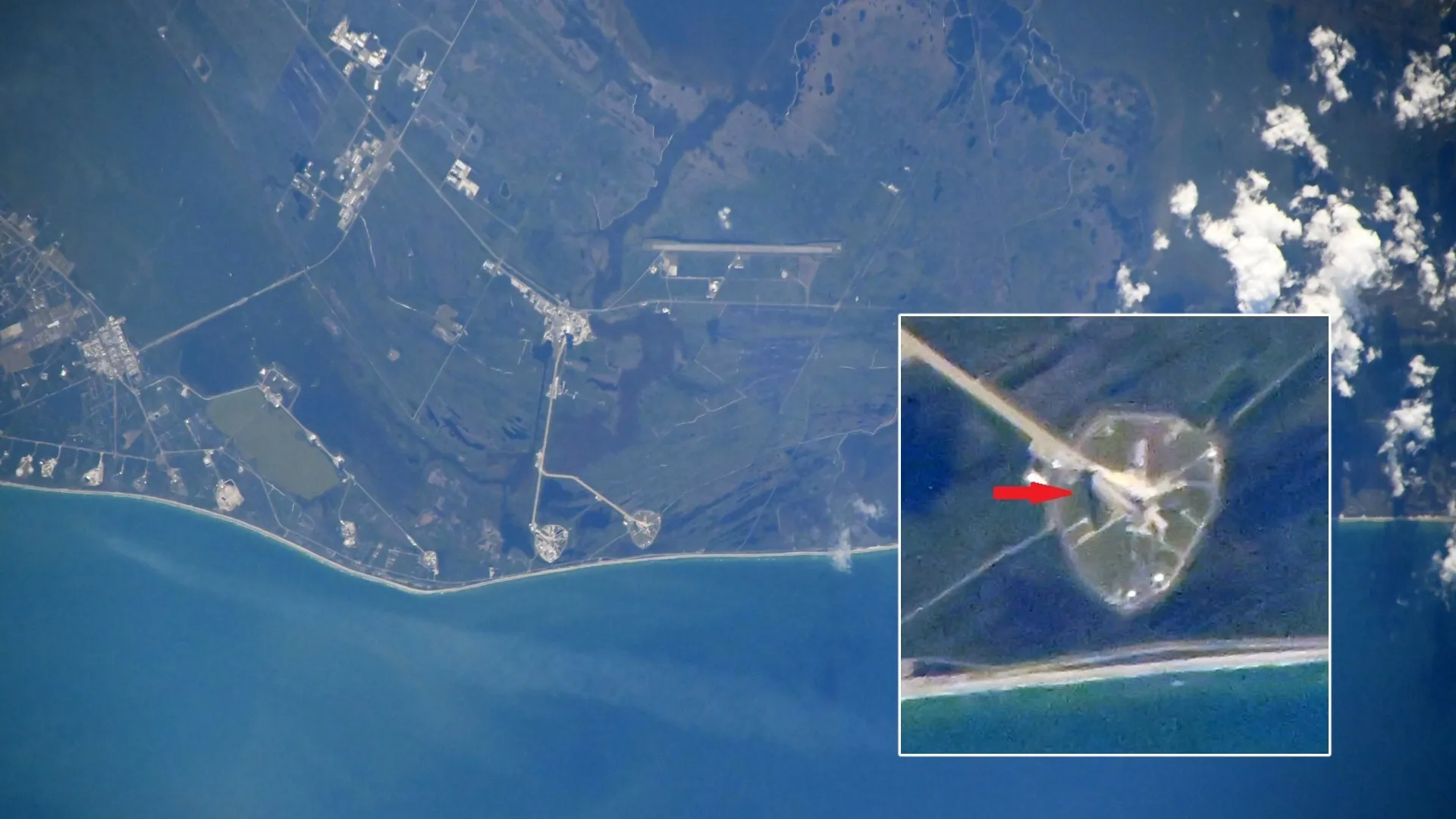
The lone U.S. astronaut currently in space took a picture of NASA's first rocket designed for a human moon mission in more than 50 years.
Artemis 2's rocket, called the Space Launch System, arrived at the launch pad Saturday (Jan. 17) — and may launch to the moon as soon as Feb. 6. From the International Space Station, NASA astronaut Chris Williams captured a view of the rocket coastside at the Kennedy Space Center in Florida. "If you zoom in on the rightmost launch pad, you can see a shadow just to the left of the center of the pad," Williams said in an X post Monday (Jan. 19). "That shadow is from the rocket (and launch tower) that will soon take four of my friends on a trip around the moon."
Artemis 2 is expected to carry four astronauts on a lunar mission: NASA's Reid Williams (commander), Victor Glover (pilot) and Christina Koch (mission specialist), along with Canadian Space Agency astronaut and mission specialist Jeremy Hansen. Glover will be the first person of color to leave low Earth orbit, while Koch will be the first woman and Hansen will be the first non-American. The moon mission is the first to return astronauts to the lunar surface since Apollo 17's moon-landing excursion in 1972.
Williams, temporarily flying solo on the U.S. side of the ISS after the early and unprecedented medical evacuation of SpaceX Crew-11 on Jan. 15, said the space photo was not his best effort. ("Should have grabbed a different lens," he added.) But it was a "special" image to him nonetheless, Williams said. The ISS coincidentally passed over Florida at about the same time SLS arrived at Launch Pad 39B on Saturday at 6:42 p.m. EST (2342 GMT). The rocket spent nearly 12 hours carefully moving across KSC on top of a baseball-infield-sized "crawler-transporter" previously tasked for Apollo and space shuttle missions.
The crew of Artemis 2 aims to spend 10 days testing the Orion spacecraft on the capsule's third space mission. The astronauts will first do a checkout in Earth orbit, and assuming all goes well, perform an engine burn (a trans-lunar injection) to bring them around the moon and home again.
Artemis 2 will be the first crewed flight for Orion. But an Orion flew uncrewed around Earth in 2014 for Exploration Flight Test-1 atop a United Launch Alliance Delta IV rocket, and another uncrewed Orion went around the moon in 2022 with Artemis 1 — which flew atop SLS on the rocket's first flight.
Artemis 2 will conduct a wide range of science and human health experiments to prepare for more long-duration moon missions. Artemis 3 is scheduled to land with astronauts in 2027 or 2028, pending readiness of the SpaceX Starship lander currently tasked to land astronauts there. More Artemis program missions are expected to follow, as NASA aims to build up a permanent presence on the moon.
The launch date of Artemis 2 is subject to change as the rocket and spacecraft undergo tests at the pad, most especially a "wet dress rehearsal" (or fueling of the rocket, in a simulated launch sequence) that required multiple attempts for certification of Artemis 1. The rehearsal is scheduled for no later than Feb. 2.
NASA has released windows for Artemis 2's launch in February, March and April. Agency officials at KSC emphasized Jan. 16 they would launch Artemis 2 with safety in mind when the mission was ready, and not "rush" the process.