Neutron stars are the remains of the cores of massive stars that have reached the end of their lives.
They are one of the two possible evolutionary endpoints of the most massive stars, the other being black holes. The densest stellar objects, apart from perhaps, whatever exists at the heart of a black hole, neutron stars are some of the universe's most extreme objects.
NASA estimates that there are as many as a billion neutron stars in our Milky Way galaxy. The majority of neutron stars discovered thus far are young neutron stars that sweep energetic radiation over the Earth as they rotate at incredible speeds. Older neutron stars that have had billions of years to slow their spin and cool are less conspicuous but are no less fascinating.
"With neutron stars, we're seeing a combination of strong gravity, powerful magnetic and electric fields, and high velocities. They are laboratories for extreme physics and conditions that we cannot reproduce here on Earth," Large Area Telescope (LAT) science team member David Thompson of NASA's Goddard Space Flight Center said in a NASA statement.
Related: What is a black hole event horizon (and what happens there)?
How do neutron stars form?
The life of a star, no matter its size, is a balancing act between the inward "push" of gravity and the outward push provided by photons generated as they conduct nuclear fusion, the forging of heavy atomic nuclei from light nuclei, at their cores. When stars run out of hydrogen to fuse into helium, they reach the end of their main sequence of nuclear-fuel-burning lives. The outward energy ceases, and gravity wins out, causing the core of the star to collapse in on itself. As this happens, nuclear fusion in the outer shell of the star continues and this causes these outer layers to "puff out." These shed outer layers cool around the still collapsing core, which, if it is massive enough, will begin a new round of nuclear fusion, forging helium into heavier elements like carbon.
Even stars with masses between 10 and 20 times that of the sun, reach a limit to the heavy elements they can forge (Green, Jones, 2015, pg 251), usually ending up with a core of almost pure iron. Even this heavy element isn't dense enough to prevent massive cores from further collapse. As this occurs the gravitational pressure is so intense that the negatively-charged electrons and positively-charged protons that comprise the iron nuclei in this stellar core are crushed together, creating a sea of uncharged, or neutral neutrons.
Some massive stellar cores are at this point saved from further collapse by a quantum phenomenon called "neutron degeneracy pressure," which occurs when such a density is reached that neutrons can no longer be packed any closer together, leaving them as neutron stars.
Why form a neutron star and not a black hole?

If this process of neutron star birth sounds familiar, that could be because it is also the path that a massive star takes to become a black hole. The question is, why do some stars birth neutron stars while others leave behind black holes?
The key difference seems to be the collapsing stellar core possessing enough mass to exceed the protection that neutron degeneracy offers neutron stars. Currently, scientists aren't exactly sure where the delineating line between black holes and neutron stars lies. This uncertainty exists because the physics inside neutron stars remains difficult to investigate.
The heaviest known neutron star has a mass equivalent to around 2.5 times the mass of the sun, while the lightest known black hole has a mass of around 5 times that of the sun. Thus there is a mass gap between these two types of dead stars which scientists are currently attempting to narrow, and it is in this gap that the line between one path and the other must lie.
Researchers currently think that the dividing line between neutron stars and black holes lies much closer to 3 times the mass of the sun than 5 times the mass of the sun (Green, Jones, 2015, pg 251).
As the main difference between a black hole and a neutron star is mass, it only makes sense that neutron stars accumulating material from a binary partner could eventually become a black hole. The process of mass accumulation could take as long as millions of years, but the eventual transformation from a neutron star to a black hole takes less than a second, according to National Radio Astronomy Observatory (NRAO) scientist Jeff Magnum.
Will the sun become a neutron star (or a black hole)?
While the line between neutron stars and black holes is vague and poorly defined, the line between the stellar remnant that our sun will become, a white dwarf and a neutron star is much better understood.
When the sun reaches the end of its hydrogen supply in around 5 billion years, and the outward pressure protecting against gravitational collapse ceases, its core will collapse. After passing through a red giant phase during which the sun's outer layers will swell out and swallow the inner planets, including Earth, the sun's core is left as a smoldering white dwarf.
Just as neutron stars are prevented from becoming black holes by neutron degeneracy pressure, white dwarf stars are protected from further collapse by electron degeneracy pressure that stops electrons from being crammed any closer together. Electron degeneracy pressure is much weaker than its neutron equivalent, and astrophysicists also have a better idea of the masses needed to overcome than they do for neutron degeneracy pressure.
To eventually become a neutron star, this white dwarf would have to exceed what is known as the Chandrasekhar limit, which is generally considered to be 1.4 solar masses , according to The SAO Encyclopedia of Astronomy. That means that the core of the sun alone would have to have 1.4 times the total mass of the sun. The Chandrasekhar limit mass, first predicted by Subrahmanyan Chandrasekhar in 1931, has so far corresponded well with observations of white dwarfs, as we are yet to find a stellar remnant of this type with a mass above 1.4 solar masses.
NASA estimates that the sun would have to be 10 times more massive to end its life as a neutron star, or it would have to be 20 times more massive to leave behind a black hole in what remains of the solar system in 5 billion years or so.
The size and mass of neutron stars
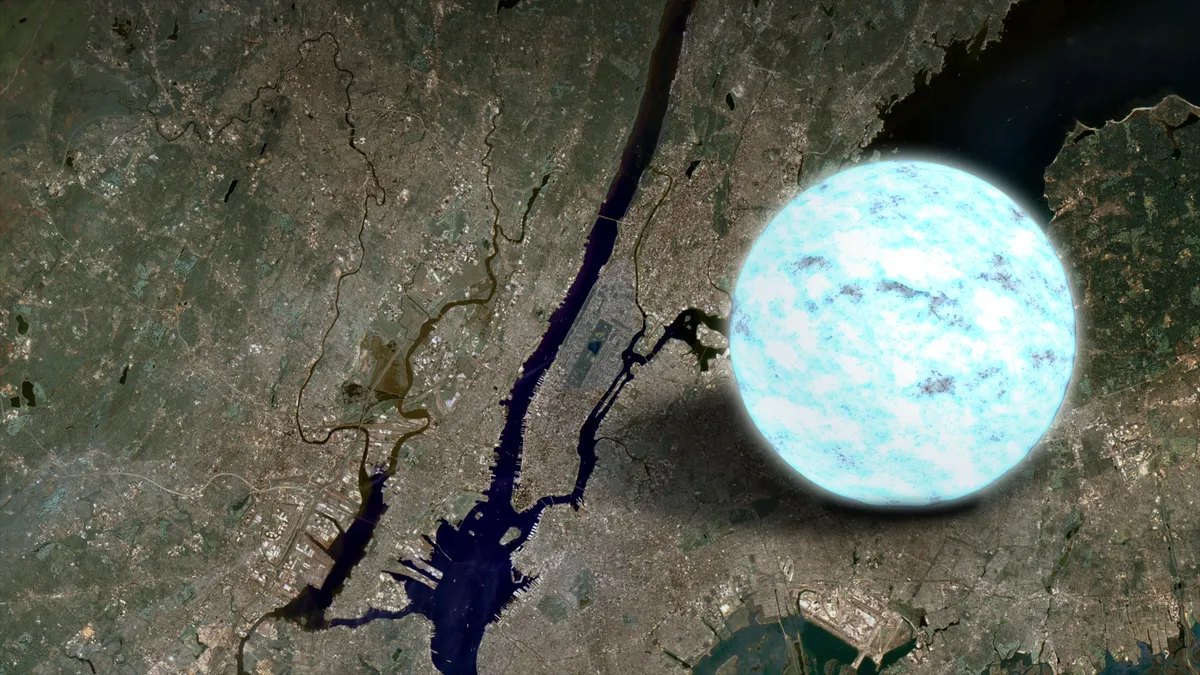
To consider how dramatic and violent the near-complete gravitational collapse that births a neutron star is, one only has to look at the material that it creates and the dimensions of the object it comprises.
The collapse of massive stellar cores results in an object that has from one to two times the mass of the sun, but only has a width of between 6 and 12 miles (10 and 20 kilometers). Imagine the sun reduced in size until it is a sphere that sits comfortably within the city of New York, which is 35 miles wide (56 kilometers wide).
Being reduced from a diameter of 870,000 miles (1.4 million kilometers) to just 12 miles (20 kilometers) would have a striking effect on the material within it, and this is definitely the case for neutron stars. NASA estimates that a single sugar cube comprised of this neutron-rich matter would weigh around 1 trillion kilograms (or 1 billion tons) if it were brought to Earth. That's a sugar cube that weighs as much as 3,000 Empire State Buildings or the entire human race.
This makes neutron star matter the densest material we can see in the universe, according to Swinburne Centre for Astrophysics and Supercomputing, and this has another effect. Neutron stars are so dense that the speed it would take to escape their gravitational influence is half the speed of light.
As a consequence, the gravity of neutron stars is so strong that NASA Goddard Flight Center says if a marshmallow were dropped to the surface of one of these exotic stellar remnants, it would accelerate so quickly that when it struck the surface, it would release energy equivalent to the detonation of a thousand hydrogen bombs.
While marshmallows don't tend to rain on neutron stars, gas stripped from companion stars in binary partnerships with these extreme stellar remnants often does. When this gas hits the neutron star's surface at speeds as great as millions of miles an hour, it creates powerful firework displays in X-ray light that flicker in intensity thousands of times per second or perhaps burst only once every few years.
The density and gravity of neutron stars isn't the only thing that makes them the most exotic objects in the universe, they also have some other extreme characteristics.
Types of neutron stars: Blazars and magnetars
When neutron stars are born, the conservation of angular moment results in them spinning at incredibly rapid speeds. To consider why this is the case think of an ice skater in a spin. As they draw their arms in, the skater's rotational speed increases.
A similar thing happens when the diameter of a stellar core shrinks as it undergoes gravitational collapse, the resultant young neutron star spins faster and faster, reaching speeds as great as 60 rotations per second, according to Swinburne Centre for Astrophysics and Supercomputing.
Many neutron stars slow as they age, reducing to rotations of around 8 times per second. But, the situation is different for neutron stars that are stealing stellar material from a binary partner. This material carries with it angular momentum, and thus this transfer of matter can actually speed up or "spin up" the rotation of neutron stars. This can result in some neutron stars rotating as fast as 600 or 700 times per second.
The fastest-spinning neutron star on record, discovered in 2006 according to the National Radio Astronomy Observatory (NRAO), is PSR J1748-2446ad, found in a globular cluster of stars located around 28,000 light-years from Earth. This neutron star spins around 716 times per second or at 716 Hertz, which is faster than the blades of a kitchen blender.
Neutron stars like PSR J1748-2446ad are discovered because as they spin, they radiate beams of radiation from each pole, including radio, visible, X-ray, and gamma-ray wavelengths. As a result, when they turn toward Earth, these beams of radiation flash over our planet, making these neutron stars almost like "cosmic lighthouses" though they are more formally known as pulsars. All pulsars are neutron stars, but not all neutron stars are pulsars.
Scientists believe that the beams of radiation of pulsars are created when the powerful magnetic fields of neutron stars channel matter to their magnetic poles. These magnetic fields for some neutron stars can be extraordinary themselves.
When a star collapses it isn't just its mass that is condensed, but the magnetic field of that star is compressed as well (Green, Jones, 2015, pg 255). Magnetic fields are represented by curved lines or field lines passing through an object, the closer together these lines are, the stronger a magnetic field is. The collapse of a stellar core to create a neutron star pushes together these field lines.
The European Space Agency (ESA) says that some neutron stars can have magnetic fields as strong as 100 thousand million Tesla, which is not only thousands of times more powerful than the magnetic field of "ordinary" neutron stars, but it is one thousand trillion times stronger than the magnetosphere of Earth and equivalent to hundred-trillion refrigerator magnets, NASA says.
This makes the magnetic field of magnetars some of the most intense magnetic fields in the known universe, and these fields are so intense they can drive the surface temperature of a magnetar to over 18 million degrees Fahrenheit (10 million degrees Celsius). With all these extreme and record-breaking characteristics, imagine what happens when two of these extreme stellar remnants come together.
What happens when two neutron stars collide?
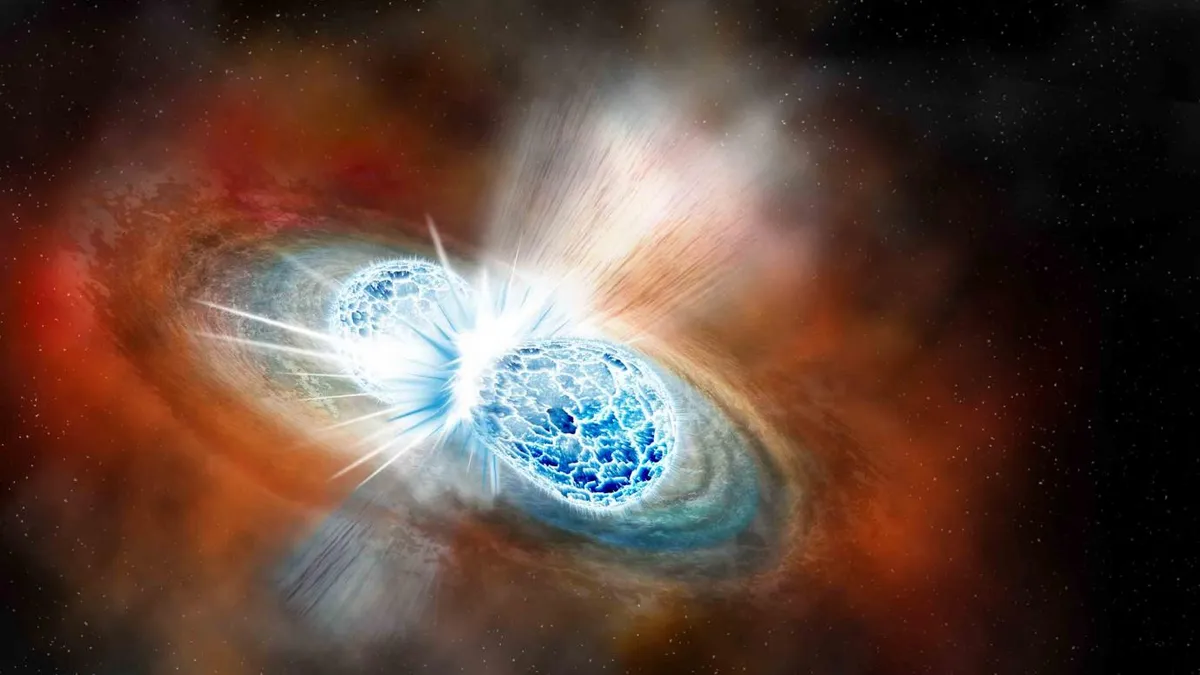
Neutron stars can exist in isolation, only detectable by their surface temperature, or they can dwell in partnerships with "ordinary" stars, often siphoning off their material, or in some cases, they can exist in binary systems with another neutron star.
In these circumstances, according to Einstein's theory of general relativity, as these binary neutron stars orbit each other they create ripples in space-time called gravitational waves. Just like material falling to the surface of a neutron star grants it angular momentum, as gravitational waves ripple away from binary neutron stars they carry angular momentum out of the system.
Loss of angular momentum causes the neutron stars to draw close together, and as this happens they radiate gravitational waves even more strongly, increasing the rate at which angular momentum is lost.
Eventually, this causes the neutron stars to collide and merge to create an even larger neutron star. The violent event, an explosion known as a kilonova, which after as long as a billion years of prelude with the stellar remnants dancing around each other, lasts just a few milliseconds. Kilonovas release energy equivalent to millions of times that of the sun, sending out an intense burst of space-distorting gravitational waves and a short but powerful burst of gamma rays, and be responsible for forging heavy elements like gold, silver, and platinum.
Depending on the size of the neutron stars that go into this kilonova event, the result could be a "hypermassive neutron star" that is too tremendously huge to remain stable thanks to neutron degeneracy pressure and thus rapidly collapses in under a second to birth a black hole.
In 2017, astronomers observed for the first time gravitational waves, ripples in the very fabric of spacetime, and light that was sent radiating outwards from a collision between neutron stars. The signals that came from clashing binary neutron stars located 130 light-years away, verify the utility of "mixed messenger astronomy," the practice of observing astronomical objects and events in different forms of radiation beyond light used in traditional astronomy.
With this powerful combination of techniques, astronomers are on the cusp of discovering much more about the nature of these collisions, and neutron stars, the extreme dead stars at their heart.

Neutron star FAQs answered by expert
We asked Genevieve Schroeder, an Astronomy Ph.D. student at Northwestern University and part of the Center for Interdisciplinary Exploration and Research in Astrophysics (CIERA), who studies some of the most powerful and violent events in the cosmos, some frequently asked questions about neutron stars.

Genevieve Schroeder is an Astronomy Ph.D. student at Northwestern University and part of the Center for Interdisciplinary Exploration and Research in Astrophysics (CIERA)
How big are neutron stars?
Neutron stars are about 12 miles (20 km) in diameter, which is about the size of a city! We can determine the radius through X-ray observations from telescopes like NICER and XMM-Newton. We know that most of the neutron stars in our galaxy are about the mass of our sun. However, we're still not sure what the highest mass of a neutron star is.
We know at least some are about two times the mass of the sun, and we think the maximum mass is somewhere around 2.2 to 2.5 times the mass of the sun. The reason we are so concerned with the maximum mass of a neutron star is that it's very unclear how matter behaves in such extreme and dense environments.
So we must use observations of neutron stars, like their determined masses and radiuses, in combination with theories, to probe the boundaries between the most massive neutron stars and the least massive black holes.
Finding this boundary is really interesting for gravitational wave observatories like LIGO, which have detected mergers of objects within this "mass gap" between 2 and 5 times the mass of the sun.
Why do neutron stars not seem to exceed these limits on size and mass?
Neutron stars are extremely dense, with one to two times the mass of our sun, which is 100 times wider and 330,000 times more massive than Earth, pushed into the size of a city.
If we pack much more matter into that small of a space, gravity wins out and the whole thing collapses into a black hole. Therefore, neutron stars exist in this precious balance of neutrons pushing against each other (known as neutron degeneracy pressure) and gravity.
How long do neutron stars "live"?
In principle, a neutron star can live "forever," as they're one of the final states of a massive star, a star corpse, if you will. However, if they have a binary companion, like another neutron star or black hole, they may merge eventually and create a black hole or a more massive neutron star.
How does your work relate to neutron stars, and why are they so fascinating?
Overall, my research focuses on radio observations of gamma-ray bursts (GRBs). One aspect of my research is following up on GRBs that come from the collisions of neutron stars. We can use observations from the radio to X-rays to track the light that comes from these explosions, known as the "afterglow." Through modeling the afterglow, we can learn about the explosion, which may lead to information about the neutron stars that merged, as well as the final product of the merger, which is expected to be either an even more massive neutron star or a black hole.
If the merger produces an even more massive neutron star, it would have a very high magnetic field, known as a "magnetar." This magnetar would energize the ejecta from the merger as it spins down, and that would, in turn, produce radio emission that peaks years after the merger. A second aspect of my research is searching for this late-rising radio signature, in order to determine whether a magnetar was produced. So far, we have not detected any of these radio emissions, but a non-detection still helps us place limits on the maximum mass of a neutron star, which is a major unanswered question in astronomy.
What are some of the events tied to neutron stars?
What makes these some of the most powerful occurrences in the universe?
Supernovae are tied to neutron stars as they are the explosive events that create them. They are so powerful because the star has lost the fight against gravity, and it ends up exploding! Superluminous supernovae are thought to be so luminous due to a magnetar being the power source of the excess emission.
Also, some gamma-ray bursts occur when a neutron star collides with another neutron star or possibly a black hole! These events are so powerful because they involve ripping apart a neutron star and colliding two very massive and dense objects together.
Some fast radio bursts are also connected to neutron stars, as we've detected a fast radio burst from a neutron star, specifically a magnetar, within our own galaxy. So overall, neutron stars are quite ubiquitous among many transients that we can observe.
Additional resources
NASA tells the story of a neutron star merger as it unfolds, giving way to a tremendous kilonova explosion. The sun will never become a neutron star, instead ending its life as a white dwarf. But while these stellar remnants are quite as extreme as neutron stars they are still fascinating according to this NASA explanation. The birth of a neutron star is accompanied by a Type II supernova or a core-collapse supernova. Swinburne Center Center for Astrophysics and Supercomputing explores these titanic cosmic explosions in more detail.
Bibliography
S.F. Green., M.H. Jones., An Introduction to the Sun and Stars, Cambridge University Press, [2015], ISBN 9781 107 49263 9 https://books.google.co.uk/books/about/An_Introduction_to_the_Sun_and_Stars.html?id=lb5owLGIQGsC&redir_esc=y
S.G. Ryan., A.J. Norton., Stellar Evolution and Nucleosynthesis, Cambridge University Press, [2010], ISBN 9780 521 133202 3
Neutron stars, NASA Goddard Space Flight Center, [Acessed 05/07/23], [https://imagine.gsfc.nasa.gov/science/objects/neutron_stars1.html]
Stars: Neutron stars, pulsars and magnetars, ESA, [Acessed 05/07/23], [https://www.esa.int/Science_Exploration/Space_Science/Stars_Neutron_stars_pulsars_and_magnetars]
Neutron Star, Swinburne Centre for Astrophysics and Supercomputing, [Acessed 05/07/23], [https://astronomy.swin.edu.au/cosmos/n/neutron+star]
Neutron star collisions are a "goldmine" of heavy elements, study finds, MIT News, [Acessed 05/07/23],
/[https://news.mit.edu/2021/neutron-star-collisions-goldmine-heavy-elements-1025]