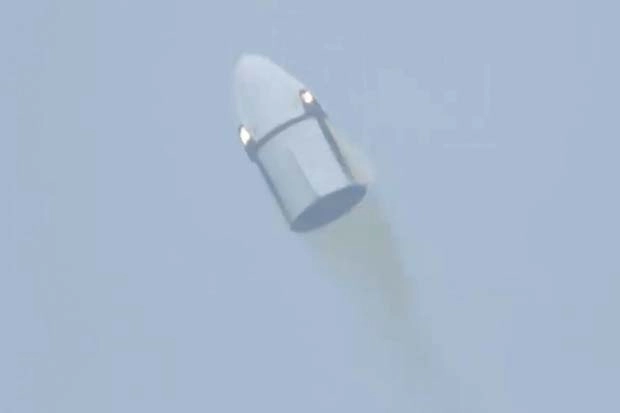
Russia's failed Progress 59 cargo spacecraft fell back to Earth, SpaceX's Dragon crew capsule launched on its first big test and the sun fired off its most powerful flare of 2015 so far. Here's a look at Space.com's top stories of the week.
Failed Russian cargo spacecraft falls to Earth
Russia's robotic Progress 59 cargo vessel died a fiery death in Earth's atmosphere Thursday night (May 7), nine days after launching on a failed mission to the International Space Station. [Full Story: Out-of-Control Russian Cargo Spaceship Falls Back to Earth]
SpaceX's Dragon crew capsule aces key safety test
SpaceX launched a major test Wednesday (May 5) of the innovative rocket escape system for its manned Dragon spaceships, a critical system designed to save astronauts in a launch emergency. [Full Story: SpaceX Tests 'Revolutionary' Dragon Launch Escape System to Save Astronauts]
'Impossible' space engine apparently achieves milestone in test
Interesting news out of NASA's Johnson Space Center this week: A group of researchers has reportedly tested an electromagnetic propulsion drive that could potentially facilitate practical space travel in and around the solar system. [Full Story: Is NASA Moving Toward a Hyperspace Drive?]
Space: the final frontier — for coffee. Italian astronaut Samantha Cristoforetti, dressed in a "Star Trek" captain's uniform, became the first person in space to sip from a freshly-made cup of coffee on Sunday (May 3), using the International Space Station's newly-installed espresso machine. [Full Story: To Boldly Brew: Astronaut Uses ISSpresso to Make 1st Cup of Coffee in Space]
The Milky Way's disk is about 60 percent larger than previously thought, a new study suggests. The new results also reveal a rippling pattern, which raises intriguing questions about what sent wavelike fluctuations rippling through the disk. [Full Story: Size of the Milky Way Upgraded, Solving Galaxy Puzzle]
Alien volcanoes may erupt on 'super Earth' planet
Temperatures on a nearby "super Earth" exoplanet varied dramatically recently, suggesting that large and very active volcanoes may exist on the alien world's surface, a new study reports. [Full Story: Alien Volcanoes on 'Super Earth' May Explain Wild Temperature Swings]
A galaxy far, far away — farther, in fact, than any other known galaxy — has been measured by astronomers. The galaxy EGS-zs8-1 lies 13.1 billion light-years from Earth, the largest distance ever measured between Earth and another galaxy. [Full Story: This Galaxy Far, Far Away Is the Farthest One Yet Found]
The nascent asteroid-mining industry is set to take its first steps into space this summer. Planetary Resources' Arkyd-3R probe currently sits aboard the International Space Station and is scheduled to be deployed sometime in July. [Full Story: Asteroid-Mining Company to Deploy 1st Satellite This Summer]
Enceladus' ocean may have life-supporting energy source
Chemical reactions that free up energy that could potentially support a biosphere have occurred — and perhaps still are occurring — deep within the Saturn moon Enceladus' salty subsurface ocean, a new study suggests. [Full Story: Ocean on Saturn Moon Enceladus May Have Potential Energy Source to Support Life]
Follow Mike Wall on Twitter @michaeldwall and Google+. Follow us @Spacedotcom, Facebook or Google+.