

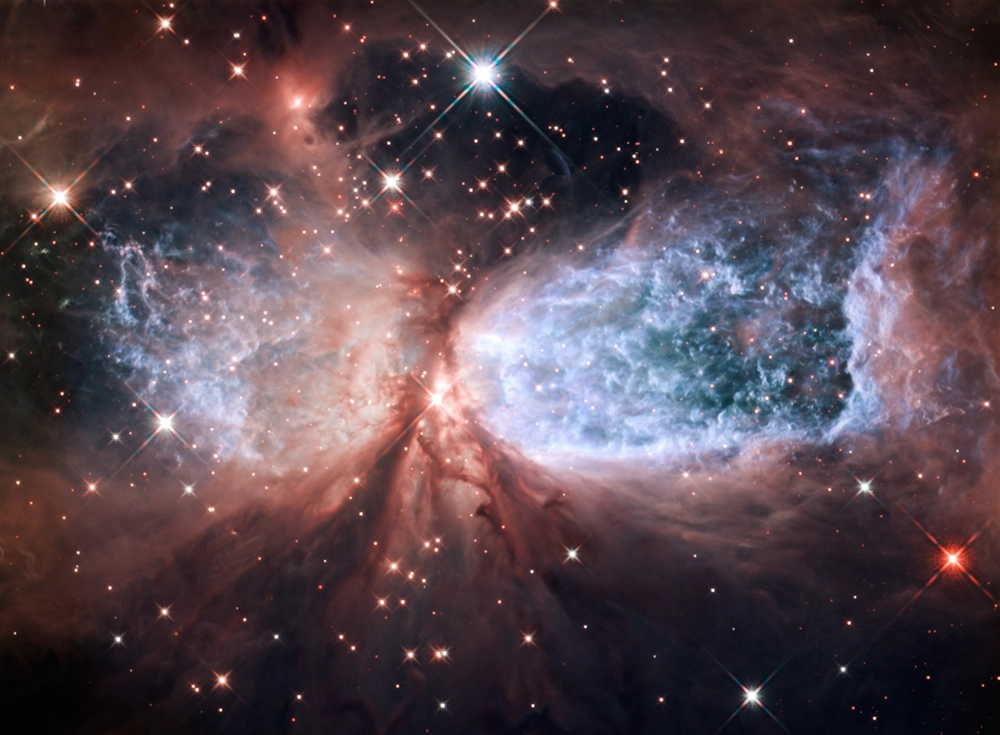
1 of 15
Snow Angel S106 Nebula - Hubble Space Telescope
Credit: NASA/ESA
This image from the Hubble Space Telescope shows Sh 2-106, or S106 for short. This is a compact star forming region in the constellation Cygnus (The Swan). The image was released on Dec. 15, 2011.
2 of 15
WISE Captures Photo of Cosmic Wreath
Credit: NASA/JPL-Caltech/UCLA
In this image, captured by NASA's WISE space telescope, the star-forming nebula Barnard 3 looks like a Christmas wreath. Baby stars are being born throughout the dusty region, while the "silver bell" stars are located both in front of, and behind, the nebula.
3 of 15
Saturn Holiday Treats: Titan and Dione
Credit: NASA/JPL-Caltech/Space Science Institute
Saturn's third-largest moon Dione can be seen through the haze of its largest moon, Titan, in this view of the two posing before the planet and its rings from NASA's Cassini spacecraft released on Dec. 22, 2011. The north polar hood can be seen on Titan appearing as a detached layer at the top of the moon here.
This view looks toward the anti-Saturn side of Titan (3200 miles, 5150 kilometers across) and Dione (698 miles, 1123 kilometers across). North is up on the moons. This view looks toward the northern, sunlit side of the rings from just above the ring plane. The image was taken on May 21, though released months later.
4 of 15
A Mercury Christmas (Crater) Carol
Credit: NASA/Johns Hopkins University Applied Physics Laboratory/Carnegie Institution of Washington
The crater at the center of this image is named Dickens, after Charles Dickens, the English novelist who lived from 1812 to 1870. Among Dickens' famous works is A Christmas Carol, the story of Bob Cratchit, his family, and horrible boss Mr. Scrooge. Scientists studying Mercury might consider the Mariner 10 mission to be Christmas Past, Messenger to be Christmas Present, and the European Bepi-Colombo mission to be Christmas Yet To Come. This photo was taken by NASA's Messenger probe orbiting Mercury and released on Dec. 21, 2011.
5 of 15
Christmas at the Moon
Credit: NASA.
"Earthrise" seen by the Apollo 8 astronauts in December 1968.
6 of 15
Saturn Holiday Treats: Titan and the Rings
Credit: NASA/JPL-Caltech/Space Science Institute
The colorful globe of Saturn's largest moon, Titan, passes in front of the planet and its rings in this true color snapshot from NASA's Cassini spacecraft released on Dec. 22, 2011.
The north polar hood can be seen on Titan (3200 miles, 5150 kilometers across) and appears as a detached layer at the top of the moon here. This view looks toward the northern, sunlit side of the rings from just above the ring plane.
Images taken using red, green and blue spectral filters were combined to create this natural color view. The images were obtained with the Cassini spacecraft narrow-angle camera on May 21, 2011 at a distance of approximately 1.4 million miles (2.3 million kilometers) from Titan. Image scale is 9 miles (14 kilometers) per pixel on Titan.
The north polar hood can be seen on Titan (3200 miles, 5150 kilometers across) and appears as a detached layer at the top of the moon here. This view looks toward the northern, sunlit side of the rings from just above the ring plane.
Images taken using red, green and blue spectral filters were combined to create this natural color view. The images were obtained with the Cassini spacecraft narrow-angle camera on May 21, 2011 at a distance of approximately 1.4 million miles (2.3 million kilometers) from Titan. Image scale is 9 miles (14 kilometers) per pixel on Titan.
7 of 15
Celestial Ornament: Pulsar SXP 1062
Credit: X-ray: NASA/CXC/Univ.Potsdam/L.Oskinova et al & ESA/XMM-Newton; Optical: AURA/NOAO/CTIO/Univ.Potsdam/L.Oskinova et al
With the holiday season in full swing, a new image from an assembly of telescopes has revealed an unusual cosmic ornament. Data from NASA's Chandra X-ray Observatory and ESA's XMM-Newton were combined to find this young pulsar in the remains of a supernova located in the Small Magellanic Cloud. It is be the first definite time a pulsar, a spinning, ultra-dense star, has been found in a supernova remnant in the SMC, a small satellite galaxy to the Milky Way.
The pulsar, known as SXP 1062, is the bright white source located on the right-hand side of the image in the middle of the diffuse blue emission inside a red shell. The diffuse X-rays and optical shell are both evidence for a supernova remnant surrounding the pulsar. The optical data also displays spectacular formations of gas and dust in a star-forming region on the left side of the image.
8 of 15
Saturn Holiday Treats: Titan and Tethys
Credit: NASA/JPL-Caltech/Space Science Institute
Saturn's moon Tethys, with its stark white icy surface, peeps out from behind the larger, hazy, colorful Titan in this Cassini view of the two moons released on Dec. 22, 2011.
The north polar hood can be seen on Titan appearing as a detached layer at the top of the moon here. Ithaca Chasma, a long series of scarps or cliffs on Tethys, faintly can be seen running north-south on that moon.
This view looks toward the anti-Saturn side of Titan (3200 miles, 5150 kilometers across) and the Saturn-facing side of Tethys (660 miles, 1062 kilometers across). This view looks toward the northern, sunlit side of the rings from just above the ring plane.
Images taken using red, green and blue spectral filters were combined to create this natural color view. The images were acquired with the Cassini spacecraft narrow-angle camera on May 21, 2011 at a distance of approximately 1.4 million miles (2.3 million kilometers) from Titan and 2.4 million miles (3.8 million kilometers) from Tethys. Image scale is 9 miles (14 kilometers) per pixel on Titan and 18 miles (27 kilometers) per pixel on Tethys.
The north polar hood can be seen on Titan appearing as a detached layer at the top of the moon here. Ithaca Chasma, a long series of scarps or cliffs on Tethys, faintly can be seen running north-south on that moon.
This view looks toward the anti-Saturn side of Titan (3200 miles, 5150 kilometers across) and the Saturn-facing side of Tethys (660 miles, 1062 kilometers across). This view looks toward the northern, sunlit side of the rings from just above the ring plane.
Images taken using red, green and blue spectral filters were combined to create this natural color view. The images were acquired with the Cassini spacecraft narrow-angle camera on May 21, 2011 at a distance of approximately 1.4 million miles (2.3 million kilometers) from Titan and 2.4 million miles (3.8 million kilometers) from Tethys. Image scale is 9 miles (14 kilometers) per pixel on Titan and 18 miles (27 kilometers) per pixel on Tethys.
9 of 15
Space Christmas Tree
Credit: ESO
This color image of the region known as NGC 2264 — an area of sky that includes the sparkling blue baubles of the Christmas Tree star cluster and the Cone Nebula — was created from data taken by the Wide Field Imager at ESO's La Silla Observatory in Chile. The image shows a region of space about 30 light-years across. This image was released on Dec. 16, 2008.

10 of 15
GRB 101225A: The Christmas Burst
Credit: Aurore Simonnet, NASA E/PO, Sonoma State University
Artist's impression of the model suggested for GRB 101225A, the "Christmas Burst" of December 2010.
11 of 15
Christmas Burst in the Style of Vincent van Gogh
Credit: Adapted from V. van Gogh's "Starry Night" (c. 1889) by S. Campana, INAF-Osservatorio astronomico di Brera
The Christmas burst of 2010 as it might have been painted by Vincent van Gogh.
12 of 15
A Cosmic Christmas Ghost
Credit: ESO
Just like Charles Dickens' Christmas Carol takes us on a journey into past, present and future in the time of only one Christmas Eve, two of ESO' s telescopes captured various stages in the life of a star in a single image.
This image from telescopes at the European Southern Observatory in Chile shows a vast stellar cluster surrounded by gas that resembles a vast cosmic ghost. The image, released on Dec. 25, 2005, hows the area surrounding the stellar cluster NGC 2467, This image from telescopes at the European Southern Observatory in Chile shows a vast stellar cluster surrounded by gas that resembles a vast cosmic ghost. The image, released on Dec. 25, 2005, hows the area surrounding the stellar cluster NGC 2467, located in the southern constellation of Puppis ("The Stern").
13 of 15
Star Explosion Shines Like Christmas Ornament In Hubble Photo
Credit: NASA, ESA, and the Hubble Heritage Team (STScI/AURA). Acknowledgment: J. Hughes (Rutgers University) [Full Story]
A delicate sphere of gas, photographed by NASA's Hubble Space Telescope, floats serenely in the depths of space. Called SNR 0509-67.5, the bubble is the visible remnant of a powerful stellar explosion in the Large Magellanic Cloud, a small galaxy about 160,000 light-years from Earth.
14 of 15
Snowflake Cluster and Cone Nebula
Credit: NASA
Strange shapes and textures can be found in the neighborhood of the Cone Nebula. These patterns result from the tumultuous unrest that accompanies the formation of the open cluster of stars known as NGC 2264, the Snowflake Cluster. To better understand this process, a detailed image of this region was taken in two colors of infrared light by the orbiting Spitzer Space Telescope.
Bright stars from the Snowflake Cluster dot the field. These stars soon heat up and destroy the gas and dust mountains in which they formed. One such dust mountain is the famous Cone Nebula, visible in the above image on the left, pointing toward a bright star near the center of the field. The entire NGC 2264 region is located about 2,500 light years away toward the constellation of the Unicorn (Monoceros).
15 of 15
A Christmas Wreath
Credit: NASA, ESA, and F. Paresce (INAF-IASF, Bologna, Italy), R. O'Connell (University of Virginia, Charlottesville), and the Wide Field Camera 3 Science Oversight Committee
This Hubble photo of 30 Doradus was taken Oct. 20-27, 2009. The blue color is light from the hottest, most massive stars; the green from the glow of oxygen; and the red from fluorescing hydrogen.


