





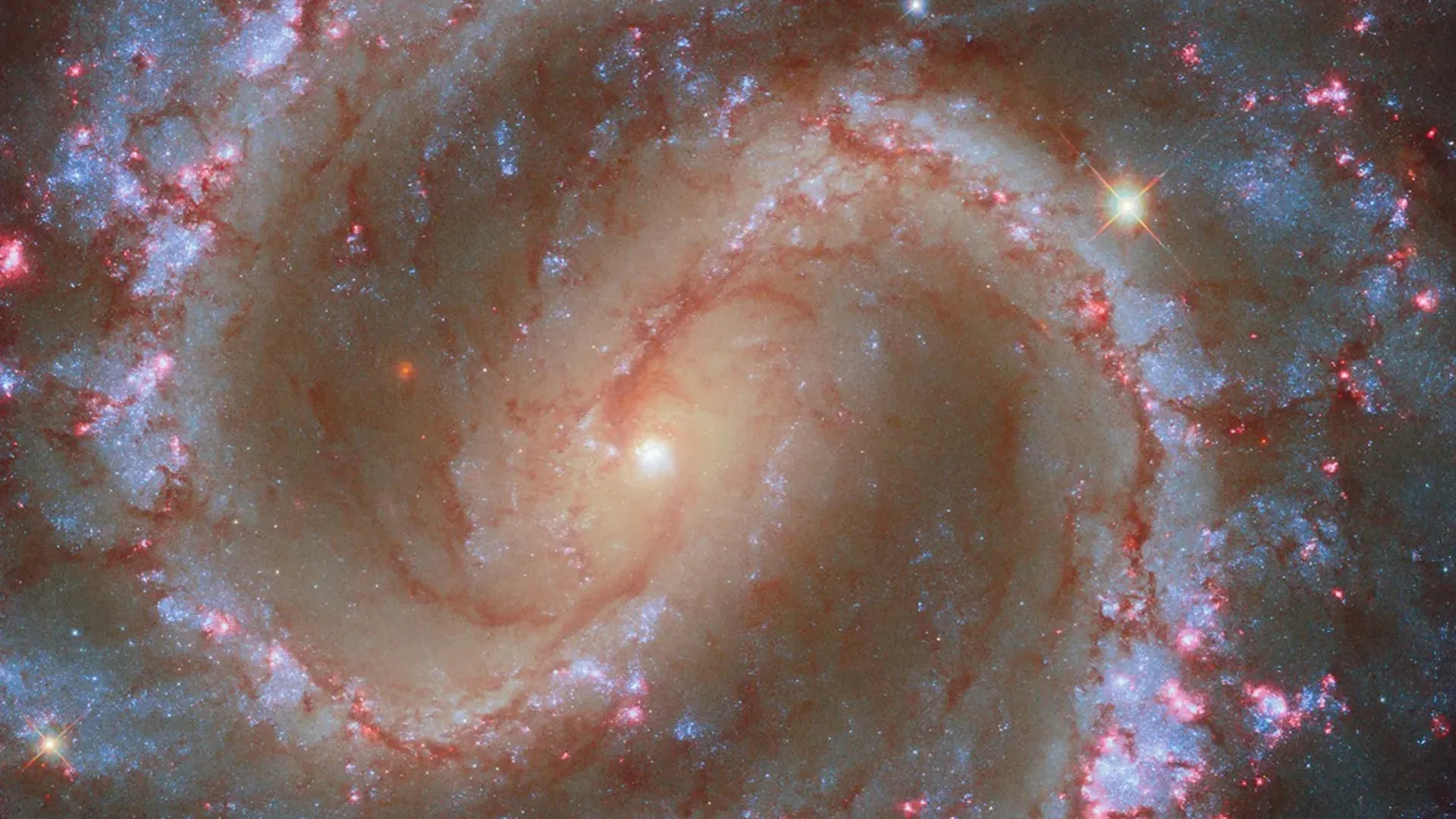
The Hubble Space Telescope has turned its sharp eye toward a ghostly swirl of stars and gas known as the "Lost Galaxy," given its faint and elusive appearance to stargazers. More scientifically, this galaxy is known as NGC 4535 and its home to lots of stellar activity.
What is it?
In this recent image, the Hubble Space Telescope captured NGC 4535's spiral arms studded with bright blue star clusters: tightly packed families of young, hot stars. Around many of these clusters are soft pink-red glowing areas, which are zones of ionized hydrogen gas known as H II regions. These H II regions act like neon signs advertising recent star formation. Massive, newly formed stars pour out intense ultraviolet radiation and powerful stellar winds, energizing the surrounding gas and making it glow.
Where is it?
The "Lost Galaxy" is found around 50 million light-years away in the Virgo constellation.

Why is it amazing?
This new image is part of a larger effort by astronomers to catalog roughly 50,000 H II regions in nearby star-forming galaxies. BY systematically mapping these glowing clouds in galaxies like NGC 4535, astronomers can better understand where and how stars form, how long star-forming regions last and how newborn stars affect the cold gas from which they came, which is part of NASA's larger PHANGS observing program.
From being a faint smudge on an Earth-based telescope to high-resolution photographs from the Hubble, NGC 4535 is no longer quite so "lost." Instead, it's emerging as a laboratory to understand how galaxies grow their stars.
Want to learn more?
You can learn more about star formation and the Hubble Space Telescope.
