NASA's next launch to the moon is back on track.
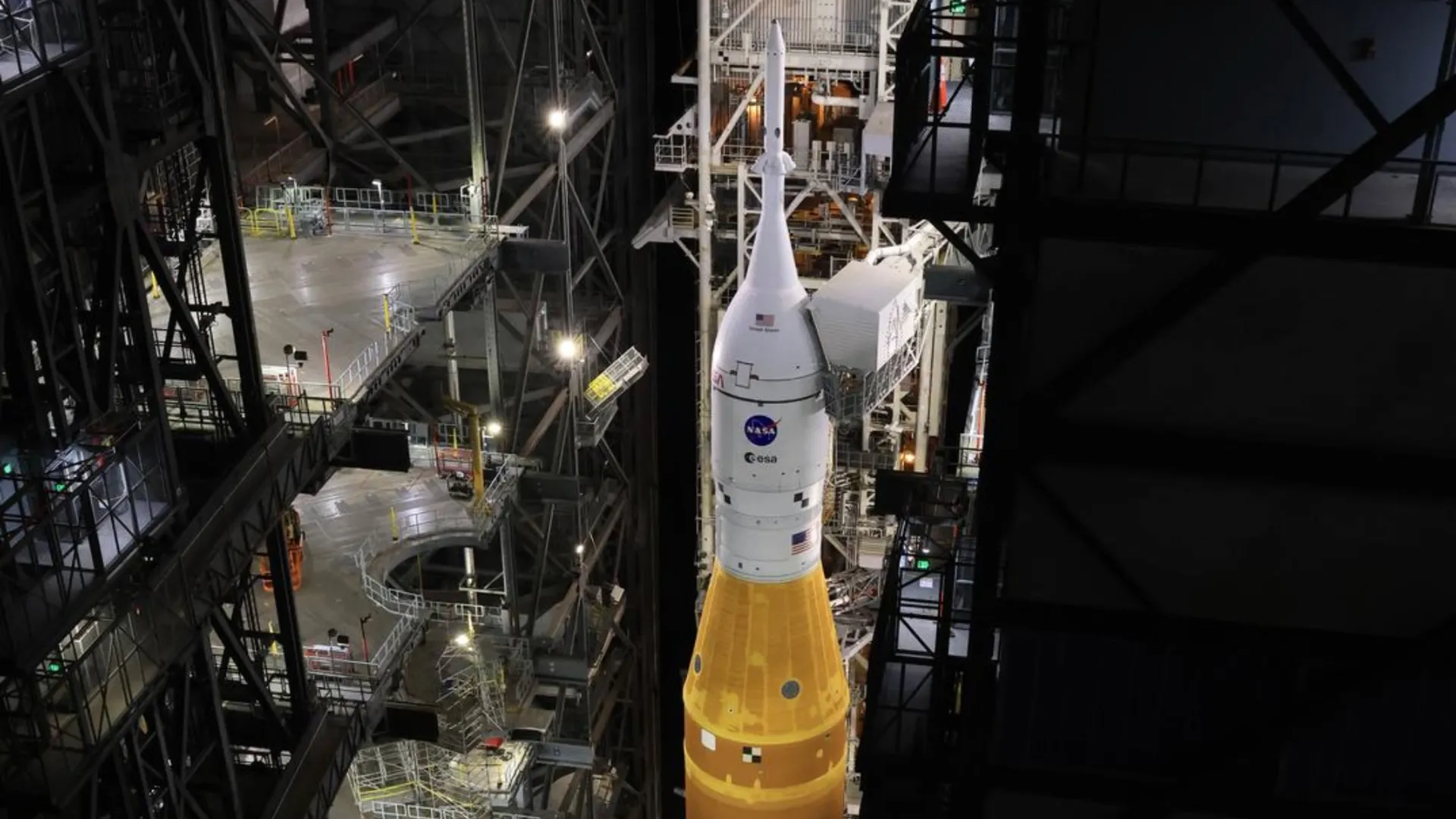
Artemis 2 managers met over the past two days, conducting the mission's flight readiness review (FRR) ahead of rolling its Space Launch System (SLS) rocket and Orion capsule back to the launch pad for liftoff. Repairs to the SLS were recently completed inside the Vehicle Assembly Building (VAB) at NASA's Kennedy Space Center (KSC) in Florida, where ground teams will now prepare the vehicle for transportation to KSC's Launch Complex-39B.
That rollout is now scheduled for March 19, with NASA targeting a launch as soon as April 1, agency officials announced today (March 12).
"During the flight readiness review, we had extremely thorough discussions — very open, transparent," Lori Glaze, NASA's Exploration Systems Development acting associate administrator, said during a post-FRR press briefing today. It's a short timeline, but NASA officials say they're putting safety first as they work toward their next launch opportunity.
"We talked a lot about our risk posture and how we're mitigating those risks," Glaze said. "We reviewed the challenges that we've had and how we've addressed them, and we talked about the work that remains, what's left to do, and how we're going to get through all of that."
Artemis 2 is NASA's first crewed mission to the moon in more than 50 years. It will launch NASA astronauts Reid Wiseman, Victor Glover and Christina Koch, as well as Canadian astronaut Jeremy Hansen, on a 10-day journey around the moon and back to Earth aboard the Orion spacecraft.
Their mission had been scheduled to get off the ground earlier this month. SLS had a shaky initial fueling test during the rocket's first "wet dress rehearsal" (WDR) countdown simulation but successfully completed that procedure during a second attempt in February. Procedures following that WDR, though, uncovered a disruption with the flow of helium in the SLS upper stage, which prompted a Feb. 25 rollback to the VAB for repair.
Once back in its hangar, NASA engineers diagnosed and addressed the issue with enough confidence to target Artemis 2's April launch opportunity. The problem was traced to a quick-disconnect (QD) seal on SLS' upper stage. The QD is the interface where umbilicals from the rocket's launch tower transfer fuel into the vehicle. A similar problem led to an aborted countdown during the first Artemis 2 WDR, when hydrogen was detected leaking from a QD on the SLS first stage.
"Our combined engineering teams across our ground systems and SLS teams came up with a design fix. That design fix was implemented on a test article, and we have successfully tested it, and we have qualified it for use on Artemis 2, and the modified QD is already on the upper stage," Exploration Ground Systems Program Manager Shawn Quinn said during today's briefing.
Now, NASA officials are confident the rocket will be ready to launch as soon as April 1.
Helium is used to maintain certain environmental systems and to pressurize SLS' propellant tanks. But the flow issue was found after the completion of the second Artemis 2 WDR and did not interfere with its success. That issue is now resolved, and NASA officials determined that a third fueling test won't be needed after the Artemis 2 stack makes it back to the pad. Instead, the mission will progress straight to its launch opportunity.
"Every time we tank the vehicle, it takes a little bit of the life out of those tanks," Glaze told Space.com during today's briefing.
"We've exercised the team. We've exercised the hardware, and I'll just tell you, from my perspective, when we tank the vehicle the very next time, I would like it to be on a day that we could actually launch," she added. "I want to be able to poll 'go' to launch."
As its name suggests, Artemis 2 will be the second mission of NASA's Artemis program — but it's the first to fly a crew aboard Orion. An uncrewed Orion capsule launched on Artemis 1 in November 2022 to certify the spacecraft's flight systems in lunar orbit. Now, Artemis 2 will verify the capsule's ability to support astronauts in deep space.
Ultimately, the goal of NASA's Artemis program is to establish a sustained presence on and around the moon. The agency hopes that doing so will build up the skills and knowledge needed to set up a crewed outpost on Mars, which it hopes to do in the 2040s. Artemis 2 was originally designed as a precursor to the program's first moon landing on Artemis 3 in 2028, but a recent shakeup has restructured NASA's plans.


Artemis 2's mission remains unchanged: fly a single figure-eight loop around the moon and back to Earth. The roadmap for missions after that, however, has shifted slightly. Artemis 3 will no longer land on the moon. Instead, that mission will focus on rendezvous and docking maneuvers between Orion and SpaceX's Starship lunar lander and/or Blue Origin's Blue Moon lander. Both of those private vehicles won NASA Human Landing System contracts to provide landing services for future Artemis missions, and the space agency has indicated a willingness to fly with whatever spacecraft can be ready in time.
With the new timelines, NASA hasn't pushed its 2028 goal to put boots on the lunar surface. But it has shifted the program's first lunar landing to Artemis 4 and aims to accomplish the same with Artemis 5 within less than a year of its predecessor.
If Artemis 2 cannot launch on April 1, NASA has other opportunities from April 2 to April 6, with another window opening April 30 and possibly extending into May.