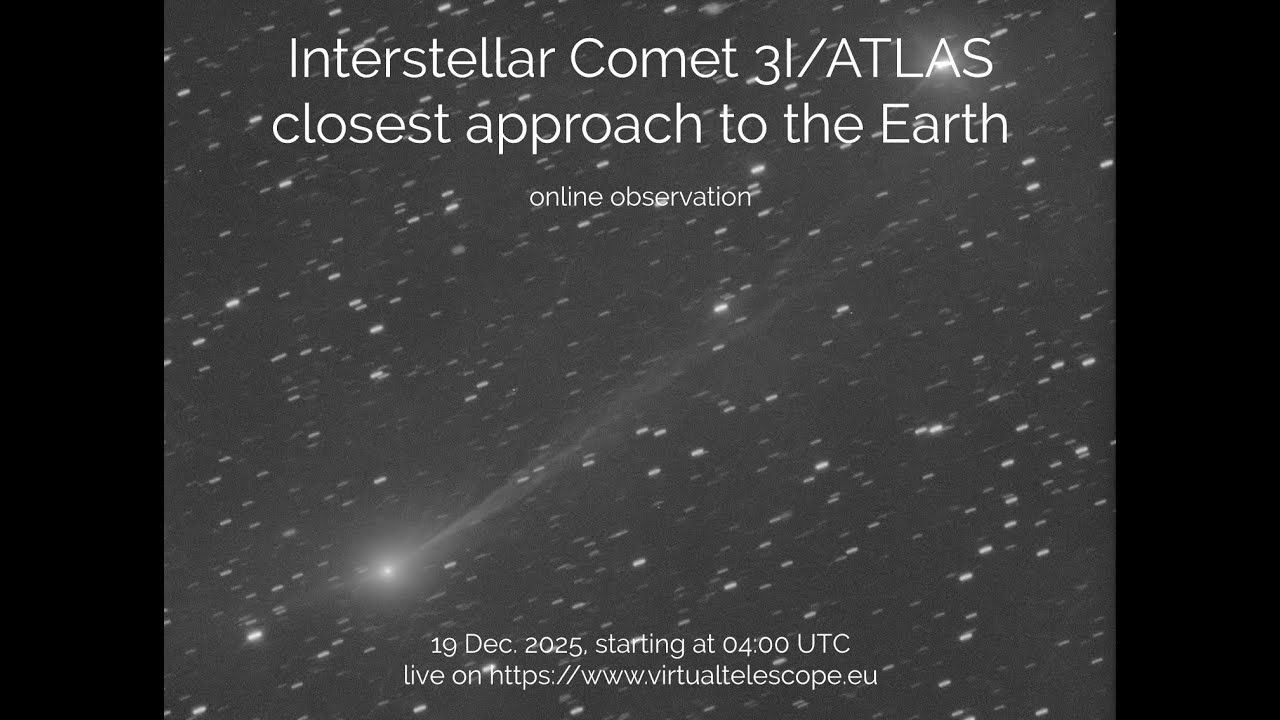
Eager skywatchers will soon have front-row seats to a rare cosmic encounter as interstellar comet 3I/ATLAS makes its closest approach to Earth, and you can watch it happen live online tonight!
The Virtual Telescope Project will host a free livestream starting at 11 p.m. EST on Dec. 19 (0400 GMT on Dec. 20), sharing real-time telescope views of comet 3I/ATLAS captured by its robotic observatories in Manciano, Italy, weather permitting.
Comet 3I/ATLAS made its closest approach to Earth at 1 a.m. EST (0600 GMT) on Dec. 19. At that time, it was about 1.8 astronomical units away — roughly 168 million miles (270 million kilometers), nearly twice the average distance between Earth and the sun.

Discovered in July 2025 by the ATLAS (Asteroid Terrestrial-impact Last Alert System) survey, 3I/ATLAS quickly captured the attention of both scientists and the public. It is only the third confirmed interstellar object ever detected passing through our solar system, following 1I/'Oumuamua in 2017 and 2I/Borisov in 2019. Researchers are especially interested in its composition and behavior, which could offer rare clues about how planetary systems form around other stars.
The comet is too faint to be seen with the naked eye and will be challenging even for small backyard telescopes. Under dark skies, observers with a telescope of 8 inches or larger may be able to spot it as a faint, fuzzy patch of light. If you're unable to look for the comet in person, you can sit back, relax and enjoy the view from the comfort of your own home via the livestream.
Editor's note: This article was updated Dec. 18 at 11 p.m. EST to notify readers that the livestream of interstellar comet 3I/ATLAS by the Virtual Telescope Project has been postponed one day due to rain at the observing site. It is now scheduled for Friday, Dec. 19, at 11 p.m. EST (0400 GMT).