





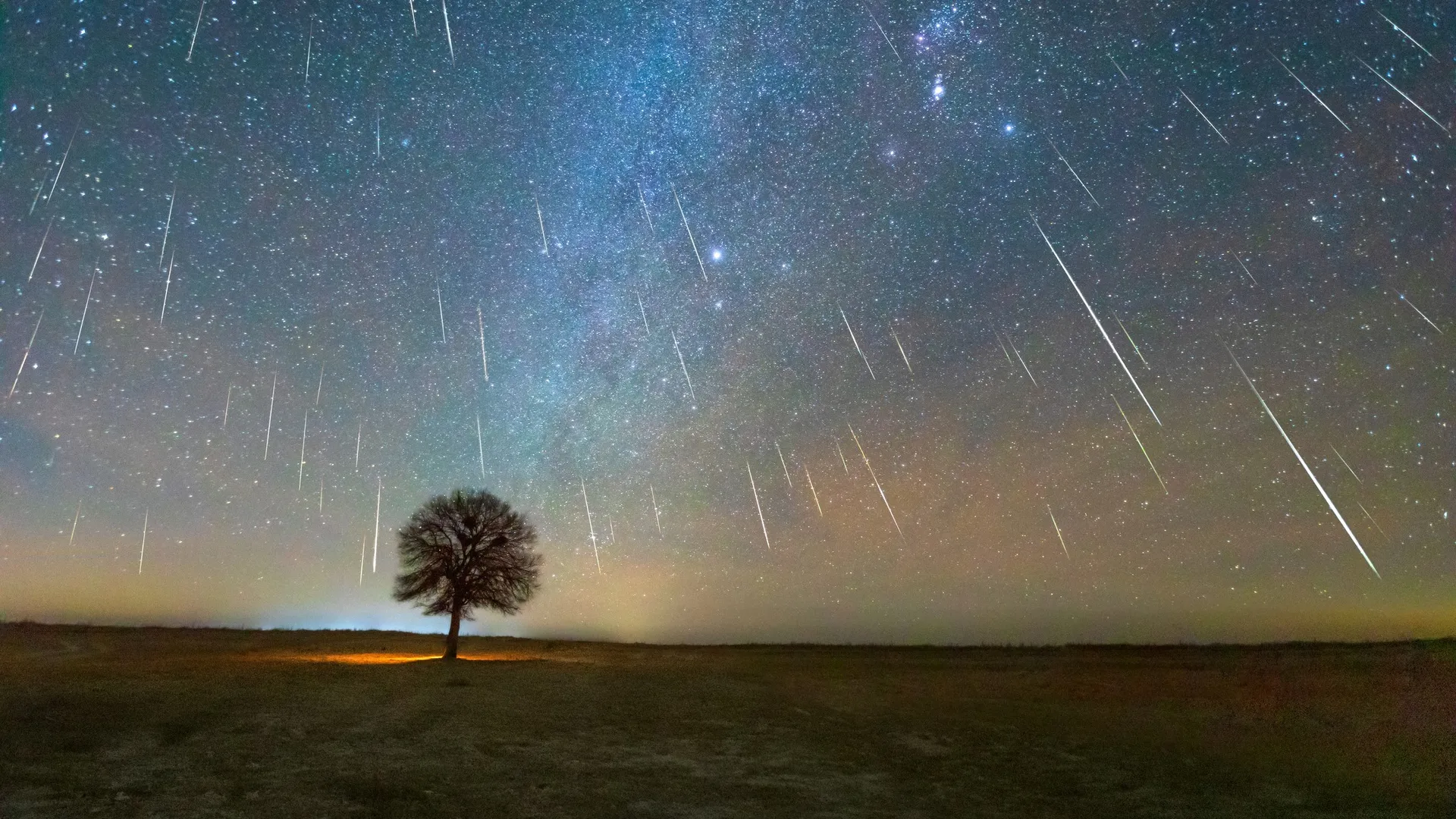
The Geminid meteor shower peaks overnight Dec. 13-14, 2026. The shower is active between Dec. 4 and Dec. 20 each year.
This year, moonlight shouldn't interfere too much with Geminid meteor hunting. A waxing crescent moon will be present during the shower's peak, but it will set early in the evening, leaving dark skies for skywatchers to enjoy one of the year's best meteor showers.
Unlike most meteor showers we see on Earth, the Geminids originate from an asteroid rather than a comet. The reliable shower produces bright meteors associated with the asteroid Phaethon, a strange bluish asteroid that displays some comet-like behavior.

Daisy joined Space.com in Feb. 2022. Before that, she worked as a staff writer for our sister publication All About Space magazine. Daisy has written numerous articles and guides for notable skywatching events, including our upcoming meteor shower guide, the next solar eclipse guide and the next lunar eclipse guide.
The Geminids are considered one of the best meteor showers of the year because they reliably produce bright, colorful meteors, sometimes in impressive numbers.
The Geminid meteor shower was first recorded in 1833, when observers spotted the display from a riverboat on the Mississippi River. Since then, the shower has grown considerably stronger, developing from a relatively modest display into one of the most prolific annual showers.
The uptick in activity is because Jupiter's gravity has tugged the stream of particles from the shower's source, the asteroid 3200 Phaethon, closer to Earth over the centuries, according to a statement from NASA astronomer Bill Cooke during a "NASA Chats" discussion.
Where can you see the Geminid meteor shower?
Right ascension: 7 hours
Declination: 20 degrees
Visible between: Latitudes 90 degrees and minus 60 degrees
Although it is best visible from the Northern Hemisphere, Geminid meteors can also be spotted from the Southern Hemisphere. Meteor showers are named after the constellation from which the meteors appear to emanate, known as the radiant. From Earth's perspective, the Geminid meteor shower appears to originate from approximately the direction of the Gemini constellation.
Gemini is fairly easy to spot in the night sky as it is located northeast of the constellation Orion, between the Taurus and Cancer constellations. The two brightest stars in the constellation, Castor and Pollux, represent the heads of the Gemini twins.
But don't look directly at Gemini to find Geminid meteors, as the shooting stars will be visible across the night sky. Make sure to move your gaze around the nearby constellations, as meteors closer to the radiant have shorter trains and are more difficult to spot. If you only look at Gemini, you might miss the more spectacular Geminids.
Related: The greatest meteor storms of all time

How to see the Geminid meteor shower
To see the Geminid meteor shower at its best, go to the darkest possible location, lean back and relax. You don't need any special equipment like telescopes or binoculars as the secret is to take in as much sky as possible and allow at least 30 minutes for your eyes to adjust to the dark. Avoid using your phone and make sure you have the red light setting on flashlights to preserve your night vision.
If you want more advice on how to photograph the Geminids, check out our how to photograph meteors and meteor showers guide and if you need imaging gear, consider our best cameras for astrophotography and best lenses for astrophotography.
What time is the Geminid meteor shower?
You can watch for Geminid meteors all night on Dec. 13 through Dec. 14 as the shower's radiant rises in the mid-evening. If you can't make it out for Dec. 13, the days before and after the peak are also worth trying.
While moonlight won't interfere too much with Geminid hunting efforts this year, you can still calculate sunrise and moonrise times in your location with this custom sunrise-sunset calculator.
Where do Geminid meteors come from?

The Geminids are associated with near-Earth object 3200 Phaethon, but exactly how this unusual object produced the vast stream of debris responsible for the meteor shower remains a mystery. Scientists have suggested that the asteroid may have once collided with another object, releasing large amounts of material into space.
3200 Phaethon orbits the sun every 1.4 years. When Earth passes through the debris left behind by Phaethon, the "asteroid crumbs" heat up as they enter Earth's atmosphere and burn up in bright bursts of light.
Editor's note: If you capture an amazing view of the Geminid meteor shower or any other night sky view that you would like to share with Space.com for a possible story or gallery, send images and comments to: spacephotos@space.com.