The October full moon reaches peak illumination at 12:11 a.m. EDT (0411 GMT) on Oct. 26, when the moon shines opposite the sun in Earth's sky and appears fully lit from our perspective.
October's full moon is traditionally known as the Hunter's moon, because it rises around the time when farmers have reaped the fields, making it easier for hunters to spot and catch animals to prepare food for winter, according to the Old Farmer's Almanac.
It's a stunning opportunity to see the entire Earth-facing lunar disk laid bare before the shadowy terminator returns to hide its eastern limb from view.
When to see the October full moon
The Hunter's Moon stalks into the eastern sky at sunset on Oct. 25, when you may see it turn a subtle yellow-orange hue, as the blue wavelengths of sunlight reflected off its surface are scattered while passing through the dense layer of atmosphere close to the horizon.
You may think the lunar disk is particularly big around moonrise, but it's actually the same angular size as when it appears directly overhead. What you're seeing is a phenomenon called the "Moon Illusion," wherein our brains trick us into thinking the moon is larger than it is while close to the horizon, with foreground objects for reference.

The table below details local full moon timings for when the moon is 100% illuminated for a selection of cities spread across the globe (local moonset and moonrise times will vary based on your location):
Local full moon timings for October 2026
City |
Local time |
|---|---|
New York |
12:11 a.m. EDT on Oct. 26 |
London |
4:11 a.m. GMT on Oct. 26 |
Beijing |
12:11 p.m. CST on Oct. 26 |
Tokyo |
1:11 p.m. JST on Oct. 26 |
Sydney |
3:11 p.m. AEDT on Oct. 26 |
Why it's called the Hunter's Moon
The October full moon is commonly known as the Hunter's Moon because it traditionally rises around the time that hunters would take to the newly harvested fields to catch animals to prepare as food for the winter. Its light also allowed the hunters to pursue their quarry long into the night, per the Old Farmer's Almanac.
Native American peoples also had their own names for the October moon. To the Cree it is the "Migrating Moon", after the southward journey taken by many birds around the time of its appearance, while the Ojibwe and Haida know it as the Ice Moon, or Freezing Moon.

It's also known as the "Seed Fall Moon" by the Celtic people of central and western Europe and as the Sanguine or Blood Moon by some who hold pagan beliefs, according to Time and Date.
The rising of October's full moon also coincides with Kojagiri Purnima, when Hindu worshippers honor the goddess Lakshmi. The word "Kojagiri" translates to "who is awake", which is reflected in the mode of worship by devotees who fast and stay awake to seek blessings of prosperity from the deity.
What else to see in the sky around the full moon
Light cast by the Hunter's Moon will drown out all but the brightest stars and planets when it rises over the eastern horizon at sunset on Oct. 25. Viewers in the U.S. will see the ringed giant Saturn appear as a bright point of light a little over 20 degrees to the south.
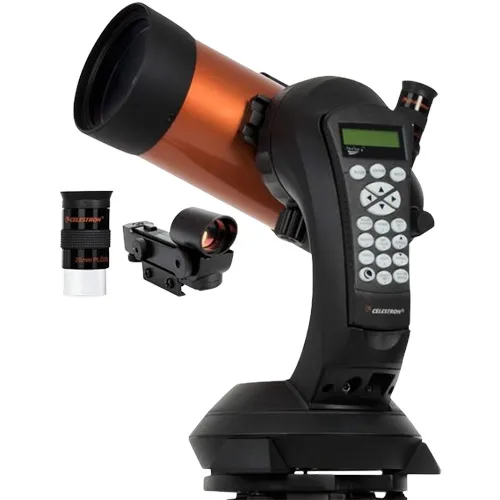
This is a fantastic go-to telescope with a 4-inch aperture that can help you quickly find a steady view of the moon. For a closer look at craters and the terminator, make sure to grab a 9mm or 12mm eyepiece and get stronger magnification.
Wait until the sun is safely below the horizon before viewing Saturn with a telescope. You can discover the exact timings for sunset for your location on Time and Date.
A 6-inch telescope can help reveal the gas giant's iconic ring system — still relatively narrow from our perspective following its March 2025 ring plane crossing, when they appeared edge-on to Earth. Increasing the aperture to 8 inches will help reveal Saturn's brightest moons, which will appear as subtly moving star-like points around the planet's disk.
The diamond-star formation of the Great Square of Pegasus will be visible glowing above Saturn, while Capella — the sixth brightest star in Earth's night sky — can be found rising about an hour after sunset to the northeast.

Finally, look halfway up the southeastern sky in the predawn hours of Oct. 26 to find Jupiter shining between the red light of Mars and the blue-white glow of Regulus — the quadruple star system that forms the point of the reverse question mark star formation in the constellation Leo.
Over the course of the night, the Hunter's Moon will appear to drift farther away from Saturn while silently leaving the constellation Pisces behind in favor of the constellation Aries, ahead of a dramatic occultation of the Pleiades open star cluster on Oct. 27.
Observing tips
October's full moon phase is a great time to photograph the lunar disk using a DSLR camera and a telephoto lens, as its surface is temporarily free from the shadows that mark it during the surrounding moon phases. Be sure to make use of our expert guide to photographing the moon, along with our picks of the best cameras and lenses for astrophotography, if you want to upgrade your equipment.
- Use a tripod to keep your camera as steady as possible.
- Use a remote shutter/timer to prevent camera wobble.
- A smartphone stargazing app can help you find the exact point of moonrise on your local horizon.
- A lens with a focal length of 12-50 mm is useful for landscape photography, while a focal length of at least 400 mm is advised for capturing more detailed views of the lunar surface.
- The moon can be made to appear particularly large while close to the horizon next to foreground objects, where it may take on an orange-yellow appearance thanks to Rayleigh scattering. A cleaner, more "classic" view can be captured as it soars high overhead.
Upcoming full moons
Month |
Full moon name |
Date and time |
|---|---|---|
November |
Beaver Moon |
9:53 a.m. EST (1453 GMT) on Nov. 24 |
December |
Cold Moon |
8:28 p.m. EST on Dec. 23 (0128 GMT on Dec. 24) |
January |
Wolf Moon |
5:02 a.m. EST (1002 GMT) on Jan. 3, 2027 |
These times mark the exact instant of full illumination. Your own moonrise or moonset may be hours earlier or later, depending on your location. For the best viewing plan, use an app such as Stellarium or SkySafari 7 Pro to find your local moonrise time and be sure to read our full moon calendar for comprehensive timings for each full moon in 2026.
Editor's Note: If you would like to share your full moon photos with Space.com's readers, then please send your photo(s) along with your name, the location and any comments on what it was like to capture the picture to spacephotos@space.com.