





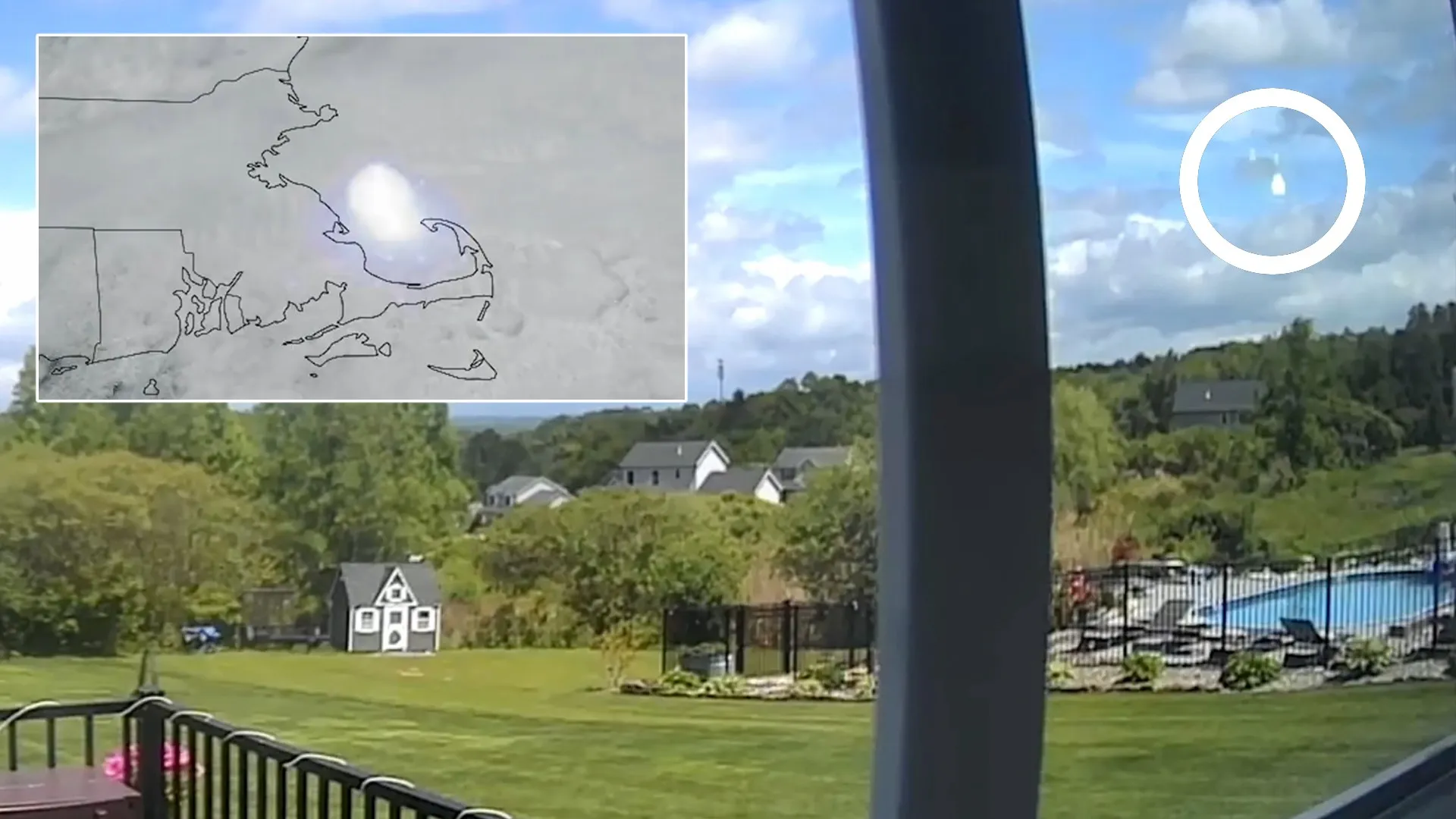
Thanks to a combination of radar, infrasound, dash-cam and security camera footage, astronomers have tracked the bright daytime meteor that fell over Cape Cod Bay in May 2026 back to its origin as a small asteroid perturbed by Jupiter and sent on a comet-like orbit towards Earth.
Meteor fireballs visible in the daytime are referred to as 'bolides'. At 1:06 p.m. local time (18:06 UTC) on May 30, 2026 one such bolide was widely witnessed falling out of the sky over coastal Massachusetts, with members of the public also reporting an associated sonic boom that rumbled across the north-eastern coast of the United States.
Now, a team of scientists from Europe and the United States, led by space physicist Juha Vierinen of the Arctic University of Norway in Tromsø, have patched together measurements from a meteor-observing radar network, regular weather radar, infrasound stations and camera footage to fully characterize the fall of this meteoroid and trace its orbit around the sun.
Key to these observations were measurements by the Spread Spectrum Interferometric Meteor Observing Network (SIMONe) based at the Massachusetts Institute of Technology's (MIT's) Haystack Observatory. SIMONe is a project jointly developed by MIT, the Arctic University of Norway and the Leibniz Institute of Atmospheric Physics in Kühlungsborn, Germany.
"We were fortunate that the event occurred within the coverage of SIMONe," Vierinen told Space.com.
This is echoed by Ryan Volz, a radio scientist at Haystack Observatory who is a member of the team who studied the May 30 bolide. "We got pretty lucky to observe this one," Volz told Space.com. "A bolide like this would have to enter the atmosphere within about 62 miles (100 kilometers) of a SIMONe-like meteor radar system for the head echoes we saw to be detectable, and there are only a handful of places in the world that currently meet that criteria."
A head echo is what radar sees when a meteoroid – what we call the lump of rock that becomes a meteor while it is still in space – enters Earth's atmosphere, generating a cloud of plasma around it as it superheats the atmosphere and its outer surface.
"The head echoes give the best constraints on the meteoroid's trajectory," said Volz.
The existence of the head echo is usually very brief, taking place at 56 miles (90 kilometers () altitude down to about 44 miles (71 kilometers) when the plasma around the meteoroid is dense enough to return a radar echo. The head echo transitions into a 'trail echo', which is produced by a streak of turbulent plasma that is left in the wake of the meteoroid after it has passed through a given part of the atmosphere.
In the case of the 30 May bolide, the trail echo was detected down to an unusually low altitude of 20 miles (32 kilometers), at which point the falling rock fragmented with an explosive force equivalent to 500 tons of TNT, whereas the total impact energy of the bolide was in the region on 1.1 kilotons of TNT. Only three recorded bolides around the world had a greater impact energy in the year before (2025), giving an indication of how rare such events are.
At this point, four of the Next Generation Weather Radars (NEXRAD) jointly operated by the National Weather Service, the Federal Aviation Administration and the U.S. Air Force took over, recording the debris from the fragmentation as solid chunks of rock fell as meteorites into Cape Cod Bay.
The radar detections were supported by infrasound readings of the atmospheric pressure waves resulting from the hypervelocity fall and break-up of the object. These pressure waves can travel hundreds or thousands of kilometers and were picked up by the Elginfield Infrasound Array (ELFO) in Ontario, Canada, as well as by citizen scientists operating their own Raspberry Shake/Boom pressure sensors, which are build-your-own micro-barometers produced by the Raspberry Pi Foundation.
"Six citizen-operated sensors jointly constrained the arrival direction," said Vierinen. "Five other single-station detections and ELFO supplied the signal periods used to estimate the energy release. We are grateful to the citizen scientists whose measurements expanded the coverage and helped locate the event."
From the data gathered, the team were able to deduce certain properties about the object that fell to Earth over Massachusetts. The meteoroid that entered the atmosphere was about a meter (approximately three feet) across, and based on how deep it penetrated into the atmosphere before fragmenting it must have been a pretty solid body, possibly rich in iron.
"We cannot determine its exact history, but we found no association with any known meteor shower," said Vierinen.
Extrapolating its trajectory back into space, the team found that the meteoroid had a comet-like elongated orbit around the sun that took it almost as far out as Jupiter. Comets on such orbits are referred to as Jupiter-family comets, since their orbits are governed by perturbations from Jupiter's powerful gravitational influence.
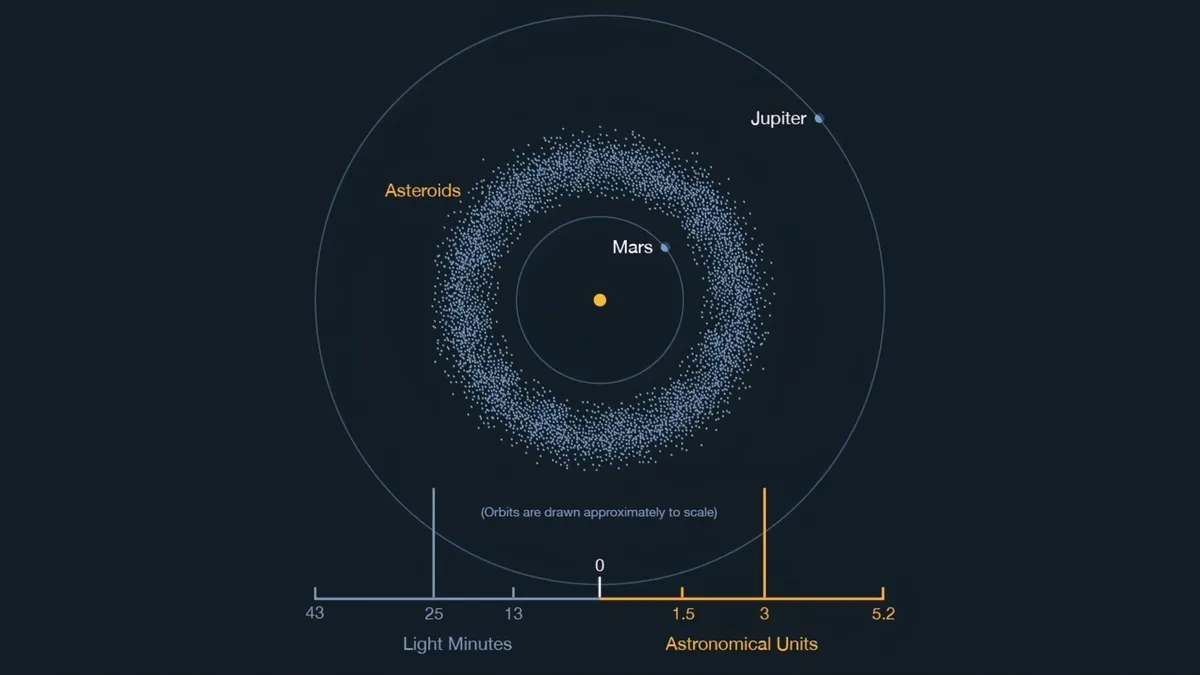
However, the meteoroid was definitely not a comet, and previous research has found that Jupiter can draw out small asteroids from the main asteroid belt between Mars and Jupiter and place them on such orbits.
"Meteoroids can be perturbed by other bodies including Jupiter," team-member Marc Fries told Space.com. "The meteoroid's aphelion – the point where it is farthest from the sun – is close to Jupiter's orbit, which suggests a close pass by the gas giant may have indeed flung it into its recent Earth-crossing path. This same process has slowly depopulated the asteroid belt throughout the solar system's history."
Meteoroids on meter-sized scales are in something of a black spot – they are not very easy to detect in space from Earth unlike larger asteroids, and they are not common enough to be falling to Earth all the time unlike the pebble-sized meteoroids and smaller that burn up as shooting stars. As such, we know relatively little about this population of bodies and every bolide that we see helps us to learn more.
"Every new piece of data we glean about Earth impactors adds to the statistics," said Fries. "It is especially helpful to have measurements of total power, location, originating orbit and similar data points for the more massive meteorites, because those are the meteoroids and asteroids we encounter less frequently."
That the meteoroid fell over such a highly populated area was a stroke of luck. Although the atmosphere is carefully monitored on a global basis by both ground stations and satellites high above us, meaning that even if a meteor streaks above an uninhabited area there is usually enough data to narrow down its trajectory somewhat, radar observations are able to do so more accurately.
"We would love to have global coverage with meteor radar networks and we and others are making progress with SIMONe and similar systems, but the current coverage is still sparse," said Volz.
Nevertheless, the Cape Cod bolide resoundingly shows that by combining radar echoes from head and trail plasma with weather radar observations and ultrasound pulses from the break-up of falling rocks, scientists can ascertain the orbits of impacting meteoroids very accurately.
While the Cape Cod meteoroid was much smaller than the asteroid that exploded over Chelyabinsk in 2013, which was about 18 meters across and exploded with an energy equivalent to between 400 and 500 kilotons of TNT, being able to trace meteoroids back to their orbits may in future reveal new populations of potentially hazardous impactors.
The research into the Cape Cod bolide is available as a preprint on the arXiv server.