




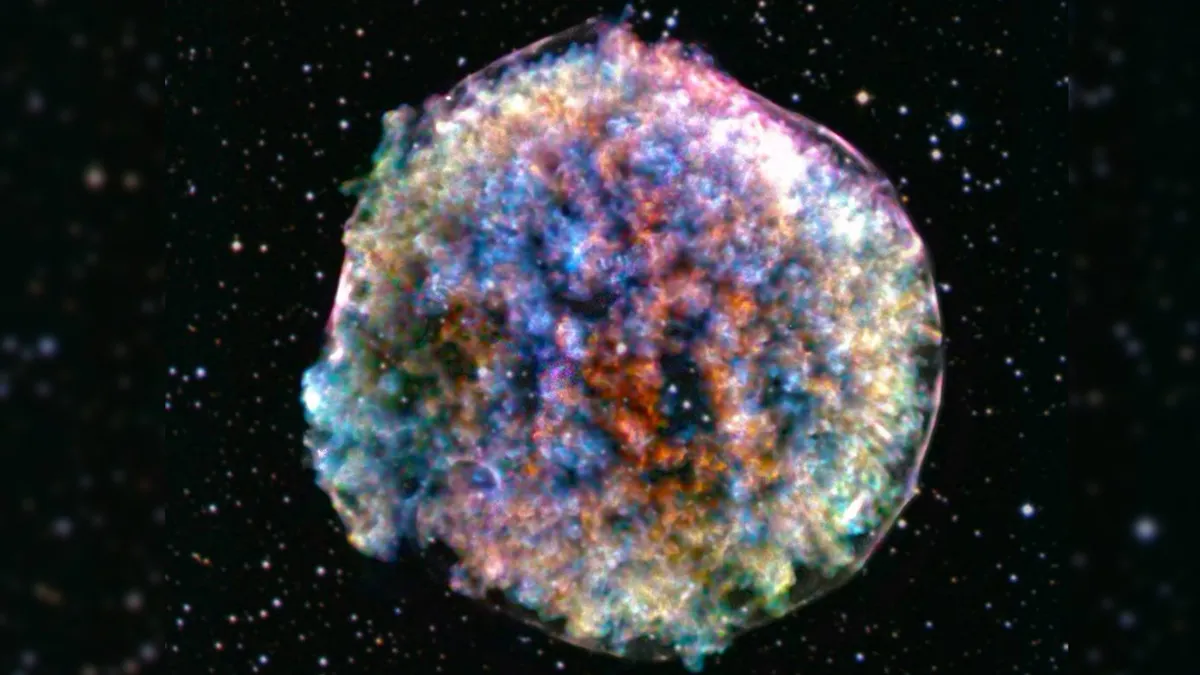
On Nov. 6, 1572, the German astronomer Wolfgang Schulër observed a supernova with his bare eyes. He spotted the exploding star in the constellation Cassiopeia. It was as bright as Venus and could even be seen during the day.
Astronomers were really confused, because it looked like a star just appeared out of nowhere. Schulër may have been the first to see it, but the Danish astronomer Tycho Brahe is widely credited for the discovery. Brahe studied it in detail and wrote a whole book about this so-called "new star." It then became known as "Tycho's Star."
At the time, supernovas had not yet been discovered. Tycho's Star was finally classified as a supernova in the 1940s. Scientists now think it was a small star called a white dwarf that exploded thousands of years ago. Because Tycho's Star is 13,000 light-years from Earth, it took a while before anyone could see it.
Why it mattered
The Tycho supernova, known technically as SN 1572, is known today as a Type Ia supernova, which is a star explosion in a binary star system in which a white dwarf star draws material away from its partner, then explodes. But in 1572, the Tycho supernova appeared as something very different: a bright new star.
While Schulër was first, other astronomers also observed the apparently new star in the sky. Tycho Brahe's numerous observations are the most well known, in no small part becuause he wrote a book all about them in "De Stella Nova" (Latin for "On The New Star." At the time, the prevailing theory among scientists was that the stars were unchanging, yet here was a new star -- a changed sky.
"The 16th century exploding star, which appeared in the constellation Cassiopeia, was seen in daylight for about two weeks, and remained visible to the naked eye for 16 months," the University of California Berkeley wrote in 2004. "Brahe's meticulous record of the brightening and dimming of the supernova now allows astronomers to identify its 'light signature" as that of a Type Ia supernova."
"This was at the end of the Dark Ages in Europe, and these observations were an important piece of evidence that the heavens were not immutable," astronomer Alex Filippenko, who led a 2004 study on the origins of the Tycho supernova, said at the time.
Today, astronomers are closely watching another star that might explode. Called T Corona Borealis, or the Blaze Star, the object is expected to be on the verge of exploding in a nova (a star explosion that is smaller than a supernova and may not destroy the star). is one of 11 known stars observed to have recurring nova explosions within gaps of 100 years or so.
Want more space history? Check out our full On This Day In Space Story archive and watch our On This Day In Space videos on YouTube.