





Another new private rocket is in the works.
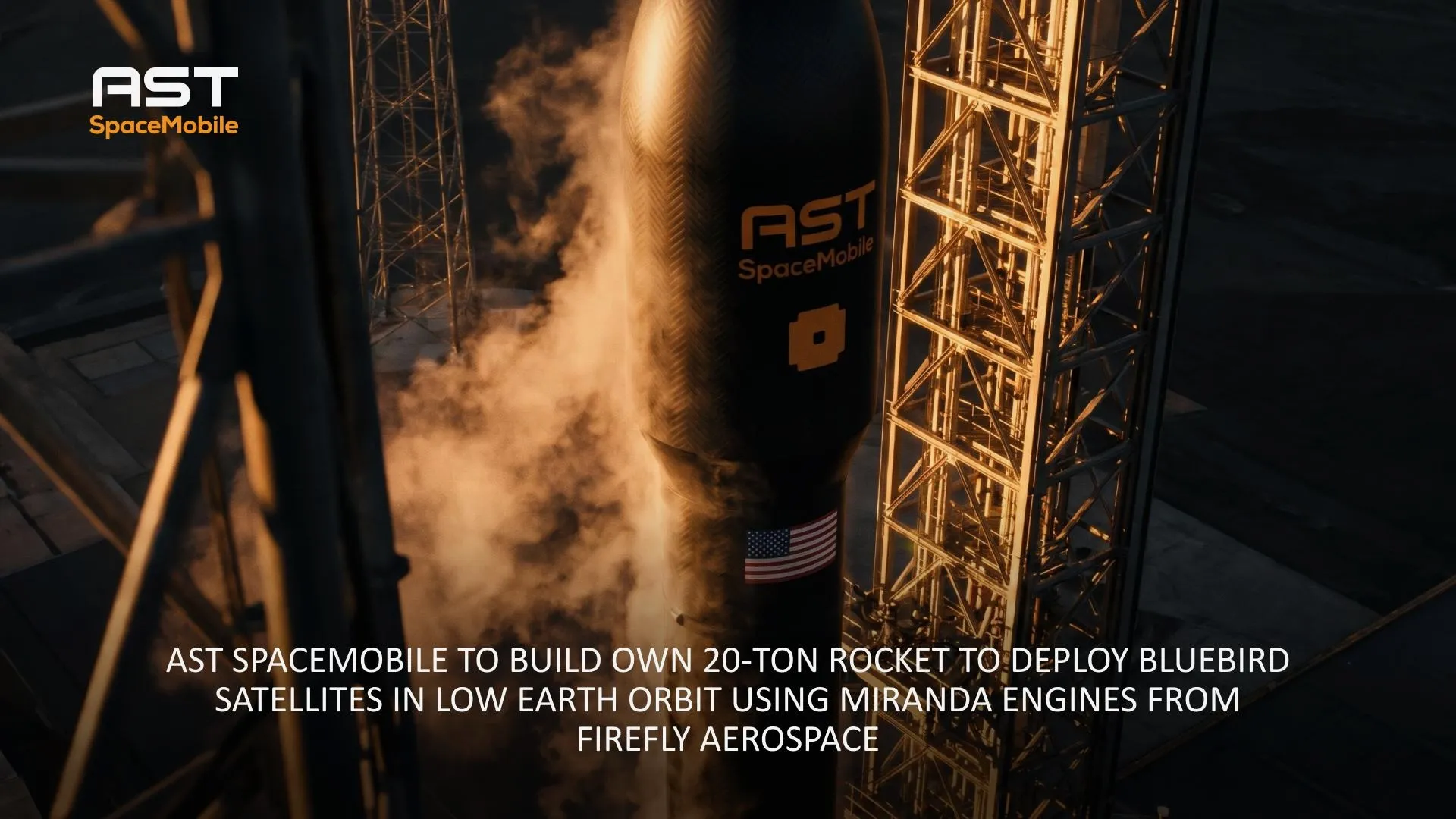
AST SpaceMobile announced today (Nov. 6) that it's building a reusable rocket called Blacklift to launch its broadband satellites to low Earth orbit (LEO), with first flight targeted in 2028.
The news comes just 10 days after Cowboy Space unveiled Big Iron, a rocket designed to launch its constellation of 20,000 AI data centers. Cowboy Space is also targeting 2028 for its first liftoff.
"The Blacklift rocket is the springboard to significantly expand our total addressable market, providing AST SpaceMobile with regular unconstrained access to orbit and providing for most favorable owners’ economics in the industry," Abel Avellan, the company's founder, chairman and CEO, said in a statement today.
"This will accelerate our mission to build a new layer of global connectivity, extending connectivity beyond terrestrial networks and helping to bring AI-enabled services wherever people live, work and travel," Avellan added.
Texas-based AST SpaceMobile is building a LEO constellation composed of its BlueBird satellites, which beam internet service directly to cell phones. The company has launched 13 BlueBirds to date, including eight "Block 2" variants. The antennas on each of these next-gen spacecraft cover a whopping 2,400 square feet (223 square m) — the largest ever deployed in LEO by a commercial satellite.
BlueBirds have flown atop three different rockets to date — SpaceX's Falcon 9, Blue Origin's New Glenn and India's Launch Vehicle Mark-3. But AST SpaceMobile wants to get more vertically integrated, which explains the push to develop Blacklift.
The company won't be starting from scratch. It has signed a deal with another Texas-based outfit, Firefly Aerospace, to provide the engines (and associated engineering services) for the first three Blacklift launches. After that, AST SpaceMobile will build the engines itself, under a licensing agreement with Firefly.
Those engines are Miranda, which will power Blacklift's booster, and Vira, which will power the upper stage.
Neither engine has flight experience. (Firefly's currently operational rocket, Alpha, uses Reavers in its booster and Lightnings in its upper stage.) But Miranda has been tested extensively on the ground, firing for more than 4,200 seconds over the course of 175 hot fires, according to AST SpaceMobile.
"The Miranda engine will allow us to leapfrog the traditional five-to-10-year development cycle as we build Blacklift," AST SpaceMobile President Scott Wisniewski said in the same statement.
The "supply and services" agreement for the first three launches is worth $500 million. The licensing agreement cost AST SpaceMobile about $800 million, with half of that paid in cash and half in stock, according to the statement.
Blacklift will be able to haul 20 tons to LEO. Each launch will therefore be able to loft up to five BlueBird satellites, according to today's announcement. (For perspective: The Falcon 9's LEO lift capacity is about 25 tons.)
BlueBirds will continue going up while AST SpaceMobile gets Blacklift ready to fly: The company already holds contracts with other providers to launch more than 100 of the satellites over the course of 2027 and 2028.
The launch landscape will likely be very different when Blacklift, Big Iron and other new rockets come online. SpaceX has said that it plans to phase out the Falcon 9, as well as its Falcon Heavy heavy lifter, after its Starship megarocket gets up and running.
That milestone could come in the next few years, ushering in something of a launch crunch for satellite operators. SpaceX has indicated that it will prioritize launches of its own satellites with Starship. And there will be a lot of them to loft — 100,000 Starlink V3 satellites and a million Starmind AI data centers, company founder and CEO Elon Musk has suggested.