




On Nov. 5, 2002, NASA's old Galileo spacecraft was almost out of fuel. But the Jupiter mission still had some science to do. Galileo flew by a small moon called Amalthea. Amalthea is small, but it's interesting for scientists.
The Jupiter moon Amalthea is the reddest object in our solar system. It also generates more heat than it gets from the sun. Scientists think Amalthea creates electrical currents as it orbits in Jupiter's huge magnetic field. Near this little moon, strong radiation from Jupiter is dangerous for spacecraft.
The flyby caused some problems for Galileo. The spacecraft went into safe mode only 30 minutes after going past Amalthea. NASA said it was ready for problems, because Galileo was on its last legs, and the radiation near Amalthea was strong. However, NASA quickly fixed the problem and got Galileo working again.
Less than a year later, Galileo threw itself into Jupiter's atmosphere. The spacecraft was crushed by the high pressure in Jupiter's atmosphere, but its data still survives on Earth.
Why it mattered
The Galileo spacecraft was running on cosmic fumes by the time it reached Amalthea and the flyby would be the last time the probe would ever swing by one of Jupiter's moons.
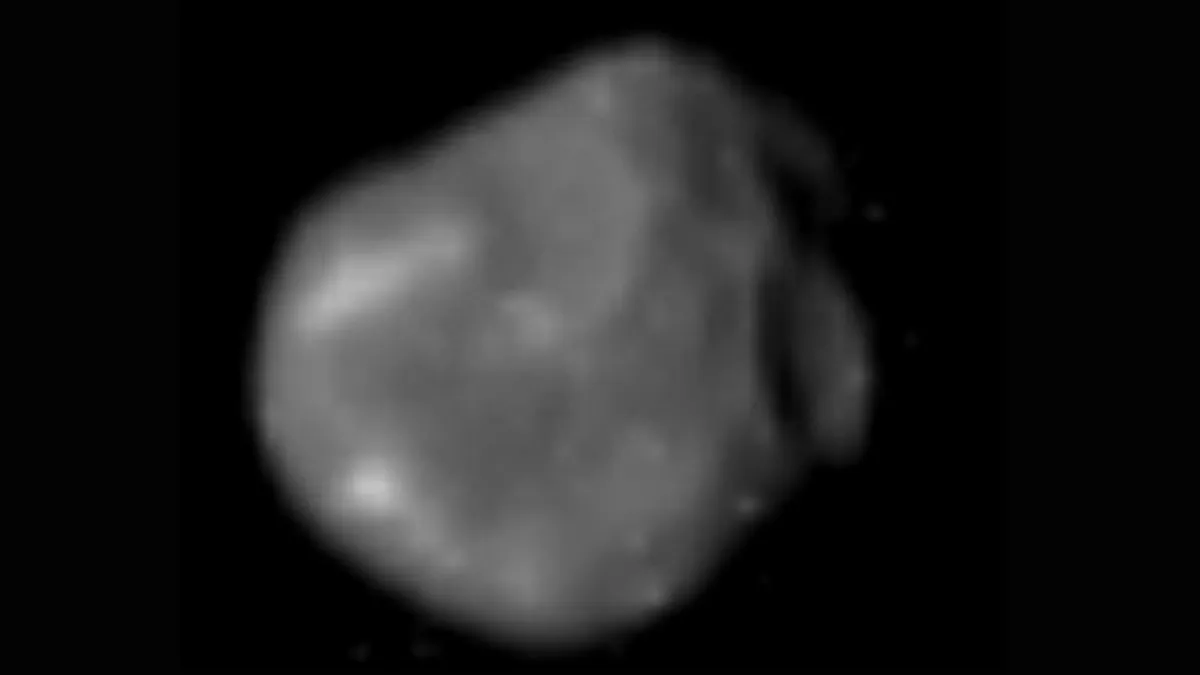
While it may not look like it in Galileo's black and white images above and below, Amalthea is tinted red due sulfur contamination on its surface. The moon is small, about 168 miles long, and orbits about 112,468 miles (181,000 km) from Jupiter (much closer to the planet than the Earth and its moon).
Galileo flew within 99 miles of Amalthea during its flyby, which also marked the closest Galileo would get to Jupiter before its death dive in September 2005.
"Scientists studying data from NASA's Galileo spacecraft have found that Jupiter's moon Amalthea is a pile of icy rubble less dense than water," NASA announced in May 2005
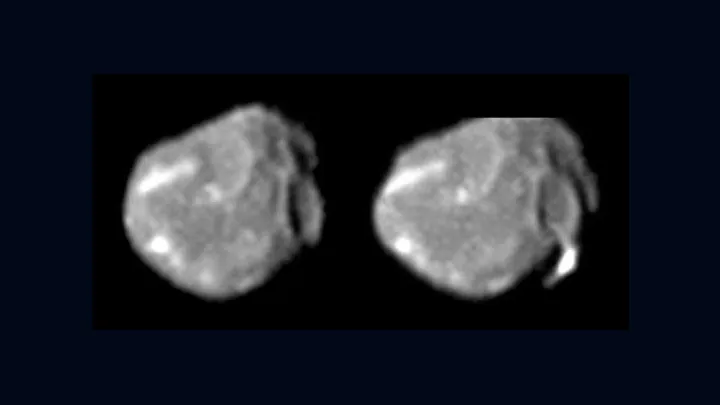


"Amalthea is throwing us a curve ball," Torrence Johnson, a study co-author on the Almathea flyby and project scientist for the Galileo mission at JPL, said in 2005. "Its density is well below that of water ice, and even with substantial porosity, Amalthea probably contains a lot of water ice, as well as rock."
Originally known as Jupiter V (because it was the fifth Jupiter moon discovered after the so-called Galilean moons Io, Europa, Ganymede, Callisto), Amalthea was named after naiad, or water nymph, from Greek mythology.
It is fitting that Amalthea was the last of Jupiter's moons to be visited by the Galileo spacecraft. The moon was also last Jupiter moon to be discovered by visual observations when it was first disovered by astronomer Edward Emerson Barnard in September 1892 using the Lick Observatory telescope in California.
The Galileo spacecraft ultimately crashed into Jupiter on Sept. 21, 2005, less than a year after its Amalthea flyby.
Want more space history? Check out our full On This Day In Space Story archive and watch our On This Day In Space videos on YouTube.