




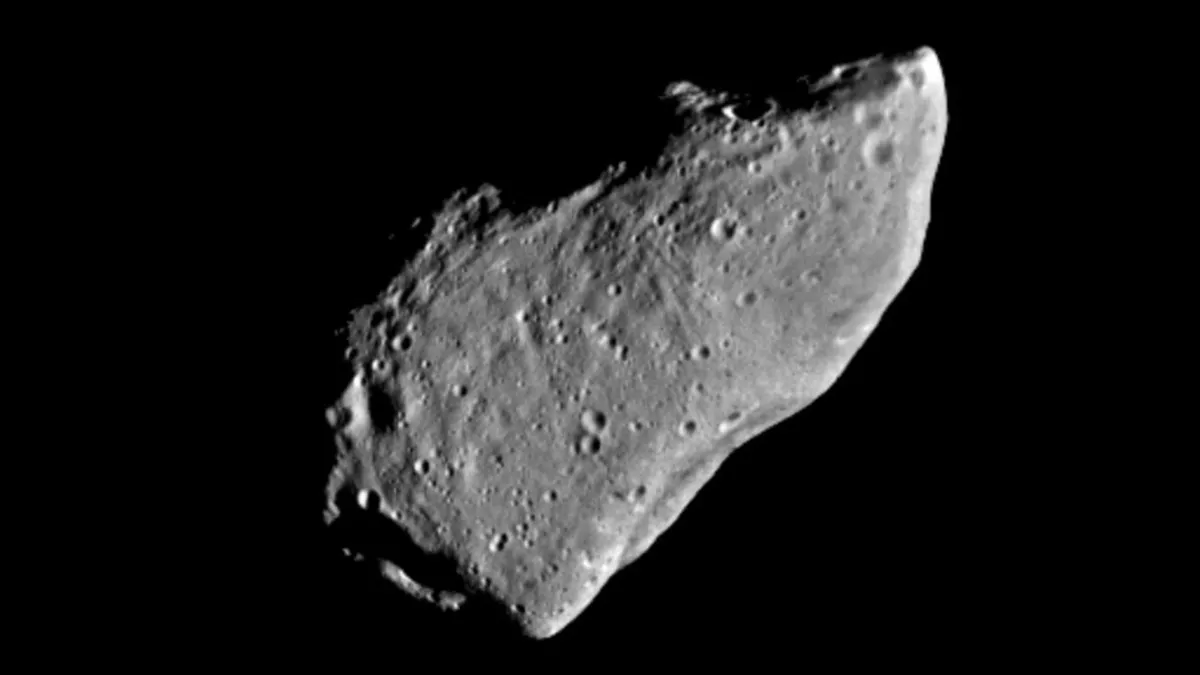
On Oct. 29, 1991, the Galileo spacecraft flew by the asteroid Gaspra on its way to Jupiter. Gaspra was the first asteroid to ever be visited by a spacecraft.
Gaspra orbits near the inner edge of the asteroid belt. The Galileo spacecraft had been travelling through the asteroid belt for about two months before it reached Gaspra. Galileo was 990 miles (1,593 kilometers) away from Gaspra when it whizzed by, and it was travelling at a relative speed of about 5 miles (8 km) per second.
The spacecraft took several photos of the asteroid and used an instrument called the Near-Infrared Mapping Spectrometer to study its chemical composition and other physical properties. Galileo determined that Gaspra has an irregular and elongated shape measuring about 12 miles long and 7 miles wide. The images revealed that Gaspra was also covered in craters. Because Galileo was too far away for Gaspra's gravity to affect it, the spacecraft was not able to determine the asteroid's mass.
Why it mattered
The Galileo spacecraft's flyby of Gaspra was a pitstop near the midpoint of its 6-year journey to Jupiter, the largest planet in our solar system. NASA launched Galileo toward Jupiter in October 1989, with the probe swinging by Venus and Earth in 1990 before its encounter with Gaspra.
The Gaspra flyby was the first asteroid flyby in history, with Galileo approaching to just under 1,000 miles (1,601 kilometers) while flying at a whopping 18,000 mph. Galileo's photos of Gaspra "revealed a cratered, complex, irregular body about 20 by 12 by 11 kilometers (12.4 by 7.4 by 6.8 miles), with a thin covering of dust and rubble," NASA wrote in an overview.
"The picture we get of Gaspra is one of something that has suffered a lot during its history," the UPI press service quoted Joseph Veverka, a Galileo imaging team member, as saying at the time. "We suspect that this is the survivor of a series of catastrophic collisions in the past."
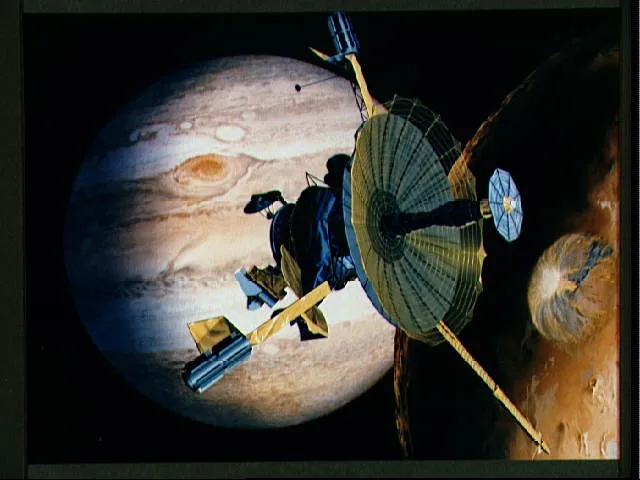
Galileo would go on to fly by Earth a second time in 1992, then swing close by the asteroid Ida in 1993 before finally arriving at Jupiter in 1995. Along the way, the probe was in the right place at the right time to watch as the Comet Shoemaker-Levy 9 broke into pieces and crashed into Jupiter in July 1994.
Since Galileo's historic first asteroid flyby, NASA and other space agencies have gone on to land on asteroids (like NEAR on asteroid Eros), collect samples of asteroids and return them to Earth (like NASA's OSIRIS-REx and Japan's Hayabusa probes), and have even intentionally crashed probes into asteroids (like NASA's DART asteroid impact mission) to test planetary protection techniques.
Want more space history? Check out our full On This Day In Space Story archive and watch our On This Day In Space videos on YouTube.