


On Sept. 11, 1985, the International Cometary Explorer, or "ICE," became the first spacecraft to fly by a comet.
Originally launched as the International Sun-Earth Explorer-3 in 1978, ICE was one of three spacecraft built for the International Sun-Earth Explorer (ISEE) program, a joint effort by NASA, the European Space Research Organization and the European Space Agency.
The program's purpose was to study space weather, or the interaction between the Earth's magnetic field and the solar wind. After completing its original mission, the spacecraft did a maneuver to steer it toward Comet Giacobini-Zinner. It flew straight through the comet's plasma tail, but it didn't stop there! Six months later, it flew by Halley's Comet, too.

Why it mattered
The International Cometary Explorer has gone down in history as a mission of epic firsts, many of which occured after it completed its primary mission.
As mentioned above, NASA, ESA and the European Space Research Organisation teamed up to build and launch the probe in 1978, when it was called the International Sun-Earth Explorer 3, or ISEE-3. The mission was the third of three to study the sun-Earth environment, with ISEE-3 aimed at studying energetic particles, electric and magnetic fields and the plasma environment. It carried 14 different instruments, including a solar wind detector and gear to measure cosmic rays, X-rays and gamma rays.
For its primary mission, ISEE-3 flew to the L1 Lagrange point about 1 million miles (1.5 million kilometers) from Earth on the sun-facing side and spent three years conducting science. It was the first spacecraft ever to orbit a Lagrange (or libration) point, NASA has said.
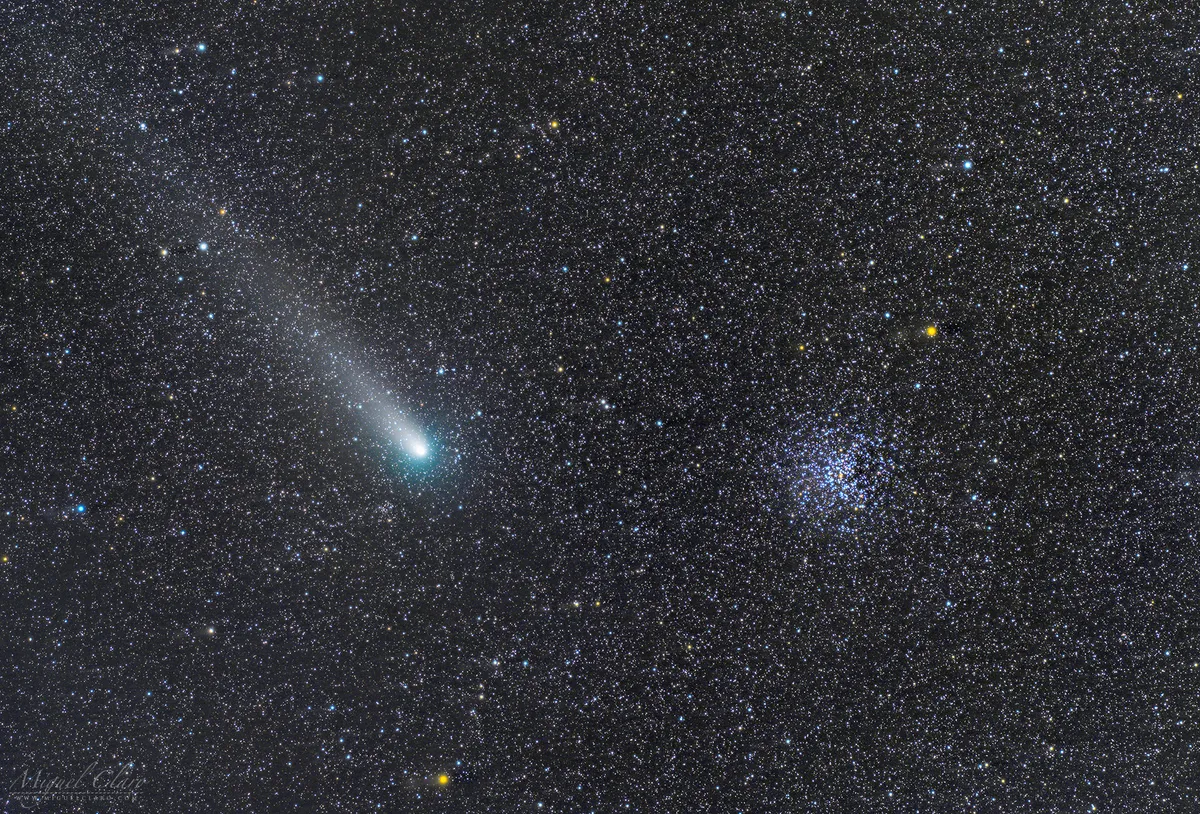
But it was in 1981, once ISEE-3's core mission was over, that things got interesting for comet fans. NASA scientists at Goddard Space Flight Center in Maryland decided to squeeze more science from the probe by sending it through Earth's magnetic tail (another first), and then on to visit a comet.
That began in 1982, with the probe firing its thrusters and performing five flybys of the moon to set course for Comet 21P/Giacobini-Zinner. It was only then, once ISEE-3 was on course for the comet, that it was renamed the International Cometary Explorer, or ICE.
On Sept. 11, 1985, the spacecraft flew within 4,885 miles (7,862 km) of Comet 21P, confirming many theories about comets (including that they are dirty "snowballs" of the solar system) and collected detailed data about its tail. It also took a long-distance look at Halley's Comet on March 28, 1986, when it passed by at a range of 25 million miles (just over 40 million km).
While NASA shut down the ICE/ISEE-3 mission in 1995, it saw renewed interest in 2014 when a group of independent scientists attempted to reactivate the probe when its orbit brought it near Earth in August 2014. At the time, the probe still had five operational instruments and an active transmitter that allowed NASA to track it across the solar system. The group raised $125,000 in crowdfunding to support their effort.
The science group managed to successfully fire ICE/ISEE-3's thrusters on July 2, 2014, but subsequent efforts failed and it flew past the moon and continued on its long orbit around the sun. It should return near Earth sometime in 2031, NASA has said.
A tragic day seen from space
Another major event occurred in space history on Sept. 11, this time in 2001.
On that day, NASA astronaut Frank Culbertson was the only American in space to see the tragic 9/11 terrorist attacks on New York City, Washington, D.C. and Pennsylvania as part of a three-man crew on the International Space Station.
Culbertson was commander of Expedition 3 to the ISS and led a crew that included Russian cosmonauts Vladimir Dezhurov and Mikhail Turin.
"I didn't know exactly what was happening, but I knew it was really bad because there was a big cloud of debris covering Manhattan," Culbertson said in a NASA video released in 2011. "That's when it really became painful, because it was like seeing a wound in the side of your country, of your family, your friends."
You can learn more about Culberton's observations of the 9/11 attacks from space at NASA's Remembering 9/11 site here.
Want more space history? Check out our full On This Day In Space Story archive and watch our On This Day In Space videos on YouTube.

