NASA's New Horizons became the first spacecraft to visit dwarf planet Pluto in July 2015. The far-traveling spacecraft also visited a distant Kuiper Belt object Ultima Thule (2014 MU69) – now called Arrokoth – in January 2019. New Horizons is still exploring our solar system and on April 17, 2021, the spacecraft reached a distance of 50 astronomical units (AU) from the sun. (One AU is the average Earth-sun distance — about 93 million miles, or 150 million kilometers.)
Observations from New Horizons are continuing to revolutionize our understanding of solar system objects orbiting far from the sun. The spacecraft's extreme distance from Earth makes it only the fifth to venture so far from home, the others being Pioneer 10 and Pioneer 11, and Voyager 1 and Voyager 2. So far, only Voyager 1 and Voyager 2 have voyaged so far that they entered interstellar space. According to NASA, New Horizons is expected to enter interstellar space in the 2040s.
New Horizons is the first of NASA's New Frontiers mission probes, which are medium-class missions designed to explore different destinations in the solar system. (Other selected missions include the Juno Jupiter mission and the OSIRIS-ReX mission to return a sample from asteroid Bennu.)
Related: NASA celebrates New Horizons' historic Pluto flyby in 2015 with awesome new videos
New Horizons was initially selected for funding in 2001 but was excluded from the NASA 2003 budget. Funding for the mission was reinstated after New Horizons was listed as a top priority in the Planetary Science Decadal Survey of 2003–2013, which identifies scientific targets for future exploration.
Spacecraft typically have a set design lifetime, similar to warranties on electronics or cars. Over time, solar particles, cosmic rays and other phenomena can degrade the surface of the spacecraft or mess up the electronics. This makes long missions like New Horizons especially challenging, requiring backup systems and a source of power (nuclear power) to keep the spacecraft alive far away from the sun.
New Horizons was launched Jan. 19, 2006, on an Atlas V rocket from Cape Canaveral Air Force Station in Florida. A power outage and high winds had delayed two previous launch attempts, but New Horizons made it safely into space on the third try.
New Horizons Jupiter flyby
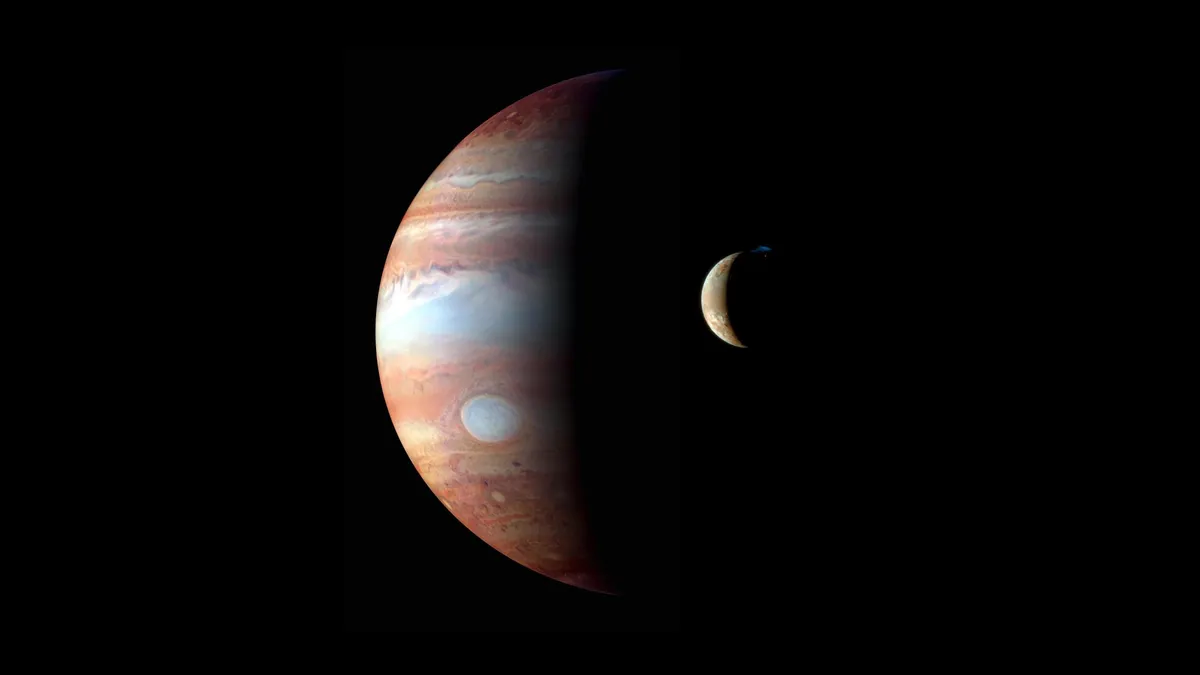
New Horizons' first target was Jupiter, which it visited in February and March 2007. The spacecraft passed by at less than 1.4 million miles (2.4 million kilometers) from the solar system's largest planet, making this the first spacecraft to swing by since the Galileo probe finished its mission at Jupiter in 2003.
Among New Horizons' first pictures were shots of Io, Jupiter's volcanic moon. The spacecraft captured the clearest pictures ever taken of the Tvashtar volcano on Io, showing volcanic fallout that was bigger than the state of Texas.
Additionally, the spacecraft flew through a stream of charged particles swirling behind Jupiter. The probe found large bubbles of charged particles, or plasma, and also revealed variations in the stream of particles. At the time, astronomers said the observations could help with understanding the environment around "hot Jupiter" planets found at other stars, or planets the size of Jupiter that orbit very close (the equivalent orbit of Mercury, or even closer) to their stars.
To conserve energy and lessen the chance of anything breaking, controllers kept the Pluto-traveling spacecraft in hibernation, aside from periodic wake-ups for navigation and systems checks. NASA had the probe emerge from hibernation in December 2014, so it could get ready for the Pluto encounter and send data back to Earth.
New Horizons reaches Pluto

New Horizons was so busy gathering data in its July 2015 encounter that, as planned, the spacecraft didn't communicate with Earth during its closest approach to Pluto and the dwarf planet's largest moon, Charon. Controllers celebrated when New Horizons phoned home, as they knew that data was on the way.
Pluto's distance, about 3 billion miles (5 billion km) from Earth, presented power challenges for the New Horizons designers since the sun's rays at that distance are too weak to generate power. There are also long communications delays for those staying in touch with the 1,054-lb. (478 kilograms) spacecraft. When New Horizons reached Pluto, it took 4.5 hours for a one-way message to get there from Earth.
According to NASA, it took 15 months to download the entire dataset collected during Horizons’ encounter with Pluto and Charon. This was because New Horizons could only transmit about 1-2 kilobits of data per second and there were about 6.25 gigabytes in total. It was undoubtedly worth the wait.
Early pictures from New Horizons showed a surprisingly young surface on Pluto, with a mountain range as high as 11,000 feet (3,500 meters). Believed to be about 100 million years old at most, this range likely points to recent geological activity on the surface, but it's unclear what caused it.
"This may cause us to rethink what powers geological activity on many other icy worlds," said John Spencer, New Horizons geology, geophysics and imaging team deputy leader, in a statement released shortly after the encounter.

More youthful terrain — such as a huge plain bereft of craters, just north of the mountainous range — popped up in pictures sent back in mid-July of 2015. The zone has been informally named Sputnik Planitia and is a region of intense scrutiny, given that geologists are still trying to figure out what caused it.
Other telescopes found several new moons at Pluto during New Horizons' journey to the dwarf planet, presenting a challenge for spacecraft navigators, who were concerned about orbital debris affecting the spacecraft’s trajectory. Fortunately, the moons were found well ahead of the Pluto encounter, and New Horizons faced no obstacles while whizzing through Pluto's system.
Some of New Horizons' other scientific discoveries included evidence of a past subsurface ocean on Charon and strange water-ice hills on Pluto floating in frozen nitrogen. In 2018, one study suggested that there may be an asphalt layer on Pluto, just beneath the world's surface. Some scientists have also suggested that Pluto could have the ingredients for life on its surface, even at its great distance from the sun.
Related: Meet the unknown female mathematician whose calculations helped discover Pluto

Pluto's planetary status change
New Horizons was already in space when the International Astronomical Union voted to change Pluto's status to "dwarf planet" in 2006, following the discovery of several similar-size objects in the Kuiper Belt.
New Horizons principal investigator Alan Stern has repeatedly said he is not in favor of the decision, especially after the flyby revealed that Pluto has a more complex formation history than initially anticipated.
In 2017, a group of planetary scientists submitted a proposal to reclassify Pluto as a planet, making their recommendations at the 48th Lunar and Planetary Science Conference in The Woodlands, Texas. The proposal redefined a "planet" as a round object that has never experienced fusion (unlike a star); the definition is expected to encompass not only dwarf planets, but also moons. Officially, Pluto is still considered a dwarf planet as of late 2021.
Arrokoth (2014 MU69) flyby
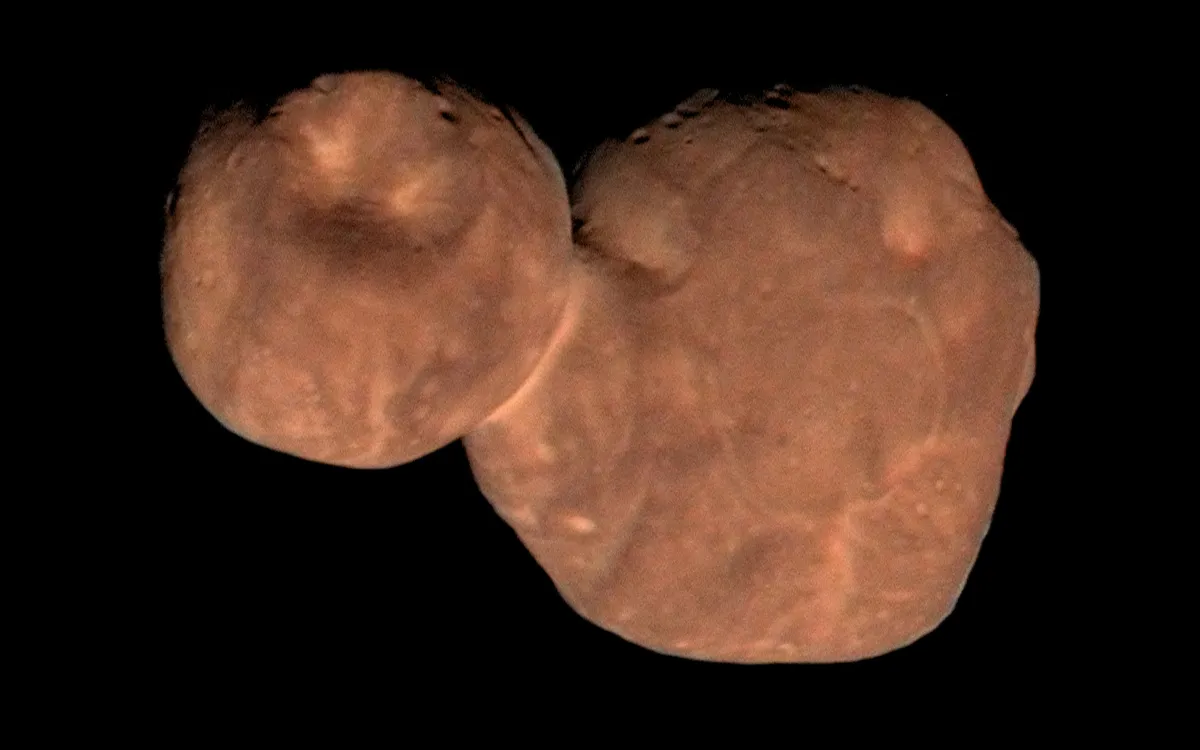
With NASA approval in 2016, New Horizons' mission was extended to take a closer look at a Kuiper Belt object dubbed 2014 MU69, which NASA nicknamed Ultima Thule and is now officially known as Arrokoth.
In September 2017, New Horizons concluded a planned five-month hibernation period in preparation for the probe's extended mission. Until December of that year, New Horizons took several photos of Kuiper Belt objects. Notably, some of New Horizons' 2017 photographs included images of objects 2012 HZ84 and 2012 HE85.
Given New Horizons' great distance from Earth at the time (3.79 billion miles or 6.12 billion km from Earth), the spacecraft's images became the farthest photos ever captured by a spacecraft flying from Earth. The previous record had been held by Voyager 1, which took the famous "Pale Blue Dot" image of Earth on Feb. 14, 1990, from 3.75 billion miles (6 billion km) away.
New Horizons flew by Arrokoth on Jan. 1, 2019. The little world is so far from Earth that NASA didn't know until 10 hours later if the flyby was successful. At its closest approach, New Horizons zoomed by Arrokoth at a distance of about 2,000 miles (3,540 km), which was 5,800 miles (9,300 km) closer than the craft flew by Pluto.
The first photos of Arrokoth showed that it was made up of two lobes, each almost spherical. NASA nicknamed the largest lobe Ultima and the smallest one Thule. These lobes appeared red (likely fading over time due to radiation) and actually used to be separate objects, which, over time, were gravitationally attracted to one another.
New Horizons is so far out in the Kuiper Belt that sending data back to Earth takes significant time. Investigators have said it will take roughly 20 months for all of the Arrokoth data to flow back to Earth, which means new information continued to arrive up until late 2020.
By March 2019, enough data had been sent to Earth that researchers could create a map showing the complex geology of Arrokoth. It's possible that several different building blocks converged to form the object, although that information is being investigated further; the lumpy surface of Arrokoth still was puzzling investigators. The team also released a 3D image that shows the relative sizes of different lumps and bumps on Arrokoth. The encounter with the small body is also telling us a lot about how planets are born which may end a long-standing debate.
Additional resources
- Learn more about the New Horizons mission from NASA.
- Find out where New Horizons is right now.
- Watch a documentary about New Horizons made by the Johns Hopkins University Applied Physics Laboratory.
This article was updated on Oct. 13, 2021, by All About Space staff writer Daisy Dobrijevic.