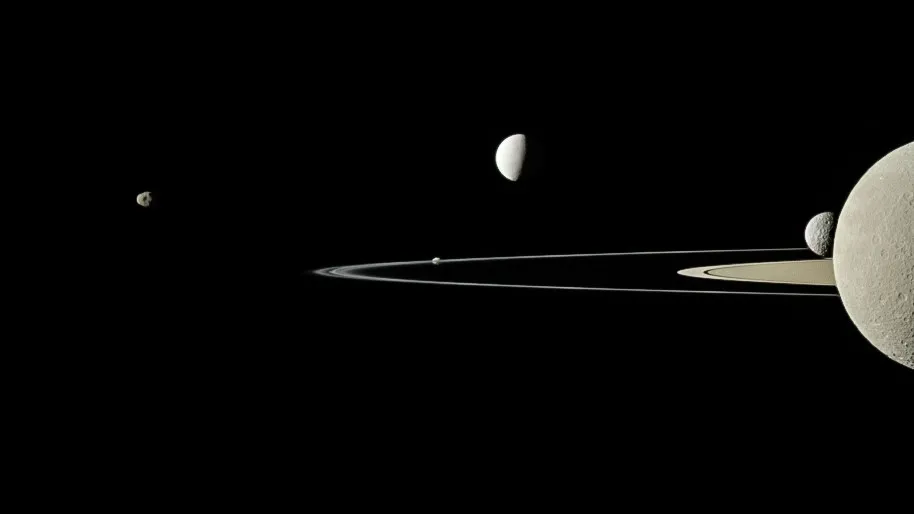
Saturn has 274 moons recognized by the International Astronomical Union.
The number of moons increased substantially in March 2025 when 128 new moons were discovered by a team led by Edward Ashton, a postdoctoral fellow at the Academia Sinica Institute of Astronomy and Astrophysics.
Its impressive moon tally means it has the most moons of any other planet in the solar system.
Saturn's satellites differ greatly in their composition, from icy giants with subsurface oceans to small, heavily cratered rocky worlds that look like something straight out of a sci-fi drama. While some travel within gaps in Saturn's rings and clear a path through the debris, others orbit farther out.
The ringed giant's moons also vary considerably in size. The largest, Titan, is bigger than the planet Mercury, while the smallest is no larger than a sports arena, according to NASA. Seven of Saturn's moons are so bright that they are visible from Earth through a telescope. With the right equipment and conditions, it's possible to spot Titan, Rhea, Tethys, Dione, Enceladus, Iapetus and Mimas.
Related: The 10 weirdest moons in the solar system

Daisy joined Space.com in February 2022, before that she worked as a staff writer for our sister publication All About Space magazine. Daisy has a Ph.D. in plant physiology and an MSci in environmental science.
Saturn's moons were thrust into the spotlight during the Voyager 1, Voyager 2, Pioneer 10 and Pioneer 11 flybys in the 1970s and 1980s, but it wasn't until NASA's Cassini mission reached Saturn in 2004 that we started to see the moons in a whole new — and far more detailed — light. For more than 10 years, Cassini observed Saturn and its family of strange moons, providing us with a window into the unique worlds in our outer solar system.
Saturn moon names and dates of discovery
Here is a list of Saturn's 63 officially named moons, along with the dates of their discovery, according to NASA:
Aegaeon: The smallest known moon of Saturn was imaged on Aug. 15, 2008, and its presence was confirmed when scientists found it in two earlier Cassini images.
Aegir: Discovered on December 12, 2004, by Scott S. Sheppard, David C. Jewitt, and Jan T. Kleyna using a wide-field camera on the Subaru 8.2-m reflector telescope on Mauna Kea, Hawaii.
Albiorix: Discovered on November 9, 2000, by Matthew J. Holman and Timothy B. Spahr with the 6.5-m reflector telescope based at the Fred Lawrence Whipple Observatory on Mt. Hopkins, Arizona.
Alvaldi: Discovered on December 12, 2004, by Scott S. Sheppard, David C. Jewitt and Jan T. Kleyna at the Mauna Kea Observatories, Hawaii.
Angrboda: Discovered on December. 12, 2004, by Scott S. Sheppard, David C. Jewitt and Jan T. Kleyna at the Mauna Kea Observatories, Hawaii.
Anthe: Discovered on May 30, 2007, by the Cassini imaging team.
Atlas: Discovered in 1980 by Richard Terrile and the Voyager 1 team by looking at photographs taken by the spacecraft during its close pass of Saturn.
Bebhionn: Discovered on December 12, 2004, by Scott S. Sheppard, David C. Jewitt and Jan T. Kleyna using a wide-field camera on the Subaru 8.2-m reflector telescope on Mauna Kea, Hawaii.
Beli: Discovered on December 12, 2004, by Scott S. Sheppard, David C. Jewitt and Jan T. Kleyna at the Mauna Kea Observatories, Hawaii.
Bergelmir: Discovered on December 12, 2004, by Scott S. Sheppard, David C. Jewitt and Jan T. Kleyna using a wide-field camera on the Subaru 8.2-m reflector telescope on Mauna Kea, Hawaii.
Bestla: Discovered on December 12, 2004, by Scott S. Sheppard, David C. Jewitt and Jan T. Kleyna using a wide-field camera on the Subaru 8.2-m reflector telescope on Mauna Kea, Hawaii.
Calypso: Discovered in March 1980 by Dan Pascu, Kenneth Seidelmann, William Baum, and Douglas Currie using a ground-based telescope.

Daphnis: Discovered on May. 1, 2005, by the Cassini mission team.
Dione: Discovered on March 21, 1684, by Giovanni Cassini.
Eggther: Discovered on December 12, 2004, by Scott S. Sheppard, David C. Jewitt and Jan T. Kleyna at the Mauna Kea Observatories, Hawaii.
Enceladus: Discovered on August 28, 1789, by British astronomer William Herschel.
Epimetheus: Observed by Audouin Dollfus on December 15, 1966, for which he proposed the name "Janus." On Dec. 18, 1966, Richard Walker made a similar observation. At that time, astronomers believed they were observing one moon known unofficially as "Janus." But in October 1978, Stephen M. Larson and John W. Fountain realized that the 1966 observations were of two separate objects (Janus and Epimetheus). This was confirmed by Voyager 1 in 1980. Therefore Larson and Fountain, along with Walker, officially share the discovery of Epimetheus.
Erriapus: Discovered on September 23, 2000, by Brett J. Gladman, John J. Kavelaars, Jean-Marc Petit, Hans Scholl, Matthew J. Holman, Brian G. Marsden, Phillip D. Nicholson and Joseph A. Burns at the Mauna Kea Observatories, Hawaii.
Farbauti: Discovered on December 12, 2004, by Scott S. Sheppard, David C. Jewitt and Jan T. Kleyna using a wide-field camera on the Subaru 8.2-m reflector telescope on Mauna Kea, Hawaii.
Fenrir: Discovered on December 12, 2004, by Scott S. Sheppard, David C. Jewitt and Jan T. Kleyna using a wide-field camera on the Subaru 8.2-m reflector telescope on Mauna Kea, Hawaii.
Fornjot: Discovered on December 12, 2004, by Scott S. Sheppard, David C. Jewitt and Jan T. Kleyna using a wide-field camera on the Subaru 8.2-m reflector telescope on Mauna Kea, Hawaii.
Geirrod: Discovered on December 12, 2004, by Scott S. Sheppard, David C. Jewitt and Jan T. Kleyna at the Mauna Kea Observatories, Hawaii.
Gerd: Discovered on December 12, 2004, by Scott S. Sheppard, David C. Jewitt and Jan T. Kleyna at the Mauna Kea Observatories, Hawaii.
Greip: Discovered on March 6, 2006, by Scott S. Sheppard, David C. Jewitt and Jan T. Kleyna using the Subaru 8.2-m reflector telescope on Mauna Kea, Hawaii.
Gridr: Discovered on December 12, 2004, by Scott S. Sheppard, David C. Jewitt and Jan T. Kleyna at the Mauna Kea Observatories, Hawaii.
Gunnlod: Discovered on December 12, 2004, by Scott S. Sheppard, David C. Jewitt and Jan T. Kleyna at the Mauna Kea Observatories, Hawaii.
Hati: Discovered on March 6, 2006, by Scott S. Sheppard, David C. Jewitt and Jan T. Kleyna using the Subaru 8.2-m reflector telescope on Mauna Kea, Hawaii.
Helene: Discovered on March 1, 1980, by Pierre Laques and Jean Lecacheux.
Hyperion: Discovered in 1848 by William Lassell and independently by William Cranch Bond, with his son George Phillips Bond the same year. All three are credited with the discovery.
Hyrrokkin: Discovered on March 6, 2006, by Scott S. Sheppard, David C. Jewitt and Jan T. Kleyna using the Subaru 8.2-m reflector telescope on Mauna Kea, Hawaii.

Iapetus: Discovered on October 25, 1671, by Giovanni Cassini, although his observations weren't validated until the Voyager 1 and 2 encounters in 1980 and 1981.
Ijiraq: Discovered on September 23, 2000, by Brett J. Gladman, John J. Kavelaars, Jean-Marc Petit, Hans Scholl, Matthew J. Holman, Brian G. Marsden, Phillip D. Nicholson and Joseph A. Burns using the 3.6-m Canada-France-Hawaii reflector on Mauna Kea, Hawaii.
Janus: Observed by Audouin Dollfus on December 15, 1966, for which he proposed the name "Janus." On Dec. 18, 1966, Richard Walker made a similar observation. At that time, astronomers believed they we only observing one moon known unofficially as "Janus." In Oct. 1978, Stephen M. Larson and John W. Fountain realized that the 1966 observations were of two separate objects (Janus and Epimetheus). This was confirmed by Voyager 1 in 1980.
Jarnsaxa: Discovered on March 6, 2006, by Scott S. Sheppard, David C. Jewitt and Jan T. Kleyna using the Subaru 8.2-m reflector telescope on Mauna Kea, Hawaii.
Kari: Discovered on March 6, 2006, by Scott S. Sheppard, David C. Jewitt and Jan T. Kleyna using the Subaru 8.2-m reflector telescope on Mauna Kea, Hawaii.
Kiviuq: Discovered on Aug. 7, 2000, by Brett J. Gladman, John J. Kavelaars, Jean-Marc Petit, Hans Scholl, Matthew J. Holman, Brian G. Marsden, Phillip D. Nicholson and Joseph A. Burns at the European Southern Observatory in La Silla, Chile.
Loge: Discovered on March 6, 2006, by Scott S. Sheppard, David C. Jewitt and Jan T. Kleyna using the Subaru 8.2-m reflector telescope on Mauna Kea, Hawaii.
Methone: Discovered on June 1, 2004, by the Cassini imaging team.
Mimas: Discovered on September. 17, 1789, by English astronomer William Herschel using his 40-foot reflector telescope.
Mundilfari: Discovered in 2000 by Brett J. Gladman, John J. Kavelaars, Jean-Marc Petit, Hans Scholl, Matthew J. Holman, Brian G. Marsden, Phillip D. Nicholson and Joseph A. Burns using the 3.6-m Canada-France-Hawaii reflector on Mauna Kea in Hawaii.
Narvi: Discovered on April 8, 2003, by Scott S. Sheppard, David C. Jewitt and Jan T. Kleyna.
Paaliaq: Discovered on August 7, 2000, by Brett J. Gladman, John J. Kavelaars, Jean-Marc Petit, Hans Scholl, Matthew J. Holman, Brian G. Marsden, Phillip D. Nicholson and Joseph A. Burns at the European Southern Observatory in La Silla, Chile.
Pallene: Discovered on June 1, 2005, by the Cassini imaging team.
Pan: Discovered by Mark Showalter in 1990 using images captured by Voyager 2, nine years prior.
Pandora: Discovered in October 1980 by the Voyager 1 science team.
Phoebe: Discovered in August 1898 by American astronomer William Pickering.
Polydeuces: Discovered on Oct. 21, 2004, by the Cassini mission team.
Prometheus: Discovered in October 1980 by the Voyager 1 science team.
Rhea: Discovered on Dec. 23, 1672.
Siarnaq: Discovered on September 23, 2000, by Brett J. Gladman, John J. Kavelaars, Jean-Marc Petit, Hans Scholl, Matthew J. Holman, Brian G. Marsden, Phillip D. Nicholson and Joseph A. Burns using the 3.6-m Canada-France-Hawaii reflector on Mauna Kea, Hawaii.
Skathi: Discovered on September 23, 2000, by Brett J. Gladman, John J. Kavelaars, Jean-Marc Petit, Hans Scholl, Matthew J. Holman, Brian G. Marsden, Phillip D. Nicholson and Joseph A. Burns using the 3.6-m Canada-France-Hawaii reflector on Mauna Kea, Hawaii.
Skoll: Discovered on March 6, 2006, by Scott S. Sheppard, David C. Jewitt and Jan T. Kleyna using the Subaru 8.3-m reflector telescope on Mauna Kea, Hawaii.
Skrymir: Discovered on December 12, 2004, by Scott S. Sheppard, David C. Jewitt and Jan T. Kleyna at the Mauna Kea Observatories, Hawaii.
Surtur: Discovered on March 6, 2006, by Scott S. Sheppard, David C. Jewitt and Jan T. Kleyna using the Subaru 8.3-m reflector telescope on Mauna Kea, Hawaii.
Suttungr: Discovered in 2000 by Brett J. Gladman, John J. Kavelaars, Jean-Marc Petit, Hans Scholl, Matthew J. Holman, Brian G. Marsden, Phillip D. Nicholson and Joseph A. Burns using the 3.6-m Canada-France-Hawaii reflector on Mauna Kea, Hawaii.
Tarqeq: Discovered on January. 16, 2007, by Scott S. Sheppard, David C. Jewitt and Jan T. Kleyna at the Subaru 8.2-m reflector at the Mauna Kea Observatory in Hawaii.
Tarvos: Discovered on September 23, 2000, by Brett J. Gladman, John J. Kavelaars, Jean-Marc Petit, Hans Scholl, Matthew J. Holman, Brian G. Marsden, Phillip D. Nicholson and Joseph A. Burns using the 3.6-m Canada-France-Hawaii reflector on Mauna Kea, Hawaii.
Telesto: Discovered in 1980 by Brad Smith, Harold Reitsema, Stephen Larson and John Fountain using ground-based observations.
Tethys: Discovered on March 21, 1684, by Giovanni Cassini.

Thiazzi: Discovered on December 12, 2004, by Scott S. Sheppard, David C. Jewitt and Jan T. Kleyna at the Mauna Kea Observatories, Hawaii.
Thrymr: Discovered in 2000 by Brett J. Gladman, John J. Kavelaars, Jean-Marc Petit, Hans Scholl, Matthew J. Holman, Brian G. Marsden, Phillip D. Nicholson and Joseph A. Burns using the 3.6-m Canada-France-Hawaii reflector on Mauna Kea, Hawaii.
Titan: Discovered on March 25, 1655, by Dutch astronomer Christiaan Huygens.
Ymir: Discovered in 2000 by Brett J. Gladman, John J. Kavelaars, Jean-Marc Petit, Hans Scholl, Matthew J. Holman, Brian G. Marsden, Phillip D. Nicholson and Joseph A. Burns using the 3.6-m Canada-France-Hawaii reflector on Mauna Kea, Hawaii.
Saturn's 8 biggest moons
1. Titan
Mean diameter: 3,200 miles (5,150 kilometers)
The largest of Saturn's moons and the first to be discovered is Titan. It is the only moon in the solar system known to have a substantial atmosphere. Nitrogen and methane extend around the moon 10 times as far into space as Earth's atmosphere, sometimes falling to Titan's surface as methane rain.
2. Rhea
Mean diameter: 950 miles (1,500 km)
Rhea is a heavily cratered moon composed of ice and rock. The frozen dirty snowball is tidally locked with Saturn, meaning one side always faces toward the ringed giant. In 2010, the Cassini spacecraft detected a thin atmosphere — known as an exosphere — composed of oxygen and carbon dioxide.
3. Iapetus

Mean diameter: 914 miles (1,470 km)
Iapetus features a high-contrast surface of light and dark. As such, it has been dubbed the yin and yang of the Saturn moons. Iapetus, like Rhea, is thought to be composed of ice and rock. When Giovanni Cassini discovered Iapetus in 1671, he noted that the moon had one side much darker than the other, as he could only see Iapetus when it was on the west side of Saturn. Iapetus also contains some of the highest mountains in the solar system. A chain of 6-mile (10 km) high mountains stretch along the moon's equator.
4. Dione
Mean diameter: 698 miles (1,120 km)
Dione is a heavily cratered moon with a dense core. It is likely composed of silicate rock with the remainder of the moon made of ice. Unusually, the tidally locked moon is more heavily cratered on its trailing hemisphere compared to its leading hemisphere. (Usually, a leading hemisphere is more cratered as it faces impactors like meteors head-on). Scientists have theorized that a recent impact could have knocked Dione, but exactly how the moon spun exactly 180 degrees remains a mystery.
5. Tethys
Mean diameter: 662 miles (1,066 km)
Tethys travels close to Saturn and feels the gravitational pull of the planet particularly strongly. The heat from Saturn may allow the moon's icy surface to melt slightly, filling in craters and other signs of impact. Made up almost entirely of water ice, the surface is highly reflective. A large trench crosses the moon, running diagonally from its north to south pole and spanning three-quarters of the satellite's circumference. A large crater on the other side of the moon covers nearly two-fifths of the moon's diameter and is nearly the size of fellow moon Mimas. Scientists have found strange red arcs on Tethys that they can't yet explain.
6. Enceladus

Mean diameter: 313 miles (504 km)
Saturn's icy ocean moon, Enceladus, has the whitest, most reflective surface in the solar system. Below its frozen shell lies a subsurface ocean sporting conditions that might harbor life. The strange moon spews its ocean out into space; in 2005, NASA's Cassini spacecraft found icy water particles gushing from the surface at approximately 800 miles per hour (400 meters per second). The ejected material forms Saturn's E ring and scientists study the ring to learn more about Enceladus' ocean. Nanograins of silica have been found in Saturn's E-ring, which suggests the presence of hydrothermal vents within Enceladus' ocean. Silica can only be generated in super-hot conditions such as in hydrothermal vents, when liquid water and rock interact at temperatures above 200 degrees Fahrenheit (90 degrees Celsius).
7. Mimas
Mean diameter: 246 miles (396 km)
Mimas has a gaping crater that gives the rocky moon a strong resemblance to the fictional Death Star in the "Star Wars" movies. The impact stands out despite the fact that Mimas is one of the most heavily cratered bodies in the solar system, with overlapping impacts covering the surface. The small moon is composed of mainly water ice — this is also the only substance ever detected on Mimas.
But Mimas continues to puzzle scientists.
The small moon orbits closer to Saturn than Enceladus and has a much larger eccentric (elongated) orbit. In theory, Mimas should receive more tidal heating than Enceladus. But while Enceladus displays evidence of internal heat through geysers of water, Mimas' heavily cratered surface implies it's been frozen for a long time. This paradoxical observation of Mimas' geological history has given rise to the "Mimas Test", which states "any theory that claims to explain the partially thawed water of Enceladus must also explain the entirely frozen water of Mimas", according to NASA Science.
8. Hyperion
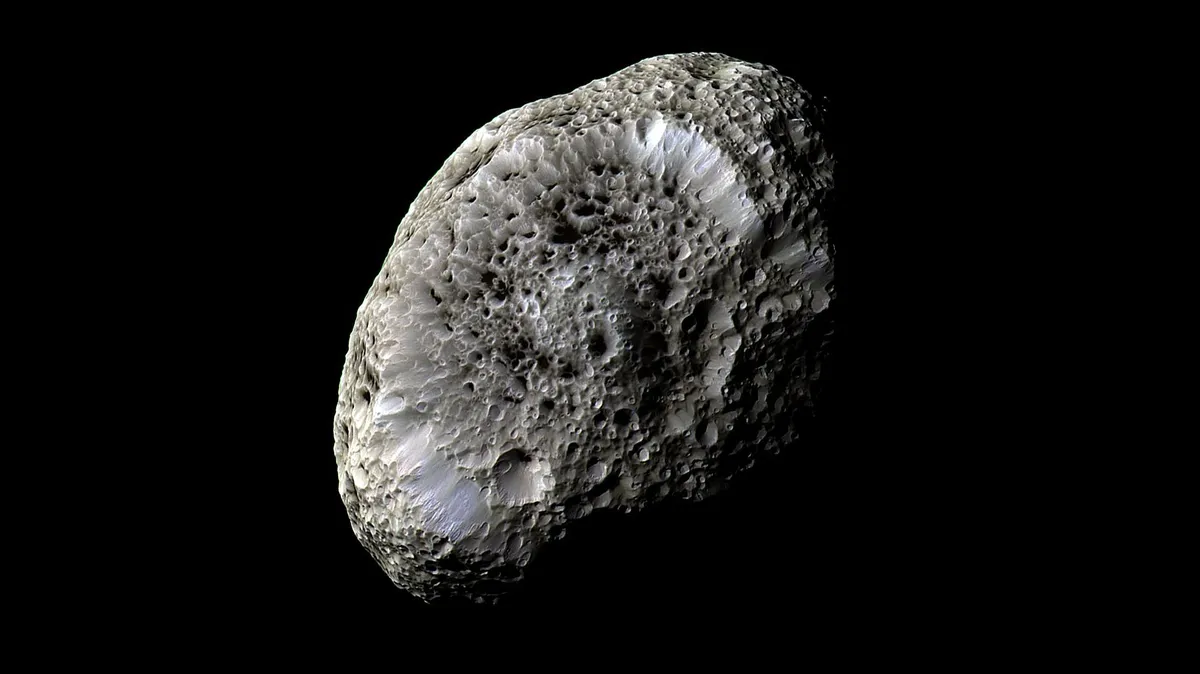
Mean diameter along its three axes: 255 x 163 x 137 miles (410 x 260 x 220 km, respectively)
Hyperion was the last of Saturn's major satellites to be discovered. It is a small, potato-shaped moon with a spongy-looking texture. Scientists suggest that Hyperion's odd shape is indicative that Hyperion may be a remnant of a much larger moon that was destroyed by an impact.
How to see Saturn's moons

Seven of Saturn's moons are so bright that they're visible through a telescope.
The easiest Saturnian moon to spot is Titan, as the giant moon can reach magnitude +8. At this brightness, you could spot it using a pair of binoculars or a small telescope. (On the magnitude scale used by astronomers, lower numbers signify brighter objects. For example, at its brightest, the planet Venus shines with a magnitude of about -4.6.)
The other six moons shine at the following magnitudes, according to astronomy technique and guides website lovethenightsky.com:
- Rhea: +9
- Tethys: +10
- Dione: +10
- Enceladus: +11.5
- Iapetus: +10.5
- Mimas: +12.5
To find out where and when to look out for Saturn's moons, we recommend using skywatching apps like SkySafari or software like Starry Night. Our picks for the best stargazing apps may help you with your planning.
If you're looking for a telescope or binoculars to observe Saturn and its moons, our best telescopes for seeing planets guide can help. We also have guides on the best binoculars deals and the best telescope deals, which may come in useful when hunting for deals.
Additional information
Find out more about Saturn and its moons with The Planetary Society. Take a free course on the moons of our solar system with The Open University to expand your knowledge. Explore 10 mysteries about Saturn's moons that scientists are eager to solve, with this feature from NASA Science.
Bibliography
How many of Saturn's moons can I see through my telescope? Love the Night Sky, accessed Oct. 17. 2022 from: https://lovethenightsky.com/how-many-of-saturns-moons-can-i-see-through-a-telescope/
NASA. Saturn Moons: Overview. Accessed Oct. 17, 2022. From: https://solarsystem.nasa.gov/moons/saturn-moons/overview
NASA. Saturn Moons: In Depth. Accessed Oct. 17, 2022. From https://solarsystem.nasa.gov/moons/saturn-moons/in-depth/
NASA. Iapetus: In Depth. Accessed Oct. 18, 2022. From https://solarsystem.nasa.gov/moons/saturn-moons/iapetus/in-depth/
NASA. Rhea: In Depth. Accessed Oct. 18, 2022. From: https://solarsystem.nasa.gov/moons/saturn-moons/rhea/in-depth
NASA. Dione: In Depth. Accessed Oct. 18, 2022. From: https://solarsystem.nasa.gov/moons/saturn-moons/dione/in-depth/
NASA. Tethys: In Depth. Accessed Oct. 18. 2022. From: https://solarsystem.nasa.gov/moons/saturn-moons/tethys/in-depth/
NASA. Enceladus: In Depth. Accessed Oct. 18, 2022. From: https://solarsystem.nasa.gov/moons/saturn-moons/enceladus/in-depth/
NASA. Mimas: In Depth. Accessed Oct. 18, 2022. From: https://solarsystem.nasa.gov/moons/saturn-moons/mimas/in-depth/