newsarama.com
advertisement


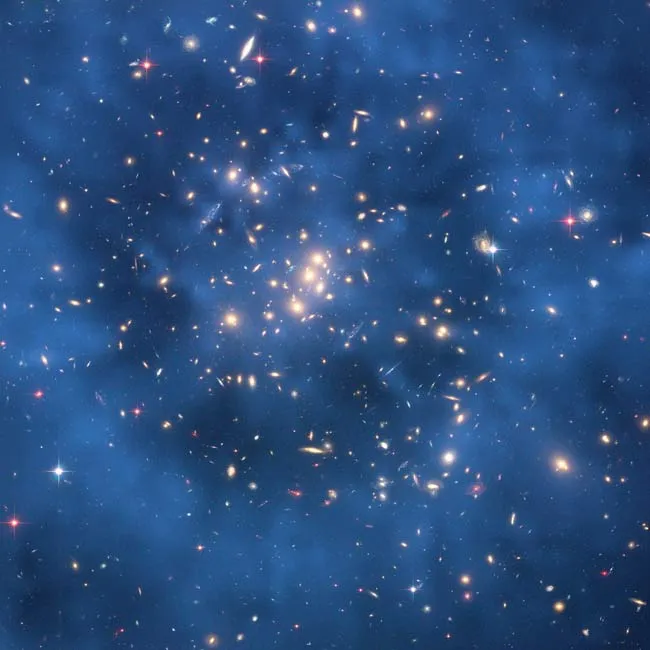
The cluster of galaxies EMSS 1358+6245 is about 4 billion light-years away in constellation Draco. When imaged with the Chandra X-ray Observatory, scientists determined the mass of dark matter there is four times larger than normal matter. Click to enlarge.
Scientists Closer to Solving Dark Matter Mystery
Astrophysics Challenged By Dark Energy Finding
Dark Planets May Orbit Strange Nearby Objects
Astronomers See First Light in Universe, Lifting Cosmic Fog
Studies Pins Down Quantity, Size of Dark Matter in Universe
By Robert Roy Britt
Senior Science Writer
posted: 10:00 am ET
06 September 2001

EMBARGOED for 10 a

WASHINGTON D.C. -- Researchers announced today they have pinned down an upper limit to the dimensions of mysterious particles known as dark matter and also figured out how much of it exists in the universe.

The latter result, which also provides a better estimate of how dense the universe is on average, supports other recent studies indicating that the universe is not dense enough to reverse its current expansion.

Using the Chandra X-ray Observatory, researchers at the University of Cambridge mapped the temperature and quantity of superheated gas that infuses the space between galaxies, which are tethered by gravity into huge clusters, creating some of the largest structures in space.

The hot gas is only visible in X-rays. In years past, it had gone unseen because X-rays do not penetrate Earth's atmosphere. But now space-based observatories like Chandra can detect it.

The Cambridge researchers examined five galaxy clusters, all between 1.4 billion and 4 billion light-years away, and added the mass of all the gas they found to the known mass of stars. They compared their result to the amount of mass that should be in the clusters to keep them from flying apart, a figure known from previous studies.

"We found that the stars in the galaxies and the hot gas together contribute only about 13 percent of the mass," said Steven Allen, a Cambridge researcher who led the study. "The rest must be in the form of dark matter."

The results were presented here at a Chandra Observatory symposium.

Because large galaxy clusters are thought to contain a significant proportion of the mass of the universe, the new study gives a better picture of how much dark matter likely exists. Previously, researchers had estimated that between 80 and 95 percent of the mass of the universe was missing and must be dark.

The new study "really settles the question" by providing a precise measurement of 87 percent, said Joel Bergman, a University of Michigan researcher who was not involved in the work.

But the fact remains that the stuff has yet to be found.

New size estimate

The search for these strange particles will get a boost from a separate new study by John Arabadjis and Mark Bautz of the Massachusetts Institute of Technology. They used Chandra observations and computer modeling to set an upper limit on the size of dark matter particles per unit weight.

A dark matter particle that weighed as much as a penny could be no larger than one-tenth the size of a penny, the researchers concluded. They could not say how large the particles are.

The result is based on observations of exactly where dark matter resides in a single galaxy cluster. Arabadjis said dark matter particles would behave like a crowd of people in Times Square. The larger they are, the more spread out they would have to be.

Toward the center of the galaxy cluster, however, he found the amount of dark matter increased more and more as observations approached the center, with no identifiable limit to the density. So he and Bautz placed a very high upper limit on the concentration of dark matter at the center -- akin to putting many times more people in Times Square than it ever holds on New Year's Eve. The only way you could do it without hurting someone is to enlist very, very small people.

By analogy, the size of the dark matter particles must be very, very small for a given amount of mass, he said.

Bregmen called this finding "a great step forward" in allowing researchers to figure out exactly what dark matter particles are.

About dark matter

Scientists assume dark matter is composed of some sort of tiny, invisible, elementary particle that exerts a gravitational force but otherwise interacts weakly with normal matter. Some of these particles are likely wafting under your nose as you read this. These as-yet undiscovered particles are called WIMPS, for "weakly interacting massive particles."

What is Dark Matter?
Strange stuff, to be sure. Here, we shed some light on the topic.

Since the 1930s, astronomers have known that galaxy clusters do not contain enough visible matter to account for the gravity that causes the swift motions of their stars.

In addition, the gravity generated by observed matter is not enough to keep individual galaxies and clusters of galaxies from simply coming unglued.

Earlier this year, researchers discovered that some of what has long been called dark matter is quite normal -- white dwarf stars that had simply eluded detection. These stars account for at least 3 percent of the previously missing matter in our galaxy, and possibly as much as 35 percent. But that still leaves much unfound.

Some of what was thought to be dark matter, researchers have realized in recent years, is simply the hot gas that fills the space between galaxies and can only be detected by X-ray telescopes.

But the Cambridge study shows there must still be a lot of WIMPS, or something even more exotic, holding everything together.

No collapse in sight

As scientists zero in on how dense the universe is, one overriding question remains in the back of their minds: Is it dense enough to hold everything together?

Astronomers know that the universe is expanding, and in recent years this expansion has been found to be accelerating. Depending on how dense things are, this expansion will either continue forever, or it will reverse course and the universe will ultimately collapse.

Since galaxy clusters are thought to represent a significant chunk of the matter in the universe -- both normal and dark -- the Cambridge researchers say their study provides strong evidence for how dense the universe is as a whole.

Allen, who led the Cambridge study, said in an interview that his work confirms recent estimates of this density made by other researchers, and that it is only about 30 percent of what's needed to stop the universe from expanding forever.

"This reinforces the conclusions we've been getting in the past couple of years that the universe won't recollapse on itself," Allen said.

Cambridge scientists Robert Schmidt and Andrew Fabian also worked on the study.

Click here for more news and information about dark matter.


Digital Blue Loop Studio with Mix Man StudioXPro
$199.00
Explore More


Site Map | News | SpaceFlight | Science | Technology | Entertainment | SpaceViews | NightSky | Ad Astra | SETI | Hot Topics
Image Galleries | Videos | Reader Favorites | Image of the Day | Amazing Images | Wallpapers | Games | Community
about us | FREE Email Newsletter | message boards | register at SPACE.com | contact us | advertise with us | terms & conditions | privacy statement
DMCA/Copyright
  What is This?