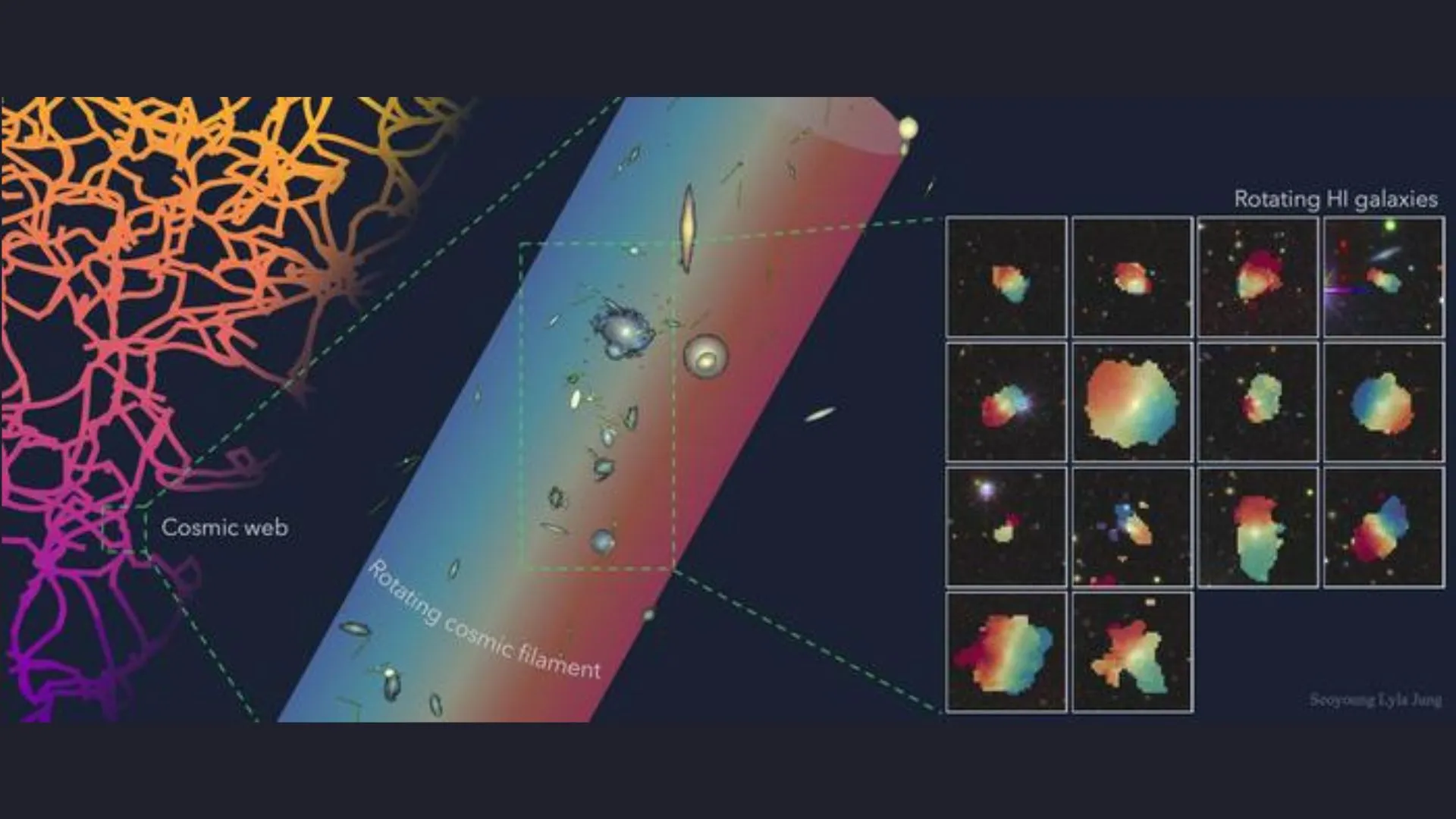
Galaxies residing in a huge filament of dark matter have been found to be mostly rotating in the same direction that the filament is spinning. It's a discovery that challenges what astronomers think they know about how the environment influences galactic evolution.
The filament is a thread in the cosmic web, which is made of mostly dark matter and laced with ordinary matter, that spans the entire universe. Located 140 million light-years away, the filament has a nested structure. At its heart is a row of 14 galaxies almost precisely placed in a line 5.5 million light years long and 117,000 light-years wide, and all are rich in hydrogen gas that's required for forming stars. This row of galaxies is then embedded in the larger filament that's 50 million light years in length and is home to about 300 galaxies in total.
The row of galaxies is extraordinary not because they are aligned in a narrow band, but because many of them are rotating in the same direction as the filament itself. Think of each galaxy, slowly rotating around its axis, and then picture those galaxies perpendicular to the long axis of the filament and rotating about that spindle at 68 miles (110 kilometers) per second in the same direction as they themselves are spinning on their axis. All together, it is one of the largest cohesive rotating structures known in the universe.
"What makes this structure exceptional is not just its size, but the combination of spin alignment and rotational motion," Lyla Jung of the University of Oxford said in a statement. "You can liken it to the teacups ride at a theme park. Each galaxy is like a spinning teacup, but the whole platform – the cosmic filament — is rotating too. This dual motion gives us rare insight into how galaxies gain their spin from the larger structures they live in."
Jung and Madalina Tudorache, also at Oxford, co-led the study into the filament using the 64 networked dishes of the MeerKAT radio telescope in South Africa to track the motion of the neutral hydrogen gas in the galaxies and the filament, combined with optical data from the Dark Energy Spectroscopic Instrument at the Kitt Peak National Observatory in Arizona and the Sloan Digital Sky Survey in New Mexico.
In 2022, astronomers discovered that filaments in the cosmic web are rotating, based on the motion of the galaxies within them. This new discovery that the galaxies themselves spin on their axis in the same direction as the filament rotates is surprising because of how astronomers think galaxies form in the first place.
The gas, stars and dust in the Milky Way galaxy, for example, are all rotating around the galactic center. It will take our sun and solar system 220 million years to complete one orbit of the galaxy. The rotation of a galaxy is partly a legacy of the spinning cloud of gas that originally formed it 13 billion years ago, the cloud passing its angular momentum on to the galaxy. However, since then most galaxies have experienced close encounters, collisions and full-on mergers with other galaxies that can disrupt how they spin.
However, the rotation of this filament clearly dominates how the galaxies within it spin, perhaps by funneling hydrogen gas along the dark-matter filament and onto the galaxies in a way that coerces their spin while providing further fuel for star formation.
"This filament is a fossil record of cosmic flows," said Tudorache. "It helps us piece together how galaxies acquire their spin and grow over time."
The galaxies in the filament also seem relatively young and in an early stage of development; it's possible that their spins could alter as they mature.
That flows of material along cosmic filaments can influence the properties of galaxies to this degree is a surprise though, and will lead to important modifications in models of how galaxies form.
Such alignments could also influence measurements made as part of weak lensing surveys, such as that to be performed by the Legacy Survey of Space and Time on the Vera C. Rubin Observatory in Chile, which is about to begin work after revealing its first-light images this past summer. Weak lensing surveys look for distortions in the shapes and alignments of galaxies caused by the subtle gravitational lensing by dark matter to allow astronomers to map the cosmic web. Understanding more about how galaxies align and rotate along those filaments will help lead to more accurate measurements.
The discovery of the alignment of galaxies in the spinning filament was reported on Dec. 4 in the journal Monthly Notices of the Royal Astronomical Society.