Alpha Centauri is a star system with components 4.2 to 4.4 light-years from Earth and comprises three stars. It is the closest star system to the solar system, and one of its stars is the nearest star to our planet other than the sun.
Collectively, the star system is the fourth-brightest star in Earth's sky (not including the sun), after Sirius, Canopus and Arcturus, according to Britannica. However, as Starwalk points out, Alpha Centauri is a southern star, located in the constellation Centaurus, and thus isn't visible to observers above 29 degrees north latitude.
Alpha Centauri is listed in Almagest, the star catalog written by Ptolemy around A.D. 150. Although Alpha Centauri was well documented in antiquity, it wasn't until the late 1600s that astronomers began to notice that it was made up of multiple stars.
Related: A guide to the brightest stars in the sky
In December 1689, while observing a passing comet, French Jesuit priest Father Jean Richaud discovered that Alpha Centauri contained the individual stars Alpha Centauri A (or Rigil Kentaurus) and Alpha Centauri B (or Toliman). This was only the second binary star system to be discovered.
Alpha Centauri's third and faintest component star, Alpha Centauri C — or Proxima Centauri, as it is better known — was discovered in 1915 by Scottish astronomer Robert Thorburn Ayton Innes.
What stars are part of Alpha Centauri?
Proxima Centauri (Alpha Centauri C)
At 4.2 light-years from Earth, Proxima Centauri is the closest star to our planet other than the sun. Its name means "nearest to Centaurus" in Latin.
Proxima Centauri is a red dwarf star with a mass of around 12.5% of the sun and a diameter of about 14% of our star's. However, Proxima Centauri is around 33 times denser than the sun, according to Star facts.
This red dwarf is a main sequence star, which means that, like the sun, it is still turning hydrogen to helium at its core via nuclear fusion, with this acting as Proxima Centauri's main source of energy. With a luminosity of 0.17% that of the sun, Proxima Centauri is producing energy at a lower rate than the sun. That means that, while our star is predicted to have a main sequence lifetime of around 10 billion years, of which around 5 billion years remain, Proxima Centauri will stay on this branch of stellar evolution for another 4 trillion years — around 300 times the current 13.8 billion-year age of the universe.
Although Proxima Centauri will outlive the sun, it will eventually experience a similar fate: When its supply of hydrogen is exhausted, Proxima Centauri will end its life as a smoldering white dwarf star, lacking the mass sufficient to become a neutron star or a black hole.

Proxima Centauri is a dim star with a magnitude of 11.05, so it's usually too faint to be seen with the naked eye. Because Proxima Centauri is a "flare star," however — meaning it's prone to sudden bursts of brightness resulting from magnetic activity — the red dwarf does give rise to powerful phenomena that can be seen here on Earth.
In 2019, researchers spotted one of the largest stellar flares ever recorded in the Milky Way emerging from Proxima Centauri. The jet of plasma, which lasted just 7 seconds, was around 100 times more powerful than any flare ever seen emerging from the sun. The first Proxima Centauri superflare was spotted in 2016 and was bright enough for observers to spot it with the naked eye in dark sites on Earth.
Rigil Kentaurus and Toliman (Alpha Centauri A and B)
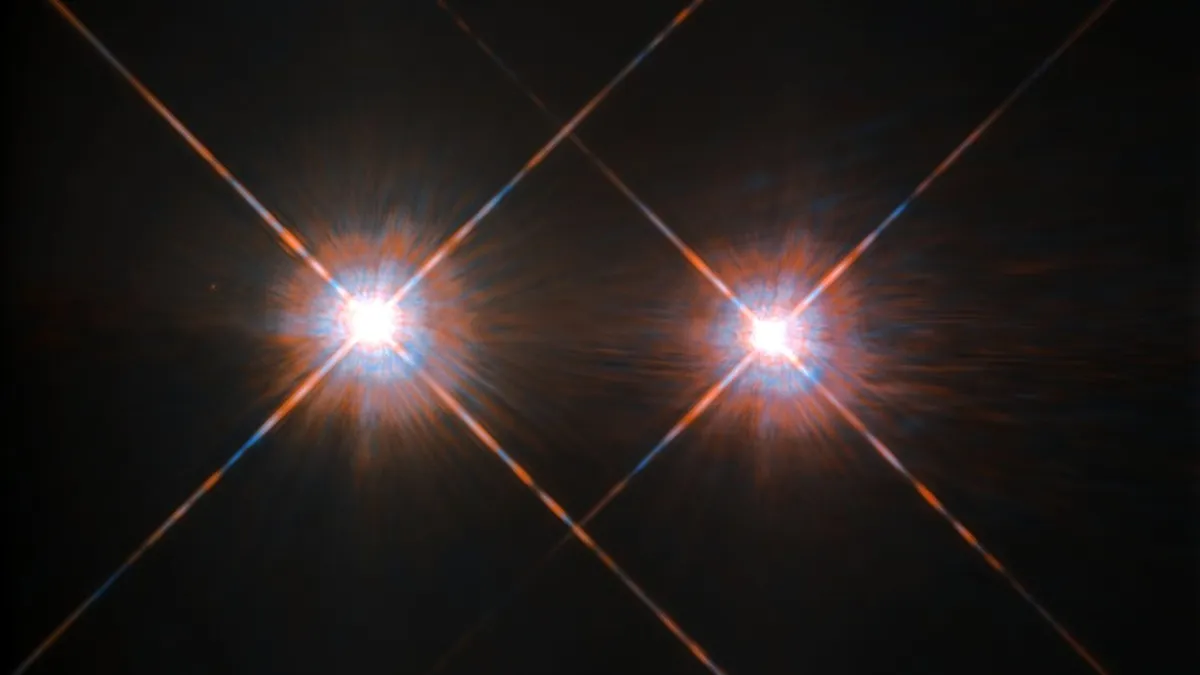
Located around 4.4 light-years from the solar system, the main component of Alpha Centauri is the binary system composed of Alpha Centauri A and B. the brightest component of Alpha Centauri is the star Alpha Centauri A, or Rigil Kentaraus, which means "foot of the centaur" in Arabic and, confusingly, is also an alternative name for the whole Alpha Centauri system. It is a sun-like star that, like Proxima Centauri, is still in its main sequence lifetime.
Rigil Kentaraus is both larger and more massive than the sun, with a diameter 1.2 times that of the sun and a mass 1.1 times our star's. Its surface temperature is about 5,790 kelvins (10,000 degrees Fahrenheit, or 5,500 degrees Celsius), and it is about 1.5 times as luminous as the sun.
Rigil Kentaurus is gravitationally locked in a binary system with Toliman (Alpha Centauri B), the second-brightest star of Alpha Centauri, and completes an orbit in 22 Earth days. According to NASA, Rigil Kentaraus and Toliman are separated by around 23 astronomical units (AU), or 23 times the distance between Earth and the sun. (One AU is the average distance between Earth and the sun: about 93 million miles, or 150 million kilometers.)
Toliman is an orange main sequence star that is both smaller and less massive than the sun, with a diameter of 86% and a mass of 97% of the sun. Toliman's surface temperature is 5,260 K (9,000 F, or 5,000 C), making it cooler than the sun, whose surface temperature is around 5,780 K (10,000 F, or 5,000 C), and it is about half as luminous as our star.
Proxima Centauri is gravitationally bound to this binary system and is located around 13,000 AU from it. Research released in 2017 showed that Proxima Centauri moves in the same direction, as the binary stars relative to the sun, and the red dwarf star takes around 550,000 years to orbit the two stars. The study also suggested that the orbit of Proxima Centauri around Rigil Kentaurus and Toliman may have influenced the evolution of planets orbiting the three stars.
Does Alpha Centauri have planets?
Considering Alpha Centauri is the closest star system to Earth, it is perhaps unsurprising that it's an area of intense searches for exoplanets. Indeed, astronomers have spotted several suspected worlds in the system.
As of 2023, five planets have been detected in the Alpha Centauri system: three orbiting Proxima Centauri (Alpha Centauri C) and two orbiting Toliman (Alpha Centauri B), though some of these have yet to be confirmed.
These include the exoplanet, Alpha Centauri Bb, which was detected in 2012. The planet orbits its star at a distance of just 3.7 million miles, over 10 times closer than Mercury is to the sun. As a result, if Alpha Centauri Bb is confirmed to exist, it is being blasted with huge doses of radiation, bringing the surface temperature up to 2,200 degrees Fahrenheit (1,200 degrees Celsius) — meaning its surface is covered in lava, according to a statement from NASA.
Another possible planet around Toliman may be a little less extreme. Alpha Centauri Bc, a proposed Earth-like planetary candidate, was spotted via a dip in light from its parent star caused as the planet crossed, or transited, its face. The planet is proposed to be roughly Earth-size, with a 20-Earth-day orbit.

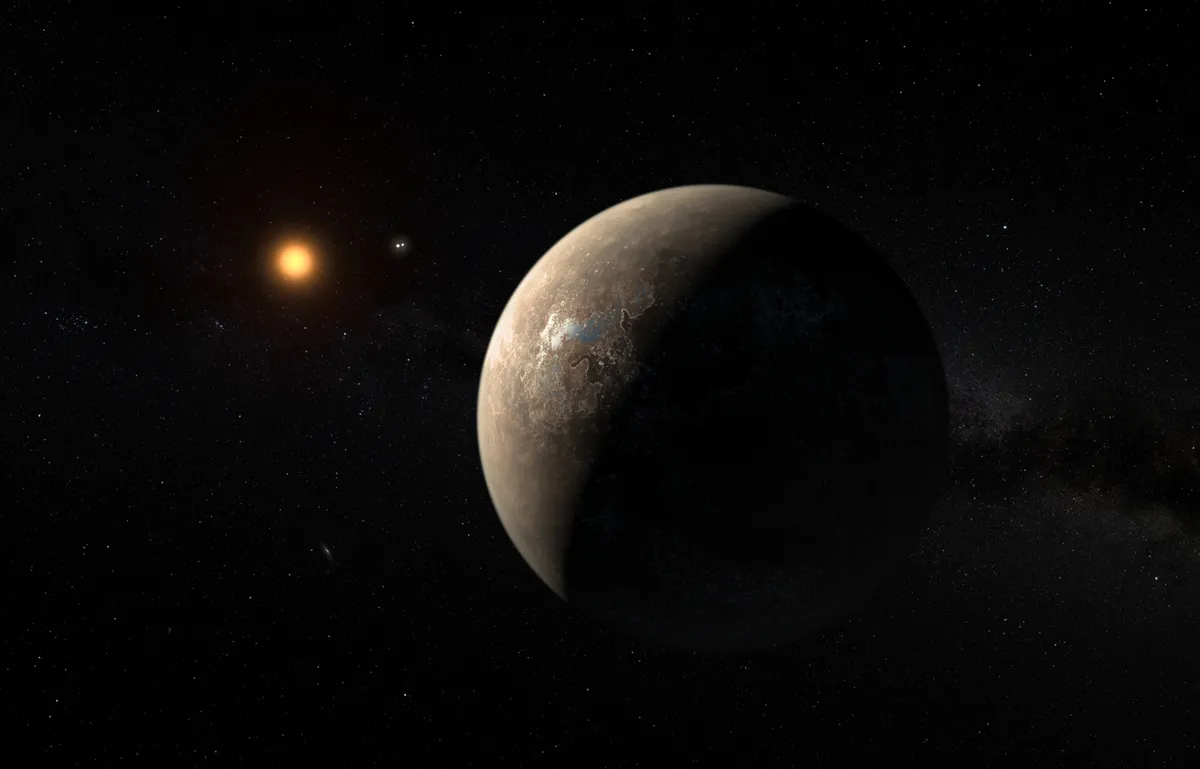
Astronomers are more confident about the planets spotted orbiting Proxima Centauri. Discovered in 2016, Proxima Centauri b is a so-called Super Earth that orbits Proxima Centauri at a distance about 5% of the distance between Earth and the sun, according to NASA. The planet has a mass similar to Earth's and a slightly larger radius, but because of its proximity to its star, the planet takes just 11.2 Earth days to complete an orbit.
Though Proxima Centauri b is much closer to its star than Earth is to the sun, it is still within Proxima Centauri's habitable zone because of the red dwarf star's low-energy output.
Farther out from Proxima Centauri, at around 1.5 AU from the red dwarf and outside its habitable zone, is the mini-Neptune exoplanet Proxima Centauri c, which is around seven times the size of Earth and orbits its star once every 1,900 Earth days, according to the Open Exoplanet Catalogue. Proxima Centauri c was first spotted in 2019 from a wobble that its gravitational influence caused in the motion of its parent star. The existence of Proxima Centauri c was confirmed in 2020 with images from the Hubble Space Telescope taken in 1995. This makes it one of the few exoplanets to have been visually confirmed.
In 2022, a third planet was discovered around Proxima Centauri. Called Proxima Centauri d, the exoplanet has around a quarter the mass of Earth and orbits its star at around 3% of the distance between Earth and the sun. Proxima Centauri d is so close to its star that it completes an orbit every five Earth days. It is one of the lightest exoplanets ever seen by astronomers.
"This detection strengthens our belief that low-mass planets, like Earth that may be habitable, are quite common in our galaxy. It also proves that we now have the technical capacity to find them using state-of-the-art instruments," research leader and Institute of Astrophysics and Space Sciences researcher told Newsweek. "From the measurement of the very low mass, we can conclude that this planet likely has a rocky composition, like the Earth and Mars."
Additionally, in 2021, astronomers spotted the possible signs of an exoplanet orbiting Rigil Kentaurus (Alpha Centauri A) in the star's habitable zone, the region around a star that is neither too hot nor too cold to support liquid water, a key ingredient for life.
Could humans live in Alpha Centauri?
We know that Alpha Centauri is the closest star system to ours, and we are fairly sure of the presence of Earth-like planets there. The question is, could humans ever actually live there?
Arguably the greatest challenge we would face in making a new home in the Alpha Centauri system would be traversing the vast distance to these three stars. Although it's the closest star system to Earth, Alpha Centauri is still more than 4 light-years away. That's about 23.5 trillion miles (37.8 trillion km).
Related: Could humanity send astronauts to Alpha Centauri like in 'Lost in Space'?
How long would it take to get to Alpha Centauri?
To travel such an enormous distance, we'd need a far faster spacecraft or some other method for getting there. According to NASA, the Discovery space shuttle (which was retired in 2011) travels at around 17,500 mph (28,000 km/h). Even moving constantly at this speed, it would take over 148,000 years to reach Alpha Centauri. Even when the Orion spacecraft, the crew capsule associated with the Artemis Program, is ready to carry crew NASA says its top speed will be around 20,000 mph. This won't significantly cut down this travel time to Proxima Centauri. That's even if either of these vehicles was designed to journey out of the solar system, rather than just making relatively short trips to the moon or Mars.
The only spacecraft to make it out of the solar system thus far are Voyager 1 and 2, and NASA estimates that even traveling at speeds of over 35,000 mph (56,000 km/h), it will take Voyagers 1 and 2 nearly 40,000 years to travel 2 light-years to reach the indistinct boundary between our solar system and Proxima Centauri. That means conceivably it would take these spacecraft over 80,000 years to reach the star itself.
Is Alpha Centauri getting closer to Earth?
The stars and planets of Alpha Centauri are moving toward Earth, but they're doing so very slowly. According to the SIMBAD Astronomical database operated by the University of Strasbourg, Alpha Centauri will be at its closest point to our solar system in around 30,000 years, when it will be around 3 light-years away.
Then 3,000 years after this, the star system will begin to move away from the solar system again, and Proxima Centauri will no longer be the sun's closest stellar neighbor. At this point, another star, Ross 248 (or HH Andromedae), will hold that distinction. Also a red dwarf star, Ross 248 is currently around 10.3 light-years from the sun and is the 10th-closest star to the solar system, according to SolStation. In 1993, it was predicted that this star would move into a period that brings it as close as 3.02 light-years from the sun in around 36,000 years.
Additional resources
Alpha Centauri is the closest star to Earth other than the sun, but Alpha Centauri A and B aren't number two and three. Read about the other stars that are closest to the solar system. You can look up Proxima Centauri b and the other exoplanets in that star system in NASA's exoplanet catalog. The multiple-star nature of Alpha Centauri was discovered by astronomer Robert Innes. You can read more about him on Physics Today.
Bibliography
Alpha Centauri: A Triple Star System about 4 Light Years from Earth, NASA, [Accessed 01/20/23], [https://www.nasa.gov/mission_pages/chandra/images/alpha-centauri-a-triple-star-system-about-4-light-years-from-earth.html]
Alpha Centauri, Britannica, [Accessed 01/20/23], [https://www.britannica.com/place/Alpha-Centauri]
The Nearest Neighbor Star, NASA, [Accessed 01/20/23], [https://imagine.gsfc.nasa.gov/features/cosmic/nearest_star_info.html]
Proxima Centauri b, NASA Exoplanet Catalog, [Accessed 01/20/23], [https://exoplanets.nasa.gov/exoplanet-catalog/7167/proxima-centauri-b/]
List of 7 Brightest Stars in the Sky, Starwalk, [Accessed 01/20/23], [https://starwalk.space/en/news/top-7-brightest-stars-in-the-sky]
Proxima Centauri, Constellation Guide, [Accessed 01/20/23], [https://www.constellation-guide.com/proxima-centauri/]
Stellar Neighbors of the Sun, Hyperphysics, [Accessed 01/20/23], [http://hyperphysics.phy-astr.gsu.edu/hbase/Starlog/strclos.html]
Rigil Kentaurus, Star Facts, [Accessed 01/23/23], [https://www.star-facts.com/rigil-kentaurus/]
P. Kervella., F. Thévenin., C. Lovis., Proxima's orbit around Alpha Centauri, ArXiV, [2017], [https://arxiv.org/abs/1611.03495]
K. Wagner, A. Boehle., P. Pathak., et al, Imaging low-mass planets within the habitable zone of α Centauri, Nature Communications, [2021], [https://www.nature.com/articles/s41467-021-21176-6]
R. Lea, One of the Lightest Planets Ever Discovered Could Help Us Find More Habitable Worlds, Newsweek, [2022], [https://www.newsweek.com/lightest-planets-ever-help-find-habitable-worlds-proxima-d-centauri-exoplanet-espresso-1677650]
J. P. Faria., A. S. Mascareño., P. Figueira., et al, A candidate short-period sub-Earth orbiting Proxima Centauri?, Astronomy & Astrophysics, [2022], [https://www.newsweek.com/lightest-planets-ever-help-find-habitable-worlds-proxima-d-centauri-exoplanet-espresso-1677650]