


HOUSTON — Two spacewalking astronautsreattached a massive solar power plant of the International Space Station (ISS)today, and inspected gears that orient its wing-like arrays toward the Sun.
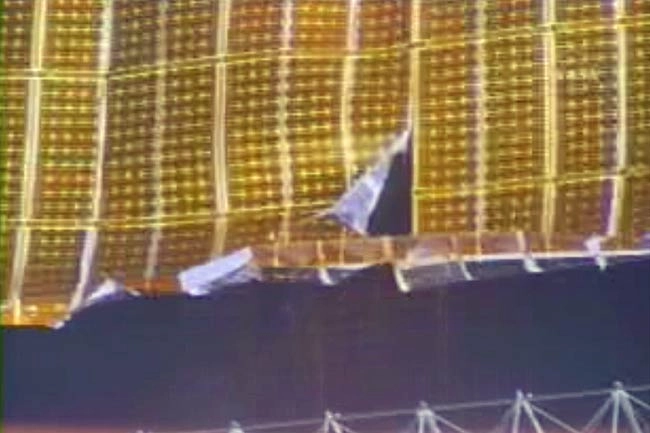
But duringNASA mission control's unfurling of wing-like solar arrays on the relocated powerplant, the right wing of the 4B solararray crinkled and tore on one edge. The array opposite of 4B, known as 2B,deployed without incident prior to 4B's unfurling.
Astronautsaboard the space station were watching mission control's unfurling of thearrays, when ISS commander Peggy Whitson told mission control to abort theoperation. The massive station piece with attached arrays was successfullyreattached during today's spacewalk, which began at 4:45 a.m. EDT (0845 GMT)and ended at 11:53 a.m. EDT (1553 GMT).
"Wejust saw the tear and stopped," Whitson told ground controller and shuttlecapsule communicator Kevin Ford after the tear was noticed. She added that theastronauts aboard the orbital laboratory could not clearly see the solar wingduring part of the deployment because the sun's glare blocked their view.
"Itlooks like the damage appeared fairly suddenly," said space shuttleDiscovery commander Pamela Melroy, who arrived with her STS-120 crew onOct. 25.
Mission controllers said about 25 meters(82 feet) of the 35-meter (115-foot) electricity-generating array was deployedbefore the unfurling was halted.
It isuncertain at this time how the tear will impact the solar wing's energygathering ability, which the space station's successful construction partlydepends on. Astronauts have begun easing tension on the array to see how thedamaged area responds.
Successfulspacewalk
Prior toaccidental damage to the solar wing, however, orbital construction workers ScottParazynski and Doug Wheelock successfully completed today's spacewalk,which lasted seven hours and eight minutes. Parazynski and Wheelock reattachedthe 35,000-pound (15,875-kilogram) Port 6 (P6) solar truss segment to the endof the orbital laboratory from which the solar arrays were later deployed.
After thebehemoth truss segment was attached, Parazynski scoped out a set of gears thatorient the station's solar panels toward the Sun. The port-side gears areworking normally, but NASA engineers want to compare them to a similar yet misbehavingmechanism at the other end of the space station.
"Ihave a happy story so far," Parazynski said as he looked under a solarcover to the paddle-like joint containing the gears. "They look likethey're brand new machines."
"It'sgoing to help a lot with the diagnosis we've been making," said missioncontrollers here at Johnson Space Center as Parazynski relayed video images ofthe gears to Earth.
The reportis a stark contrast that made by space shuttle Discovery astronaut Dan Tani,who found unusual metallic grit coating the gears of the 10-foot (3-meter)diameter starboard joint.
"Itlooked like a black dust of metallic shavings or filings," Tani said ofthe grit during an in-flight interview Monday. "It was unmistakable thatit should not be there."
Theunwelcome discovery prompted officials to extendthe mission by one day, which will make room to replace a short spacewalkwith a long, more complete check-out of the suspect starboard joint onThursday.
Todaymarked the third of five record-tying extravehicular activities, or EVAs,planned during the STS-120's 15-day mission. It was Parazynski's sixth EVA andWheelock's second.
The spaceshuttle Discovery is scheduled to land on Nov. 7 at Kennedy Space Center in Cape Canaveral, Fla. The spaceship will ferry ISS crewmember Clayton Andersonback to Earth, leaving Tani to take his place as a member of the Expedition 16crew led by Whitson.
- SPACE.com Video Interplayer: Delivering 'Harmony' with NASA's STS-120 Mission
- NASA: Shuttle Launch Paves Way to Larger Space Station
- Complete Space Shuttle Mission Coverage